Gear manufacturing tolerances that affect noise and service life
In gear manufacturing, tight tolerances are not just quality metrics—they directly shape noise levels, vibration behavior, efficiency, and long-term service life. For buyers, engineers, and quality teams evaluating gear manufacturing options, understanding how profile, pitch, runout, and surface finish interact is essential to reducing failure risk, maintenance costs, and performance inconsistency across demanding industrial applications.
Across industrial drives, robotics, conveyors, pumps, compressors, medical devices, and precision automation, even small deviations in tooth geometry can produce measurable changes in sound pressure, contact stress, heat generation, and bearing load. A few microns of error may look minor on an inspection report, but in continuous-duty systems running 8,000 to 20,000 hours, those deviations often determine whether a gearbox remains stable or develops early wear, whining, pitting, or backlash drift.
For procurement teams and project owners, the practical question is not whether tighter tolerances are better in theory. The real issue is which tolerances matter most for the application, how they should be specified, and where additional manufacturing cost actually delivers a return through lower noise, fewer warranty events, and longer replacement intervals. The sections below break down the gear tolerances that most directly affect acoustic behavior and service life, along with inspection, sourcing, and quality control guidance.
Which gear tolerances have the strongest impact on noise and durability
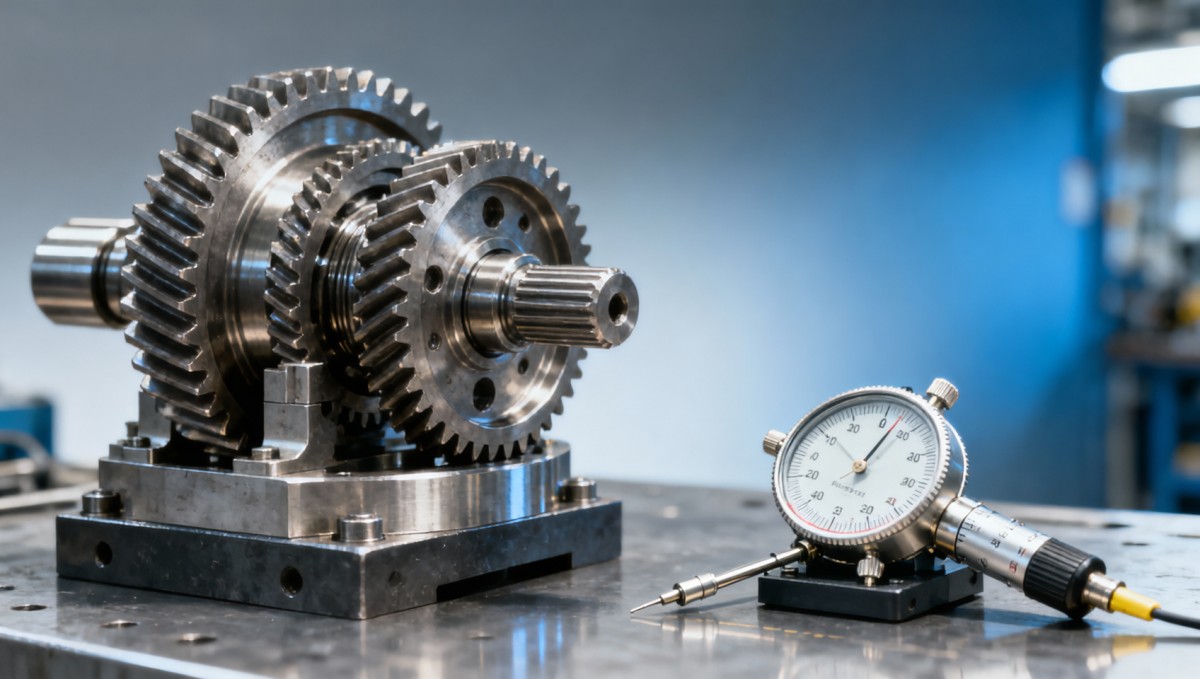
Not all dimensional tolerances influence gear performance equally. In most industrial gear sets, the highest-priority variables for noise and service life are profile deviation, lead deviation, pitch error, runout, and surface roughness. These parameters affect how smoothly teeth enter and exit mesh, how load is distributed across the tooth flank, and whether contact remains stable under changing torque, temperature, and alignment conditions.
Profile deviation changes the involute shape and directly affects transmission error, one of the most common sources of tonal gear noise. Lead deviation influences face-width contact and can create edge loading, especially in helical gears or wider gears above 25 mm face width. Pitch error alters tooth spacing, often producing cyclic vibration at mesh frequency. Runout shifts the gear center dynamically, while rough surfaces raise friction and can accelerate micropitting during the first 100 to 500 operating hours.
In practical sourcing terms, gears for low-speed agricultural drives and gears for high-speed servo reducers should never be evaluated with the same tolerance priorities. A gearbox running below 300 rpm may tolerate broader deviations if the load is moderate and noise is noncritical. By contrast, a precision actuator or e-mobility subsystem operating at 1,500 to 6,000 rpm typically requires much tighter control of total composite error and flank finish.
Why tooth geometry matters more than nominal size alone
Buyers sometimes focus heavily on module, diameter, material, and hardness, but two gears with identical nominal dimensions can perform very differently if the micro-geometry is inconsistent. The tooth form determines contact ratio, rolling behavior, local pressure peaks, and the ability to maintain a lubricant film. That is why noise complaints often appear even when a supplier meets basic dimensional checks such as outside diameter and bore tolerance.
Where duty cycles are variable, geometry errors become even more significant. Repeated acceleration, reversing motion, shock loading, or frequent start-stop cycles amplify the effect of pitch variation and localized profile defects. This is especially relevant for automated warehousing, packaging equipment, and compact electromechanical assemblies where sound, positioning stability, and maintenance access are all critical.
Typical tolerance areas linked to field performance
The table below summarizes the manufacturing tolerances most often reviewed during technical assessment and supplier qualification for industrial gears.
The key takeaway is that noise rarely comes from one variable alone. In many cases, a moderate profile error combined with excessive runout and marginal surface finish produces a bigger problem than one isolated defect. That is why qualified suppliers inspect both individual tooth geometry and total composite behavior rather than relying on a single dimension report.
How profile, pitch, and runout translate into real acoustic and wear problems
Gear noise is typically generated by dynamic forces at tooth mesh. When profile or pitch variation increases transmission error, the gear pair no longer transfers torque smoothly. Instead, the teeth engage with fluctuating stiffness, producing vibration at mesh frequency and its harmonics. In enclosed gearboxes, that vibration is then amplified by shafts, bearings, housings, and mounting plates, often making a small manufacturing deviation sound much worse in the final machine.
Runout is especially important because it creates periodic eccentricity once per revolution. Even when tooth form appears acceptable, excessive runout can raise radial force, disturb backlash, and create a repeating noise pattern that operators notice immediately. In high-speed assemblies, this effect becomes more severe as speed doubles. For example, a gear train that sounds acceptable at 600 rpm may become objectionable at 1,800 rpm because the dynamic response of the system crosses a resonance range.
Service life is affected through similar mechanisms. Poor contact distribution raises local stress, which increases the chance of micropitting, macropitting, tooth root fatigue, or scuffing. Once wear starts, backlash changes and contact becomes even less stable. This creates a self-reinforcing cycle: more vibration leads to more wear, and more wear leads to more noise. In production equipment running 16 hours per day, that cycle can shorten maintenance intervals from 24 months to less than 12 months.
Common failure pathways linked to tolerance errors
Engineering teams should connect tolerance specifications to failure modes rather than treating inspection data as a paperwork exercise. The list below shows a practical mapping used in many supplier audits and incoming quality reviews.
- Profile deviation too high: increased transmission error, tonal mesh noise, localized stress concentration, and reduced efficiency under partial load.
- Lead deviation too high: uneven face contact, edge pressure, flank polishing on one side, and pitting near tooth ends after several hundred hours.
- Pitch variation too high: cumulative spacing error, cyclic vibration, unstable backlash, and poor positioning repeatability in servo-driven equipment.
- Runout too high: shaft eccentricity effect, one-per-revolution noise, fluctuating bearing load, and seal wear in enclosed units.
- Surface finish too rough: difficult lubricant film formation, high break-in friction, elevated temperature, and greater scuffing risk at peak torque.
A frequent sourcing mistake is assuming that heat treatment alone will solve durability concerns. Hardness improves wear resistance, but hard gears with poor geometry can fail faster than softer gears with superior tooth accuracy. For many precision applications, consistency from batch to batch is more valuable than chasing the highest hardness or the lowest initial unit price.
Operational signals that indicate a tolerance problem
When field complaints emerge, several symptoms often point back to manufacturing tolerance rather than lubrication or installation alone:
- Noise increases within the first 50 to 200 hours instead of stabilizing after break-in.
- Vibration spectrum shows dominant peaks at gear mesh frequency or once-per-revolution frequency.
- Contact pattern blueing reveals edge concentration rather than centered flank contact.
- Backlash measurements drift across rotational positions by more than expected assembly variation.
- Bearing temperature rises 5°C to 15°C above comparable units under the same load.
These indicators help procurement and quality teams decide whether to request a corrective action report, additional inspection data, or a redesign of the tolerance stack across the gearbox assembly.
Tolerance classes, surface finish, and inspection methods buyers should review
For sourcing decisions, tolerance discussions should be tied to recognized gear quality grades, measurement capability, and process stability. The exact grade required depends on speed, torque, application criticality, and acceptable sound level. A broad industrial reducer may perform well with a mid-range gear quality level, while high-speed motion systems and quiet indoor equipment often require a tighter class and more detailed flank inspection.
Surface finish deserves special attention because it is sometimes undervalued during quotation review. A smoother flank can reduce friction and improve lubricant retention, but over-polishing without proper geometry correction does not eliminate noise. In many cases, a balanced target such as Ra 0.4 to 0.8 µm for finish-ground gears is more meaningful than a simplistic request for the lowest possible roughness. Soft-cut gears used in lower-speed applications may operate acceptably at rougher values if the lubrication regime and load are moderate.
Inspection capability matters as much as the nominal tolerance stated on the drawing. If a supplier claims tight profile and lead control but cannot provide gear measuring center reports, runout records, or process capability evidence over multiple lots, the real manufacturing risk remains high. For batch programs above 500 pieces per release, consistency and traceability often matter more than achieving an extreme tolerance on a prototype batch of 20 pieces.
What to request during technical evaluation
The table below outlines practical checkpoints that purchasing, quality, and engineering teams can use when comparing gear manufacturing partners.
This comparison framework helps teams move beyond price-only evaluation. A supplier with slightly higher piece cost may still deliver lower total ownership cost if it controls distortion, documents tooth geometry, and keeps rejection rates below 1% to 2% over repeated production runs.
Inspection methods that add real value
Useful verification methods often include analytical gear inspection, rolling tests, contact pattern checks, roughness measurement, hardness testing, and selected noise or vibration testing at assembly level. For safety-critical or low-noise products, many buyers also require first article validation and a pilot lot before approving mass production.
A practical review sequence often follows 4 steps:
- Confirm the application duty profile, speed range, and allowable acoustic level.
- Match required gear quality and flank finish to that operating envelope.
- Verify the supplier’s manufacturing and inspection route after heat treatment.
- Audit sample reports from at least 3 separate lots, not just one prototype batch.
This process gives finance approvers and decision-makers a clearer basis for evaluating whether tighter tolerances will reduce lifecycle cost enough to justify the added manufacturing expense.
How to specify tolerances by application instead of overpaying for unnecessary precision
One of the most common commercial mistakes in gear procurement is over-specifying every tolerance regardless of application. Tighter tolerances usually increase machining time, grinding requirements, inspection effort, and scrap risk. Depending on gear size and material route, moving one quality level tighter may raise cost by 10% to 30%, while moving to a fully ground flank process can increase cost even further. If the equipment runs slowly, intermittently, or in a non-noise-sensitive environment, that premium may not create a measurable business benefit.
The better approach is to define tolerance targets around operating speed, torque fluctuation, duty cycle, lubrication quality, acoustic requirement, and expected replacement interval. For example, a compact medical device, collaborative robot joint, or indoor logistics actuator usually justifies a low-noise strategy because sound levels affect end-user acceptance. A mining conveyor or bulk material drive may prioritize wear margin and impact resistance instead, accepting higher sound if uptime is maintained.
This application-based method also improves communication between engineering and purchasing. Rather than specifying “tightest possible tolerance,” teams can define critical-to-function characteristics and allow wider tolerances elsewhere. That reduces cost pressure without compromising mesh quality where it matters most.
Application-driven tolerance strategy
The matrix below provides a practical decision guide for common industrial contexts.
The commercial lesson is straightforward: tolerance budgets should be selective. Put the strictest controls on parameters that drive system-level performance, and avoid paying premium machining cost on noncritical surfaces or dimensions that do not materially change noise or lifespan.
Questions procurement teams should ask suppliers
- Which tolerance values are held before and after heat treatment, and which features are corrected by grinding or honing?
- What is the normal lead time for prototype, pilot lot, and production release—such as 2 to 4 weeks for samples and 4 to 8 weeks for stable batch supply?
- Can the supplier provide measured data for at least 5 to 10 sample pieces from each lot rather than a single best-piece report?
- Which tolerances are process-capable at volume, and which are only achievable with elevated scrap or extended cycle time?
These questions help distributors, OEM buyers, and program managers compare offers on a total-risk basis instead of a nominal quotation alone.
Implementation, incoming quality control, and long-term supplier management
Even a well-written drawing does not guarantee stable field performance unless the receiving organization has a disciplined validation and supplier-management process. For new gear programs, it is wise to combine drawing review, first article inspection, pilot-run testing, and application-level endurance checks. This is particularly important when launching equipment into export markets where service access is limited and replacement downtime is expensive.
Incoming quality control should focus on the parameters most closely tied to risk. Measuring every characteristic on every gear is rarely efficient, but sampling the wrong features creates blind spots. A good plan often separates routine dimensional checks from critical performance checks. For instance, bore and keyway dimensions may be checked on a broad sample basis, while profile, lead, runout, and roughness are validated on a defined subset or at lot release depending on volume and risk level.
Long-term supplier management should track three areas over time: quality drift, delivery stability, and field feedback. If complaint frequency rises after six months, the issue may not be design-related. It could reflect tool wear, heat-treatment distortion changes, subcontracted process variation, or less rigorous final inspection. That is why periodic audits and comparative lot data remain important long after initial approval.
A practical control plan for buyers and quality teams
- Define the operating envelope: torque, speed, duty cycle, acoustic target, and expected life in hours or cycles.
- Identify 4 to 6 critical gear characteristics, typically profile, lead, pitch, runout, surface finish, and hardness or case depth when relevant.
- Approve the manufacturing route, including heat treatment and final finishing sequence.
- Require first article reporting and pilot validation before full-volume release.
- Monitor lot performance every 3 to 6 months using inspection trends, returns data, and application feedback.
This process is effective because it links purchasing decisions to technical risk. It also gives finance stakeholders a clear framework for evaluating whether a lower-cost supplier truly reduces spend or simply shifts cost into warranty claims, service visits, and production interruptions.
FAQ: common sourcing and engineering questions
How tight do gear tolerances need to be for low-noise applications?
There is no universal number because gear size, speed, housing stiffness, lubrication, and assembly accuracy all matter. In general, low-noise products should prioritize reduced profile deviation, controlled lead, low runout, and a smoother flank finish. It is better to specify the full combination than to tighten only one feature.
Can surface finish alone solve gear noise?
No. Surface finish influences friction, break-in, and wear, but tonal noise is often driven more strongly by transmission error from profile and pitch variation. A smooth but geometrically inaccurate gear can still be noisy.
What should be checked first when service life is shorter than expected?
Start with contact pattern, runout, profile and lead reports, lubrication condition, and bearing alignment. If wear is concentrated near the tooth edge or repeats at one rotational position, tolerance-related contact problems are a likely cause.
How long does qualification usually take for a new gear supplier?
For many B2B programs, technical review, sample production, first article approval, and pilot validation together take 4 to 10 weeks, depending on gear complexity, heat treatment route, and whether assembly-level testing is required.
Gear manufacturing tolerances are not abstract drawing details. They are direct drivers of sound quality, vibration behavior, maintenance frequency, and usable service life. The most effective sourcing strategy is to identify the few tolerance parameters that matter most for the target application, verify that suppliers can measure and repeat them at production scale, and connect every tolerance decision to total lifecycle cost rather than purchase price alone.
For organizations evaluating gear suppliers across advanced manufacturing, smart equipment, healthcare technology, or automated logistics, a disciplined tolerance strategy reduces technical uncertainty and improves procurement outcomes. To assess suitable manufacturing routes, compare supplier capability, or discuss a more application-specific evaluation framework, contact TradeNexus Pro to get tailored sourcing insight, deeper technical analysis, and practical decision support.
Get weekly intelligence in your inbox.
No noise. No sponsored content. Pure intelligence.
 Apr 18, 2026TradeNexus Pro Launches Global Compliance RadarTradeNexus Pro Launches Global Compliance Radar
 Apr 18, 2026JIS T 2304:2026 Takes Effect June 1, 2026 for IVD SoftwareJIS T 2304:2026 Takes Effect June 1, 2026 for IVD Software
 Pathway for Rehab Devices with AI Modules") Apr 18, 2026FDA Updates 510(k) Pathway for Rehab Devices with AI ModulesFDA Updates 510(k) Pathway for Rehab Devices with AI Modules
Apr 18, 2026FDA Updates 510(k) Pathway for Rehab Devices with AI ModulesFDA Updates 510(k) Pathway for Rehab Devices with AI Modules Apr 18, 2026India BIS Approves 3 Chinese IoT Labs for IS 16444:2026 CertificationIndia BIS Approves 3 Chinese IoT Labs for IS 16444:2026 Certification
 Apr 18, 2026THE Alliance Launches Green Slot Priority for China PortsTHE Alliance Launches Green Slot Priority for China Ports
 Apr 18, 2026TÜV Rheinland Releases Dual-Standard ESS Certification Guide for ChinaTÜV Rheinland Releases Dual-Standard ESS Certification Guide for China
 Apr 18, 2026Vietnam Imposes AD Duties on Chinese Electronic ComponentsVietnam Imposes AD Duties on Chinese Electronic Components
 Apr 18, 2026SASO Launches PV Carbon Footprint Labeling from July 2026SASO Launches PV Carbon Footprint Labeling from July 2026
 Apr 18, 2026U.S. Adds 17 Smart Warehouse Robot Components to Export Control ListU.S. Adds 17 Smart Warehouse Robot Components to Export Control List
 Apr 18, 2026EU Enforces EN IEC 62443-4-2:2026 for Industrial Control Devices from 18 Apr 2026EU Enforces EN IEC 62443-4-2:2026 for Industrial Control Devices from 18 Apr 2026
 Apr 17, 2026Temperature data loggers drift unpredictably inside lithium-ion battery storage enclosuresTemperature data loggers drift unpredictably inside lithium-ion battery storage enclosures
 Apr 17, 2026Are solar microinverters really worth the extra cost?Are solar microinverters really worth the extra cost?
 Apr 17, 2026Bifacial solar panels: How much more energy can they generate?Bifacial solar panels: How much more energy can they generate?
 Apr 17, 2026Gear manufacturing: How to optimize production for high precision?Gear manufacturing: How to optimize production for high precision?
 Apr 17, 2026Why power transmission components fail earlier than expectedWhy power transmission components fail earlier than expected
 Apr 17, 2026Linear motion systems: belt drive or ball screw for speed?Linear motion systems: belt drive or ball screw for speed?
 Apr 17, 2026Industrial bearing suppliers: what signals reliable quality?Industrial bearing suppliers: what signals reliable quality?
 Apr 17, 2026When pneumatic valves wholesale gets expensive laterWhen pneumatic valves wholesale gets expensive later
 Apr 17, 2026Hydraulic cylinder fabrication mistakes that cause oil leaksHydraulic cylinder fabrication mistakes that cause oil leaks
 Apr 17, 2026Heavy equipment manufacturing delays often start hereHeavy equipment manufacturing delays often start here
 Apr 17, 2026Custom heatsinks: when a larger size solves nothingCustom heatsinks: when a larger size solves nothing
 Apr 17, 2026Electronic enclosure fabrication: steel or aluminum?Electronic enclosure fabrication: steel or aluminum?
 Apr 17, 2026Automotive parts machining tolerances that drive up scrapAutomotive parts machining tolerances that drive up scrap
 Apr 17, 2026Medical device manufacturing changes under tighter traceabilityMedical device manufacturing changes under tighter traceability
 Apr 17, 2026How to Choose Solid State Batteries in 2026How to Choose Solid State Batteries in 2026
 Apr 17, 2026Are Solid State Batteries Worth the Cost Yet?Are Solid State Batteries Worth the Cost Yet?
 Apr 17, 2026Commercial Energy Storage Sizing: What Matters Most?Commercial Energy Storage Sizing: What Matters Most?