When digital twin manufacturing pays off on the factory floor
Digital twin manufacturing pays off when virtual models start improving real factory outcomes—from throughput and quality to downtime and cost control. For teams evaluating powder coating, anodizing services, surface finishing services, low volume manufacturing, rapid tooling, urethane casting, plastic extrusion, precision casting, and metal stamping parts, the real question is not whether digital twins are innovative, but when they deliver measurable ROI on the factory floor.
That question matters across the full manufacturing chain. Operators want fewer surprises during shifts. Technical evaluators want cleaner data and faster root-cause analysis. Finance teams want a payback window they can defend. Quality and safety managers need traceability, process control, and lower defect risk. Project leaders need implementation paths that do not disrupt output for 8–12 weeks just to prove a concept.
In practice, digital twin manufacturing starts paying off when the virtual model is connected to live production variables and used to support decisions in scheduling, maintenance, energy use, tooling, and process optimization. The strongest results usually come from narrow, high-impact use cases first, then wider rollout. For B2B buyers and plant leaders, the value is rarely theoretical; it appears in measurable changes such as 5%–15% throughput gains, 10%–30% scrap reduction, or 15%–25% less unplanned downtime when the deployment is properly scoped.
Where digital twin manufacturing creates real factory-floor value
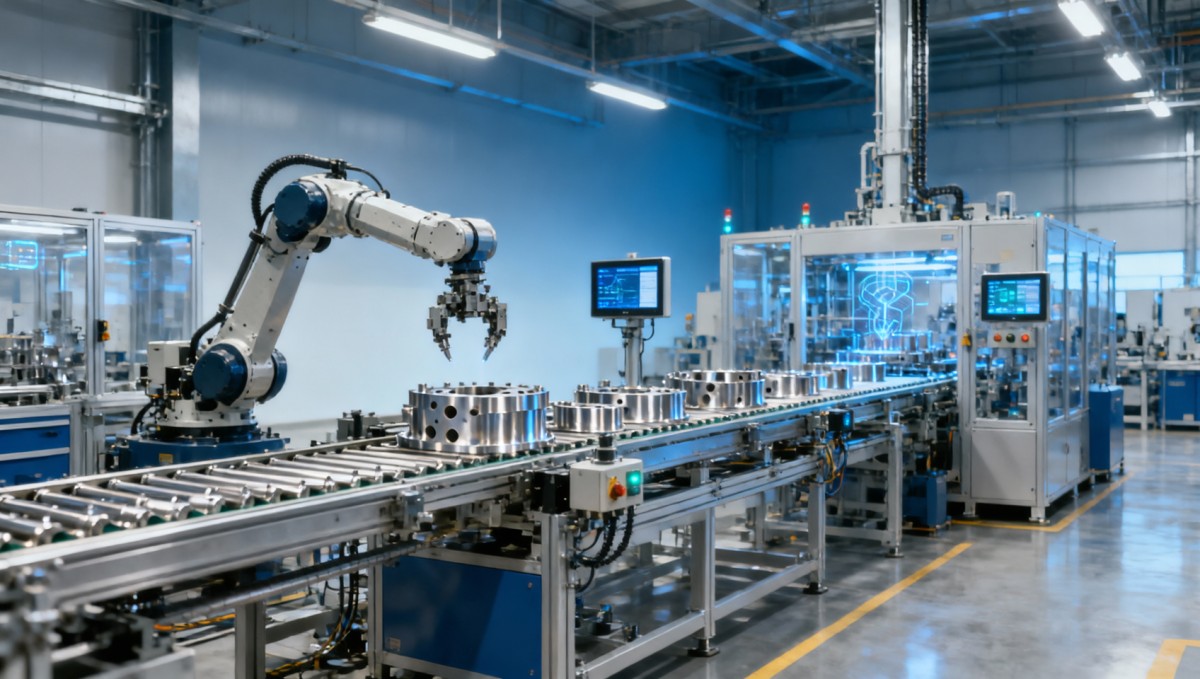
A digital twin is not just a 3D visualization of a machine or line. In manufacturing, it is a data-linked virtual representation of equipment, tooling, process parameters, workflows, and sometimes even operator interactions. The economic value appears when the twin is fed with timely data from PLCs, sensors, MES, ERP, quality records, or maintenance logs and then used to predict outcomes before a real-world change is made.
This matters in discrete and process environments alike. A metal stamping line can use a digital twin to simulate die wear, press tonnage variation, and part tolerances before quality drifts outside limits. A powder coating line can compare conveyor speed, cure time, and oven temperature across 3–5 production scenarios to reduce rework. A plastic extrusion operation can model melt temperature, line speed, and dimensional consistency to avoid downtime caused by trial-and-error adjustments.
The payoff threshold is often reached faster in plants with repeatable operations, high machine utilization, or frequent changeovers. If a facility runs 2 or 3 shifts, has bottleneck machines above 80% utilization, or loses more than 5 hours per month to unplanned stops on a critical asset, digital twin manufacturing can move from pilot interest to business case very quickly.
It is also valuable in supplier-heavy manufacturing ecosystems. For buyers comparing low volume manufacturing, rapid tooling, urethane casting, precision casting, and metal stamping parts, a digital twin can help validate process capability before committing volume. That reduces sourcing risk, especially when a part has tight tolerances, cosmetic finish requirements, or multi-step secondary processing.
High-return use cases that usually justify early adoption
- Predictive maintenance for bottleneck equipment where one failure can stop an entire line for 2–6 hours.
- Process tuning in coating, anodizing, or finishing lines where defect rates above 2%–4% materially affect margin.
- Tooling optimization in rapid tooling, low volume manufacturing, and casting programs where frequent design iterations drive hidden setup cost.
- Capacity planning for plants with variable order intake, seasonal peaks, or labor constraints.
The common thread is simple: the more expensive the mistake, the faster the twin pays off. Plants that suffer from unstable OEE, variable scrap, energy spikes, or late-stage quality failures usually gain more than plants that already run stable, low-mix, low-variation production with strong manual controls.
How to identify the right ROI moment instead of chasing the technology too early
Many factories do not fail with digital twins because the concept is wrong. They fail because they launch too broadly, collect too much low-value data, or start with assets that are not economically critical. The right ROI moment is usually when three conditions align: a measurable production problem exists, data quality is sufficient, and the site can act on recommendations within normal operating cycles.
For finance approvers, a realistic first-stage payback target is often 9–18 months, not 90 days. If a pilot is expected to improve a line running 20 hours per day, cut scrap by 1.5 percentage points, and reduce unplanned maintenance by 10%, the numbers can work. If the process is low-volume, manually variable, and lightly instrumented, the case may be weaker unless the cost of failure is exceptionally high.
Technical teams should evaluate readiness with operational thresholds rather than abstract maturity language. For example, does the line have at least 6–12 months of maintenance history? Are critical parameters logged at useful intervals, such as every 1 second, 10 seconds, or batch cycle? Can quality outcomes be linked to machine states, tooling conditions, and environmental factors? If not, the first investment may need to be in instrumentation and data integration, not the twin itself.
Procurement and project leaders should also consider the implementation burden. If the digital twin requires custom integration across 4 systems, a shutdown window longer than 2 weekends, and heavy operator retraining, the time to value may slip. A lighter first step focused on one asset cluster or one process family is often the more credible path.
A practical readiness screen for plant teams
The table below helps decision-makers judge whether a digital twin program is likely to deliver value now, later, or only after preparation work. It is especially useful for mixed operations handling metal parts, coatings, finishing, and outsourced component programs.
A clear pattern emerges: digital twin manufacturing pays off sooner when the line is important, the data is usable, and the organization can respond quickly. Without those conditions, the project may still be worthwhile, but the first phase should focus on data capture, process mapping, and governance rather than advanced modeling claims.
Common early-stage mistakes
- Starting with a plant-wide model before proving one line, one cell, or one asset family.
- Assuming visualization alone will improve KPIs without action workflows.
- Ignoring operator input, even though operators often know the 3–4 failure modes that matter most.
- Building a model around data the plant cannot maintain after the pilot ends.
What factory teams should measure across coating, casting, tooling, and metal-forming processes
The best digital twin manufacturing projects do not try to model everything at once. They focus on the parameters that explain cost, quality, and flow. In powder coating, that may include pretreatment conditions, conveyor speed, oven cure profile, line balance, and rework rate. In anodizing services, bath chemistry stability, dwell time, current density, and finish uniformity may matter more. In metal stamping parts, press force, die temperature, lubrication consistency, and dimensional variation are often the economic core.
For low volume manufacturing and rapid tooling, the model should also capture engineering iteration speed. If tooling changes occur every 3–7 days during a new product introduction phase, the digital twin should help forecast the effect on first-pass yield, setup hours, and supplier lead time. In urethane casting, mold life, material behavior, and cure timing may be more relevant than high-frequency machine telemetry.
Quality and safety managers should avoid a narrow production-only view. A strong model also includes environmental and compliance factors where relevant: temperature, humidity, ventilation behavior, energy usage, and process alarms. This is especially important for finishing environments, where small shifts in ambient conditions can affect adhesion, appearance, and defect repeatability.
The table below outlines process-specific variables that often produce decision-grade insights. These are not fixed standards, but they are common reference points for planning instrumentation and selecting the scope of a pilot.
The key takeaway is that digital twin manufacturing should mirror the economics of the process. Plants should prioritize the variables that explain the highest cost drivers, not just the easiest signals to collect. A twin that predicts a 20-minute maintenance need on a critical press may be more valuable than a model that visualizes ten low-impact conditions beautifully.
Metrics that matter to different stakeholders
- Operators: alarm frequency, changeover time, first-pass yield, response instructions.
- Technical evaluators: data latency, model accuracy band, integration complexity, system interoperability.
- Finance approvers: payback in months, avoided scrap cost, maintenance savings, inventory impact.
- Quality and safety managers: traceability depth, deviation detection speed, audit readiness, process stability.
A phased implementation plan that protects output and improves adoption
A practical rollout usually follows 4 phases rather than one large transformation. Phase 1 defines the use case and maps the data. Phase 2 builds a limited twin around one asset, line section, or process family. Phase 3 validates predictions against live production over 4–8 weeks. Phase 4 expands to scheduling, maintenance, and supplier coordination if the business case holds. This staged approach reduces integration risk and gives plant teams time to trust the outputs.
For project managers, governance is as important as software capability. Each phase should have named owners from operations, engineering, IT, quality, and finance. Without that, the model may become a technical artifact rather than a decision tool. Plants that review model output daily or weekly usually capture more value than those treating the twin as a quarterly reporting system.
Change management should be designed into the program. Operators need clear instructions on what to do when the twin identifies a likely failure or process drift. Maintenance teams need work order triggers and escalation rules. Procurement teams may need supplier feedback loops if external processes such as anodizing services or precision casting are included in the workflow.
The list below shows a realistic implementation structure for factories that want measurable gains without destabilizing production.
Recommended 4-step rollout
- Select one high-value process with a known pain point such as scrap, downtime, or unstable cycle time.
- Connect only the essential data sources first, usually 3–5 inputs, instead of attempting a full enterprise integration.
- Run side-by-side validation for at least 30 days or one meaningful production cycle.
- Expand only after the pilot shows KPI improvement and teams can act on recommendations reliably.
Implementation risks to control early
- Poor sensor calibration can create false alerts and erode trust within 2–3 weeks.
- Disconnected quality data prevents useful correlation between machine behavior and defects.
- No maintenance workflow means predicted failures do not translate into avoided downtime.
- No supplier alignment weakens results when critical steps are outsourced.
For many organizations, the smartest path is not more technology at the start, but tighter operational discipline around one business problem. Once the twin helps solve that problem repeatedly, plant-wide adoption becomes easier to justify.
Buying and evaluation criteria for decision-makers, technical teams, and sourcing leaders
When selecting a digital twin manufacturing partner or platform, buyers should evaluate more than interface quality. The core questions are whether the system can integrate with existing plant architecture, whether it supports the specific manufacturing process, and whether it can produce actionable insights in operational timeframes. A visually impressive platform with weak line-level data discipline will struggle to deliver savings.
Decision-makers should request clarity on deployment scope, data ownership, update frequency, model retraining, and support structure. In many factories, especially those managing multiple suppliers for finishing, tooling, or cast and stamped parts, interoperability matters more than feature volume. If a platform cannot absorb supplier-side data or export useful output into MES, ERP, or maintenance planning systems, its impact may remain limited.
Commercial evaluation should also be tied to operational outcomes. Ask which KPIs the pilot will target, what baseline period will be used, and how success will be measured after 30, 60, and 90 days. This avoids the common problem of approving a technology budget without a shared agreement on value capture.
The checklist below summarizes the criteria that usually matter most to cross-functional buying teams.
Core buying criteria
A disciplined evaluation process helps avoid overbuying. Most plants do not need every advanced feature on day one. They need a system that can prove value in one controlled environment, support daily use, and expand in line with operational maturity. That is usually where digital twin manufacturing becomes financially credible rather than merely strategically attractive.
FAQ for sourcing and plant teams
How long does a first digital twin pilot usually take?
A focused pilot often takes 6–12 weeks from scoping to initial validation, depending on data readiness and integration complexity. If the site already logs production, maintenance, and quality data in usable formats, the timeline can be shorter. If instrumentation upgrades are needed, allow additional time before expecting stable KPI comparisons.
Which plants benefit first: high-volume or low-volume operations?
High-volume operations often see faster payback because even small improvements in scrap or uptime multiply quickly. Low volume manufacturing can still benefit, especially when tooling changes, engineering revisions, or quality failures are expensive. The deciding factor is usually cost of variation, not just production volume.
Can digital twins help with outsourced processes?
Yes, but only if supplier data, quality feedback, and lead-time signals can be shared consistently. This is useful for outsourced anodizing services, surface finishing services, precision casting, and metal stamping parts supply chains. Even a lighter supplier-facing model can improve forecast accuracy, inspection planning, and batch acceptance decisions.
What KPI should be used first?
Start with one KPI that directly affects plant economics, such as unplanned downtime hours, scrap percentage, first-pass yield, or changeover duration. Once one metric improves consistently over 30–60 days, expand the scope to adjacent KPIs. This creates a clearer value story for operations and finance alike.
Digital twin manufacturing pays off on the factory floor when it is tied to a clear production problem, fed by usable data, and embedded into daily decisions. For plants managing coating, finishing, extrusion, casting, tooling, and metal-forming operations, the best results usually come from targeted pilots that reduce downtime, stabilize quality, and improve throughput within a defined review period.
For sourcing leaders, project managers, technical evaluators, and finance approvers, the opportunity is not simply to adopt a new digital layer. It is to make process knowledge measurable, transferable, and easier to scale across internal lines and supplier networks. TradeNexus Pro helps manufacturing decision-makers evaluate these shifts with practical market intelligence, cross-sector context, and procurement-focused insight.
If you are assessing where digital twins fit into your manufacturing strategy, now is the right time to compare use cases, scope the strongest ROI scenarios, and align technology choices with real plant priorities. Contact TradeNexus Pro to discuss your evaluation criteria, explore tailored solution paths, and learn more about manufacturing intelligence that supports faster, better-grounded decisions.
Get weekly intelligence in your inbox.
No noise. No sponsored content. Pure intelligence.
 Apr 18, 2026TradeNexus Pro Launches Global Compliance RadarTradeNexus Pro Launches Global Compliance Radar
 Apr 18, 2026JIS T 2304:2026 Takes Effect June 1, 2026 for IVD SoftwareJIS T 2304:2026 Takes Effect June 1, 2026 for IVD Software
 Pathway for Rehab Devices with AI Modules") Apr 18, 2026FDA Updates 510(k) Pathway for Rehab Devices with AI ModulesFDA Updates 510(k) Pathway for Rehab Devices with AI Modules
Apr 18, 2026FDA Updates 510(k) Pathway for Rehab Devices with AI ModulesFDA Updates 510(k) Pathway for Rehab Devices with AI Modules Apr 18, 2026India BIS Approves 3 Chinese IoT Labs for IS 16444:2026 CertificationIndia BIS Approves 3 Chinese IoT Labs for IS 16444:2026 Certification
 Apr 18, 2026THE Alliance Launches Green Slot Priority for China PortsTHE Alliance Launches Green Slot Priority for China Ports
 Apr 18, 2026TÜV Rheinland Releases Dual-Standard ESS Certification Guide for ChinaTÜV Rheinland Releases Dual-Standard ESS Certification Guide for China
 Apr 18, 2026Vietnam Imposes AD Duties on Chinese Electronic ComponentsVietnam Imposes AD Duties on Chinese Electronic Components
 Apr 18, 2026SASO Launches PV Carbon Footprint Labeling from July 2026SASO Launches PV Carbon Footprint Labeling from July 2026
 Apr 18, 2026U.S. Adds 17 Smart Warehouse Robot Components to Export Control ListU.S. Adds 17 Smart Warehouse Robot Components to Export Control List
 Apr 18, 2026EU Enforces EN IEC 62443-4-2:2026 for Industrial Control Devices from 18 Apr 2026EU Enforces EN IEC 62443-4-2:2026 for Industrial Control Devices from 18 Apr 2026
 Apr 17, 2026Temperature data loggers drift unpredictably inside lithium-ion battery storage enclosuresTemperature data loggers drift unpredictably inside lithium-ion battery storage enclosures
 Apr 17, 2026Are solar microinverters really worth the extra cost?Are solar microinverters really worth the extra cost?
 Apr 17, 2026Bifacial solar panels: How much more energy can they generate?Bifacial solar panels: How much more energy can they generate?
 Apr 17, 2026Gear manufacturing: How to optimize production for high precision?Gear manufacturing: How to optimize production for high precision?
 Apr 17, 2026Why power transmission components fail earlier than expectedWhy power transmission components fail earlier than expected
 Apr 17, 2026Linear motion systems: belt drive or ball screw for speed?Linear motion systems: belt drive or ball screw for speed?
 Apr 17, 2026Industrial bearing suppliers: what signals reliable quality?Industrial bearing suppliers: what signals reliable quality?
 Apr 17, 2026When pneumatic valves wholesale gets expensive laterWhen pneumatic valves wholesale gets expensive later
 Apr 17, 2026Hydraulic cylinder fabrication mistakes that cause oil leaksHydraulic cylinder fabrication mistakes that cause oil leaks
 Apr 17, 2026Heavy equipment manufacturing delays often start hereHeavy equipment manufacturing delays often start here
 Apr 17, 2026Custom heatsinks: when a larger size solves nothingCustom heatsinks: when a larger size solves nothing
 Apr 17, 2026Electronic enclosure fabrication: steel or aluminum?Electronic enclosure fabrication: steel or aluminum?
 Apr 17, 2026Automotive parts machining tolerances that drive up scrapAutomotive parts machining tolerances that drive up scrap
 Apr 17, 2026Medical device manufacturing changes under tighter traceabilityMedical device manufacturing changes under tighter traceability
 Apr 17, 2026How to Choose Solid State Batteries in 2026How to Choose Solid State Batteries in 2026
 Apr 17, 2026Are Solid State Batteries Worth the Cost Yet?Are Solid State Batteries Worth the Cost Yet?
 Apr 17, 2026Commercial Energy Storage Sizing: What Matters Most?Commercial Energy Storage Sizing: What Matters Most?