What Makes a Bluetooth Speaker Sound Good Outdoors?
Great outdoor audio is not just about volume. The best bluetooth speakers combine balanced tuning, strong bass response, weather resistance, battery efficiency, and stable wireless performance in real-world environments. For buyers and technical evaluators comparing rugged devices across broader innovation markets—from smart rings and mechanical keyboards to renewable energy and EV charging stations—understanding what truly affects outdoor sound quality is essential.
In B2B sourcing, outdoor speaker performance is rarely judged by a single headline specification. Procurement teams, distributors, product managers, and technical reviewers need to assess how a speaker behaves in open air, on uneven surfaces, near water, under wind noise, and across usage cycles that often exceed 6 to 10 hours. A model that sounds impressive in a demo room may lose clarity, bass weight, or connection stability once moved into a patio, construction zone, event site, or mobile field operation.
For enterprise buyers tracking smart electronics and adjacent innovation categories, outdoor bluetooth speaker quality is a practical evaluation topic. It intersects with acoustic engineering, battery management, enclosure design, wireless protocol reliability, and user safety expectations. The sections below break down the factors that make a bluetooth speaker sound good outdoors, how to compare competing models, and what decision-makers should verify before placing volume orders or distribution commitments.
Why Outdoor Sound Is Different from Indoor Listening
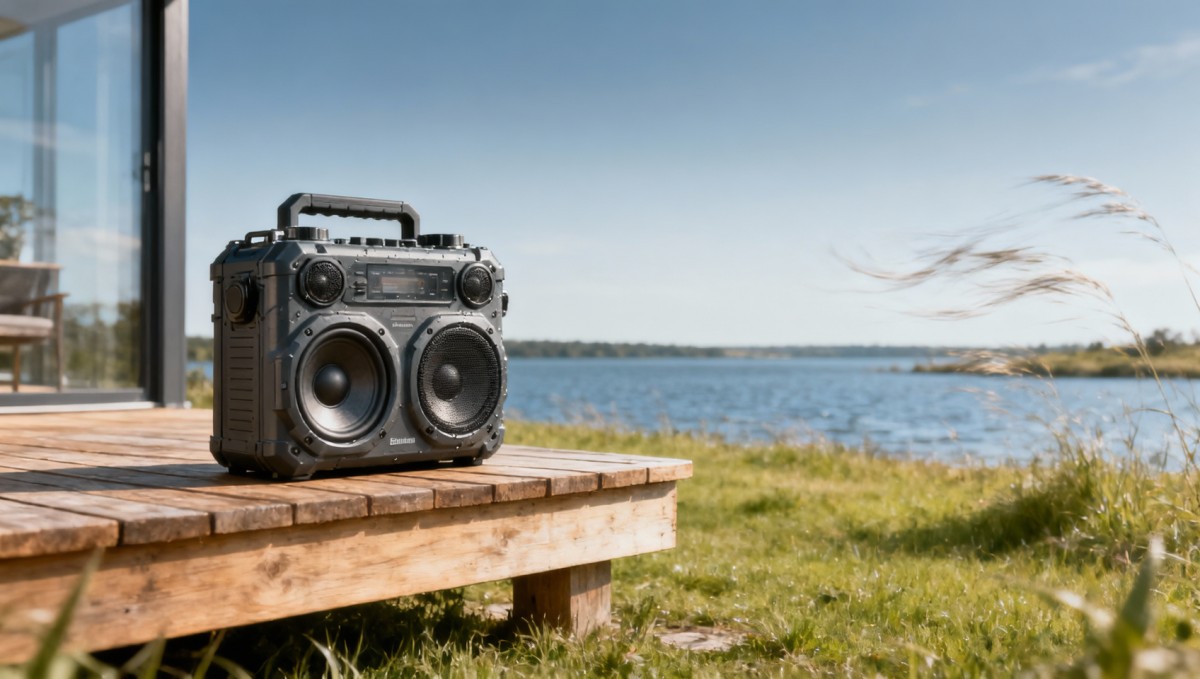
Outdoor listening removes many of the acoustic supports that help speakers sound fuller indoors. Inside a room, walls and ceilings reflect sound waves, often reinforcing bass and midrange energy. Outside, those reflections are greatly reduced, so the speaker must generate more usable output on its own. This is why a 20W to 30W unit that feels acceptable indoors can sound thin in a park, on a rooftop, or at a jobsite gathering.
Distance also changes perception. If listeners are spread over 3 to 8 meters instead of sitting within 1 to 2 meters, clarity becomes more important than raw loudness. High frequencies can dissipate faster in open space, while low frequencies may feel weaker unless the cabinet design, passive radiators, or driver tuning are engineered to compensate. In practical terms, good outdoor audio depends on how evenly the speaker projects sound, not just how loud it can get at maximum volume.
Environmental noise creates another challenge. Wind, traffic, crowd chatter, and water noise often occupy the same frequency regions that carry vocals and detail. A speaker with poor midrange tuning may appear powerful on paper but become difficult to understand outdoors. For user groups such as field operators, mobile sales teams, hospitality staff, and event coordinators, speech intelligibility can matter as much as bass response.
Buyers should also consider placement effects. A speaker placed on grass, sand, metal tables, or wooden decking will interact differently with surrounding surfaces. Some enclosures vibrate or lose bass control on hollow surfaces. Others benefit from boundary reinforcement when positioned near a wall or corner. This means outdoor performance testing should be carried out in at least 3 scenarios rather than relying on a single indoor bench test.
Key Outdoor Acoustic Constraints
- Open-air sound dispersion reduces perceived bass and fullness compared with enclosed rooms.
- Ambient noise can mask vocals, especially between roughly 1 kHz and 4 kHz.
- Longer listening distances demand stronger clarity, not just higher peak volume.
- Surface placement affects cabinet resonance, vibration control, and low-frequency impact.
What This Means for Product Evaluation
For technical evaluators, the first screening question should be whether the speaker is tuned for close personal listening or broader outdoor projection. Compact lifestyle speakers may perform well at desk range but struggle beyond 4 meters. Rugged outdoor models are usually designed with larger drivers, dual passive radiators, or DSP-assisted tuning to preserve tonal balance in open environments. That distinction affects both user satisfaction and return rates in channel sales.
The Core Sound Factors: Tuning, Drivers, Bass, and Volume Headroom
A bluetooth speaker sounds good outdoors when its acoustic system remains balanced as output rises. The most important factors are driver configuration, cabinet volume, digital signal processing, and tuning priorities. A speaker with 2 full-range drivers and 2 passive radiators often delivers a wider, more stable sound than a single-driver unit, especially when listening angles extend beyond 45 degrees from center. Stereo separation may still be limited in a compact enclosure, but perceived spaciousness improves.
Bass is important outdoors, yet too much emphasis can harm usable clarity. Some products boost low frequencies aggressively to create a quick showroom impression. Outside, that tuning may lead to muddy mids and faster battery drain at higher volumes. A better outdoor design typically maintains enough low-end extension to sound full while keeping vocals and snare detail intact. In many cases, controlled bass between roughly 60 Hz and 100 Hz is more valuable than an exaggerated low-end peak that disappears in real use.
Volume headroom matters because distortion rises as small speakers are pushed near their limits. If a model sounds clean at 50% but becomes harsh at 80%, it may not be suitable for group use. Technical teams should evaluate total listening quality at three stages: moderate playback, typical outdoor playback, and near-maximum playback. A good outdoor bluetooth speaker should remain listenable during at least 70% to 85% of its volume range without obvious compression, rattling, or vocal collapse.
Signal processing is often overlooked in sourcing discussions. Well-implemented DSP can protect drivers, control distortion, and adjust tonal balance dynamically as volume changes. Poor DSP can do the opposite, making the speaker sound thin at low levels and strained at high levels. This is especially relevant for distributors comparing ODM and OEM smart electronics products where outward design similarities may hide large differences in tuning quality.
Typical Audio Elements to Compare
The table below gives a practical comparison framework for buyers assessing the sound architecture of outdoor bluetooth speakers. It focuses on real-world usefulness instead of marketing claims alone.
The main takeaway is that sound quality outdoors comes from system balance. Higher wattage alone does not guarantee better results. A well-tuned 30W to 40W design can outperform a poorly tuned 50W unit if it preserves vocal definition, controls distortion, and projects more evenly over a wider area.
Common Selection Mistakes
- Choosing by advertised peak output without testing sustained playback quality for 30 to 60 minutes.
- Overvaluing bass-heavy demos that sound impressive indoors but blur outdoors.
- Ignoring off-axis listening, even though many outdoor users stand to the side rather than directly in front.
- Assuming all stereo-pair or party modes work equally well across firmware versions and device ecosystems.
Durability, Battery Efficiency, and Wireless Stability in Real Outdoor Use
Even excellent tuning loses value if the speaker fails under moisture, dust, or battery stress. Outdoor audio quality is closely tied to product reliability because power drops, thermal limits, and unstable connections can degrade the listening experience. A speaker that begins with strong output but throttles after 90 minutes of high-volume playback will not meet the needs of mobile teams, outdoor retailers, resort operators, or event service providers.
Ingress protection ratings are a practical starting point. For outdoor leisure and light commercial scenarios, IPX5 or IPX6 can be sufficient for splash resistance. For broader field use, poolside placement, and accidental immersion risk, many buyers prefer IP67-class designs. However, protection claims should be viewed together with port sealing, button durability, and charging interface design. A strong IP rating does not automatically mean the speaker will survive repeated drops or rough transport.
Battery efficiency directly affects sound quality at higher volumes. Many speakers advertise 12 to 24 hours of playtime, but those figures are often measured at 40% to 50% volume under controlled conditions. In outdoor operation, where volume may sit closer to 65% or 75%, effective runtime can drop sharply. Buyers should ask for test conditions, battery capacity ranges in mAh or Wh, and whether sound tuning changes noticeably when battery level falls below 20%.
Bluetooth reliability is equally important. Outdoors, line-of-sight range may look good on paper, sometimes up to 10 meters or more, but interference from multiple devices, metal structures, and mobile traffic can reduce stability. Newer bluetooth versions, multipoint pairing, and app-based firmware support can improve usability, yet implementation quality varies. In distribution and enterprise gifting channels, connection failures are one of the fastest drivers of complaints and returns.
Field Conditions That Affect Perceived Performance
The table below summarizes the operational factors that most often influence outdoor speaker satisfaction beyond pure acoustic tuning.
For quality managers and safety-focused buyers, the broader lesson is clear: good outdoor sound is inseparable from stable operating conditions. A speaker that maintains tonal balance, connection, and battery output across 1 full usage cycle is more valuable than one that performs well only during the first 20 minutes of playback.
Minimum Practical Verification Checklist
- Run playback for at least 2 hours at realistic outdoor volume.
- Test after light water exposure and after transport vibration.
- Measure connection consistency across at least 2 source devices.
- Check whether sound signature changes significantly below 30% battery.
How B2B Buyers Should Compare Outdoor Bluetooth Speakers
In B2B procurement, a good buying decision balances product performance, after-sales risk, unit economics, and channel suitability. A speaker intended for corporate promotions may prioritize compactness and brand presentation. A speaker for retail distribution may need stronger shelf differentiation and lower return risk. A speaker for hospitality, construction support, fleet services, or outdoor activation teams may need better durability and all-day battery behavior. The target scenario should define the evaluation matrix from the start.
Buyers should compare at least 4 dimensions: acoustic performance, environmental resilience, user interface practicality, and supply consistency. Sample testing should include more than one environment, ideally a quiet indoor reference, a semi-open area, and a noisy outdoor setting. This three-stage review often reveals whether a speaker is genuinely versatile or simply optimized for controlled demos. Procurement managers can reduce sourcing error by creating weighted scorecards rather than relying on single-feature impressions.
Commercial requirements matter as much as sound. Lead times of 3 to 6 weeks, accessory availability, packaging durability, replacement policy, and firmware support all influence the total procurement outcome. For distributors and resellers, an attractive price point can be undermined by elevated defect handling costs or inconsistent batch tuning. For enterprise decision-makers, the best vendor is often the one that provides stable documentation, clear test samples, and responsive post-sale support rather than the lowest initial quote.
Because bluetooth speakers sit within the broader smart electronics ecosystem, cross-category sourcing standards can be useful. The same rigor applied to evaluating mechanical keyboards, wearable devices, and power accessories should apply here: define target users, verify environmental fit, inspect component consistency, and assess software support. This makes selection more repeatable and financially defensible for both technical teams and budget approvers.
Sample B2B Decision Matrix
The following matrix can help buyers compare options in a structured way before moving to trial orders or annual supply agreements.
This approach helps technical evaluators speak the same language as finance teams. Instead of debating isolated claims such as “louder” or “more bass,” stakeholders can link performance to return rates, use-case fit, and lifecycle value. That is especially important in high-mix sourcing portfolios where audio devices are only one part of a broader smart products strategy.
A Practical 5-Step Procurement Process
- Define the main use case: personal carry, group entertainment, hospitality, field team use, or branded distribution.
- Shortlist 3 to 5 candidate products with comparable size and price bands.
- Test each model in at least 3 environments and for 2-hour runtime consistency.
- Review packaging, documentation, firmware support, and replacement terms.
- Approve a pilot order before scaling to larger quarterly or annual volumes.
Common Questions, Risks, and Best-Fit Recommendations
Many buyers ask whether larger size automatically means better outdoor sound. In general, a larger enclosure provides more room for bass development and stronger output, but tuning and build quality still decide the final result. A poorly designed large speaker can sound boomy and uneven, while a compact but well-engineered model can be cleaner and more useful for small-group listening. Size should be matched to audience area, typical distance, and portability requirements.
Another common concern is whether stereo pairing is necessary. For outdoor use, pairing 2 speakers can improve spread and perceived scale, especially in spaces wider than 5 meters. However, it adds complexity in setup, firmware compatibility, and battery management. For commercial buyers, paired mode should be treated as a secondary advantage rather than the only path to acceptable sound. Each single unit should still perform credibly on its own.
A frequent risk in sourcing is overreliance on catalog specifications. Numbers such as output wattage, battery duration, or bluetooth range can be useful, but they do not capture distortion behavior, cabinet rattle, pairing recovery, or weather-exposed control reliability. Quality teams should verify physical buttons, seals, charging ports, and acoustic consistency across at least 2 to 3 samples from the same batch wherever possible.
For distributors and agents, the best-fit outdoor bluetooth speakers usually share several traits: clear vocal tuning, durable enclosure materials, dependable battery behavior, simple pairing flow, and packaging that communicates use-case value quickly. Products that are merely loud often generate short-term attention but weaker long-term user satisfaction. Products that balance sound, durability, and everyday convenience tend to achieve healthier channel performance.
FAQ: How should buyers judge outdoor speaker sound quality quickly?
Start with a 15 to 20 minute listening test in open air at low, medium, and high volume. Focus on whether vocals remain clear, bass stays controlled, and the sound becomes harsh near the top of the volume range. Then check battery status drop, connection stability, and enclosure behavior on different surfaces. This short test reveals more than spec-sheet comparisons alone.
FAQ: Which specifications matter most for outdoor use?
The most useful indicators are driver layout, realistic battery runtime, water and dust protection level, and stable wireless behavior. If a supplier claims 20-hour playback, ask at what volume that figure was measured. If a speaker claims rugged use, ask whether the port design, buttons, and housing edges support repeated transport and outdoor handling.
FAQ: When is a rugged speaker worth the higher cost?
It is usually worth the premium when the speaker will be used in wet environments, travel frequently, or serve professional teams that cannot tolerate interruption. In those cases, higher upfront cost can reduce replacement frequency, complaint rates, and operational friction over 12 months or more.
FAQ: What are the most common buying mistakes?
The biggest mistakes are judging by loudness only, trusting battery claims without test conditions, ignoring connection reliability, and skipping sample comparison across real outdoor environments. Another common error is buying a speaker designed for personal use when the actual need is small-group coverage.
A bluetooth speaker sounds good outdoors when its sound remains balanced, clear, and dependable in conditions that remove the acoustic advantages of indoor spaces. Buyers should evaluate more than wattage: tuning, driver design, bass control, battery efficiency, weather resistance, and wireless stability all shape real-world performance. For research teams, technical evaluators, distributors, and enterprise procurement leaders, a structured comparison process leads to better product-market fit and lower downstream risk.
TradeNexus Pro helps decision-makers analyze smart electronics and adjacent innovation categories with deeper sourcing context, technical interpretation, and market-facing insight. If you are comparing rugged bluetooth speakers, validating supplier options, or building a broader product strategy across advanced electronics and connected devices, contact us to get tailored guidance, product evaluation support, and more solution-focused intelligence.
Get weekly intelligence in your inbox.
No noise. No sponsored content. Pure intelligence.
 Apr 18, 2026TradeNexus Pro Launches Global Compliance RadarTradeNexus Pro Launches Global Compliance Radar
 Apr 18, 2026JIS T 2304:2026 Takes Effect June 1, 2026 for IVD SoftwareJIS T 2304:2026 Takes Effect June 1, 2026 for IVD Software
 Pathway for Rehab Devices with AI Modules") Apr 18, 2026FDA Updates 510(k) Pathway for Rehab Devices with AI ModulesFDA Updates 510(k) Pathway for Rehab Devices with AI Modules
Apr 18, 2026FDA Updates 510(k) Pathway for Rehab Devices with AI ModulesFDA Updates 510(k) Pathway for Rehab Devices with AI Modules Apr 18, 2026India BIS Approves 3 Chinese IoT Labs for IS 16444:2026 CertificationIndia BIS Approves 3 Chinese IoT Labs for IS 16444:2026 Certification
 Apr 18, 2026THE Alliance Launches Green Slot Priority for China PortsTHE Alliance Launches Green Slot Priority for China Ports
 Apr 18, 2026TÜV Rheinland Releases Dual-Standard ESS Certification Guide for ChinaTÜV Rheinland Releases Dual-Standard ESS Certification Guide for China
 Apr 18, 2026Vietnam Imposes AD Duties on Chinese Electronic ComponentsVietnam Imposes AD Duties on Chinese Electronic Components
 Apr 18, 2026SASO Launches PV Carbon Footprint Labeling from July 2026SASO Launches PV Carbon Footprint Labeling from July 2026
 Apr 18, 2026U.S. Adds 17 Smart Warehouse Robot Components to Export Control ListU.S. Adds 17 Smart Warehouse Robot Components to Export Control List
 Apr 18, 2026EU Enforces EN IEC 62443-4-2:2026 for Industrial Control Devices from 18 Apr 2026EU Enforces EN IEC 62443-4-2:2026 for Industrial Control Devices from 18 Apr 2026
 Apr 17, 2026Temperature data loggers drift unpredictably inside lithium-ion battery storage enclosuresTemperature data loggers drift unpredictably inside lithium-ion battery storage enclosures
 Apr 17, 2026Are solar microinverters really worth the extra cost?Are solar microinverters really worth the extra cost?
 Apr 17, 2026Bifacial solar panels: How much more energy can they generate?Bifacial solar panels: How much more energy can they generate?
 Apr 17, 2026Gear manufacturing: How to optimize production for high precision?Gear manufacturing: How to optimize production for high precision?
 Apr 17, 2026Why power transmission components fail earlier than expectedWhy power transmission components fail earlier than expected
 Apr 17, 2026Linear motion systems: belt drive or ball screw for speed?Linear motion systems: belt drive or ball screw for speed?
 Apr 17, 2026Industrial bearing suppliers: what signals reliable quality?Industrial bearing suppliers: what signals reliable quality?
 Apr 17, 2026When pneumatic valves wholesale gets expensive laterWhen pneumatic valves wholesale gets expensive later
 Apr 17, 2026Hydraulic cylinder fabrication mistakes that cause oil leaksHydraulic cylinder fabrication mistakes that cause oil leaks
 Apr 17, 2026Heavy equipment manufacturing delays often start hereHeavy equipment manufacturing delays often start here
 Apr 17, 2026Custom heatsinks: when a larger size solves nothingCustom heatsinks: when a larger size solves nothing
 Apr 17, 2026Electronic enclosure fabrication: steel or aluminum?Electronic enclosure fabrication: steel or aluminum?
 Apr 17, 2026Automotive parts machining tolerances that drive up scrapAutomotive parts machining tolerances that drive up scrap
 Apr 17, 2026Medical device manufacturing changes under tighter traceabilityMedical device manufacturing changes under tighter traceability
 Apr 17, 2026How to Choose Solid State Batteries in 2026How to Choose Solid State Batteries in 2026
 Apr 17, 2026Are Solid State Batteries Worth the Cost Yet?Are Solid State Batteries Worth the Cost Yet?
 Apr 17, 2026Commercial Energy Storage Sizing: What Matters Most?Commercial Energy Storage Sizing: What Matters Most?