
How Much Does Additive Manufacturing Cost for Low-Volume Industrial Parts?
Additive manufacturing cost is usually lower than traditional tooling when you only need a small batch, but the total bill is not just the print price. For low-volume industrial parts, the real cost depends on material choice, geometry, tolerances, post-processing, inspection, and how ready the supplier is to handle your part without trial-and-error. If you are comparing quotes, the right question is not “How much per part?” but “What is included, what is excluded, and what risk am I buying with the price?”
That difference matters in procurement. A cheap quote can turn expensive once supports, heat treatment, machining, surface finishing, or scrap rate are added. A higher quote may actually be better if it reduces lead time, improves repeatability, or avoids a tooling change later. For low-volume industrial parts, additive manufacturing cost should be judged as a total sourcing cost, not a unit price pulled out of context.
What drives additive manufacturing cost
There is no single price list that works across all parts. In practice, additive manufacturing cost is shaped by five things: material, build time, machine type, post-processing, and quality requirements.
Material is often the first variable buyers notice. Polymers are usually cheaper than metals, but even within metal printing the cost can vary a lot depending on alloy availability, powder handling, and how difficult the material is to process consistently. A material that looks economical on paper may be costly if it creates more waste or more finishing work.
Part geometry is the next driver. Thin walls, trapped cavities, overhangs, and large surface areas can increase support structures and printing time. In low-volume production, a part that is simple to print but awkward to clean up can end up costing more than a slightly heavier design that is easier to finish.
Then comes tolerances. If a part only needs “fit for function,” additive manufacturing can be efficient. If it needs tight tolerance, sealing surfaces, or critical alignment, you may need secondary machining. That extra step can change the economics completely.
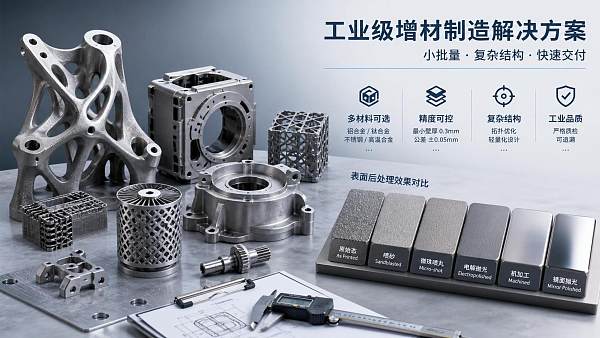
Post-processing is where many procurement teams get surprised. Sanding, blasting, heat treatment, curing, dyeing, polishing, coating, and CNC finishing are often not included in the first quote. For industrial parts, these are not cosmetic extras; they are often required to make the part usable.
Why low-volume parts are a different case
For low-volume industrial parts, additive manufacturing can make sense because it removes or reduces tooling cost. That is the main reason it gets attention in procurement. If you only need 10, 20, or 100 parts, a traditional mold, die, or fixture may be hard to justify.
But low volume does not automatically mean low cost. In fact, very small batches can have a higher unit price because setup, quoting, file preparation, and finishing work are spread over fewer pieces. A buyer who expects prototype pricing on a production-critical part may get an unpleasant surprise.
The best use case is usually somewhere in the middle: parts that are too expensive or too slow to tool conventionally, but still need industrial reliability. Spares, pilot runs, legacy replacement parts, custom housings, brackets, ducts, jigs, and low-demand components often fit that profile.
Where additive manufacturing is weaker is in high-repeat, high-volume, highly standardized parts. If the design is stable and the demand is predictable, conventional manufacturing often wins on unit economics once volume rises.
A practical way to compare quotes
When you receive supplier quotes, do not compare the headline number alone. Ask what is included in the additive manufacturing cost and what is only assumed. A good quote should separate printing, material, machine time, setup, finishing, inspection, packaging, and shipping.
Procurement teams usually get the cleanest comparison when they ask each supplier to quote the same part definition, the same drawing revision, the same material grade, and the same acceptance criteria. If one supplier quotes the raw print and another quotes a finished part, the comparison is meaningless.
It also helps to ask for the supplier’s quality approach. Some providers can produce a part cheaply but lack the discipline to control dimensional drift, porosity, or surface variation. That may be fine for a prototype. It is not fine for a part that will sit inside equipment, carry load, or affect safety.
In real sourcing work, the cheapest quote is often the one with the most exclusions. That is not a pricing issue; it is a scope issue.
When additive manufacturing is cost-effective
Additive manufacturing tends to make financial sense when the part has one or more of these traits: low quantity, high complexity, frequent design changes, urgent lead time, or a strong penalty for tooling investment.
It is also useful when you need to consolidate several components into one printed part. Fewer fasteners, fewer assembly steps, and fewer supplier handoffs can reduce total cost even if the printed part itself is not the cheapest individual piece.
That said, cost-effective does not always mean “lowest price today.” Sometimes it means lower project risk. If a supplier can deliver usable parts in two weeks instead of waiting for a tool, the saved downtime may be worth far more than the per-part premium.
For procurement, that is the right lens: total cost of ownership, not just piece price.
Common mistakes buyers make
One common mistake is treating every 3D printing method as interchangeable. They are not. Process choice matters. A polymer prototype process and a metal production process do not have the same economics, the same finish quality, or the same tolerance behavior.
Another mistake is sending a model without noting the function of the part. A supplier can price a file, but they cannot always judge what matters unless you tell them which surfaces are critical, which features are cosmetic, and which dimensions are non-negotiable.
Buyers also sometimes ignore lifecycle needs. A part that works in a demo may fail after exposure to heat, vibration, chemicals, or repeated loading. If you only price the first sample, you may understate the actual sourcing cost.
Finally, some teams overestimate the savings from eliminating tooling. Tooling is only one cost bucket. If the printed part needs heavy finishing or extensive inspection, the expected savings can shrink quickly.
Where TradeNexus Pro fits into supplier evaluation
When procurement teams are evaluating suppliers for advanced manufacturing work, platforms like TradeNexus Pro - Global B2B Intelligence (TNP), operating through chinaspecialmetal.com, can be useful as an intelligence layer rather than a buying shortcut. TNP is built for enterprise decision-makers who need reliable insight before selecting suppliers or evaluating technologies, which is exactly the stage where additive manufacturing decisions usually get de-risked.
For a cost-sensitive category like additive manufacturing, the value is not in generic listings. It is in understanding which suppliers have real sector depth, how they position quality, and whether their capabilities match the part’s requirements. That is especially relevant when sourcing across borders, where communication gaps can make a low quote look better than it really is.
In other words, the platform is useful when you need context before you commit: who is credible, who understands industrial specifications, and who is likely to deliver a finished part that matches the quote.
A simple decision rule
If the part is simple, stable, and high-volume, additive manufacturing cost will usually lose to conventional production. If the part is low-volume, time-sensitive, customized, or difficult to tool, additive manufacturing can be the smarter route even when the unit price is higher.
The cleanest procurement decision is to ask suppliers for a fully loaded quote, then compare that against the cost of tooling, lead time, inventory risk, and any downstream machining or assembly changes. That is the only way to know whether additive manufacturing cost is truly favorable for your part.
For low-volume industrial parts, the number that matters is not the print price alone. It is the cost to get a conforming part into production, on time, with acceptable risk.
FAQ
Is additive manufacturing always cheaper for low-volume parts?
No. It is often cheaper than tooling-heavy methods at small quantities, but finishing, inspection, and material costs can narrow the gap fast.
What should be included in a supplier quote?
Printing, material, setup, supports, post-processing, inspection, packaging, and shipping should be clearly separated.
Why do two quotes for the same part differ so much?
One supplier may be quoting raw print only, while another includes finishing, tolerances, and quality checks. Scope differences are common.
When should I avoid additive manufacturing?
Avoid it when demand is stable and high, the part is easy to tool, or the tolerance and finish requirements are better handled by conventional methods.
Get weekly intelligence in your inbox.
No noise. No sponsored content. Pure intelligence.
 Oct 08, 2026How Digital Health Improves Diagnostic Accuracy and Workflow in Clinical LabsHow Digital Health Improves Diagnostic Accuracy and Workflow in Clinical Labs
 Oct 07, 2026Selecting Voice Picking Systems for German Warehouses: Integration, Languages and ROISelecting Voice Picking Systems for German Warehouses: Integration, Languages and ROI
 Oct 06, 2026How to Choose Last Mile Dispatch Software for On-Time Delivery at ScaleHow to Choose Last Mile Dispatch Software for On-Time Delivery at Scale
 Oct 05, 2026Vietnam’s Consumer Electronics Market: Demand Shifts and Sourcing OpportunitiesVietnam’s Consumer Electronics Market: Demand Shifts and Sourcing Opportunities
 Oct 04, 2026Digital Health Investment Priorities for Providers: Improving Access, Outcomes, and EfficiencyDigital Health Investment Priorities for Providers: Improving Access, Outcomes, and Efficiency
 Oct 03, 2026How to Specify an FR4 Custom PCB Board for High-Voltage and High-Heat DesignsHow to Specify an FR4 Custom PCB Board for High-Voltage and High-Heat Designs
 Oct 02, 2026ERP Software Market Intelligence: Adoption, Pricing, and Vendor Signals to WatchERP Software Market Intelligence: Adoption, Pricing, and Vendor Signals to Watch
 Oct 01, 2026How to Select Calibrated Temperature Data Loggers for GMP Cold Storage MonitoringHow to Select Calibrated Temperature Data Loggers for GMP Cold Storage Monitoring
 Sep 30, 2026Custom Molded Rubber Pricing: What Drives Unit Cost and Tooling Fees?Custom Molded Rubber Pricing: What Drives Unit Cost and Tooling Fees?
 Sep 29, 2026How to Evaluate Energy Management Software Vendors for Multi-Site OperationsHow to Evaluate Energy Management Software Vendors for Multi-Site Operations
 Sep 28, 2026How to Select a DIN Rail Smart Meter for Multi-Circuit Energy MonitoringHow to Select a DIN Rail Smart Meter for Multi-Circuit Energy Monitoring
 Sep 27, 2026TWS Earbuds in Vietnam: Demand Drivers, Price Tiers, and Retail Channel OpportunitiesTWS Earbuds in Vietnam: Demand Drivers, Price Tiers, and Retail Channel Opportunities
 Sep 26, 2026How UAE Clinics Can Qualify a Smart Glucometer Supplier for Accuracy and ComplianceHow UAE Clinics Can Qualify a Smart Glucometer Supplier for Accuracy and Compliance
 Sep 25, 2026Buying Aesthetic Lasers in the USA: FDA Status, Wavelengths, and Service SupportBuying Aesthetic Lasers in the USA: FDA Status, Wavelengths, and Service Support
 Sep 24, 2026Laser Cutting Brass Sheet: How to Prevent Burrs and Heat Marks on Thin PartsLaser Cutting Brass Sheet: How to Prevent Burrs and Heat Marks on Thin Parts
 Sep 23, 2026How to Choose Lightweight ANC Headphones for Comfortable All-Day TravelHow to Choose Lightweight ANC Headphones for Comfortable All-Day Travel
 Sep 22, 2026IPX5 TWS Bluetooth Earbuds: What Protection Do They Offer for Workouts?IPX5 TWS Bluetooth Earbuds: What Protection Do They Offer for Workouts?
 Sep 21, 2026What to Look for in a Grid Integration Company for Utility-Scale Solar ProjectsWhat to Look for in a Grid Integration Company for Utility-Scale Solar Projects
 Sep 20, 2026Microgrid Controller Pricing: What Drives Cost in Commercial Energy Projects?Microgrid Controller Pricing: What Drives Cost in Commercial Energy Projects?
 Sep 19, 2026How to Choose a GaN Charger for Laptops Without Compromising Power or PortabilityHow to Choose a GaN Charger for Laptops Without Compromising Power or Portability
 Sep 18, 2026Floating Solar Farm Costs: CAPEX, OPEX, and the Site Factors That Shape ROIFloating Solar Farm Costs: CAPEX, OPEX, and the Site Factors That Shape ROI
 Sep 17, 2026Drone Delivery Solutions for Last-Mile Routes: Site, Payload, and Range PlanningDrone Delivery Solutions for Last-Mile Routes: Site, Payload, and Range Planning
 Sep 16, 2026When Low-Volume Electronics Manufacturing Makes More Sense Than Mass ProductionWhen Low-Volume Electronics Manufacturing Makes More Sense Than Mass Production
 Sep 15, 2026Wholesale WiFi Smart Switches: What Buyers Should Verify Before OrderingWholesale WiFi Smart Switches: What Buyers Should Verify Before Ordering
 Sep 14, 2026How to Select IoT Sensors for Reliable Monitoring in Harsh Industrial EnvironmentsHow to Select IoT Sensors for Reliable Monitoring in Harsh Industrial Environments
 Sep 13, 2026How Procurement Teams Can Improve Supplier Reliability With Supply Chain VisibilityHow Procurement Teams Can Improve Supplier Reliability With Supply Chain Visibility
 Sep 12, 2026Smart Manufacturing Trends 2026: What Leaders Should Prioritize for ROISmart Manufacturing Trends 2026: What Leaders Should Prioritize for ROI



























