
How to Evaluate Custom Steel Forging for High-Load Industrial Parts?
Evaluating custom steel forging for high-load industrial parts requires more than checking price or basic specifications. Technical assessors must examine load conditions, grain flow, material integrity, dimensional tolerance, heat treatment consistency, and supplier process capability to reduce failure risk and improve lifecycle performance. This guide outlines the key criteria that help industrial buyers and engineering teams make more reliable forging decisions.
In practice, the hardest part of supplier or process selection is not deciding whether forged steel is “stronger” in a general sense. It is determining whether a specific forging route, material grade, and supplier control system can produce a part that will survive real loading conditions over time. High-load parts fail not because the drawing looked acceptable, but because the evaluation missed the interaction between geometry, metallurgy, process stability, and service environment.
That is why technical assessment should begin with function, not quotation. A forged shaft, hub, connecting component, flange, ring, gear blank, or heavy-duty coupling insert may all be called “high-load parts,” yet their risk profiles differ sharply. Some are governed by fatigue. Others are limited by impact loading, creep resistance, surface wear, stress corrosion, or dimensional stability after machining and heat treatment. The right forging decision comes from matching the process to the actual failure mode.
Start with the load case, not the forged part itself
Many evaluations go wrong because the review begins with available supplier catalogs or with a nominal material grade. For high-load industrial components, the more useful sequence is:
- define the dominant load type;
- identify the most likely failure mechanism;
- determine which material and process variables control that failure;
- check whether the forging supplier can repeatedly control those variables.
A part subjected to alternating torsion and bending requires a different assessment than one loaded mainly in compression. If the component sees shock loading, inclusion control and toughness may matter more than headline tensile strength. If the part is used in mining, marine, oil and gas, power transmission, or heavy press equipment, the operating environment may make heat treatment uniformity and internal soundness more critical than near-net-shape efficiency.
Technical teams should ask one direct question early: what kind of failure is least tolerable in this application? Once that is clear, the forging evaluation becomes more disciplined.
Why forging is often preferred for high-load parts
Forging remains a preferred route for many high-load applications because it can improve mechanical reliability compared with cast or machined-from-bar alternatives, especially where directional grain flow and dense internal structure matter. In well-designed forgings, metal flow follows the shape of the part, which can improve fatigue strength and impact performance in critical zones.
That advantage, however, is often overstated in supplier discussions. Forging is not automatically superior in every case. A poor die design, uncontrolled reduction ratio, overheating, decarburization, or inconsistent quenching can erase much of the theoretical benefit. Technical assessors should treat “forged” as a process family, not a performance guarantee.
When comparing custom forgings with castings, plate fabrications, or large bar-machined parts, the decision usually hinges on five questions:
- Does the application require superior fatigue or impact performance?
- Does the geometry benefit from controlled grain flow?
- Can internal defects be tolerated, or is structural integrity critical?
- Is machining allowance economically acceptable?
- Will production volume justify tooling and process development?
Material grade is only one layer of the decision
Technical reviews often over-focus on steel grade designations such as carbon steel, alloy steel, stainless steel, or low-alloy high-strength steel. Grade selection matters, but the same nominal grade can perform very differently depending on melting route, cleanliness, forging reduction, heat treatment, and section thickness.
For high-load service, assessors should not stop at the grade name on the drawing. They should verify:
- required mechanical properties at room or elevated temperature;
- through-thickness performance for large sections;
- toughness targets, if any, at service temperature;
- hardenability relative to section size;
- weldability or machinability if downstream processing is needed;
- corrosion or oxidation resistance in the actual environment.
In cross-border sourcing, equivalency between standards can also create risk. A buyer may reference ASTM, EN, JIS, GB, or proprietary specifications that look comparable but have differences in chemistry range, heat treatment condition, or test requirements. If a part is safety-critical, material substitution should never be assumed equivalent without engineering review.
Grain flow and forging design deserve closer scrutiny than many buyers give them
One of the strongest technical arguments for custom steel forging is optimized grain flow around highly stressed areas. This is especially relevant in crank-like geometries, stepped shafts, lugs, and transition sections where stress concentration is structurally unavoidable.
But grain flow is not something to accept as a sales claim. It should be discussed in relation to the actual part geometry and loading direction. Assessors should review whether the die design and forging sequence orient the grain flow through the critical load path rather than cutting across it. If the final machining removes too much forged contour, the benefit may be reduced.
In practical supplier review, this means asking for:
- forging process drawings or flow simulations where available;
- estimated forging ratio or reduction details;
- location of flash, parting line, and critical transitions;
- machining allowance versus final stress-bearing geometry;
- examples of similar parts previously produced.
A technically capable supplier will be able to explain why the forging route supports performance, not just output.
Internal soundness is often the hidden decision driver
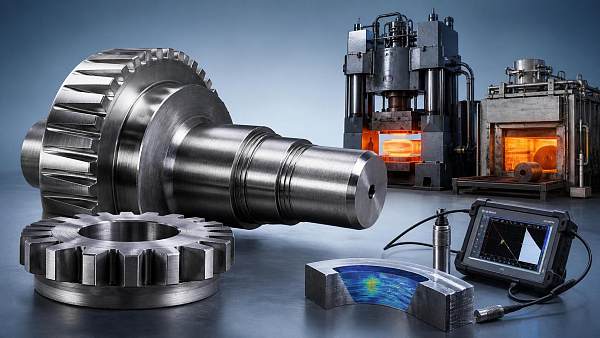
For high-load industrial parts, internal quality frequently matters more than external appearance. Surface finish can be machined. Internal discontinuities cannot. Depending on application severity, technical assessors should evaluate the risk of shrinkage remnants, segregation, laps, bursts, flakes, and non-metallic inclusions.
This becomes more important as section size increases. Large forgings can show acceptable surface condition while still carrying internal metallurgical variability that affects fatigue life or fracture resistance. Where failure consequences are high, ultrasonic testing requirements should be defined clearly, including acceptance criteria, scanning coverage, and timing of inspection relative to heat treatment and rough machining.
Applicable standards vary by industry and customer specification. Where a supplier cites compliance with an internal standard only, the buyer should confirm whether it aligns with recognized NDT and material quality requirements or whether additional acceptance criteria are needed. If a supplier cannot clearly explain its ultrasonic examination practice, calibration method, and rejection handling, that is a technical risk signal rather than a paperwork issue.
Heat treatment capability often separates reliable suppliers from merely capable ones
Many high-load parts meet design intent only after correct quenching, tempering, normalizing, annealing, solution treatment, or stress relieving. Yet heat treatment is one of the most common sources of variation in forged parts, especially in international supply chains where subcontracted thermal processing is common.
Assessors should verify whether heat treatment is performed in-house or outsourced, and whether the supplier can demonstrate control over:
- furnace uniformity;
- load arrangement and section-size consistency;
- quench media control;
- time-temperature records;
- hardness distribution and property verification;
- distortion management for complex shapes.
For thick-section components, the question is not only whether the test coupon meets tensile requirements, but whether the actual part section achieves the intended microstructure throughout critical zones. This is where many sourcing decisions become overly optimistic. A coupon taken from a favorable location may not represent the most demanding section of the forging.
Tolerance capability should be judged against machining strategy
Dimensional tolerance in custom forgings is rarely a standalone issue. It is tied to die wear, trimming accuracy, thermal contraction behavior, straightness control, and the amount of stock left for machining. Technical teams sometimes over-specify tight as-forged tolerances on parts that will be extensively machined anyway, which increases cost without improving final performance.
The more useful assessment is to review the forging and machining plan together. Questions worth asking include:
- Which surfaces are functionally critical in the forged condition?
- Where is machining stock really needed?
- Can the part be forged closer to final shape without increasing defect risk?
- Will heat treatment distortion compromise downstream machining datum control?
- Is straightening likely, and could it introduce residual stress?
This is also where supplier engineering maturity shows. A strong forging supplier usually challenges drawings that are technically manufacturable but commercially inefficient.
Process capability matters as much as equipment size
Buyers often equate larger presses or hammers with better capability. In reality, equipment capacity is only one part of the evaluation. What matters is whether the supplier can repeatedly produce the part with stable metallurgy, controlled deformation, documented inspection, and manageable variation.
For technical qualification, it is worth looking at process capability through a broader lens:
- raw material traceability from mill source;
- die design and maintenance discipline;
- temperature control during forging;
- operator dependence versus process standardization;
- NDT and destructive testing resources;
- corrective action handling for nonconformance;
- experience with similar load-bearing applications.
In custom projects, first-article success is useful, but not sufficient. The more important question is whether the supplier can maintain consistency across repeat batches, especially if the part will be sourced over several years or across multiple regions.
Documentation should support engineering judgment, not replace it
Material certificates, test reports, and quality manuals are necessary, but experienced assessors know they are not enough on their own. A complete-looking document package can still mask process weakness if the specification does not test the right risk points.
For high-load parts, useful documentation review should cover:
- chemical composition by heat;
- mechanical properties in the specified condition;
- heat treatment records;
- NDT reports with defined acceptance criteria;
- dimensional inspection results;
- traceability between part, heat number, and test data;
- deviation approval process where applicable.
If the forging is for regulated sectors such as pressure systems, energy equipment, rail, or medical-related machinery, additional compliance review may be necessary depending on jurisdiction and end use. Project teams should check the governing customer or industry standard directly rather than assume a generic ISO certificate is enough.
Common evaluation mistakes in custom forging projects
Several recurring mistakes appear in sourcing and technical approval cycles.
The first is buying to nominal strength only. Higher tensile values can come at the expense of toughness or fatigue reliability if process control is weak. The second is approving a supplier based on general forging experience without confirming experience in comparable geometry and service stress. The third is underestimating the effect of machining removal on forged grain orientation. The fourth is treating large forgings and small forgings as if the same process assumptions apply. They do not.
Another frequent mistake is viewing cost only at piece price level. A cheaper forging can become the more expensive option if it increases machining time, inspection burden, failure risk, or replacement frequency in service. For high-load parts, lifecycle cost and downtime exposure usually matter more than initial unit price.
A practical decision framework for technical assessors
When evaluating a custom steel forging supplier or process route, the decision is usually strongest when four conditions are met at the same time:
- the forging design aligns with the real load path;
- the selected material and heat treatment match the dominant failure mode;
- internal quality and dimensional control are verified through appropriate inspection;
- the supplier can demonstrate repeatable process capability, not just one-off production success.
If one of these is weak, the project may still proceed, but the residual risk should be explicit. That is particularly important for imported components where design feedback, production oversight, and failure investigation can be slower than in local supply relationships.
For technical teams, the best evaluation outcome is not simply choosing a forging supplier. It is reducing uncertainty before the part enters production. In high-load applications, the cost of incomplete assessment usually appears later—during machining, assembly, field performance, warranty exposure, or unplanned shutdowns. A disciplined review of forging design, metallurgy, inspection, and supplier control remains one of the most effective ways to avoid that outcome.
Get weekly intelligence in your inbox.
No noise. No sponsored content. Pure intelligence.
 Oct 08, 2026How Digital Health Improves Diagnostic Accuracy and Workflow in Clinical LabsHow Digital Health Improves Diagnostic Accuracy and Workflow in Clinical Labs
 Oct 07, 2026Selecting Voice Picking Systems for German Warehouses: Integration, Languages and ROISelecting Voice Picking Systems for German Warehouses: Integration, Languages and ROI
 Oct 06, 2026How to Choose Last Mile Dispatch Software for On-Time Delivery at ScaleHow to Choose Last Mile Dispatch Software for On-Time Delivery at Scale
 Oct 05, 2026Vietnam’s Consumer Electronics Market: Demand Shifts and Sourcing OpportunitiesVietnam’s Consumer Electronics Market: Demand Shifts and Sourcing Opportunities
 Oct 04, 2026Digital Health Investment Priorities for Providers: Improving Access, Outcomes, and EfficiencyDigital Health Investment Priorities for Providers: Improving Access, Outcomes, and Efficiency
 Oct 03, 2026How to Specify an FR4 Custom PCB Board for High-Voltage and High-Heat DesignsHow to Specify an FR4 Custom PCB Board for High-Voltage and High-Heat Designs
 Oct 02, 2026ERP Software Market Intelligence: Adoption, Pricing, and Vendor Signals to WatchERP Software Market Intelligence: Adoption, Pricing, and Vendor Signals to Watch
 Oct 01, 2026How to Select Calibrated Temperature Data Loggers for GMP Cold Storage MonitoringHow to Select Calibrated Temperature Data Loggers for GMP Cold Storage Monitoring
 Sep 30, 2026Custom Molded Rubber Pricing: What Drives Unit Cost and Tooling Fees?Custom Molded Rubber Pricing: What Drives Unit Cost and Tooling Fees?
 Sep 29, 2026How to Evaluate Energy Management Software Vendors for Multi-Site OperationsHow to Evaluate Energy Management Software Vendors for Multi-Site Operations
 Sep 28, 2026How to Select a DIN Rail Smart Meter for Multi-Circuit Energy MonitoringHow to Select a DIN Rail Smart Meter for Multi-Circuit Energy Monitoring
 Sep 27, 2026TWS Earbuds in Vietnam: Demand Drivers, Price Tiers, and Retail Channel OpportunitiesTWS Earbuds in Vietnam: Demand Drivers, Price Tiers, and Retail Channel Opportunities
 Sep 26, 2026How UAE Clinics Can Qualify a Smart Glucometer Supplier for Accuracy and ComplianceHow UAE Clinics Can Qualify a Smart Glucometer Supplier for Accuracy and Compliance
 Sep 25, 2026Buying Aesthetic Lasers in the USA: FDA Status, Wavelengths, and Service SupportBuying Aesthetic Lasers in the USA: FDA Status, Wavelengths, and Service Support
 Sep 24, 2026Laser Cutting Brass Sheet: How to Prevent Burrs and Heat Marks on Thin PartsLaser Cutting Brass Sheet: How to Prevent Burrs and Heat Marks on Thin Parts
 Sep 23, 2026How to Choose Lightweight ANC Headphones for Comfortable All-Day TravelHow to Choose Lightweight ANC Headphones for Comfortable All-Day Travel
 Sep 22, 2026IPX5 TWS Bluetooth Earbuds: What Protection Do They Offer for Workouts?IPX5 TWS Bluetooth Earbuds: What Protection Do They Offer for Workouts?
 Sep 21, 2026What to Look for in a Grid Integration Company for Utility-Scale Solar ProjectsWhat to Look for in a Grid Integration Company for Utility-Scale Solar Projects
 Sep 20, 2026Microgrid Controller Pricing: What Drives Cost in Commercial Energy Projects?Microgrid Controller Pricing: What Drives Cost in Commercial Energy Projects?
 Sep 19, 2026How to Choose a GaN Charger for Laptops Without Compromising Power or PortabilityHow to Choose a GaN Charger for Laptops Without Compromising Power or Portability
 Sep 18, 2026Floating Solar Farm Costs: CAPEX, OPEX, and the Site Factors That Shape ROIFloating Solar Farm Costs: CAPEX, OPEX, and the Site Factors That Shape ROI
 Sep 17, 2026Drone Delivery Solutions for Last-Mile Routes: Site, Payload, and Range PlanningDrone Delivery Solutions for Last-Mile Routes: Site, Payload, and Range Planning
 Sep 16, 2026When Low-Volume Electronics Manufacturing Makes More Sense Than Mass ProductionWhen Low-Volume Electronics Manufacturing Makes More Sense Than Mass Production
 Sep 15, 2026Wholesale WiFi Smart Switches: What Buyers Should Verify Before OrderingWholesale WiFi Smart Switches: What Buyers Should Verify Before Ordering
 Sep 14, 2026How to Select IoT Sensors for Reliable Monitoring in Harsh Industrial EnvironmentsHow to Select IoT Sensors for Reliable Monitoring in Harsh Industrial Environments
 Sep 13, 2026How Procurement Teams Can Improve Supplier Reliability With Supply Chain VisibilityHow Procurement Teams Can Improve Supplier Reliability With Supply Chain Visibility
 Sep 12, 2026Smart Manufacturing Trends 2026: What Leaders Should Prioritize for ROISmart Manufacturing Trends 2026: What Leaders Should Prioritize for ROI



























