
Why custom metal fabrication for energy sector matters
For project managers and engineering leads, custom metal fabrication for energy sector projects is more than a sourcing choice—it directly affects safety, compliance, durability, and delivery timelines.
As energy systems become more complex, standard parts often create fit issues, inspection risks, and costly field modifications.
That is why custom metal fabrication for energy sector infrastructure matters across power generation, transmission, storage, and processing environments.
The right fabrication approach supports precise tolerances, material traceability, corrosion resistance, and installation efficiency.
It also strengthens lifecycle value, especially when downtime, harsh exposure, and regulatory oversight shape project success.
When project conditions make custom metal fabrication for energy sector work essential
Not every project needs the same fabrication strategy.
However, several conditions clearly signal when custom metal fabrication for energy sector applications becomes the safer and smarter route.
- Non-standard layouts with tight space constraints
- High-pressure, high-temperature, or corrosive operating environments
- Strict compliance under ASME, API, ISO, ASTM, or project-specific standards
- Retrofit projects requiring exact dimensional matching
- Critical equipment that cannot tolerate frequent maintenance shutdowns
In these settings, fabricated assemblies must match engineering intent without forcing field adjustments.
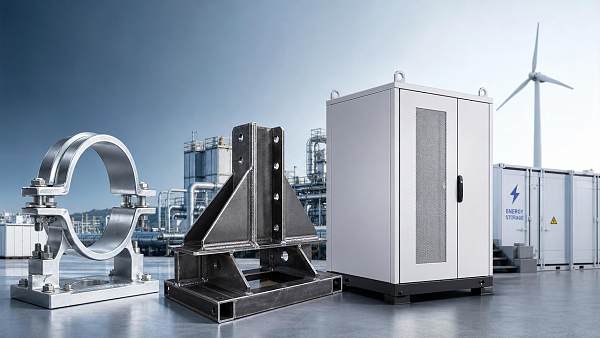
Precision in brackets, skids, housings, support frames, ducts, enclosures, and structural elements protects schedule and performance.
How application scenarios change the value of custom metal fabrication for energy sector projects
Energy is not one operating environment.
Different assets face different loads, chemicals, temperatures, weather patterns, and maintenance realities.
That is why custom metal fabrication for energy sector work should always be judged by scenario, not by unit price alone.
Renewable power sites: weather exposure and modular installation
Solar and wind projects often depend on fast deployment across remote or exposed sites.
Fabricated supports, cabinets, and transition structures must resist corrosion, vibration, and variable loads.
In these cases, custom metal fabrication for energy sector delivery improves pre-fit accuracy and reduces installation delays.
Oil, gas, and thermal plants: pressure, heat, and inspection readiness
Conventional energy facilities face demanding thermal cycles and severe process conditions.
Skids, pipe supports, access platforms, and containment structures require certified welding, tested materials, and documented quality control.
Here, custom metal fabrication for energy sector systems helps maintain code compliance and operating reliability.
Battery and energy storage systems: enclosure integrity and thermal management
Storage projects demand enclosure precision, ventilation planning, and stable structural integration.
Small dimensional errors can affect cable routing, thermal spacing, and service access.
Custom metal fabrication for energy sector enclosures supports safer assembly and cleaner system integration.
Grid and substation upgrades: retrofit accuracy and downtime control
Grid modernization rarely happens on a blank site.
Existing foundations, cable paths, and legacy equipment create exact-fit requirements.
Custom metal fabrication for energy sector retrofits reduces on-site rework and helps keep outage windows under control.
Typical fabrication needs differ sharply by energy scenario
The following comparison shows why one fabrication method rarely suits every energy asset.
What to evaluate before choosing custom metal fabrication for energy sector deployment
A strong decision starts with the operating context, not with the drawing package alone.
Several review points can clarify whether custom metal fabrication for energy sector applications will deliver measurable value.
- Material selection against corrosion, fatigue, pressure, and temperature exposure
- Required tolerances for mating parts, cable management, and equipment interfaces
- Need for NDT, welding procedure qualification, and documentation packages
- Coating systems, galvanizing, or finishing based on field conditions
- Packaging and logistics planning for oversized or remote-site shipments
- Installation sequence and whether assemblies should be modularized
These checks reduce hidden costs that usually appear after fabrication, during installation, testing, or commissioning.
Practical scenario-based recommendations that improve project fit
The best custom metal fabrication for energy sector strategy depends on where risk is highest.
If the site is remote or weather-exposed
- Prioritize corrosion-resistant metals and durable finishing systems
- Use modular fabricated sections for easier transport and faster assembly
- Confirm lifting points and field handling requirements early
If compliance and inspection are dominant concerns
- Request full material traceability and weld documentation
- Align fabrication procedures with project codes before production starts
- Build hold points for dimensional checks and witness inspections
If retrofit timing is critical
- Validate field measurements with digital models where possible
- Split assemblies to match outage windows and access constraints
- Include installation hardware and interface details in the fabrication scope
Common mistakes that weaken custom metal fabrication for energy sector outcomes
The most expensive mistakes often happen before metal is cut.
One common error is treating custom metal fabrication for energy sector work like generic industrial fabrication.
Energy assets usually operate under stricter reliability expectations and harsher service conditions.
Another mistake is underestimating documentation.
Without clear records, even well-made parts can create approval delays or installation questions.
Teams also overlook coating compatibility, access for maintenance, and the effect of transport loads on fabricated assemblies.
In retrofit environments, poor measurement control remains a major source of preventable rework.
Why this topic deserves closer attention across global industrial decision cycles
Across advanced manufacturing, green energy, smart electronics, healthcare technology, and supply chain SaaS, one trend is consistent.
Projects now demand more resilient, traceable, and performance-specific physical infrastructure.
That makes custom metal fabrication for energy sector programs relevant beyond fabrication alone.
It influences procurement planning, supplier qualification, digital quality records, and long-term asset performance strategy.
For organizations tracking industrial competitiveness, fabrication capability is now part of supply chain intelligence.
Next steps for evaluating custom metal fabrication for energy sector priorities
Start by mapping the project scenario clearly.
Define exposure conditions, code requirements, lifecycle expectations, and installation constraints before comparing suppliers or designs.
Then review whether custom metal fabrication for energy sector scope should include prototyping, testing, modularization, or documentation support.
A scenario-led approach improves fit, reduces hidden risk, and protects both budget and operating confidence.
For deeper market insight, technical comparisons, and supply chain evaluation frameworks, TradeNexus Pro provides a high-authority environment built for industrial decision quality.
Get weekly intelligence in your inbox.
No noise. No sponsored content. Pure intelligence.
 Oct 08, 2026How Digital Health Improves Diagnostic Accuracy and Workflow in Clinical LabsHow Digital Health Improves Diagnostic Accuracy and Workflow in Clinical Labs
 Oct 07, 2026Selecting Voice Picking Systems for German Warehouses: Integration, Languages and ROISelecting Voice Picking Systems for German Warehouses: Integration, Languages and ROI
 Oct 06, 2026How to Choose Last Mile Dispatch Software for On-Time Delivery at ScaleHow to Choose Last Mile Dispatch Software for On-Time Delivery at Scale
 Oct 05, 2026Vietnam’s Consumer Electronics Market: Demand Shifts and Sourcing OpportunitiesVietnam’s Consumer Electronics Market: Demand Shifts and Sourcing Opportunities
 Oct 04, 2026Digital Health Investment Priorities for Providers: Improving Access, Outcomes, and EfficiencyDigital Health Investment Priorities for Providers: Improving Access, Outcomes, and Efficiency
 Oct 03, 2026How to Specify an FR4 Custom PCB Board for High-Voltage and High-Heat DesignsHow to Specify an FR4 Custom PCB Board for High-Voltage and High-Heat Designs
 Oct 02, 2026ERP Software Market Intelligence: Adoption, Pricing, and Vendor Signals to WatchERP Software Market Intelligence: Adoption, Pricing, and Vendor Signals to Watch
 Oct 01, 2026How to Select Calibrated Temperature Data Loggers for GMP Cold Storage MonitoringHow to Select Calibrated Temperature Data Loggers for GMP Cold Storage Monitoring
 Sep 30, 2026Custom Molded Rubber Pricing: What Drives Unit Cost and Tooling Fees?Custom Molded Rubber Pricing: What Drives Unit Cost and Tooling Fees?
 Sep 29, 2026How to Evaluate Energy Management Software Vendors for Multi-Site OperationsHow to Evaluate Energy Management Software Vendors for Multi-Site Operations
 Sep 28, 2026How to Select a DIN Rail Smart Meter for Multi-Circuit Energy MonitoringHow to Select a DIN Rail Smart Meter for Multi-Circuit Energy Monitoring
 Sep 27, 2026TWS Earbuds in Vietnam: Demand Drivers, Price Tiers, and Retail Channel OpportunitiesTWS Earbuds in Vietnam: Demand Drivers, Price Tiers, and Retail Channel Opportunities
 Sep 26, 2026How UAE Clinics Can Qualify a Smart Glucometer Supplier for Accuracy and ComplianceHow UAE Clinics Can Qualify a Smart Glucometer Supplier for Accuracy and Compliance
 Sep 25, 2026Buying Aesthetic Lasers in the USA: FDA Status, Wavelengths, and Service SupportBuying Aesthetic Lasers in the USA: FDA Status, Wavelengths, and Service Support
 Sep 24, 2026Laser Cutting Brass Sheet: How to Prevent Burrs and Heat Marks on Thin PartsLaser Cutting Brass Sheet: How to Prevent Burrs and Heat Marks on Thin Parts
 Sep 23, 2026How to Choose Lightweight ANC Headphones for Comfortable All-Day TravelHow to Choose Lightweight ANC Headphones for Comfortable All-Day Travel
 Sep 22, 2026IPX5 TWS Bluetooth Earbuds: What Protection Do They Offer for Workouts?IPX5 TWS Bluetooth Earbuds: What Protection Do They Offer for Workouts?
 Sep 21, 2026What to Look for in a Grid Integration Company for Utility-Scale Solar ProjectsWhat to Look for in a Grid Integration Company for Utility-Scale Solar Projects
 Sep 20, 2026Microgrid Controller Pricing: What Drives Cost in Commercial Energy Projects?Microgrid Controller Pricing: What Drives Cost in Commercial Energy Projects?
 Sep 19, 2026How to Choose a GaN Charger for Laptops Without Compromising Power or PortabilityHow to Choose a GaN Charger for Laptops Without Compromising Power or Portability
 Sep 18, 2026Floating Solar Farm Costs: CAPEX, OPEX, and the Site Factors That Shape ROIFloating Solar Farm Costs: CAPEX, OPEX, and the Site Factors That Shape ROI
 Sep 17, 2026Drone Delivery Solutions for Last-Mile Routes: Site, Payload, and Range PlanningDrone Delivery Solutions for Last-Mile Routes: Site, Payload, and Range Planning
 Sep 16, 2026When Low-Volume Electronics Manufacturing Makes More Sense Than Mass ProductionWhen Low-Volume Electronics Manufacturing Makes More Sense Than Mass Production
 Sep 15, 2026Wholesale WiFi Smart Switches: What Buyers Should Verify Before OrderingWholesale WiFi Smart Switches: What Buyers Should Verify Before Ordering
 Sep 14, 2026How to Select IoT Sensors for Reliable Monitoring in Harsh Industrial EnvironmentsHow to Select IoT Sensors for Reliable Monitoring in Harsh Industrial Environments
 Sep 13, 2026How Procurement Teams Can Improve Supplier Reliability With Supply Chain VisibilityHow Procurement Teams Can Improve Supplier Reliability With Supply Chain Visibility
 Sep 12, 2026Smart Manufacturing Trends 2026: What Leaders Should Prioritize for ROISmart Manufacturing Trends 2026: What Leaders Should Prioritize for ROI



























