What Makes a Reliable Custom PCB Supplier?
Choosing a reliable custom PCB supplier is critical for companies developing custom pcb boards, flexible printed circuits, and integrated medical devices such as portable ultrasound scanners, smart glucometers, digital blood pressure monitors, wearable ECG monitors, telemedicine carts, and remote patient monitoring systems. From SMT assembly services to compliance, scalability, and quality assurance, the right partner can directly influence product performance, procurement efficiency, and long-term business risk.
A reliable custom PCB supplier is not simply the vendor with the lowest quote or the fastest stated lead time. For most buyers, the real question is whether the supplier can consistently deliver the right board quality, documentation, compliance support, production stability, and communication needed to keep a product launch or procurement program on track. Especially in medical electronics, smart devices, and other high-stakes applications, supplier reliability should be evaluated as a combination of engineering capability, manufacturing control, traceability, responsiveness, and long-term partnership value.
What actually makes a custom PCB supplier reliable?
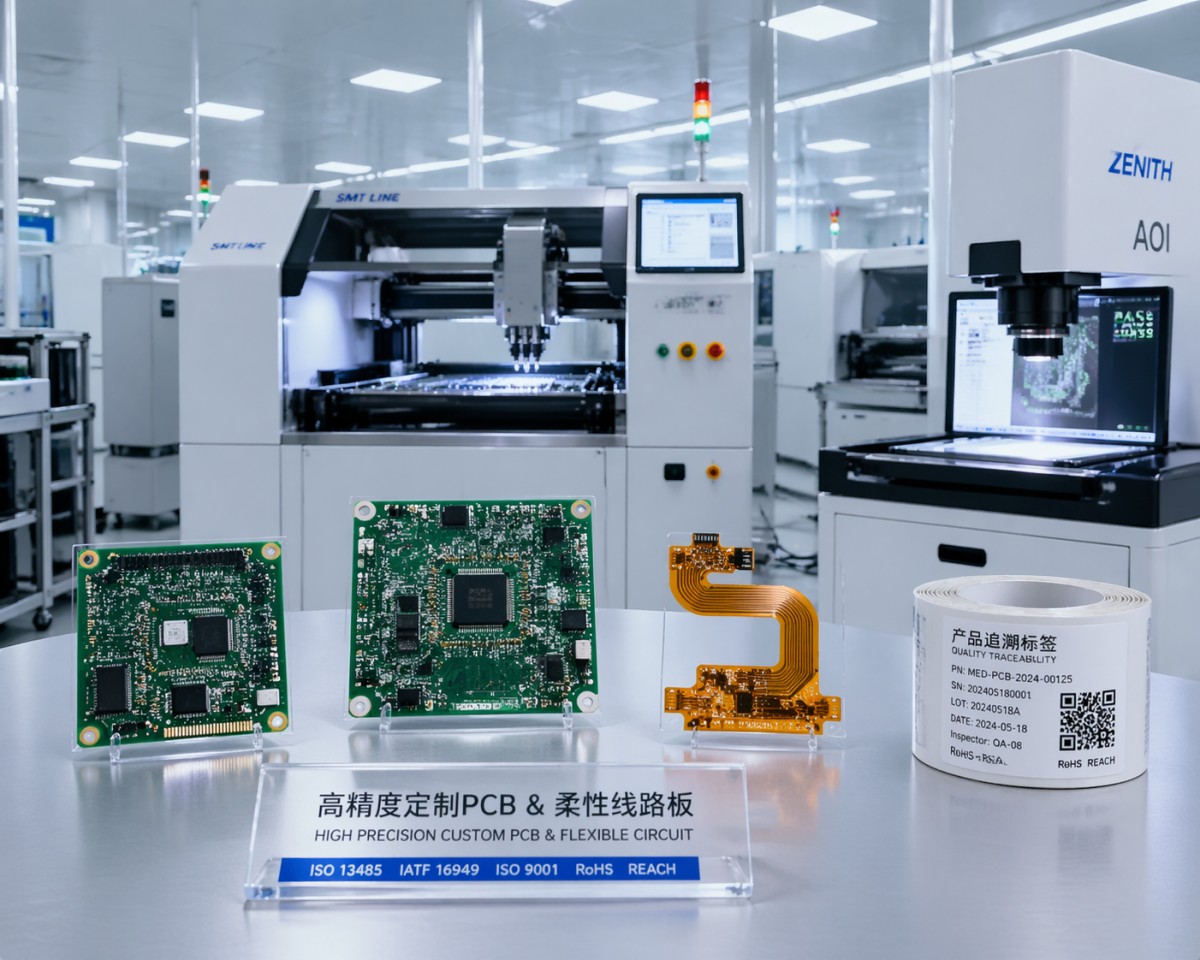
The most reliable suppliers usually perform well across five practical dimensions:
- Technical capability: They can manufacture the board types you actually need, whether that means multilayer custom pcb boards, HDI structures, flexible printed circuits, rigid-flex designs, fine-pitch assembly, or compact layouts for connected healthcare devices.
- Quality consistency: They have stable processes, inspection systems, testing protocols, and documented quality controls rather than depending on manual correction after defects appear.
- Compliance and traceability: They can support material declarations, lot traceability, process records, and industry-specific requirements that matter for regulated or safety-sensitive products.
- Operational dependability: They meet lead times, communicate quickly, handle engineering changes properly, and can scale from prototype to volume production without major process disruption.
- Commercial transparency: Their quotations, DFM feedback, tooling charges, MOQ policies, and change-order handling are clear enough for procurement, finance, and project teams to make sound decisions.
If a supplier is strong in only one area, such as low price or fast prototyping, but weak in engineering support or quality discipline, that supplier may still create delays, hidden costs, or field failures later.
Which supplier risks matter most to buyers and project teams?
Different stakeholders evaluate a custom PCB supplier from different angles, but their concerns often converge around the same operational risks.
Procurement teams usually want pricing stability, realistic lead times, second-source potential, and fewer disruptions. A supplier that frequently revises cost assumptions, misses delivery windows, or lacks material planning discipline can damage purchasing performance even if the unit price looks attractive.
Engineers and operators tend to focus on manufacturability, assembly yield, tolerances, solderability, board flatness, stack-up accuracy, and support during design iterations. If the supplier cannot provide useful DFM or DFT input, teams often discover issues too late.
Quality and safety managers care about process control, failure analysis, incoming quality consistency, and documentation. For medical and connected electronics, traceability and validation support can be just as important as the board itself.
Business evaluators and enterprise decision-makers usually look at broader supplier risk: operational resilience, export capability, account management quality, data security, and whether the supplier is suitable for long-term product roadmaps.
Finance approvers often want confidence that a lower quote will not become a higher total cost through scrap, rework, product delays, warranty exposure, or emergency logistics.
That is why the best supplier evaluation process does not ask only, “Can they make this PCB?” It asks, “Can they make it repeatedly, compliantly, on schedule, and at an acceptable total business risk?”
How do you evaluate technical capability beyond a sales claim?
Many suppliers describe themselves as experienced in custom PCB manufacturing, but reliability becomes clearer when you test specifics. Ask targeted questions tied to your actual application.
For example, if your product includes compact medical electronics or wearable monitoring equipment, you may need support for:
- Fine-pitch SMT assembly services
- Flexible printed circuits or rigid-flex integration
- Miniaturized layouts and dense interconnects
- Low-noise signal handling for sensing devices
- Battery-powered product optimization
- Functional testing support at board level
- Clean handling and controlled processes for sensitive components
A reliable supplier should be able to explain not just whether they can build these boards, but how they control the risks involved. Useful evidence includes stack-up recommendations, impedance control capability, assembly line limits, AOI and X-ray inspection availability, rework criteria, and examples of how they solved similar manufacturing challenges.
Strong suppliers also provide early DFM feedback. This is often one of the clearest signs of reliability. If they review Gerber files, BOM structure, panelization strategy, material choice, and assembly risks before production begins, they reduce the chance of expensive downstream surprises.
Why quality systems and traceability matter more than low price
Low board pricing can be appealing, especially in competitive sourcing environments, but PCB quality failures are often expensive in ways that standard quotations do not show. A cheap board that causes intermittent faults, assembly defects, calibration issues, or premature field failures can quickly erase any savings.
Reliable custom PCB suppliers usually have documented quality systems that include:
- Incoming material inspection
- Process control at fabrication and assembly stages
- AOI, ICT, flying probe, functional testing, or other suitable verification methods
- Nonconformance handling and corrective action procedures
- Lot tracking and production record retention
- Defined acceptance criteria for workmanship and defects
For sectors such as healthcare technology, traceability is especially important. If an issue is discovered in the field, teams need to know which lot, material batch, or process window may be involved. A supplier without solid traceability may create compliance problems, slower investigations, and greater product risk.
In practical sourcing terms, quality maturity reduces total cost by lowering scrap, reducing incoming inspection burden, limiting emergency reorders, and improving product reliability after launch.
What certifications and compliance signals should buyers look for?
Certifications do not guarantee performance on their own, but they are still useful indicators when interpreted correctly. The right compliance profile depends on the end market and product category.
Common areas to review include:
- ISO 9001: A baseline signal for quality management discipline
- ISO 13485: Highly relevant for suppliers serving medical device programs
- IPC standards familiarity: Important for fabrication, assembly, and workmanship expectations
- RoHS and REACH support: Necessary for environmental and market access requirements in many regions
- UL capability or other product-related compliance support: Relevant depending on the application
- Material traceability and declarations: Important for regulated industries and enterprise documentation workflows
Buyers should also verify whether the supplier can provide real supporting documentation rather than simply listing certifications in marketing materials. Ask for certificate status, scope, expiry, process coverage, and examples of routine documentation packages.
If your product will be integrated into portable ultrasound scanners, digital blood pressure monitors, or remote patient monitoring systems, supplier readiness for regulated documentation and process discipline becomes especially important.
Can the supplier scale from prototype to production without disrupting your program?
One of the most common sourcing mistakes is selecting a supplier that is excellent for prototypes but unstable in low-volume or mass production. Reliability includes the ability to support your product through multiple commercial stages.
A strong custom PCB supplier should be able to explain how they manage:
- Prototype turnaround and engineering iteration
- NPI to pilot-run transition
- Volume planning and capacity allocation
- Critical material sourcing and alternates
- ECO and revision control
- Production continuity during demand changes
This matters for product managers and enterprise decision-makers because launch schedules are often harmed not by technical impossibility, but by poor operational scaling. A supplier may produce ten boards successfully, but fail when asked to deliver thousands with consistent yield and documentation.
Ask for examples of customers they have supported from sample stage to recurring production. Also ask what changed operationally during that transition. Their answer will tell you whether scaling is a managed system or an improvised reaction.
How important are communication and project support?
Very important. In real purchasing and manufacturing environments, supplier communication often determines whether problems stay small or become expensive.
Reliable suppliers typically show strong communication habits such as:
- Fast engineering clarification before production starts
- Clear ownership for project management and account support
- Structured updates on lead times and exceptions
- Immediate escalation of quality or material issues
- Accurate documentation for revisions, approvals, and shipment records
This is especially valuable when multiple stakeholders are involved, including engineering, procurement, QA, finance, and external distributors. Good communication reduces decision lag, prevents assumption gaps, and helps cross-functional teams evaluate risk more quickly.
For distributors, agents, and resellers, communication quality also affects customer confidence. If the manufacturer is unresponsive or vague, channel partners are left exposed when end users request updates or corrective action.
What questions should you ask before approving a custom PCB supplier?
A practical supplier review should go beyond general introductions. The following questions help uncover real reliability:
- What board types and assembly processes do you handle in-house, and what is outsourced?
- What are your process limits for layer count, line width, spacing, via structures, materials, and component pitch?
- How do you perform DFM review before release to production?
- What inspection and test methods are standard, and which are optional?
- How do you manage lot traceability, material records, and nonconforming product?
- What certifications are currently active, and what scopes do they cover?
- How do you support prototypes, pilot builds, and production scaling?
- What is your typical response process for engineering changes or urgent supply issues?
- Can you share examples of similar products or industries you support?
- What are the most common causes of delay in your process, and how do you mitigate them?
The quality of the answers matters as much as the answers themselves. Reliable suppliers are usually specific, structured, and transparent. Weak suppliers often answer in broad claims without operational detail.
How should buyers compare suppliers in a more strategic way?
If your team is evaluating multiple options, avoid choosing solely on unit cost. A better approach is to compare suppliers using a weighted scorecard that reflects your business priorities.
Typical categories include:
- Technical fit for the product
- Quality systems and testing capability
- Compliance and traceability readiness
- Lead time performance and capacity
- Communication and project management
- Total cost, including risk-related cost
- Scalability and long-term supply continuity
This approach is particularly useful for procurement personnel, project leaders, and financial approvers because it turns supplier selection into a measurable business decision rather than a subjective impression.
In many cases, the most reliable custom PCB supplier is not the cheapest option upfront, but the one that lowers lifecycle cost, reduces launch risk, and supports steady growth over time.
Conclusion: reliability is a business advantage, not just a manufacturing feature
A reliable custom PCB supplier combines manufacturing competence with quality discipline, compliance readiness, responsive communication, and the ability to scale with your program. For organizations building custom pcb boards, flexible printed circuits, and integrated medical or smart electronic devices, supplier reliability directly affects product quality, regulatory confidence, procurement efficiency, and long-term cost control.
The best way to evaluate a supplier is to look beyond marketing claims and test how well they perform in the areas that matter most: technical capability, process control, traceability, project support, and operational resilience. When those elements are in place, a PCB supplier becomes more than a vendor. They become a practical risk-reduction partner in your product and sourcing strategy.
Get weekly intelligence in your inbox.
No noise. No sponsored content. Pure intelligence.
 Apr 29, 2026USITC Launches Section 337 Investigation into Chinese Wi-Fi 7 RF ModulesUSITC Launches Section 337 Investigation into Chinese Wi-Fi 7 RF Modules
 Apr 29, 2026Côte d'Ivoire Launches $500M Grid Storage Tender, Chinese BESS Fast-TrackedCôte d'Ivoire Launches $500M Grid Storage Tender, Chinese BESS Fast-Tracked
 Apr 29, 2026Morocco Enforces IEC 61427-2:2025 PV Mounting Certification from Q3 2026Morocco Enforces IEC 61427-2:2025 PV Mounting Certification from Q3 2026
 Apr 29, 2026UAE Becomes Global AI Hub: New CE-ADAS+ Path for Chinese Smart Industrial EquipmentUAE Becomes Global AI Hub: New CE-ADAS+ Path for Chinese Smart Industrial Equipment
 Apr 29, 2026Red Sea Crisis: Suez Canal Fees Up 12%, China-Europe Rail Premium at 35%Red Sea Crisis: Suez Canal Fees Up 12%, China-Europe Rail Premium at 35%
 Apr 29, 2026TÜV Rheinland Launches Fast-Track Certification for Chinese Warehouse RobotsTÜV Rheinland Launches Fast-Track Certification for Chinese Warehouse Robots
 Apr 29, 2026Vietnam's SMT Expansion Drives CNC Fixture Export DelaysVietnam's SMT Expansion Drives CNC Fixture Export Delays
![]() Apr 29, 2026NEOM Smart Infrastructure Phase II Opens Bidding: Chinese PV Mounting & BESS Pre-QualifiedNEOM Smart Infrastructure Phase II Opens Bidding: Chinese PV Mounting & BESS Pre-Qualified
Apr 29, 2026NEOM Smart Infrastructure Phase II Opens Bidding: Chinese PV Mounting & BESS Pre-QualifiedNEOM Smart Infrastructure Phase II Opens Bidding: Chinese PV Mounting & BESS Pre-Qualified Apr 29, 2026EU Enforces Battery Passport for Energy Storage Imports from July 2026EU Enforces Battery Passport for Energy Storage Imports from July 2026
 Apr 29, 2026Maine Bans New >20MW Data Centers — AI Hardware Delivery ImpactedMaine Bans New >20MW Data Centers — AI Hardware Delivery Impacted
 Apr 28, 2026Suez Canal Fee Hike & China-Europe Rail Premium: Q2 2026 ImpactSuez Canal Fee Hike & China-Europe Rail Premium: Q2 2026 Impact
 Apr 28, 2026TÜV Rheinland Launches Fast-Track Certification for Chinese Warehouse RobotsTÜV Rheinland Launches Fast-Track Certification for Chinese Warehouse Robots
 Apr 28, 2026EU Enforces Battery Passport Rule for Chinese ESS Exports from 2027EU Enforces Battery Passport Rule for Chinese ESS Exports from 2027
 Apr 28, 2026ADB Raises Vietnam GDP Forecast to 7.2%: SMT & Precision Fixture Demand RisesADB Raises Vietnam GDP Forecast to 7.2%: SMT & Precision Fixture Demand Rises
 Apr 28, 2026US ITC Launches Section 337 Investigation into Chinese Wi-Fi 7 RF FEMsUS ITC Launches Section 337 Investigation into Chinese Wi-Fi 7 RF FEMs
 Apr 28, 2026Côte d'Ivoire Opens $500M Power Tender: Chinese BESS Get Fast-Track AccessCôte d'Ivoire Opens $500M Power Tender: Chinese BESS Get Fast-Track Access
 Apr 28, 2026BP’s Algeria East Basin Permit Spurs Valve Demand, Lead Times Extend to 18 WeeksBP’s Algeria East Basin Permit Spurs Valve Demand, Lead Times Extend to 18 Weeks
") Apr 28, 2026Vietnam Mandates V-Trust for Smart Appliances Export (July 2026)Vietnam Mandates V-Trust for Smart Appliances Export (July 2026)
Apr 28, 2026Vietnam Mandates V-Trust for Smart Appliances Export (July 2026)Vietnam Mandates V-Trust for Smart Appliances Export (July 2026) Apr 28, 2026Morocco Enforces PV Mounting Structure Certification from Q3 2026Morocco Enforces PV Mounting Structure Certification from Q3 2026
 Apr 28, 2026UAE Establishes AI Hub Status, Opens CE-ADAS+ Pathway for Chinese Smart Industrial EquipmentUAE Establishes AI Hub Status, Opens CE-ADAS+ Pathway for Chinese Smart Industrial Equipment
 Apr 27, 2026Algeria’s Oil & Steel FDI Push Opens Valve, Corrosion-Resistant Material OrdersAlgeria’s Oil & Steel FDI Push Opens Valve, Corrosion-Resistant Material Orders
 Apr 27, 2026Azerbaijan’s New PV Mounting Standard Opens Path for Chinese SuppliersAzerbaijan’s New PV Mounting Standard Opens Path for Chinese Suppliers
 Apr 27, 2026Fitch Cuts East Africa Growth Forecasts, Raises Cross-Border Trade RisksFitch Cuts East Africa Growth Forecasts, Raises Cross-Border Trade Risks
 Apr 27, 2026ADB Raises Vietnam GDP Forecast to 7.2% on Electronics Export GrowthADB Raises Vietnam GDP Forecast to 7.2% on Electronics Export Growth
 Apr 27, 2026Maine Halts Large Data Centers: AI Server Export ImpactMaine Halts Large Data Centers: AI Server Export Impact
 Apr 27, 2026OFID $500M for Côte d'Ivoire: Boost to Factory Automation & Warehouse RoboticsOFID $500M for Côte d'Ivoire: Boost to Factory Automation & Warehouse Robotics
 Apr 27, 2026Morocco Ranks 4th in EU Energy Aid to AfricaMorocco Ranks 4th in EU Energy Aid to Africa