Wireless Chargers vs Wired: Is the Convenience Worth It?
Wireless chargers promise cable-free ease, but do they truly outperform wired options in speed, efficiency, and long-term value? For buyers and technical evaluators comparing smart electronics—from wireless chargers and portable monitors to lithium ion batteries and smart thermostats—this analysis breaks down the real trade-offs. Whether you manage procurement, product quality, or business strategy, understanding convenience versus performance is key to making smarter purchasing decisions.
In B2B purchasing, the answer is rarely as simple as “wireless is more modern” or “wired is more practical.” The right charging method depends on use case, power requirement, device compatibility, energy loss, safety controls, and replacement cycle. A charging accessory that works well for a single desk user may perform poorly in hospitality, retail counters, fleet vehicles, or shared office environments.
For procurement teams and project managers, the decision also affects total cost of ownership. Charging speed, accessory failure rates, cable wear, heat generation, and desk-space efficiency all influence long-term value. When evaluated across a 12–36 month deployment window, convenience may be worth paying for in some workflows, but not in all of them.
How Wireless and Wired Charging Actually Differ in Commercial Use
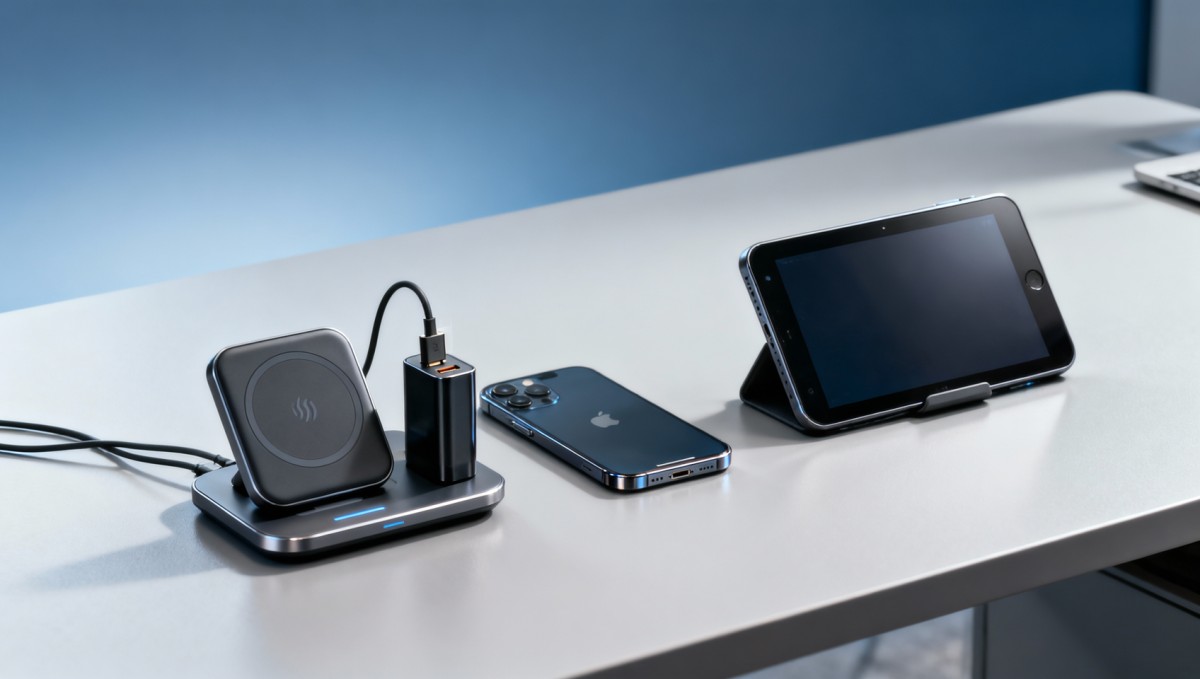
At a technical level, wired charging transfers power through a direct physical connection, usually via USB-C, Lightning, or other standardized ports. Wireless charging relies on inductive power transfer, where energy moves between coils over a very short distance. In practical terms, wired systems usually deliver higher efficiency and more predictable charging behavior, while wireless systems prioritize ease of placement and reduced cable handling.
For most smart electronics deployments, wired charging remains the baseline for performance. Typical wired consumer and prosumer chargers range from 5W to 65W, with some categories going much higher. Wireless chargers in mainstream office and consumer environments often operate at 5W, 7.5W, 10W, or 15W. That gap matters when users expect a battery to recover 50% charge in 30–45 minutes instead of 60–120 minutes.
However, raw wattage is not the only purchasing factor. In reception areas, hotel rooms, conference tables, and shared workstations, the ability to place a phone on a pad without plugging and unplugging a cable can reduce visible clutter and lower connector wear. For facility managers, a cleaner setup can also improve user satisfaction and simplify daily housekeeping routines.
Technical evaluators should also remember that wireless performance depends on alignment, case thickness, thermal control, and protocol compatibility. A rated 15W charger may not consistently deliver 15W in real operating conditions. If the device shifts off-center by a few millimeters, charging speed can drop, and heat may increase during longer sessions.
Core operating differences to assess
- Wired charging usually provides higher power transfer efficiency, often with less energy loss during the charging cycle.
- Wireless charging reduces cable handling, which can be valuable in shared environments with high daily user turnover.
- Wired accessories depend heavily on port durability, while wireless systems depend more on coil alignment and heat management.
- Wireless charging often delivers stronger convenience for phones and earbuds, but less value for high-draw devices such as portable monitors or larger battery systems.
The table below summarizes the most important operational differences for B2B buyers evaluating charger deployment across office, retail, and mixed-use environments.
The main takeaway is straightforward: wireless charging improves interaction simplicity, while wired charging still leads on speed and consistency. In B2B environments, the strongest choice depends on whether user convenience or power performance is the higher-priority requirement.
Speed, Efficiency, and Energy Loss: Where Wired Still Leads
When technical teams compare charging methods, three metrics matter most: delivered power, conversion efficiency, and thermal behavior. Wired charging generally performs better across all three. For many common devices, wired systems can maintain stronger charging speeds over a 20–80% battery window, while wireless systems may reduce output sooner to control heat.
This difference is especially relevant in high-usage environments. If staff rotate devices every 1–2 hours, or if field personnel need rapid top-ups between tasks, slow or inconsistent charging can create workflow bottlenecks. A device that regains only 15–20% battery during a short break may not support another work cycle, whereas a wired fast charger may deliver significantly more usable runtime in the same period.
Energy loss also affects operating cost. Wireless charging commonly produces more conversion loss than wired charging because power moves through magnetic induction and is sensitive to placement. On a single device, the cost difference may look minor. Across 100, 500, or 1,000 deployed endpoints over 24 months, the efficiency gap becomes more visible, especially where charging is frequent and continuous.
Heat is another practical issue. Battery health generally benefits from controlled charging temperatures. If a wireless charger runs hot because of poor ventilation, thick phone cases, or misalignment, battery aging may accelerate. For organizations managing mobile fleets, even a modest reduction in battery lifespan can increase replacement frequency and service calls.
Why charging efficiency matters to buyers
Operational impact
In procurement terms, efficiency is not just an engineering metric. It influences charging time, electricity use, user complaints, and hardware life. A purchasing decision should therefore consider not only product price, but also charge completion rate, expected thermal behavior, and suitability for continuous daily use over 8–12 hour operating windows.
Battery lifecycle impact
Lithium ion batteries are sensitive to repeated heat exposure. While both wired and wireless systems can be designed safely, poor-quality wireless pads or poorly matched charging profiles may increase heat during repeated cycles. For enterprises managing warranty claims or battery replacements, this is a quality-control issue, not just a user preference issue.
The following table provides a practical performance view for evaluation teams comparing everyday charging behavior.
For buyers focused on throughput, uptime, and energy efficiency, wired charging remains the stronger option. Wireless convenience has value, but it rarely replaces wired charging where speed and battery management are critical purchasing criteria.
Where Wireless Charging Delivers Real Business Value
Wireless charging is most valuable when the charging experience itself creates friction. Shared desks, hotel bedside tables, premium meeting rooms, medical carts, reception counters, and customer-facing kiosks all benefit from simpler user interaction. In these settings, saving 5–10 seconds per interaction may look minor, but repeated dozens of times per day, it improves usability and reduces support questions.
There is also a durability argument. In some deployments, cable replacement is a recurring expense. Public or semi-public environments often experience cable fraying, bent connectors, and missing charging leads within 3–9 months. A fixed wireless charging surface can reduce consumable accessory loss and present a cleaner, more premium interface for guests and employees.
Wireless charging can also align with interior design and brand positioning. For smart office furniture, collaborative workspaces, and executive environments, embedded charging pads support a more integrated electronics ecosystem. This matters for enterprises investing in workplace modernization or customer-facing smart electronics where convenience contributes to perceived product quality.
That said, not every environment benefits equally. Wireless charging offers the strongest value when devices are frequently parked on a surface for moderate durations, such as 30 minutes to several hours. It is less suitable when users need precise fast charging, when devices are moved constantly, or when the product category draws more power than typical wireless standards handle efficiently.
Best-fit commercial scenarios
- Conference rooms where multiple visitors need simple charging access without cable compatibility issues.
- Hospitality spaces where visual cleanliness and guest convenience support brand perception.
- Reception areas and lounges where devices are often placed down for 20–60 minutes.
- Executive desks and premium office installations where clutter reduction is part of facility design goals.
Use wireless when convenience is the KPI
If the priority is seamless access, low cable handling, and premium workspace integration, wireless charging is often worth the premium. This is especially true in environments where user satisfaction, aesthetics, and accessory management matter as much as charging speed.
Use wired when uptime is the KPI
If the priority is operational continuity, battery turnaround, or compatibility with multiple smart electronics categories, wired charging remains the safer default. For many businesses, the most practical answer is not either-or, but a mixed deployment strategy.
Procurement Checklist: What Buyers Should Compare Before Approving a Deployment
For sourcing teams, evaluating chargers only by unit price is a common mistake. A more reliable comparison includes at least 6 dimensions: charging power, protocol compatibility, thermal control, installation format, replacement frequency, and expected user behavior. These factors influence not only product selection, but also support workload and long-term operating cost.
Technical assessment should begin with device mapping. Count how many devices are phone-class products, how many use USB-C power delivery, how many remain stationary during charging, and how many need fast turnaround. A deployment of 50 fixed desk phones is different from a 200-user hot-desking office or a field-service fleet charging in short intervals.
Quality and safety managers should also review materials, enclosure temperature behavior, foreign object detection where applicable, and the consistency of charging under standard cases and normal room temperatures. Even without citing proprietary test labs, procurement teams can require internal validation over a 7-day to 14-day pilot cycle before scaling to larger volumes.
Commercial evaluators should then compare deployment cost over 1 year, 2 years, and 3 years. This includes not only hardware cost, but cable replacements, desk modifications, support requests, and downtime caused by poor charging performance. In many cases, the lowest upfront option is not the lowest total-cost option.
Suggested B2B evaluation matrix
The matrix below can help procurement, engineering, and finance teams align on a shared decision framework before issuing a purchase order or requesting a pilot batch.
A structured evaluation prevents overbuying convenience where it adds little value, and underbuying performance where uptime matters. For many organizations, a hybrid policy—wireless in shared spaces, wired in task-critical zones—produces the most balanced outcome.
Common Buying Mistakes, Implementation Risks, and Practical FAQ
One of the most common mistakes is assuming that all wireless chargers offer the same experience. In reality, charging quality can vary based on coil design, thermal protection, surface materials, and compatibility with different phone ecosystems. Another mistake is comparing chargers only by labeled wattage, without testing whether that power is sustained in real daily conditions.
A second risk is ignoring environment. Chargers installed in enclosed furniture, under direct sunlight, or in poorly ventilated counters may behave differently from test-bench conditions. This matters for quality teams because a deployment that works well in a 22°C office may show thermal slowdown in warmer locations or in heavy-duty customer-facing use.
A third mistake is deploying one charging standard across all smart electronics. Portable monitors, handheld scanners, phones, earbuds, and battery-powered accessories do not always share the same power and charging pattern. Mixed-device environments often require at least 2 charging formats to avoid bottlenecks and user frustration.
Below are several practical questions that frequently arise during sourcing, pilot testing, and rollout planning.
Is wireless charging worth the added cost for enterprise buyers?
It can be, especially in hospitality, premium office design, and public-access charging points. If reduced cable replacement, better aesthetics, and easier user interaction produce measurable value over 12–24 months, the premium is justified. If speed and device turnaround are the main KPIs, wired charging usually delivers better return.
Which devices should stay on wired charging?
Devices with larger batteries, higher power draw, or frequent rapid-charge needs should generally remain wired. This often includes portable monitors, tablets, service tools, and electronics used in shift-based operations. Wired charging is also preferable where workers have only 15–30 minute charging windows.
How long should a pilot test last before full procurement?
A practical pilot usually runs 7–14 days for office use and 14–30 days for high-traffic or public-facing environments. During the pilot, track charge completion, user complaints, surface temperature trends, cable replacement events, and compatibility exceptions. Even a small test group of 10–20 units can reveal deployment risks early.
What is the most practical selection strategy today?
For many B2B buyers, the best strategy is layered deployment: wireless chargers for convenience-driven zones and wired chargers for performance-driven workflows. This approach balances user experience, battery management, and purchasing discipline without forcing one charging model onto every use case.
Wireless chargers are not a universal upgrade over wired solutions. They are a targeted convenience tool that performs best in the right environment, with the right devices, and under the right operating assumptions. Wired charging still leads in speed, efficiency, and broad compatibility, while wireless charging creates real value in shared, design-focused, and cable-sensitive spaces.
For procurement leaders, engineers, quality teams, and business decision-makers, the smartest choice is to match charging method to operational need rather than trend appeal. If you are evaluating smart electronics sourcing, rollout planning, or accessory standardization across multiple device categories, TradeNexus Pro can help you compare options with greater clarity. Contact us to discuss your application, request a tailored assessment, or explore more sourcing-focused technology insights.
Get weekly intelligence in your inbox.
No noise. No sponsored content. Pure intelligence.
 Apr 29, 2026USITC Launches Section 337 Investigation into Chinese Wi-Fi 7 RF ModulesUSITC Launches Section 337 Investigation into Chinese Wi-Fi 7 RF Modules
 Apr 29, 2026Côte d'Ivoire Launches $500M Grid Storage Tender, Chinese BESS Fast-TrackedCôte d'Ivoire Launches $500M Grid Storage Tender, Chinese BESS Fast-Tracked
 Apr 29, 2026Morocco Enforces IEC 61427-2:2025 PV Mounting Certification from Q3 2026Morocco Enforces IEC 61427-2:2025 PV Mounting Certification from Q3 2026
 Apr 29, 2026UAE Becomes Global AI Hub: New CE-ADAS+ Path for Chinese Smart Industrial EquipmentUAE Becomes Global AI Hub: New CE-ADAS+ Path for Chinese Smart Industrial Equipment
 Apr 29, 2026Red Sea Crisis: Suez Canal Fees Up 12%, China-Europe Rail Premium at 35%Red Sea Crisis: Suez Canal Fees Up 12%, China-Europe Rail Premium at 35%
 Apr 29, 2026TÜV Rheinland Launches Fast-Track Certification for Chinese Warehouse RobotsTÜV Rheinland Launches Fast-Track Certification for Chinese Warehouse Robots
 Apr 29, 2026Vietnam's SMT Expansion Drives CNC Fixture Export DelaysVietnam's SMT Expansion Drives CNC Fixture Export Delays
![]() Apr 29, 2026NEOM Smart Infrastructure Phase II Opens Bidding: Chinese PV Mounting & BESS Pre-QualifiedNEOM Smart Infrastructure Phase II Opens Bidding: Chinese PV Mounting & BESS Pre-Qualified
Apr 29, 2026NEOM Smart Infrastructure Phase II Opens Bidding: Chinese PV Mounting & BESS Pre-QualifiedNEOM Smart Infrastructure Phase II Opens Bidding: Chinese PV Mounting & BESS Pre-Qualified Apr 29, 2026EU Enforces Battery Passport for Energy Storage Imports from July 2026EU Enforces Battery Passport for Energy Storage Imports from July 2026
 Apr 29, 2026Maine Bans New >20MW Data Centers — AI Hardware Delivery ImpactedMaine Bans New >20MW Data Centers — AI Hardware Delivery Impacted
 Apr 28, 2026Suez Canal Fee Hike & China-Europe Rail Premium: Q2 2026 ImpactSuez Canal Fee Hike & China-Europe Rail Premium: Q2 2026 Impact
 Apr 28, 2026TÜV Rheinland Launches Fast-Track Certification for Chinese Warehouse RobotsTÜV Rheinland Launches Fast-Track Certification for Chinese Warehouse Robots
 Apr 28, 2026EU Enforces Battery Passport Rule for Chinese ESS Exports from 2027EU Enforces Battery Passport Rule for Chinese ESS Exports from 2027
 Apr 28, 2026ADB Raises Vietnam GDP Forecast to 7.2%: SMT & Precision Fixture Demand RisesADB Raises Vietnam GDP Forecast to 7.2%: SMT & Precision Fixture Demand Rises
 Apr 28, 2026US ITC Launches Section 337 Investigation into Chinese Wi-Fi 7 RF FEMsUS ITC Launches Section 337 Investigation into Chinese Wi-Fi 7 RF FEMs
 Apr 28, 2026Côte d'Ivoire Opens $500M Power Tender: Chinese BESS Get Fast-Track AccessCôte d'Ivoire Opens $500M Power Tender: Chinese BESS Get Fast-Track Access
 Apr 28, 2026BP’s Algeria East Basin Permit Spurs Valve Demand, Lead Times Extend to 18 WeeksBP’s Algeria East Basin Permit Spurs Valve Demand, Lead Times Extend to 18 Weeks
") Apr 28, 2026Vietnam Mandates V-Trust for Smart Appliances Export (July 2026)Vietnam Mandates V-Trust for Smart Appliances Export (July 2026)
Apr 28, 2026Vietnam Mandates V-Trust for Smart Appliances Export (July 2026)Vietnam Mandates V-Trust for Smart Appliances Export (July 2026) Apr 28, 2026Morocco Enforces PV Mounting Structure Certification from Q3 2026Morocco Enforces PV Mounting Structure Certification from Q3 2026
 Apr 28, 2026UAE Establishes AI Hub Status, Opens CE-ADAS+ Pathway for Chinese Smart Industrial EquipmentUAE Establishes AI Hub Status, Opens CE-ADAS+ Pathway for Chinese Smart Industrial Equipment
 Apr 27, 2026Algeria’s Oil & Steel FDI Push Opens Valve, Corrosion-Resistant Material OrdersAlgeria’s Oil & Steel FDI Push Opens Valve, Corrosion-Resistant Material Orders
 Apr 27, 2026Azerbaijan’s New PV Mounting Standard Opens Path for Chinese SuppliersAzerbaijan’s New PV Mounting Standard Opens Path for Chinese Suppliers
 Apr 27, 2026Fitch Cuts East Africa Growth Forecasts, Raises Cross-Border Trade RisksFitch Cuts East Africa Growth Forecasts, Raises Cross-Border Trade Risks
 Apr 27, 2026ADB Raises Vietnam GDP Forecast to 7.2% on Electronics Export GrowthADB Raises Vietnam GDP Forecast to 7.2% on Electronics Export Growth
 Apr 27, 2026Maine Halts Large Data Centers: AI Server Export ImpactMaine Halts Large Data Centers: AI Server Export Impact
 Apr 27, 2026OFID $500M for Côte d'Ivoire: Boost to Factory Automation & Warehouse RoboticsOFID $500M for Côte d'Ivoire: Boost to Factory Automation & Warehouse Robotics
 Apr 27, 2026Morocco Ranks 4th in EU Energy Aid to AfricaMorocco Ranks 4th in EU Energy Aid to Africa