Are Smart Pet Feeders Reliable When You Travel Often
When travel is frequent, many users and buyers ask whether smart pet feeders can truly deliver consistent feeding, remote control, and fail-safe performance. For technical evaluators, procurement teams, and decision-makers comparing automatic pet water fountains, indoor drone cameras, and other connected devices, reliability is more than convenience—it is a product quality, safety, and long-term value question worth examining closely.
What does reliability really mean for a smart pet feeder?
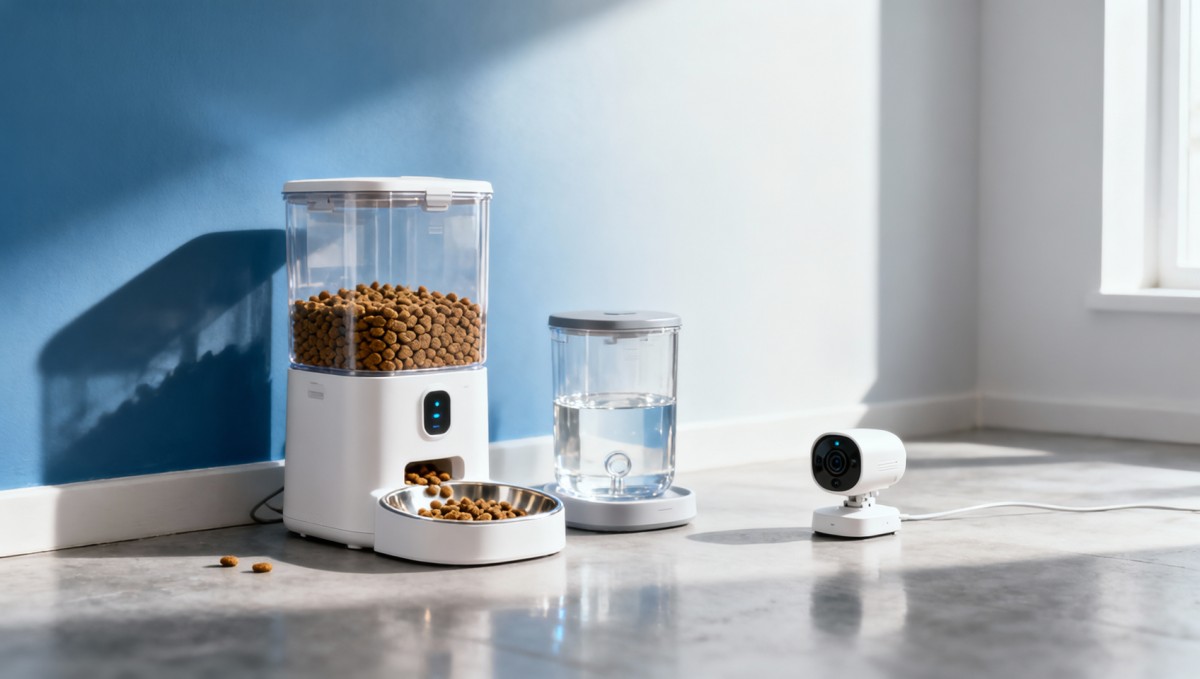
A reliable smart pet feeder is not simply a device that dispenses food on schedule once or twice. In practical use, reliability means stable operation over 7–30 days of unattended use, accurate portion release, resilient network behavior, safe materials, and predictable recovery after power or app interruptions. For households and distributors alike, that definition is much closer to a risk-control framework than a convenience feature list.
This matters because travel use creates a harsher operating condition than daily home use. A feeder may need to run through multiple cycles per day, maintain app connectivity across time zones, and avoid jamming when dry kibble varies in size. If one missed meal can trigger animal welfare concerns, the buyer should evaluate the product as a semi-critical connected appliance rather than a gadget.
In the broader smart electronics category, smart pet feeders sit at the intersection of motor control, sensor logic, food-contact safety, and cloud-based remote access. That makes them relevant not only to end users but also to technical assessment teams, quality managers, and sourcing professionals reviewing device consistency, replacement rates, and support burden over a 12–24 month lifecycle.
For B2B buyers, the first mistake is treating all automatic feeders as functionally similar. They are not. Entry-level products may rely on simple timer logic, while stronger models combine local scheduling, anti-jam structure, desiccant protection, and backup battery operation. Reliability often depends less on marketing labels and more on architecture choices that are visible only in the technical review stage.
The 4 dimensions buyers should test first
- Feeding accuracy: verify whether scheduled portions remain consistent across 10–20 consecutive dispensing cycles and across different kibble diameters.
- Operational continuity: check performance during Wi-Fi loss, power fluctuation, and app logout events, especially for trips lasting several days.
- Mechanical stability: inspect auger, impeller, chute angle, lid lock, and anti-clog design because jams are a primary real-world failure mode.
- Service readiness: confirm spare parts policy, firmware update cadence, and after-sales response window, often 24–72 hours in better supplier programs.
For readers using TradeNexus Pro as a sourcing and intelligence reference, the key advantage is not generic product browsing. It is the ability to compare connected device categories through a procurement lens: failure points, supply continuity, compliance exposure, and support practicality. That approach helps buyers avoid decisions based only on app screenshots and promotional claims.
Which technical features make a smart pet feeder dependable during travel?
The strongest indicator of dependable travel performance is local schedule retention. If the feeder can continue dispensing based on stored settings even when the internet is unavailable for 12–48 hours, it has a much higher reliability profile than cloud-dependent devices. Remote control is useful, but local autonomy is what protects feeding continuity.
Power resilience is the second core factor. Models with battery backup, whether disposable cells or rechargeable support, can bridge short outages and prevent missed feeding events. Buyers should not assume backup power covers full operation indefinitely. A practical review should confirm whether the battery supports dispensing only, Wi-Fi only, or both, and for how many cycles.
Mechanical design is equally important. Dry kibble differs in oil level, shape, and diameter, so a feeder that works with 6–8 mm pellets may perform differently with 10–12 mm or irregular shapes. Anti-blockage geometry, hopper sealing, and motor torque should be reviewed together. In many field complaints, feeding errors are caused by food variation rather than electronic failure alone.
From a technical evaluation standpoint, materials and hygiene matter too. Food-contact parts should be easy to disassemble and clean every 1–2 weeks in normal use, or before and after a travel period. If cleaning is difficult, residue buildup can degrade sensor behavior, attract moisture, and gradually reduce reliability even when the electronics are intact.
Key technical checkpoints for travel-focused feeder assessment
The table below helps technical evaluators and procurement teams compare the most practical feeder reliability indicators before approving samples or volume orders.
These checks are especially relevant for travel scenarios because reliability failures often happen as combined events: a small power issue, a network delay, and a mechanical clog occurring within the same 24-hour period. A feeder does not need advanced branding to be dependable, but it does need layered safeguards.
Useful review questions for engineering and QA teams
- Can the device complete 3–6 scheduled meals per day without cloud access?
- Does the app send a missed-dispense alert or only a schedule reminder?
- Are food-contact components removable without tools for routine cleaning?
- Is firmware updating optional, controlled, and documented for support teams?
For distributors and resellers, these details also influence return rates. Products that appear attractive in demos but fail under variable food conditions create expensive service loops. In connected home categories, reliability claims should always be validated through scenario testing rather than feature counting.
How do smart pet feeders compare with adjacent connected pet devices?
Buyers often evaluate smart pet feeders alongside automatic pet water fountains and indoor monitoring cameras because all three are common travel-use devices. However, they solve different risks. A feeder addresses schedule continuity and portion control. A water fountain addresses hydration freshness and circulation. A camera provides visibility, not physical care. The most dependable travel setup often combines 2–3 devices rather than relying on one.
The comparison is important for commercial buyers building product bundles or category strategies. A smart pet feeder with poor local autonomy may underperform, even if paired with an excellent camera. Conversely, a stable feeder plus simple monitoring may satisfy many users who travel for short 2–5 day periods and prioritize lower support complexity.
From a merchandising and procurement perspective, adjacent devices also differ in maintenance expectations. Water systems may require more frequent cleaning every few days, while feeders demand stronger anti-clog design and portion repeatability. Cameras emphasize network stability and image latency. That means reliability metrics should be category-specific.
For business evaluators, the practical question is not which device is smartest. It is which combination lowers customer anxiety, minimizes support tickets, and maintains acceptable total ownership cost over the first 6–12 months after purchase.
Travel-use comparison across common smart pet devices
The following table can support category managers and buyers comparing smart pet feeders with related connected products in travel scenarios.
This comparison shows why a smart pet feeder should be judged by execution reliability, not by app richness alone. A video feed can confirm a problem, but it cannot correct a failed feeding event. For travel-heavy users, feeding continuity remains the most operationally sensitive requirement.
When a feeder is the right choice
- You need scheduled nutrition control rather than simple observation.
- The travel pattern is repetitive, such as weekly trips or 2–4 day absences each month.
- You need evidence-based procurement criteria for a connected consumer device category.
TradeNexus Pro helps this kind of comparison by framing smart pet feeders inside the larger smart electronics and supply chain context. That perspective is useful when buyers must compare not just product features, but service burden, sourcing risk, and portfolio fit across connected device lines.
What should procurement teams and decision-makers check before buying?
Procurement should begin with scenario definition, not catalog filtering. A travel-use smart pet feeder for one cat in a stable apartment differs from a feeder intended for multi-pet use, reseller distribution, or premium retail positioning. Before sample approval, teams should identify 3 core variables: trip length, feeding frequency, and acceptable intervention level from a remote caregiver.
Once the use profile is clear, buyers should move to a structured review covering hardware, software, compliance, service, and commercial terms. In many purchasing cycles, the smartest step is a 2-stage selection: first shortlist 3–5 suppliers on technical fit, then validate 1–2 through operational sample testing over 14–21 days. This avoids paying for broad trials on unsuitable products.
Finance approvers usually focus on unit price, but the more meaningful measure is cost of failure. A lower-cost feeder with higher return probability can consume margin through replacements, customer support, and reputation loss. For distributors and retailers, a small difference in defect handling time—say 48 hours versus 5 business days—can materially change post-sale workload.
Quality and safety managers should also review basic compliance suitability for the destination market. Although specific requirements vary, common areas include electrical safety, EMC expectations, food-contact material suitability, labeling completeness, battery handling, and user instructions. For connected products, data privacy and app maintenance transparency are increasingly relevant in cross-border sales.
A practical selection checklist for smart pet feeder procurement
- Confirm feeding range: how many meals per day, what portion increments, and what kibble size range are supported in routine use.
- Review failure handling: whether the feeder stores schedules locally, sends exception alerts, and resumes correctly after outage recovery.
- Check maintenance burden: how long cleaning takes, how often desiccant or filters need replacement, and whether operators need tools.
- Assess support terms: spare part availability, firmware support window, sample lead time, and after-sales communication process.
- Validate commercial fit: MOQ, packaging readiness, localization, documentation, and realistic delivery windows such as 2–6 weeks depending on order size.
Common buying mistakes
One common mistake is prioritizing camera integration or voice recording over dispensing stability. Those features may improve user experience, but they do not compensate for poor mechanical consistency. Another mistake is skipping food compatibility testing. A smart pet feeder can perform well with one dry formula and fail with another because of shape, surface oil, or crumb level.
A third mistake is ignoring service design. If replacement parts, troubleshooting instructions, and app update notes are unclear, even a technically acceptable device can become difficult to support at scale. For B2B buyers, operational friction often emerges after launch, not during the initial product demo.
This is where a platform like TradeNexus Pro adds practical value. Instead of treating procurement as a one-time price exercise, TNP supports a more strategic review of supplier maturity, connected device risk, and cross-sector sourcing intelligence that matters to enterprise buyers and channel partners.
FAQ: the most important questions about smart pet feeder reliability
Search intent around smart pet feeders usually centers on one question: can the device be trusted when no one is home? The answer depends on design depth, maintenance discipline, and purchase criteria. The following questions summarize the issues buyers ask most often.
Can a smart pet feeder work if Wi-Fi goes down?
Some can, some cannot. The more dependable smart pet feeder stores its feeding schedule locally and continues for at least the planned cycles even when Wi-Fi is unavailable. Buyers should request an offline behavior check or test it directly for 24 hours. If the feeder needs cloud access to trigger every meal, travel reliability is weaker.
How long can a smart pet feeder be left unattended?
That depends on hopper capacity, meal frequency, food type, and local environment. In practical terms, buyers should evaluate unattended use in three bands: 1–2 days, 3–5 days, and 6–7 days. Capacity alone is not enough. Moisture exposure, clog risk, and power stability all influence whether the feeder remains dependable through the full travel window.
Are smart pet feeders safer than asking someone to feed the pet manually?
For routine, measured feeding, a well-designed smart pet feeder can reduce inconsistency. It dispenses on schedule and avoids missed visits caused by human delays. However, it does not replace all care tasks. For longer trips, many users combine a feeder, water solution, and periodic human check. Procurement teams should position the device as controlled feeding support, not total care substitution.
What is the best way to test reliability before purchase or rollout?
Use a 3-step test: first, run 10–20 dispensing cycles with the intended kibble; second, simulate a power or Wi-Fi interruption; third, check cleaning and reassembly time. If the device passes all three with stable results, it is far more likely to succeed in travel use. This process is especially useful for channel buyers assessing multiple connected pet devices.
Why consult TradeNexus Pro before selecting smart pet feeders?
Selecting a smart pet feeder is no longer a simple consumer electronics decision. It touches product engineering, sourcing continuity, service design, and risk management. TradeNexus Pro supports buyers, technical evaluators, distributors, and decision-makers who need more than surface-level product descriptions. Our value is in structured intelligence, clearer comparison logic, and market-relevant evaluation criteria.
For teams exploring smart pet feeders, automatic pet water fountains, or related connected home products, TNP can help frame the decision around practical business questions: which specifications matter most, what failure points deserve sample testing, how lead times typically vary, and how to compare supply-side options without losing sight of quality and service implications.
If you are planning sourcing, category expansion, or technical evaluation, contact TradeNexus Pro to discuss parameter confirmation, product selection logic, expected delivery windows, compliance considerations, sample review priorities, and quotation communication. This is especially useful when you need to balance travel-use reliability, cost discipline, and scalable support expectations in one purchasing decision.
A better smart pet feeder decision starts with better questions. TNP helps you ask them early—before purchase errors turn into service issues, avoidable returns, or weak portfolio performance.
Get weekly intelligence in your inbox.
No noise. No sponsored content. Pure intelligence.
 Apr 29, 2026USITC Launches Section 337 Investigation into Chinese Wi-Fi 7 RF ModulesUSITC Launches Section 337 Investigation into Chinese Wi-Fi 7 RF Modules
 Apr 29, 2026Côte d'Ivoire Launches $500M Grid Storage Tender, Chinese BESS Fast-TrackedCôte d'Ivoire Launches $500M Grid Storage Tender, Chinese BESS Fast-Tracked
 Apr 29, 2026Morocco Enforces IEC 61427-2:2025 PV Mounting Certification from Q3 2026Morocco Enforces IEC 61427-2:2025 PV Mounting Certification from Q3 2026
 Apr 29, 2026UAE Becomes Global AI Hub: New CE-ADAS+ Path for Chinese Smart Industrial EquipmentUAE Becomes Global AI Hub: New CE-ADAS+ Path for Chinese Smart Industrial Equipment
 Apr 29, 2026Red Sea Crisis: Suez Canal Fees Up 12%, China-Europe Rail Premium at 35%Red Sea Crisis: Suez Canal Fees Up 12%, China-Europe Rail Premium at 35%
 Apr 29, 2026TÜV Rheinland Launches Fast-Track Certification for Chinese Warehouse RobotsTÜV Rheinland Launches Fast-Track Certification for Chinese Warehouse Robots
 Apr 29, 2026Vietnam's SMT Expansion Drives CNC Fixture Export DelaysVietnam's SMT Expansion Drives CNC Fixture Export Delays
![]() Apr 29, 2026NEOM Smart Infrastructure Phase II Opens Bidding: Chinese PV Mounting & BESS Pre-QualifiedNEOM Smart Infrastructure Phase II Opens Bidding: Chinese PV Mounting & BESS Pre-Qualified
Apr 29, 2026NEOM Smart Infrastructure Phase II Opens Bidding: Chinese PV Mounting & BESS Pre-QualifiedNEOM Smart Infrastructure Phase II Opens Bidding: Chinese PV Mounting & BESS Pre-Qualified Apr 29, 2026EU Enforces Battery Passport for Energy Storage Imports from July 2026EU Enforces Battery Passport for Energy Storage Imports from July 2026
 Apr 29, 2026Maine Bans New >20MW Data Centers — AI Hardware Delivery ImpactedMaine Bans New >20MW Data Centers — AI Hardware Delivery Impacted
 Apr 28, 2026Suez Canal Fee Hike & China-Europe Rail Premium: Q2 2026 ImpactSuez Canal Fee Hike & China-Europe Rail Premium: Q2 2026 Impact
 Apr 28, 2026TÜV Rheinland Launches Fast-Track Certification for Chinese Warehouse RobotsTÜV Rheinland Launches Fast-Track Certification for Chinese Warehouse Robots
 Apr 28, 2026EU Enforces Battery Passport Rule for Chinese ESS Exports from 2027EU Enforces Battery Passport Rule for Chinese ESS Exports from 2027
 Apr 28, 2026ADB Raises Vietnam GDP Forecast to 7.2%: SMT & Precision Fixture Demand RisesADB Raises Vietnam GDP Forecast to 7.2%: SMT & Precision Fixture Demand Rises
 Apr 28, 2026US ITC Launches Section 337 Investigation into Chinese Wi-Fi 7 RF FEMsUS ITC Launches Section 337 Investigation into Chinese Wi-Fi 7 RF FEMs
 Apr 28, 2026Côte d'Ivoire Opens $500M Power Tender: Chinese BESS Get Fast-Track AccessCôte d'Ivoire Opens $500M Power Tender: Chinese BESS Get Fast-Track Access
 Apr 28, 2026BP’s Algeria East Basin Permit Spurs Valve Demand, Lead Times Extend to 18 WeeksBP’s Algeria East Basin Permit Spurs Valve Demand, Lead Times Extend to 18 Weeks
") Apr 28, 2026Vietnam Mandates V-Trust for Smart Appliances Export (July 2026)Vietnam Mandates V-Trust for Smart Appliances Export (July 2026)
Apr 28, 2026Vietnam Mandates V-Trust for Smart Appliances Export (July 2026)Vietnam Mandates V-Trust for Smart Appliances Export (July 2026) Apr 28, 2026Morocco Enforces PV Mounting Structure Certification from Q3 2026Morocco Enforces PV Mounting Structure Certification from Q3 2026
 Apr 28, 2026UAE Establishes AI Hub Status, Opens CE-ADAS+ Pathway for Chinese Smart Industrial EquipmentUAE Establishes AI Hub Status, Opens CE-ADAS+ Pathway for Chinese Smart Industrial Equipment
 Apr 27, 2026Algeria’s Oil & Steel FDI Push Opens Valve, Corrosion-Resistant Material OrdersAlgeria’s Oil & Steel FDI Push Opens Valve, Corrosion-Resistant Material Orders
 Apr 27, 2026Azerbaijan’s New PV Mounting Standard Opens Path for Chinese SuppliersAzerbaijan’s New PV Mounting Standard Opens Path for Chinese Suppliers
 Apr 27, 2026Fitch Cuts East Africa Growth Forecasts, Raises Cross-Border Trade RisksFitch Cuts East Africa Growth Forecasts, Raises Cross-Border Trade Risks
 Apr 27, 2026ADB Raises Vietnam GDP Forecast to 7.2% on Electronics Export GrowthADB Raises Vietnam GDP Forecast to 7.2% on Electronics Export Growth
 Apr 27, 2026Maine Halts Large Data Centers: AI Server Export ImpactMaine Halts Large Data Centers: AI Server Export Impact
 Apr 27, 2026OFID $500M for Côte d'Ivoire: Boost to Factory Automation & Warehouse RoboticsOFID $500M for Côte d'Ivoire: Boost to Factory Automation & Warehouse Robotics
 Apr 27, 2026Morocco Ranks 4th in EU Energy Aid to AfricaMorocco Ranks 4th in EU Energy Aid to Africa