Automatic Pet Water Fountain Problems to Avoid Early
Automatic pet water fountains can improve hydration and convenience, but early design, hygiene, and maintenance problems often lead to leaks, pump failure, noise, or unsafe water quality. For buyers comparing automatic pet water fountains and related smart pet feeders, understanding these risks upfront helps users, procurement teams, and technical evaluators make safer, more cost-effective decisions.
Why do automatic pet water fountain problems appear so early?
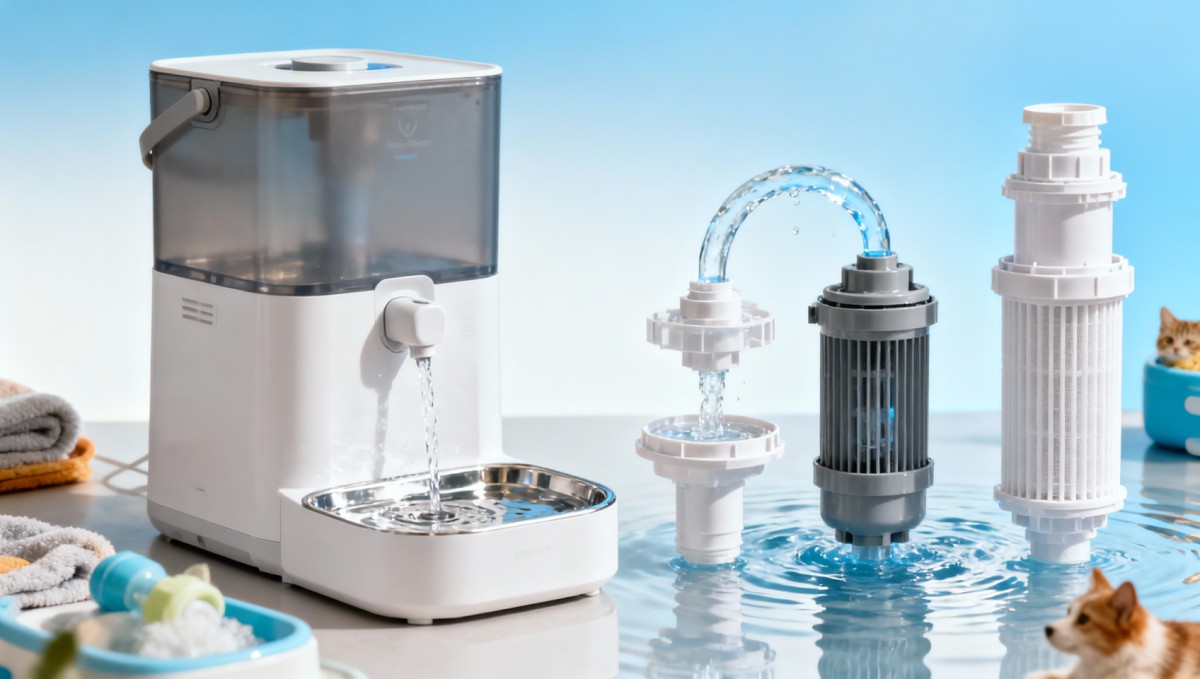
Many automatic pet water fountain problems do not begin after years of use. They often show up within the first 2–8 weeks, especially when the unit is placed in a dusty room, used by multiple pets, or installed without a stable cleaning routine. In B2B sourcing and product evaluation, this early failure window is critical because it reveals weaknesses in design, assembly tolerance, and material selection.
For operators and end users, the most visible signs are unusual pump noise, weak water flow, frequent refilling, and slippery biofilm buildup. For procurement teams, early issues create a wider cost problem: returns, replacement inventory, customer complaints, and higher after-sales handling. For quality and safety reviewers, poor fountain hygiene can become a product risk rather than a convenience feature.
In the broader smart electronics and consumer product supply chain, automatic pet water fountains sit at the intersection of plastics, low-voltage pumps, filters, sensors, and packaging quality. A low-cost component mismatch in any one of these areas can affect the whole unit. This is why technical assessment should not stop at appearance, capacity, or price per unit.
TradeNexus Pro helps decision-makers look beyond surface listings by comparing supplier depth, component maturity, maintenance burden, and likely field failure points. That approach matters when distributors, retailers, and sourcing managers need products that perform reliably over 3–6 months of regular household use, not just during pre-shipment inspection.
The 4 earliest failure categories to check
- Water circulation failure caused by weak pumps, clogged impellers, or poor debris filtration.
- Leakage around the tank body, pump cable exit, or poorly seated seals after repeated disassembly.
- Hygiene degradation from difficult-to-clean corners, fast slime formation, or ineffective filter structure.
- Noise and user dissatisfaction from vibration, low water level sensitivity, or unstable placement on smooth floors.
Which design and technical flaws should buyers screen first?
When evaluating automatic pet water fountains, technical reviewers should start with the parts most likely to fail under daily use. These include the pump, cable routing, filter housing, water tray geometry, and reservoir joining points. A unit that looks refined on a listing page may still hide weak snap-fits, thin plastic walls, or inaccessible cleaning zones.
Pump structure is usually the first checkpoint. In many entry-level fountains, the pump loses flow after 7–14 days if pet hair, food particles, or mineral residue enter the impeller chamber. A removable pump cover, accessible rotor, and clear cleaning steps reduce field problems significantly. Technical buyers should request exploded views or maintenance diagrams before confirming supplier suitability.
Material choice also matters. Thin plastic bodies may warp under warm water cleaning, while poorly molded seams can create hidden residue lines. Stainless steel contact surfaces are often easier to sanitize than full-plastic basins, but the total design still matters. If the underside, corners, or lid channels trap water, even a metal top surface will not solve hygiene concerns.
Another overlooked issue is filter architecture. A charcoal pad alone does not equal strong filtration. Buyers should review whether the fountain uses 2-stage or 3-stage filtration, how often filters need replacement, and whether replacement packs are standardized. If consumables are hard to source after 30–90 days, the user experience and lifetime value drop quickly.
Practical screening checklist for technical evaluators
Before approving a supplier or product line, many teams use a short technical screening matrix. The table below highlights the most common early-risk points and the review questions that matter during sourcing, pilot testing, and channel distribution planning.
This kind of matrix is useful across sourcing and commercial roles because it translates product complaints into measurable review points. It also helps distributors compare two similar automatic pet water fountains that appear equal in photos but differ sharply in maintenance burden and return risk.
What technical details often get missed?
- Cable routing that creates a capillary path for slow leakage after repeated washing.
- Low water level operation that increases noise and shortens pump life within a few cleaning cycles.
- Filter cartridges with inconsistent fit, causing bypass flow instead of real filtration.
- Water basins that look smooth but have narrow underside ribs that trap residue in 5–10 cleaning sessions.
How should procurement teams compare automatic pet water fountain options?
Procurement teams should avoid selecting automatic pet water fountains on unit cost alone. A lower landed price may lead to higher total cost once consumables, replacement pumps, service tickets, and customer dissatisfaction are considered. In private label, distribution, and retail procurement, the smarter benchmark is usually 12-month operating cost rather than the initial invoice value.
The most practical comparison framework uses 5 dimensions: build quality, cleaning complexity, consumable dependency, operating noise, and after-sales burden. This matters for finance approvers and business evaluators because a product with frequent filter confusion or pump complaints can erode margin even if the gross purchase price looks attractive in the first quotation round.
For sourcing managers handling multiple SKUs, it is also useful to classify fountains by user environment. A single-cat household, a two-pet apartment, and a small pet boarding setting do not place the same demands on water volume, cleaning frequency, or wear rate. Product-market fit reduces returns more effectively than generic feature inflation.
TradeNexus Pro supports this stage by helping teams interpret supplier claims in commercial context. Rather than comparing only brochure features, buyers can align specifications with channel strategy, replacement planning, and realistic usage conditions across different regions and distribution models.
Comparison table for sourcing and channel decisions
The table below gives a practical procurement view of common fountain configurations. It is designed for buyers, distributors, and project teams that need to compare product suitability, not just feature lists.
A useful sourcing takeaway is that the “best” fountain depends on channel economics and user maintenance behavior. A technically advanced unit can still underperform if the replacement filter supply chain is unstable or if setup is too complex for typical users.
5 procurement questions worth asking suppliers
- What is the recommended cleaning interval in normal household use: every 3 days, weekly, or every 2 weeks?
- Can the pump be opened and cleaned without tools in under 5 minutes?
- How often do filters need replacement under light and heavy usage conditions?
- Are replacement pumps and filters available for at least one routine sales cycle?
- Which materials are in direct water contact, and how are they cleaned safely?
What hygiene, compliance, and safety issues should not be ignored?
Not every automatic pet water fountain problem is mechanical. Some of the most serious issues relate to hygiene and product safety. If stagnant water, residue retention, or poor cleaning design is ignored, a fountain can become a contamination source rather than a hydration aid. This is especially important for quality teams, safety reviewers, and enterprise buyers evaluating import risk.
A practical review starts with food-contact material suitability, low-voltage electrical safety, and cleaning instructions. While exact compliance requirements vary by destination market, buyers should still expect consistent labeling, material declarations where applicable, and clear use conditions. A product that lacks basic care instructions may generate misuse complaints within the first 30 days.
Water quality also depends on user behavior. Even a well-designed fountain may need cleaning every 3–7 days in homes with shedding pets, heavy dust, or food contamination nearby. Filters often need replacement on a regular cycle such as every 2–4 weeks, depending on water hardness and usage intensity. If the product is marketed without these expectations, complaint rates usually rise.
For distributors and brand owners, the safest approach is to align product selection with realistic instructions, consumable support, and service documentation. TradeNexus Pro is valuable here because it helps teams connect technical product review with market-entry planning, reducing the gap between sourcing assumptions and field performance.
Key risk areas for quality control and market readiness
- Material-contact risk: verify whether water-contact parts are presented as suitable for repeated use and routine cleaning.
- Electrical risk: confirm safe low-voltage operation, cable insulation integrity, and stable adapter matching where supplied.
- Instruction risk: review whether setup, cleaning, filter replacement, and dry-run avoidance are clearly documented.
- After-sales risk: check availability of spare filters and pumps over a standard selling period.
Common misconceptions that create avoidable failures
One common misconception is that moving water always means clean water. In reality, circulation helps, but it does not eliminate the need for frequent basin cleaning and filter replacement. Another misunderstanding is that a quiet pump equals a healthy pump. In some cases, a pump becomes quieter right before flow weakens because debris is obstructing movement.
A third misconception is that larger capacity automatically means lower maintenance. A bigger tank can lengthen refill time, but if users delay cleaning, biofilm and residue may spread across a larger internal surface. For this reason, operating guidance should always balance water capacity with realistic cleaning intervals and household conditions.
How can teams reduce risk before ordering, launching, or distributing?
Risk reduction starts before the purchase order. Whether you are a distributor, brand manager, or procurement lead, it is wise to run a structured pre-launch review. A practical process can be completed in 4 steps over 2–4 weeks: specification review, sample test, consumable verification, and channel-fit assessment. This prevents avoidable surprises after listing or retail placement.
During sample testing, users should not focus only on first-day appearance. They should simulate actual use by running the fountain continuously, pausing refills, exposing it to pet hair, and repeating cleaning cycles. Even 7–10 days of routine simulation can reveal whether a pump clogs easily, whether seals loosen after washing, and whether the basin traps residue.
Commercial teams should also verify support items early. A good fountain program includes clear replacement filter packs, simple user instructions, and spare part continuity. Without these elements, even a technically acceptable unit may fail in the market because service friction becomes too high for sellers, agents, or end users.
For decision-makers operating across smart electronics, consumer accessories, and cross-border supply chains, TradeNexus Pro offers a practical advantage: it connects product evaluation with supplier intelligence, category trends, and market positioning. That helps teams avoid isolated buying decisions and instead build a more resilient product selection strategy.
Recommended pre-order workflow
The following workflow is useful when comparing automatic pet water fountains for private label, retail assortment, or distribution rollout. It keeps technical, commercial, and operational review in one framework.
This workflow reduces the chance of selecting a fountain that looks competitive on paper but underperforms in actual use. It also helps finance and management teams understand why low visible cost can still mean high operational risk.
FAQ and next-step guidance for serious buyers
Automatic pet water fountain sourcing often involves mixed priorities: user convenience, product reliability, compliance readiness, and margin control. The questions below reflect common search and purchasing concerns from operators, evaluators, and decision-makers handling pet care product selection.
How often should an automatic pet water fountain be cleaned?
A practical range is every 3–7 days for routine basin cleaning, with faster cleaning needed in dusty homes, multi-pet use, or hard-water areas. Pump cleaning may be needed weekly or biweekly depending on hair and residue levels. If a supplier promotes longer intervals without explaining conditions, buyers should review the claim carefully.
What should procurement teams prioritize: low unit price or lower maintenance burden?
In most B2B scenarios, lower maintenance burden creates better long-term value. A fountain that costs slightly more but uses stable filters, opens easily for cleaning, and generates fewer complaints often delivers a better total-cost outcome over 6–12 months. This is especially true for distributors and retailers managing returns and customer support.
Are smart pet feeders and water fountains evaluated the same way?
They overlap, but not completely. Both require review of plastics, electronics, user cleaning behavior, and spare part continuity. However, automatic pet water fountains need more attention on pump durability, water hygiene, and leak prevention, while smart feeders require closer focus on portion control, jam resistance, and food-safe storage design.
What is the safest way to compare suppliers before placing a larger order?
Use a side-by-side framework covering 3 categories: technical structure, consumable continuity, and post-sale support burden. Request samples, run at least one 7–10 day use simulation, and confirm replacement filter and pump availability. Comparing only appearance, app functions, or first quotation pricing is not enough for reliable channel planning.
Why choose us for product intelligence and sourcing evaluation support?
TradeNexus Pro is built for teams that need more than general product summaries. We help buyers, technical evaluators, and commercial leaders assess automatic pet water fountain risks through a wider B2B lens: component maturity, supplier positioning, maintenance implications, category trends, and channel-fit logic. This is especially useful when pet care products intersect with smart electronics sourcing and multi-market distribution.
If you are comparing automatic pet water fountains or related smart pet feeders, you can contact TradeNexus Pro for support on parameter confirmation, sourcing benchmarks, supplier shortlisting, delivery-cycle expectations, replacement consumable planning, certification-oriented review, sample evaluation checkpoints, and quotation comparison. That makes the buying process clearer for procurement, finance, quality, and project teams alike.
Get weekly intelligence in your inbox.
No noise. No sponsored content. Pure intelligence.
 Apr 29, 2026USITC Launches Section 337 Investigation into Chinese Wi-Fi 7 RF ModulesUSITC Launches Section 337 Investigation into Chinese Wi-Fi 7 RF Modules
 Apr 29, 2026Côte d'Ivoire Launches $500M Grid Storage Tender, Chinese BESS Fast-TrackedCôte d'Ivoire Launches $500M Grid Storage Tender, Chinese BESS Fast-Tracked
 Apr 29, 2026Morocco Enforces IEC 61427-2:2025 PV Mounting Certification from Q3 2026Morocco Enforces IEC 61427-2:2025 PV Mounting Certification from Q3 2026
 Apr 29, 2026UAE Becomes Global AI Hub: New CE-ADAS+ Path for Chinese Smart Industrial EquipmentUAE Becomes Global AI Hub: New CE-ADAS+ Path for Chinese Smart Industrial Equipment
 Apr 29, 2026Red Sea Crisis: Suez Canal Fees Up 12%, China-Europe Rail Premium at 35%Red Sea Crisis: Suez Canal Fees Up 12%, China-Europe Rail Premium at 35%
 Apr 29, 2026TÜV Rheinland Launches Fast-Track Certification for Chinese Warehouse RobotsTÜV Rheinland Launches Fast-Track Certification for Chinese Warehouse Robots
 Apr 29, 2026Vietnam's SMT Expansion Drives CNC Fixture Export DelaysVietnam's SMT Expansion Drives CNC Fixture Export Delays
![]() Apr 29, 2026NEOM Smart Infrastructure Phase II Opens Bidding: Chinese PV Mounting & BESS Pre-QualifiedNEOM Smart Infrastructure Phase II Opens Bidding: Chinese PV Mounting & BESS Pre-Qualified
Apr 29, 2026NEOM Smart Infrastructure Phase II Opens Bidding: Chinese PV Mounting & BESS Pre-QualifiedNEOM Smart Infrastructure Phase II Opens Bidding: Chinese PV Mounting & BESS Pre-Qualified Apr 29, 2026EU Enforces Battery Passport for Energy Storage Imports from July 2026EU Enforces Battery Passport for Energy Storage Imports from July 2026
 Apr 29, 2026Maine Bans New >20MW Data Centers — AI Hardware Delivery ImpactedMaine Bans New >20MW Data Centers — AI Hardware Delivery Impacted
 Apr 28, 2026Suez Canal Fee Hike & China-Europe Rail Premium: Q2 2026 ImpactSuez Canal Fee Hike & China-Europe Rail Premium: Q2 2026 Impact
 Apr 28, 2026TÜV Rheinland Launches Fast-Track Certification for Chinese Warehouse RobotsTÜV Rheinland Launches Fast-Track Certification for Chinese Warehouse Robots
 Apr 28, 2026EU Enforces Battery Passport Rule for Chinese ESS Exports from 2027EU Enforces Battery Passport Rule for Chinese ESS Exports from 2027
 Apr 28, 2026ADB Raises Vietnam GDP Forecast to 7.2%: SMT & Precision Fixture Demand RisesADB Raises Vietnam GDP Forecast to 7.2%: SMT & Precision Fixture Demand Rises
 Apr 28, 2026US ITC Launches Section 337 Investigation into Chinese Wi-Fi 7 RF FEMsUS ITC Launches Section 337 Investigation into Chinese Wi-Fi 7 RF FEMs
 Apr 28, 2026Côte d'Ivoire Opens $500M Power Tender: Chinese BESS Get Fast-Track AccessCôte d'Ivoire Opens $500M Power Tender: Chinese BESS Get Fast-Track Access
 Apr 28, 2026BP’s Algeria East Basin Permit Spurs Valve Demand, Lead Times Extend to 18 WeeksBP’s Algeria East Basin Permit Spurs Valve Demand, Lead Times Extend to 18 Weeks
") Apr 28, 2026Vietnam Mandates V-Trust for Smart Appliances Export (July 2026)Vietnam Mandates V-Trust for Smart Appliances Export (July 2026)
Apr 28, 2026Vietnam Mandates V-Trust for Smart Appliances Export (July 2026)Vietnam Mandates V-Trust for Smart Appliances Export (July 2026) Apr 28, 2026Morocco Enforces PV Mounting Structure Certification from Q3 2026Morocco Enforces PV Mounting Structure Certification from Q3 2026
 Apr 28, 2026UAE Establishes AI Hub Status, Opens CE-ADAS+ Pathway for Chinese Smart Industrial EquipmentUAE Establishes AI Hub Status, Opens CE-ADAS+ Pathway for Chinese Smart Industrial Equipment
 Apr 27, 2026Algeria’s Oil & Steel FDI Push Opens Valve, Corrosion-Resistant Material OrdersAlgeria’s Oil & Steel FDI Push Opens Valve, Corrosion-Resistant Material Orders
 Apr 27, 2026Azerbaijan’s New PV Mounting Standard Opens Path for Chinese SuppliersAzerbaijan’s New PV Mounting Standard Opens Path for Chinese Suppliers
 Apr 27, 2026Fitch Cuts East Africa Growth Forecasts, Raises Cross-Border Trade RisksFitch Cuts East Africa Growth Forecasts, Raises Cross-Border Trade Risks
 Apr 27, 2026ADB Raises Vietnam GDP Forecast to 7.2% on Electronics Export GrowthADB Raises Vietnam GDP Forecast to 7.2% on Electronics Export Growth
 Apr 27, 2026Maine Halts Large Data Centers: AI Server Export ImpactMaine Halts Large Data Centers: AI Server Export Impact
 Apr 27, 2026OFID $500M for Côte d'Ivoire: Boost to Factory Automation & Warehouse RoboticsOFID $500M for Côte d'Ivoire: Boost to Factory Automation & Warehouse Robotics
 Apr 27, 2026Morocco Ranks 4th in EU Energy Aid to AfricaMorocco Ranks 4th in EU Energy Aid to Africa