Smart Pet Feeders What Distributors Should Check First
As demand grows for smart pet feeders and automatic pet water fountains, distributors need to evaluate more than price and packaging. From app stability and feeding accuracy to compliance, supply continuity, and after-sales support, the first checkpoints can determine long-term market success. This guide outlines what distributors should verify before adding smart pet feeders to their product portfolio.
For most distributors, the first priority is not finding the cheapest smart pet feeder. It is identifying whether a product can be sold, supported, and scaled with acceptable risk. In practice, that means checking product reliability, regulatory compliance, software stability, refill and replacement support, manufacturing consistency, and supplier responsiveness before discussing volume discounts. A smart pet feeder that looks competitive on paper can quickly become a return-heavy, reputation-damaging SKU if these basics are weak.
What should distributors check first before listing a smart pet feeder?
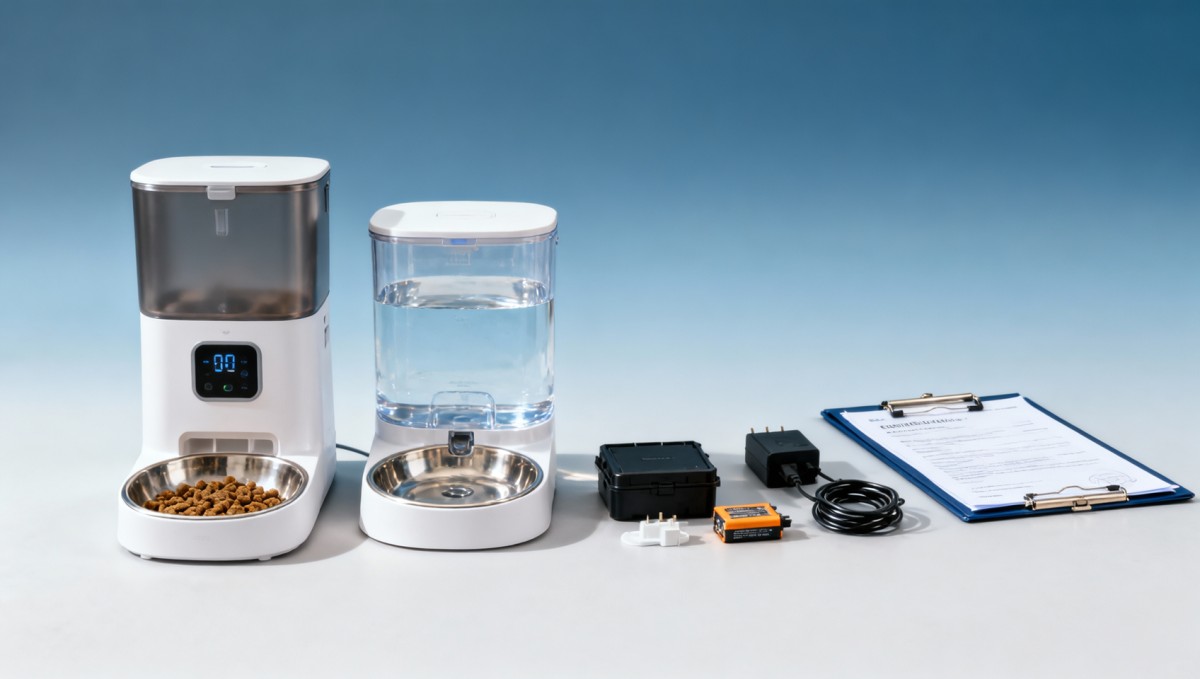
The fastest way to assess a smart pet feeder is to review five areas in this order:
- Core product performance: feeding accuracy, anti-jam design, power backup, and portion consistency.
- App and connectivity stability: Wi-Fi pairing, notification reliability, firmware support, and data privacy handling.
- Compliance and safety: electrical safety, food-contact materials, wireless certifications, and labeling readiness for target markets.
- Supply continuity: factory capacity, component sourcing, lead times, and quality consistency across batches.
- After-sales structure: spare parts, warranty response, troubleshooting materials, and return management.
If a supplier cannot provide clear answers in these five areas, the risk level is already high. For distributors, this early-screening method saves time and prevents downstream issues with retailers, e-commerce platforms, and end customers.
Why product reliability matters more than headline features
Many smart pet feeders compete on attractive functions such as app scheduling, voice recording, camera integration, or multi-pet feeding presets. But for distribution partners, the commercial value of these features depends on whether the device performs consistently in real homes.
The most important hardware checks include:
- Portion accuracy: Does the dispenser release the programmed amount consistently across different kibble sizes?
- Jam resistance: Is the mechanism tested with oily, irregular, or larger pellets?
- Power resilience: Does the feeder continue basic operation during outages through battery backup?
- Seal and freshness: Does the storage design protect food from moisture and contamination?
- Cleaning practicality: Are food-contact parts easy to remove, wash, and reassemble?
Distributors should request internal test results, defect-rate history, and, if possible, sample units for real-use trials. A feeder that works in a controlled demo but struggles after several weeks of use can create expensive returns and poor channel feedback.
How important are app stability and smart functions for distributor success?
They are critical. In smart pet products, hardware defects are only one source of failure. App instability is often the bigger commercial problem because it directly affects user trust. If scheduled feeding does not sync properly, notifications arrive late, or pairing fails during setup, customer reviews can drop quickly.
Distributors should verify:
- Whether the feeder supports stable connection in key target markets
- How often firmware updates are released
- Whether the supplier maintains its own app or depends on a third-party white-label platform
- What happens if cloud services are interrupted
- Whether core feeding functions still work offline
- How user data is stored and protected
This is especially important for distributors serving organized retail, established marketplaces, or brand-sensitive sales channels. A smart pet feeder is no longer just a plastic appliance; it is a connected product whose software quality affects brand reputation and repeat purchase rates.
Which compliance and safety documents should be verified early?
For importers, distributors, and brand partners, compliance should be checked before commercial commitment, not after purchase planning. Requirements vary by market, but the following areas are commonly relevant:
- Electrical safety certifications
- EMC and wireless compliance
- Food-contact material declarations
- Battery transport and safety documentation
- RoHS, REACH, or equivalent environmental compliance where applicable
- Instruction manual, labeling, and packaging conformity
Distributors should not rely only on certificate screenshots. Ask for certificate numbers, issuing bodies, test scope, model references, and consistency between certified models and the exact SKU being purchased. For smart electronics, mismatches between certified samples and mass-produced versions can become a serious legal and financial issue.
How can distributors evaluate supplier quality beyond the product sample?
A good sample is not enough. What matters is whether the supplier can deliver stable quality at scale. This is where many distribution projects fail. The first sample may perform well, while later shipments show inconsistency in motors, sensors, plastic molding, adapters, or app modules.
Key supplier assessment points include:
- Factory audit status: Does the manufacturer have documented quality systems and process controls?
- Incoming component control: How are motors, PCBs, sensors, and power modules inspected?
- Production testing: Is each unit tested for dispensing, connectivity, and power function?
- Traceability: Can batches be tracked if field issues appear?
- Corrective action capability: How quickly does the supplier respond to quality claims?
For distributors managing multiple channels, it is also wise to ask about annual output, peak-season capacity, and dependency on single-source electronic components. Smart pet feeders may appear simple, but their bill of materials can be sensitive to electronics supply fluctuations.
What commercial risks should distributors assess before placing volume orders?
Before moving from test order to scale, distributors should evaluate the full business case, not only unit price. The most relevant questions are:
- What is the expected return rate for this product category?
- How much customer support does setup require?
- What is the actual landed cost after certification, warranty, spare parts, and replacement stock?
- Can the supplier support private label, localized manuals, and packaging adaptation?
- Is there channel conflict risk if the factory also sells directly into the same market?
A low-cost model with weak support can become more expensive than a higher-priced feeder with stable firmware, lower return rates, and better documentation. For procurement teams and finance approvers, this total-cost perspective is more useful than comparing ex-works prices alone.
Why after-sales support can determine long-term market performance
After-sales capability is often underestimated during sourcing. Yet in connected pet devices, support quality directly affects product ratings, retailer confidence, and repeat business. End users may need help with pairing, scheduling, cleaning, descaling, firmware updates, or troubleshooting jam alerts.
Distributors should check whether the supplier can provide:
- Clear troubleshooting guides
- Localized user manuals
- Training materials for channel partners or customer service teams
- Spare parts availability
- Defined warranty terms and replacement procedures
- Fast technical response for escalated cases
This matters even more when selling alongside automatic pet water fountains, since buyers often expect a reliable ecosystem of connected pet care products rather than one-off devices. Suppliers that can support a broader category strategy usually create stronger long-term distributor value.
A practical distributor checklist for smart pet feeder sourcing
Before approving a new supplier or SKU, distributors can use this simplified checklist:
- Test feeding accuracy across multiple kibble types.
- Confirm anti-jam performance and offline functionality.
- Review app ownership, update frequency, and cloud dependence.
- Verify compliance documents for the exact model ordered.
- Request quality-control process details and batch traceability.
- Check production capacity and critical component sourcing stability.
- Review warranty, spare parts, and technical support commitments.
- Assess total landed cost, expected return burden, and margin realism.
- Clarify branding rights, channel policy, and market exclusivity if needed.
- Run a pilot order before full-scale rollout.
This approach gives procurement, quality, technical, and business teams a shared basis for decision-making. It also reduces the chance of choosing a product that performs well in marketing materials but poorly in the field.
Conclusion: the best first check is commercial viability backed by technical proof
When evaluating smart pet feeders, distributors should start with one central question: can this product be sold and supported reliably in our target market? The answer depends on more than design and price. It requires proof of dispensing accuracy, app stability, compliance readiness, production consistency, and after-sales execution.
In a fast-growing market for smart pet feeders and automatic pet water fountains, the strongest distributor advantage comes from disciplined early verification. Products that pass these first checks are more likely to deliver lower returns, better customer reviews, stronger channel confidence, and healthier long-term margins.
Get weekly intelligence in your inbox.
No noise. No sponsored content. Pure intelligence.
 Apr 29, 2026USITC Launches Section 337 Investigation into Chinese Wi-Fi 7 RF ModulesUSITC Launches Section 337 Investigation into Chinese Wi-Fi 7 RF Modules
 Apr 29, 2026Côte d'Ivoire Launches $500M Grid Storage Tender, Chinese BESS Fast-TrackedCôte d'Ivoire Launches $500M Grid Storage Tender, Chinese BESS Fast-Tracked
 Apr 29, 2026Morocco Enforces IEC 61427-2:2025 PV Mounting Certification from Q3 2026Morocco Enforces IEC 61427-2:2025 PV Mounting Certification from Q3 2026
 Apr 29, 2026UAE Becomes Global AI Hub: New CE-ADAS+ Path for Chinese Smart Industrial EquipmentUAE Becomes Global AI Hub: New CE-ADAS+ Path for Chinese Smart Industrial Equipment
 Apr 29, 2026Red Sea Crisis: Suez Canal Fees Up 12%, China-Europe Rail Premium at 35%Red Sea Crisis: Suez Canal Fees Up 12%, China-Europe Rail Premium at 35%
 Apr 29, 2026TÜV Rheinland Launches Fast-Track Certification for Chinese Warehouse RobotsTÜV Rheinland Launches Fast-Track Certification for Chinese Warehouse Robots
 Apr 29, 2026Vietnam's SMT Expansion Drives CNC Fixture Export DelaysVietnam's SMT Expansion Drives CNC Fixture Export Delays
![]() Apr 29, 2026NEOM Smart Infrastructure Phase II Opens Bidding: Chinese PV Mounting & BESS Pre-QualifiedNEOM Smart Infrastructure Phase II Opens Bidding: Chinese PV Mounting & BESS Pre-Qualified
Apr 29, 2026NEOM Smart Infrastructure Phase II Opens Bidding: Chinese PV Mounting & BESS Pre-QualifiedNEOM Smart Infrastructure Phase II Opens Bidding: Chinese PV Mounting & BESS Pre-Qualified Apr 29, 2026EU Enforces Battery Passport for Energy Storage Imports from July 2026EU Enforces Battery Passport for Energy Storage Imports from July 2026
 Apr 29, 2026Maine Bans New >20MW Data Centers — AI Hardware Delivery ImpactedMaine Bans New >20MW Data Centers — AI Hardware Delivery Impacted
 Apr 28, 2026Suez Canal Fee Hike & China-Europe Rail Premium: Q2 2026 ImpactSuez Canal Fee Hike & China-Europe Rail Premium: Q2 2026 Impact
 Apr 28, 2026TÜV Rheinland Launches Fast-Track Certification for Chinese Warehouse RobotsTÜV Rheinland Launches Fast-Track Certification for Chinese Warehouse Robots
 Apr 28, 2026EU Enforces Battery Passport Rule for Chinese ESS Exports from 2027EU Enforces Battery Passport Rule for Chinese ESS Exports from 2027
 Apr 28, 2026ADB Raises Vietnam GDP Forecast to 7.2%: SMT & Precision Fixture Demand RisesADB Raises Vietnam GDP Forecast to 7.2%: SMT & Precision Fixture Demand Rises
 Apr 28, 2026US ITC Launches Section 337 Investigation into Chinese Wi-Fi 7 RF FEMsUS ITC Launches Section 337 Investigation into Chinese Wi-Fi 7 RF FEMs
 Apr 28, 2026Côte d'Ivoire Opens $500M Power Tender: Chinese BESS Get Fast-Track AccessCôte d'Ivoire Opens $500M Power Tender: Chinese BESS Get Fast-Track Access
 Apr 28, 2026BP’s Algeria East Basin Permit Spurs Valve Demand, Lead Times Extend to 18 WeeksBP’s Algeria East Basin Permit Spurs Valve Demand, Lead Times Extend to 18 Weeks
") Apr 28, 2026Vietnam Mandates V-Trust for Smart Appliances Export (July 2026)Vietnam Mandates V-Trust for Smart Appliances Export (July 2026)
Apr 28, 2026Vietnam Mandates V-Trust for Smart Appliances Export (July 2026)Vietnam Mandates V-Trust for Smart Appliances Export (July 2026) Apr 28, 2026Morocco Enforces PV Mounting Structure Certification from Q3 2026Morocco Enforces PV Mounting Structure Certification from Q3 2026
 Apr 28, 2026UAE Establishes AI Hub Status, Opens CE-ADAS+ Pathway for Chinese Smart Industrial EquipmentUAE Establishes AI Hub Status, Opens CE-ADAS+ Pathway for Chinese Smart Industrial Equipment
 Apr 27, 2026Algeria’s Oil & Steel FDI Push Opens Valve, Corrosion-Resistant Material OrdersAlgeria’s Oil & Steel FDI Push Opens Valve, Corrosion-Resistant Material Orders
 Apr 27, 2026Azerbaijan’s New PV Mounting Standard Opens Path for Chinese SuppliersAzerbaijan’s New PV Mounting Standard Opens Path for Chinese Suppliers
 Apr 27, 2026Fitch Cuts East Africa Growth Forecasts, Raises Cross-Border Trade RisksFitch Cuts East Africa Growth Forecasts, Raises Cross-Border Trade Risks
 Apr 27, 2026ADB Raises Vietnam GDP Forecast to 7.2% on Electronics Export GrowthADB Raises Vietnam GDP Forecast to 7.2% on Electronics Export Growth
 Apr 27, 2026Maine Halts Large Data Centers: AI Server Export ImpactMaine Halts Large Data Centers: AI Server Export Impact
 Apr 27, 2026OFID $500M for Côte d'Ivoire: Boost to Factory Automation & Warehouse RoboticsOFID $500M for Côte d'Ivoire: Boost to Factory Automation & Warehouse Robotics
 Apr 27, 2026Morocco Ranks 4th in EU Energy Aid to AfricaMorocco Ranks 4th in EU Energy Aid to Africa