When Predictive Maintenance Sensors Save More Than Scheduled Service
For business evaluators weighing asset strategy, predictive maintenance sensors often create savings that scheduled service alone cannot reach. The reason is simple: calendar-based maintenance reduces some risk, but it does not tell you which asset is actually drifting toward failure, which machine is healthy enough to keep running, or where hidden inefficiencies are already eroding margin. Sensor-based maintenance closes that gap with condition data.
For companies managing critical equipment, the real financial case is rarely just “fewer repairs.” It is lower unplanned downtime, better labor allocation, reduced spare-parts waste, fewer quality defects, longer asset life, and less revenue disruption across operations and supply commitments. For evaluators comparing investment options, that broader value matters more than the sensor hardware itself.
This article focuses on the question decision-makers actually need answered: when do predictive maintenance sensors save more than scheduled service, and how should a business evaluate the return? Rather than treating predictive maintenance as a generic Industry 4.0 trend, we will look at where the economics work, where they do not, and how to judge fit by asset criticality, failure mode, operating context, and measurable business outcomes.
Why scheduled service often leaves money on the table
Scheduled maintenance remains useful, especially for regulated environments and straightforward wear-based components. It provides structure, supports compliance, and can prevent obvious failures. But it also assumes that assets age in a predictable, uniform pattern. In reality, equipment condition changes according to load, environment, operator behavior, contamination, start-stop cycles, and process variability.
That mismatch creates two common forms of waste. First, maintenance may happen too early. Teams replace parts, stop production, and consume labor before the asset truly needs intervention. Second, maintenance may happen too late. A machine passes its planned interval but has already entered a condition that leads to vibration issues, overheating, lubrication breakdown, or electrical instability. In both cases, the calendar is not a precise indicator of risk.
For business evaluators, the hidden cost is not only maintenance spend. It is the cost of poor timing. If a scheduled service window interrupts throughput during a high-demand period, if a missed early warning causes a line stoppage, or if excessive preventive work reduces technician availability for higher-priority tasks, the organization pays in multiple places. Predictive maintenance sensors matter because they improve timing, not just visibility.
What predictive maintenance sensors actually change in the economics
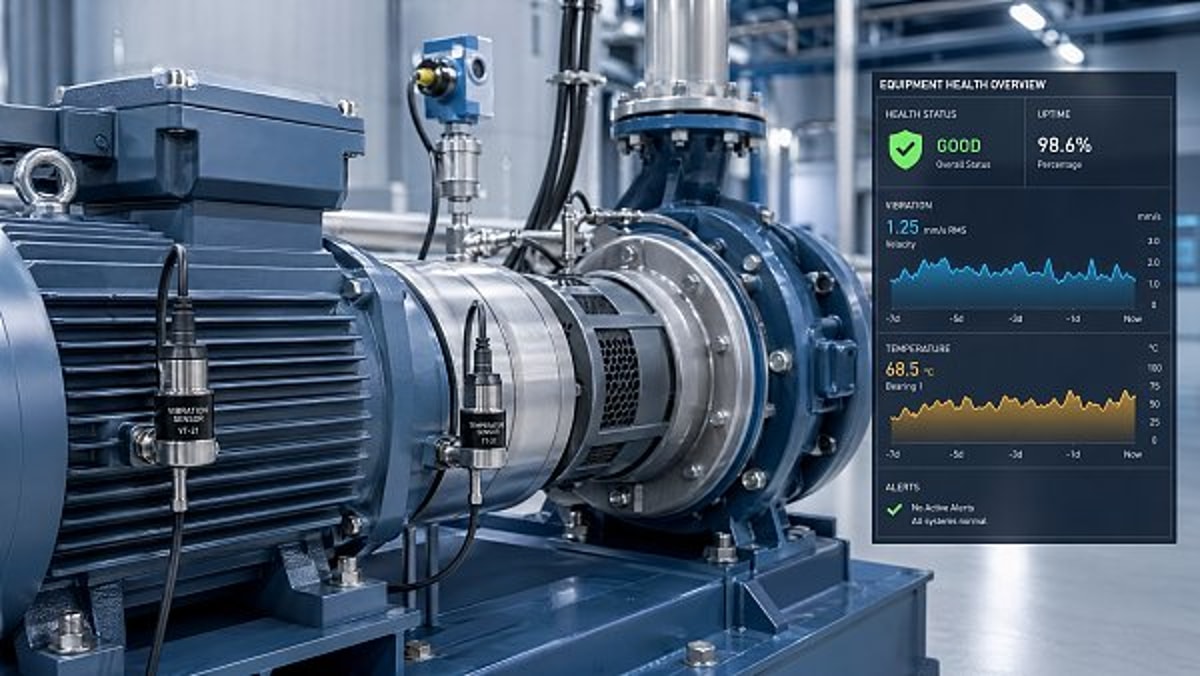
Predictive maintenance sensors collect condition data from equipment and help teams detect abnormal patterns before a failure becomes operationally expensive. Common sensor types monitor vibration, temperature, acoustic behavior, pressure, humidity, current, voltage, oil quality, or rotational speed. Their role is not merely to “add data,” but to convert physical signals into actionable maintenance decisions.
That changes the economics in three ways. First, organizations can intervene earlier, when corrective action is cheaper and less disruptive. Replacing a bearing during a planned short stop is far less expensive than managing a cascading failure that damages shafts, housings, or adjacent components. Second, organizations can avoid unnecessary routine interventions on assets that remain healthy. Third, teams can prioritize labor and parts around real risk instead of static intervals.
For evaluators, the key point is that predictive maintenance sensors do not compete with scheduled service on a one-to-one basis. They often outperform it by reducing uncertainty. A better maintenance decision can preserve production continuity, protect customer deliveries, and support more accurate operational planning. That is why the savings often exceed the maintenance budget line and appear across uptime, quality, procurement, and service performance metrics.
Where the biggest savings usually come from
Many business cases focus too narrowly on avoided repair bills. In practice, the largest savings often come from avoided downtime. If a bottleneck machine fails unexpectedly, every upstream and downstream process may be affected. Idle labor, missed output, delayed shipments, overtime recovery, and customer service issues can easily outweigh the direct cost of the failed part. On critical assets, even a single prevented outage may justify the program.
The second major savings source is maintenance efficiency. Scheduled programs can generate excessive inspections, premature part replacement, and broad shutdown activity that is not aligned with actual asset condition. Predictive maintenance sensors help narrow work orders to assets showing true degradation. That can reduce wrench time on low-risk machines while improving focus on high-risk ones, which is especially valuable when maintenance labor is scarce.
A third savings category is quality and process stability. Equipment degradation does not always produce an immediate breakdown. Sometimes it first causes subtle drift: inconsistent temperatures, irregular motion, pressure fluctuations, or electrical anomalies that degrade product quality. Early detection can reduce scrap, rework, warranty exposure, and customer complaints. For industries where process precision matters, this quality protection can be as valuable as downtime prevention.
There is also a working-capital effect. Better condition visibility can improve spare-parts planning by reducing emergency purchases and helping procurement align stock levels with probable needs. Instead of carrying excess inventory “just in case,” operations can make more informed stocking decisions. This does not eliminate inventory requirements, but it can improve inventory quality and lower the premium cost of urgent replacement sourcing.
How business evaluators should decide whether the investment is worth it
The strongest evaluations begin with asset criticality, not technology enthusiasm. Ask which assets create the greatest business risk when they fail. A useful shortlist usually includes bottleneck machines, high-value continuous-process assets, systems with expensive downtime, equipment with safety or compliance implications, and machines whose failure affects customer delivery commitments. If an asset is not operationally important, sensor deployment may not generate meaningful return.
Next, examine failure modes. Predictive maintenance sensors create the most value when failures show detectable condition changes before breakdown. Bearings, motors, pumps, compressors, fans, conveyors, gearboxes, and electrical systems often fit this profile. If a component fails randomly with little measurable warning, or if replacement is so cheap that intervention strategy barely matters, a sensor-based approach may have limited economic upside.
Then quantify the baseline. Evaluators should gather data on downtime hours, maintenance labor usage, emergency work orders, parts consumption, scrap rates, service response costs, and any delivery penalties or lost production associated with equipment problems. Without a baseline, it becomes difficult to separate real savings from general operational variation. A credible business case compares current-state performance with specific, measurable improvement assumptions.
Finally, evaluate organizational readiness. Predictive maintenance sensors are not only a hardware purchase. They require data interpretation, escalation rules, workflow integration, and accountability. If alerts are ignored, if there is no maintenance planning process tied to sensor insights, or if operations cannot schedule timely interventions, the technology may generate noise rather than value. Return depends as much on execution discipline as on analytics capability.
When predictive maintenance sensors outperform scheduled service most clearly
The clearest advantage appears in environments where downtime is expensive and asset usage is variable. In these settings, fixed service intervals are blunt tools because machines do not age at the same rate. A compressor running under fluctuating loads in a dusty environment, for example, may deteriorate faster than the same model in a cleaner, more stable application. Sensors capture that difference; schedules generally do not.
Another strong fit is multi-site operations where maintenance consistency is difficult to maintain. Condition monitoring can create a more standardized signal for intervention across facilities, especially when local teams have different experience levels or staffing constraints. For enterprise decision-makers, that consistency supports better benchmarking, capital planning, and network-wide risk management rather than leaving asset reliability entirely to site-by-site judgment.
Predictive maintenance sensors also tend to outperform scheduled service when the cost of false positives is lower than the cost of missed warnings. In industries with tight service-level commitments, product sensitivity, or limited redundancy, catching a problem early has disproportionate value. Even if some alerts lead to inspections that reveal no urgent issue, the operational protection may still justify the system if the prevented failure scenarios are severe enough.
When scheduled service may still be the better primary model
Not every asset needs condition-based monitoring. Scheduled service may remain the more sensible primary strategy for simple, low-cost, non-critical equipment where replacement is quick and operational impact is minor. If a component can be swapped cheaply with minimal interruption, investing in extensive sensing and analytics may not produce an acceptable return. The business case must be proportional to the asset’s importance.
Regulated and warranty-sensitive environments may also require fixed maintenance intervals regardless of sensor data. In these cases, predictive maintenance sensors can still add value, but often as a supplement rather than a replacement. They help identify anomalies between scheduled services, improve root-cause analysis, and support reliability improvements without changing the mandatory service framework.
It is also important to recognize that poor data environments can undermine ROI. If assets are not digitally identifiable, maintenance history is unreliable, or network infrastructure is weak, the organization may need foundational work before expecting strong returns from advanced monitoring. For evaluators, this does not mean saying no to predictive maintenance; it means sequencing the investment realistically.
Common concerns that slow approval—and how to assess them rationally
One frequent concern is that sensor projects look attractive in pilots but fail at scale. This risk is real when companies start with easy assets and then expand without clear selection criteria. The solution is disciplined segmentation: identify which asset classes justify continuous monitoring, which need periodic condition checks, and which should stay on preventive schedules. Scale works best when deployment logic is tied to business criticality and failure behavior.
Another concern is alert fatigue. If systems generate too many warnings without clear thresholds or action paths, maintenance teams lose confidence. Evaluators should ask vendors and internal stakeholders how alerts will be validated, prioritized, and routed into maintenance workflows. Strong programs define what constitutes an actionable event, who owns it, and how response timing will be measured. A sensor without a response process is not a reliability strategy.
Cybersecurity and integration also matter, particularly for enterprise buyers. Connected sensors may interact with operational technology, cloud platforms, or CMMS and ERP systems. The value of predictive maintenance sensors increases when insights are integrated into maintenance planning and asset management systems, but so do governance requirements. A sound evaluation includes data ownership, network architecture, vendor support, and system interoperability—not just equipment performance claims.
A practical framework for building the business case
For evaluators who need a clear approval path, start with five questions. Which assets are most critical? What failure modes are detectable? What is the cost of unplanned downtime per hour or per event? How much maintenance activity today is preventive but low-value? And what organizational process will turn sensor insights into action? These questions quickly separate strategic opportunities from technology experiments.
From there, build a scenario model with conservative assumptions. Estimate the number of avoidable failures per year, the reduction in emergency maintenance, the decrease in unnecessary routine service, and any quality or inventory benefits. Then compare those gains against hardware, installation, software, integration, training, and ongoing monitoring costs. The most credible models avoid optimistic AI language and focus on operational realities the business can verify.
It is also wise to include non-financial value, especially in sectors where reliability affects reputation, customer retention, or compliance outcomes. While finance teams need direct savings, senior decision-makers often care equally about resilience, service continuity, and planning accuracy. Predictive maintenance sensors can strengthen all three. Framing the investment only as a maintenance tool may understate its strategic value.
Conclusion: the real test is not the sensor, but the business impact
When predictive maintenance sensors save more than scheduled service, they do so because they improve decisions at the moment timing matters most. They help organizations avoid expensive failures, reduce unnecessary maintenance, protect quality, and allocate resources based on real equipment condition rather than assumptions. For business evaluators, that means the return often shows up across operations, procurement, service performance, and risk reduction—not just in the maintenance budget.
The right question, then, is not whether predictive maintenance sensors are advanced or fashionable. It is whether your critical assets have detectable failure patterns, whether downtime carries meaningful business cost, and whether your organization can act on condition insights effectively. If the answer is yes, sensor-based maintenance can deliver value well beyond scheduled service and become a practical lever for stronger operational economics.
In short, scheduled service is still useful, but it is often too static for high-stakes, variable operating environments. Predictive maintenance sensors earn their place when they reduce uncertainty in ways that the business can measure. For companies making asset strategy decisions, that is where the smarter investment case begins.
Get weekly intelligence in your inbox.
No noise. No sponsored content. Pure intelligence.
 May 02, 2026China’s '15th Five-Year Plan' Prioritizes Low-Altitude Economy, Boosting Warehouse Robotics ExportsChina’s '15th Five-Year Plan' Prioritizes Low-Altitude Economy, Boosting Warehouse Robotics Exports
 May 02, 2026Q1 2026 Industrial Profits +15.5%; CNC Machining Capacity Utilization RisesQ1 2026 Industrial Profits +15.5%; CNC Machining Capacity Utilization Rises
 May 02, 2026China Opens Green Channel for Smart Home Exporters with Int'l CertsChina Opens Green Channel for Smart Home Exporters with Int'l Certs
 May 02, 2026Solar PV Export Timeliness Rises via Western Land-Sea CorridorSolar PV Export Timeliness Rises via Western Land-Sea Corridor
 May 02, 2026UAE Tops Global AI Hub Ranking; Demand Rises for Chinese FA SolutionsUAE Tops Global AI Hub Ranking; Demand Rises for Chinese FA Solutions
 May 02, 2026ADB Raises Vietnam GDP Forecast to 7.2% for 2026ADB Raises Vietnam GDP Forecast to 7.2% for 2026
") May 02, 2026China’s Trade SaaS Export Standards Updated (2026–2030)China’s Trade SaaS Export Standards Updated (2026–2030)
May 02, 2026China’s Trade SaaS Export Standards Updated (2026–2030)China’s Trade SaaS Export Standards Updated (2026–2030) May 02, 2026World's First 10,000-Car PCTC Delivered in GuangzhouWorld's First 10,000-Car PCTC Delivered in Guangzhou
 May 02, 2026China’s 5-Dept Battery Recycling Traceability Rule Affects ESS ExportsChina’s 5-Dept Battery Recycling Traceability Rule Affects ESS Exports
 May 02, 2026WeChat Pay QR Integration for 5 Countries: Eases Cross-Border ProcurementWeChat Pay QR Integration for 5 Countries: Eases Cross-Border Procurement
 May 01, 2026Beijing’s New E-Bike Rules Trigger Dual-Certification Demand for China’s Swappable Battery CabinetsBeijing’s New E-Bike Rules Trigger Dual-Certification Demand for China’s Swappable Battery Cabinets
 May 01, 2026GNA’s GEO Service Assessment Elevates AI Search as Digital Procurement Metric for Chinese ExportersGNA’s GEO Service Assessment Elevates AI Search as Digital Procurement Metric for Chinese Exporters
 May 01, 20262026 China Cycle Expo: Chinese EPS Systems Achieve UL 2849:2026 Full Certification2026 China Cycle Expo: Chinese EPS Systems Achieve UL 2849:2026 Full Certification
 May 01, 2026GB 42236-2026 Enforces EV Charger Efficiency & Overload Protection from May 2026GB 42236-2026 Enforces EV Charger Efficiency & Overload Protection from May 2026
 May 01, 2026GB/T 43790-2026 Drone EMC Standard Effective May 2026GB/T 43790-2026 Drone EMC Standard Effective May 2026
 May 01, 20262026 Foshan Tanzhou Auto Industry Expo Opens2026 Foshan Tanzhou Auto Industry Expo Opens
 May 01, 2026China’s New Hazardous Chemicals Safety Law Takes Effect May 2026China’s New Hazardous Chemicals Safety Law Takes Effect May 2026
 May 01, 2026New Maritime and Fisheries Laws Take Effect May 1, 2026New Maritime and Fisheries Laws Take Effect May 1, 2026
 May 01, 2026Supply Chain Automation Works Best Where Delays RepeatSupply Chain Automation Works Best Where Delays Repeat
 May 01, 2026High Strength Steel Forgings: What Should Be Tested First?High Strength Steel Forgings: What Should Be Tested First?
 May 01, 2026Automotive Steel Forging: Cost Pressure vs Part ReliabilityAutomotive Steel Forging: Cost Pressure vs Part Reliability
 May 01, 2026Why High Durability Steel Forgings Fail Earlier Than ExpectedWhy High Durability Steel Forgings Fail Earlier Than Expected
 May 01, 2026Construction Aluminum Extrusions: Which Finish Lasts Longer?Construction Aluminum Extrusions: Which Finish Lasts Longer?
 May 01, 2026Lightweight Aluminum Extrusions: Where Savings Really HappenLightweight Aluminum Extrusions: Where Savings Really Happen
 May 01, 2026Aerospace Aluminum Extrusions Need More Than Low WeightAerospace Aluminum Extrusions Need More Than Low Weight
 May 01, 2026Precision Lathe Turning Problems That Show Up After AssemblyPrecision Lathe Turning Problems That Show Up After Assembly
 May 01, 2026High Precision Lathe Turning: Tolerance Claims to VerifyHigh Precision Lathe Turning: Tolerance Claims to Verify