High Strength Steel Forgings: What Should Be Tested First?
When evaluating steel forging high strength components, the first tests should not begin with full mechanical characterization alone. Technical assessors usually get the clearest early risk signal by starting with material identity and soundness: chemical composition verification, heat-treatment confirmation, basic hardness mapping, and non-destructive examination for internal or surface defects. These first checks reveal whether the forging is even worth moving into more expensive tensile, impact, fatigue, fracture, or application-specific qualification stages.
For technical evaluation teams, the real question is not simply “what can be tested,” but “what should be tested first to reduce approval risk fastest.” In high-strength forgings, many downstream failures trace back to the wrong grade, poor cleanliness, segregation, quench-and-temper inconsistency, laps, cracks, or unacceptable grain flow. If those issues are missed early, later test data can look acceptable while the part still carries hidden reliability risk.
This guide is written for technical assessors who need a practical testing sequence. It focuses on how to prioritize tests, what each test actually answers, and how to judge whether a supplier’s data package is enough for sourcing, qualification, or release decisions.
Start with the tests that answer one core question: is the forging fundamentally what it claims to be?

The best first-test strategy for high-strength steel forgings is to verify conformance before performance. In other words, confirm the forging’s identity, internal integrity, and process consistency before investing heavily in advanced mechanical programs. This approach saves time because many disqualifying issues show up in the earliest layers of evaluation.
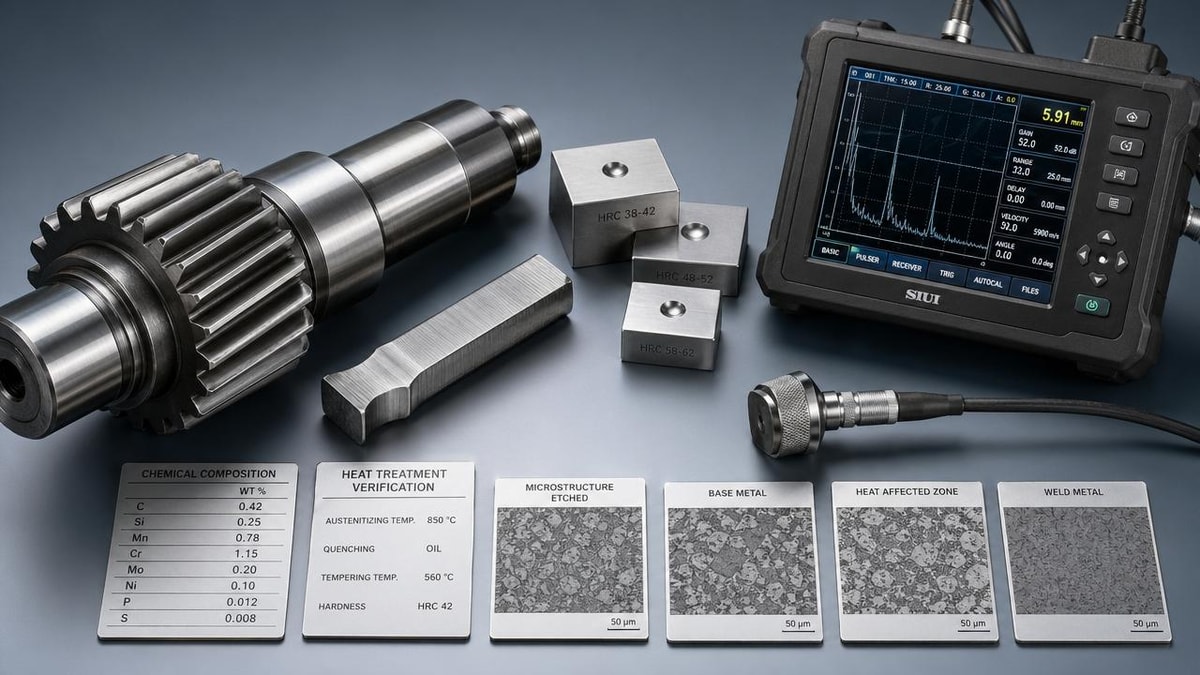
For most high-strength forged parts, the first testing tier should include four essentials: chemical composition analysis, heat-treatment verification, hardness testing, and non-destructive testing. Together, they establish whether the supplied component matches the specified alloy, whether the heat-treatment route likely produced the intended microstructure, whether hardness is within the expected process window, and whether obvious discontinuities or subsurface defects are present.
These tests matter because high-strength forgings are process-sensitive. Two parts with the same drawing dimensions can behave very differently if one has banding, decarburization, retained austenite, quench cracking, hydrogen damage, or poor forging reduction. Mechanical tests alone may not fully expose those risks at the start, especially when sampling is limited.
What should be tested first in practice? A risk-based sequence for technical assessors
A practical first-pass sequence usually looks like this: review certification and traceability, confirm chemistry, check hardness, verify microstructure and heat-treatment condition, then perform non-destructive examination. After that, move to tensile, impact, toughness, fatigue, and application-specific testing based on criticality.
This sequence works because it follows failure economics. Chemistry and traceability are relatively fast and inexpensive to validate. Hardness is also fast and often acts as a useful screen for heat-treatment deviation. Microstructure review provides evidence of grain size, phases, carbides, decarburization depth, and abnormal transformation products. NDT then helps identify internal soundness and surface quality problems that could invalidate the forging even if coupon properties appear acceptable.
For safety-critical components such as shafts, gears, hubs, pressure-containing parts, or load-bearing connectors, skipping early-stage verification is risky. A forging can pass tensile strength requirements yet still fail in service due to directional properties, inclusions, forging laps, centerline segregation, or low-cycle fatigue sensitivity originating from manufacturing defects.
Chemical composition verification: the first gate for material identity
If a technical assessor must choose one test to start with, chemistry verification is often the most defensible first step. It confirms whether the part was produced from the specified alloy family and whether key elements fall within required ranges. This is especially important in global sourcing, where mill certificates alone may not provide enough assurance.
Optical emission spectroscopy, XRF where appropriate, or laboratory wet chemistry can be used depending on alloy system, component geometry, and required confidence level. The goal is not only to confirm nominal grade but also to detect subtle deviations in carbon, chromium, molybdenum, nickel, vanadium, boron, sulfur, phosphorus, and residual elements that can significantly influence hardenability, toughness, weldability, and fatigue performance.
For steel forging high strength components, chemistry is tightly linked to the heat-treatment response. Even a small variation in carbon equivalent or residual content can shift final hardness, case depth response, toughness, or crack sensitivity. If the chemistry is wrong, every later property test becomes less meaningful because the part may never have had the correct metallurgical foundation.
Hardness testing: the fastest indicator of heat-treatment consistency
After chemistry, hardness testing is usually the quickest and most revealing screening tool. It is not a substitute for tensile or impact testing, but it is an excellent early warning method. If hardness is out of range, the forging may have been under-tempered, over-tempered, incompletely quenched, non-uniformly cooled, or improperly processed after forging.
Technical assessors should request hardness mapping rather than a single reading when geometry, section thickness, or critical zones vary. Surface and core readings can expose non-uniform transformation. In larger forgings, localized hardness variation may indicate uneven quench severity, segregation effects, or problems in thermal cycle control.
Hardness data also helps assess whether the component is in a reasonable condition for later destructive testing. For example, unexpectedly high hardness may imply brittle behavior risk or residual stress concerns. Unexpectedly low hardness can suggest inadequate strength or poor hardenability through section thickness. Either result can justify stopping the approval process before deeper test investment.
Microstructure and heat-treatment verification: where hidden process problems become visible
Many sourcing failures occur because buyers approve a forging based on certificates and tensile data without checking the actual microstructure. For high-strength forgings, microstructural examination should happen early, not as an afterthought. It provides direct evidence of whether the forging and heat-treatment route created the intended metallurgical condition.
A metallographic review may assess grain size, grain flow orientation, inclusion content, carbide distribution, decarburization, oxidation, banding, bainite or martensite formation, ferrite-pearlite remnants, untempered structures, and signs of overheating or burning. The exact acceptance criteria depend on component class and specification, but the principle is the same: the microstructure must support the intended load path and service environment.
For technical assessors, microstructure is especially valuable when evaluating a new supplier, a new source country, a design transfer, or a cost-down proposal. It reveals whether the supplier truly controls forging reduction ratio, reheating practices, die design, quenching, tempering, and section-sensitive thermal behavior. That insight is hard to obtain from certificates alone.
Non-destructive testing: detect discontinuities before they become field failures
Once the material and process condition appear credible, non-destructive testing should be used to assess soundness. The best NDT method depends on geometry, alloy, surface finish, and expected defect modes. Common choices include ultrasonic testing for internal defects, magnetic particle inspection for surface and near-surface discontinuities in ferromagnetic steels, and dye penetrant in specific situations where surface-breaking flaws must be detected.
Ultrasonic testing is especially important for larger forgings where shrinkage, inclusions, internal cracking, or centerline issues may exist. Magnetic particle inspection is highly effective for laps, seams, grinding cracks, quench cracks, and forging surface defects. For machined critical areas, combining UT and MPI often provides a stronger first-pass confidence level than relying on one method alone.
For high-strength components, defect tolerance is usually lower than for standard structural parts. Small discontinuities can become fatigue initiation sites under cyclic loading. That is why technical assessors should align NDT acceptance criteria with the actual service profile, not merely with generic shop practice.
When should tensile, impact, and toughness tests enter the sequence?
After the first-pass qualification gates are cleared, mechanical testing should validate whether the forging can perform under required loads and temperatures. Tensile testing remains essential because it confirms yield strength, ultimate tensile strength, elongation, and reduction of area. These values are still central to most engineering approvals.
However, tensile testing should not always be the first activity. If chemistry, hardness, or soundness is wrong, a tensile result may create false confidence. Sampling location can also distort interpretation, especially in large forgings where property gradients exist from surface to core or from one orientation to another.
Impact testing, such as Charpy V-notch, becomes a higher priority when the application involves low temperatures, dynamic loading, code compliance, or brittle fracture risk. Fracture toughness testing may be required for highly critical applications, thick sections, aggressive environments, or parts with demanding damage-tolerance requirements.
Technical assessors should tie these tests to the service environment. A forging for a static industrial bracket does not need the same early test emphasis as a rotating shaft, wind-energy drivetrain part, heavy-equipment pin, or pressure-system component. Sequence should follow failure consequence.
Fatigue and application-specific testing: critical, but usually not first
Fatigue performance is often the true service-life limiter for steel forging high strength components. Still, fatigue testing is usually not the first step because it is time-consuming, expensive, and strongly influenced by factors that should already have been screened out, such as inclusions, microstructural inconsistency, surface defects, and hardness variation.
Once the forging has passed early qualification, fatigue testing becomes highly valuable for components under cyclic bending, torsion, rolling contact, or fluctuating tensile loads. Depending on the application, assessors may need axial fatigue, rotating bending, low-cycle fatigue, rolling contact fatigue, or corrosion-fatigue evaluation.
Application-specific tests may also include wear testing, hydrogen embrittlement assessment, stress-corrosion evaluation, elevated-temperature strength checks, case-depth validation, residual stress analysis, or straightness/distortion studies after heat treatment. These tests are vital when service conditions justify them, but they should be selected based on real failure modes rather than added by habit.
How technical assessors should judge a supplier’s test package
The quality of a test package depends not just on the number of tests, but on whether the tests answer the right questions. Assessors should confirm traceability from raw material heat to forging lot, heat-treatment batch, machining stage, and final inspection records. Without traceability, even accurate test results may not be decision-grade.
Review whether coupons were taken from representative locations and orientations. In forged parts, properties can vary with grain flow and section thickness. A supplier that reports only one favorable coupon location may be masking risk. Ask how test locations were chosen and whether they match specification requirements or critical stress zones.
Also examine whether the supplier’s process controls support repeatability. A strong test report from one lot is less meaningful if the forging route lacks disciplined control over stock origin, reduction ratio, die wear, reheating temperature, quench transfer time, temper uniformity, and NDT calibration. Technical approval should reflect process capability, not isolated data points.
Common mistakes in first-stage forging evaluation
One common mistake is starting with full mechanical qualification while postponing chemistry verification and NDT. This can waste time and budget on a forging that was non-conforming from the beginning. Another mistake is accepting a mill certificate as complete proof of the delivered component’s chemistry and integrity, especially when remanufacture, mixed lots, or subcontracted heat treatment may be involved.
Another frequent error is over-relying on hardness as a final acceptance metric. Hardness is an excellent early screen, but by itself it cannot confirm fracture resistance, ductility, cleanliness, or fatigue strength. It should be interpreted alongside microstructure and later mechanical data.
Assessors also sometimes use generic acceptance criteria that do not reflect service criticality. A high-strength forged pin in a mining application, for example, may need a different NDT sensitivity and toughness expectation than a non-rotating industrial connector. Testing sequence and thresholds should reflect actual operating risk.
A practical decision framework: what to test first by component criticality
For low-to-moderate criticality parts, start with certificate review, chemistry verification, hardness, dimensional checks, and surface NDT. If those pass, proceed to tensile testing and limited metallography as needed. This is often sufficient for lower-risk industrial applications with well-established suppliers.
For medium-to-high criticality forged components, add mandatory metallography and volumetric NDT early in the sequence. Then perform tensile, impact, and orientation-sensitive sampling. This level is suitable for highly loaded machine parts, drivetrain elements, and structural parts where hidden discontinuities or through-section property variation matter.
For very high criticality applications, such as safety-relevant rotating or pressure-related components, the early stage should include chemistry, full traceability audit, hardness mapping, metallography, UT, MPI, and a formal review of the forging and heat-treatment process route before advanced mechanical and fatigue programs begin. In these cases, the first tests are part of a wider qualification system, not isolated lab events.
Conclusion: test identity and soundness first, then validate performance
The best answer to “what should be tested first” in high-strength steel forgings is this: start with the tests that most quickly confirm the part is the correct material, in the correct condition, and free from major defects. In most cases, that means chemistry verification, hardness testing, microstructural and heat-treatment assessment, and appropriate non-destructive examination before deeper mechanical qualification.
For technical assessors, this sequence improves decision quality because it filters out the most expensive risks early. It also creates a more reliable basis for later tensile, impact, toughness, fatigue, and application-specific testing. When evaluating steel forging high strength components, early discipline in test prioritization is not just a laboratory issue. It is a sourcing, reliability, and production-readiness advantage.
If a forging passes the first gates with strong traceability and representative data, later performance testing becomes far more meaningful. If it fails them, the smartest decision is often to stop, investigate the process route, and resolve the root cause before moving forward. That is how technical assessment reduces field risk and accelerates confident supplier approval.
Get weekly intelligence in your inbox.
No noise. No sponsored content. Pure intelligence.
 May 01, 2026Beijing’s New E-Bike Rules Trigger Dual-Certification Demand for China’s Swappable Battery CabinetsBeijing’s New E-Bike Rules Trigger Dual-Certification Demand for China’s Swappable Battery Cabinets
 May 01, 2026GNA’s GEO Service Assessment Elevates AI Search as Digital Procurement Metric for Chinese ExportersGNA’s GEO Service Assessment Elevates AI Search as Digital Procurement Metric for Chinese Exporters
 May 01, 20262026 China Cycle Expo: Chinese EPS Systems Achieve UL 2849:2026 Full Certification2026 China Cycle Expo: Chinese EPS Systems Achieve UL 2849:2026 Full Certification
 May 01, 2026GB 42236-2026 Enforces EV Charger Efficiency & Overload Protection from May 2026GB 42236-2026 Enforces EV Charger Efficiency & Overload Protection from May 2026
 May 01, 2026GB/T 43790-2026 Drone EMC Standard Effective May 2026GB/T 43790-2026 Drone EMC Standard Effective May 2026
 May 01, 20262026 Foshan Tanzhou Auto Industry Expo Opens2026 Foshan Tanzhou Auto Industry Expo Opens
 May 01, 2026China’s New Hazardous Chemicals Safety Law Takes Effect May 2026China’s New Hazardous Chemicals Safety Law Takes Effect May 2026
 May 01, 2026New Maritime and Fisheries Laws Take Effect May 1, 2026New Maritime and Fisheries Laws Take Effect May 1, 2026
 May 01, 2026Supply Chain Automation Works Best Where Delays RepeatSupply Chain Automation Works Best Where Delays Repeat
 May 01, 2026High Strength Steel Forgings: What Should Be Tested First?High Strength Steel Forgings: What Should Be Tested First?
 May 01, 2026Automotive Steel Forging: Cost Pressure vs Part ReliabilityAutomotive Steel Forging: Cost Pressure vs Part Reliability
 May 01, 2026Why High Durability Steel Forgings Fail Earlier Than ExpectedWhy High Durability Steel Forgings Fail Earlier Than Expected
 May 01, 2026Construction Aluminum Extrusions: Which Finish Lasts Longer?Construction Aluminum Extrusions: Which Finish Lasts Longer?
 May 01, 2026Lightweight Aluminum Extrusions: Where Savings Really HappenLightweight Aluminum Extrusions: Where Savings Really Happen
 May 01, 2026Aerospace Aluminum Extrusions Need More Than Low WeightAerospace Aluminum Extrusions Need More Than Low Weight
 May 01, 2026Precision Lathe Turning Problems That Show Up After AssemblyPrecision Lathe Turning Problems That Show Up After Assembly
 May 01, 2026High Precision Lathe Turning: Tolerance Claims to VerifyHigh Precision Lathe Turning: Tolerance Claims to Verify
 May 01, 2026When CNC Lathe Turning Is Better Than General MachiningWhen CNC Lathe Turning Is Better Than General Machining
 May 01, 2026Medical Device Prototyping Needs More Than SpeedMedical Device Prototyping Needs More Than Speed
 May 01, 20263D Printing Prototyping: Fast Turnaround or Better Finish?3D Printing Prototyping: Fast Turnaround or Better Finish?
 May 01, 2026Low Cost Rapid Prototyping: Where Quality Gets LostLow Cost Rapid Prototyping: Where Quality Gets Lost
 May 01, 2026Quick EV Charger Installation Still Needs Site ChecksQuick EV Charger Installation Still Needs Site Checks
 May 01, 2026Public Parking EV Chargers: What Slows Installation DownPublic Parking EV Chargers: What Slows Installation Down
 May 01, 2026Choosing a Lithium Ion Battery Manufacturer in ChinaChoosing a Lithium Ion Battery Manufacturer in China
 May 01, 2026How to Vet a Lithium Ion Battery OEM SupplierHow to Vet a Lithium Ion Battery OEM Supplier
 May 01, 2026EV Lithium Ion Batteries: Range Is Not the Only MetricEV Lithium Ion Batteries: Range Is Not the Only Metric
 May 01, 2026Lithium Ion ESS Batteries: Safety Details Worth CheckingLithium Ion ESS Batteries: Safety Details Worth Checking