EV Lithium Ion Batteries: Range Is Not the Only Metric
When evaluating lithium ion batteries for electric vehicles, range is only the starting point. For technical assessors, factors such as thermal stability, charging efficiency, cycle life, safety architecture, and supply chain resilience often matter just as much. This article explores the deeper performance metrics that shape long-term EV battery value, helping decision-makers move beyond headline mileage and toward smarter, evidence-based comparisons.
In B2B procurement, the wrong battery choice rarely fails on day 1. It underperforms over 12 to 36 months through accelerated degradation, inconsistent fast charging, thermal stress in hot or cold duty cycles, or replacement bottlenecks caused by upstream material constraints. For technical evaluation teams, the real task is not identifying the battery with the highest advertised range, but the one with the best total operational fit.
That is especially true when comparing lithium ion batteries for electric vehicles across fleet, passenger, commercial, and specialized industrial mobility applications. A pack designed for 600 km headline range may still be a poor fit if it loses charge acceptance after 800 cycles, requires narrow thermal control windows, or depends on a fragile multi-region supply chain. Sound assessment requires a broader matrix of technical, commercial, and risk variables.
Why Range Alone Creates Blind Spots in EV Battery Assessment
Range remains a useful top-level metric because it translates battery capacity into an outcome that buyers and end users understand immediately. Yet range is influenced by far more than cell chemistry. Vehicle weight, drivetrain efficiency, ambient temperature, tire choice, software calibration, and usable state-of-charge window can all shift the final number by 10% to 30% in real conditions.
For technical assessors, this means range should be treated as an output variable rather than a standalone quality indicator. Two battery packs with similar nominal capacity, such as 60 kWh to 75 kWh, may deliver very different field performance if one maintains lower internal resistance, better thermal uniformity, and more stable power delivery under repeated DC fast-charging sessions.
The difference between brochure range and operational value
Operational value is the combination of energy availability, reliability, charging turnaround, safety margin, and service life. For example, a fleet operator may prefer a battery that supports 20% to 80% charging in 25 to 35 minutes repeatedly, even if its theoretical range is 8% lower than an alternative that charges more slowly or degrades faster after frequent high-power charging.
This is one reason lithium ion batteries for electric vehicles should be reviewed through use-case profiles. Urban delivery routes, regional shuttle systems, premium passenger vehicles, and heavy-duty mixed loads all stress batteries differently. A battery optimized for one profile may show compromises in another, especially in heat rejection, depth-of-discharge tolerance, and pack-level maintenance complexity.
Core questions technical teams should ask early
Before comparing suppliers, evaluation teams should define 4 baseline questions: What is the required cycle life at the target depth of discharge? What charging pattern will dominate daily operation? What ambient temperature range must the pack tolerate? What service and replacement lead times are commercially acceptable? These questions narrow the shortlist faster than headline range figures alone.
- Target daily operating window: 1 to 3 shifts, or intermittent private-use charging
- Expected cycle threshold: often 1,000 to 3,000 full-equivalent cycles depending on duty profile
- Thermal operating range: typically evaluated from -20°C to 45°C, with stricter limits for peak performance
- Charging dependence: AC dominant, mixed AC/DC, or high-frequency DC fast charging
Once these variables are defined, battery selection becomes less vulnerable to marketing distortion and more aligned with measurable business outcomes such as uptime, energy cost consistency, and replacement planning.
The Performance Metrics That Matter Beyond Mileage
A structured technical review of lithium ion batteries for electric vehicles typically covers at least 6 performance dimensions: energy density, power density, cycle life, charging efficiency, thermal behavior, and safety architecture. Each dimension affects long-term value differently, and the relative weighting should reflect the operational environment rather than generic market claims.
Cycle life and degradation profile
Cycle life is not just the number of cycles until failure. It is more useful to review the capacity retention curve over time. A battery that retains 80% capacity after 1,500 full-equivalent cycles may outperform one advertised at 2,000 cycles if the second design experiences steep degradation after the first 600 to 800 cycles under fast-charge-heavy use.
Technical teams should ask whether cycle data is measured at 25°C, at what charge rate, and within what state-of-charge window. Test conditions matter. Data generated at 0.5C charge and discharge under laboratory conditions may not reflect commercial use where charging can reach 1C to 2C and thermal load fluctuates daily.
Charging efficiency and charging curve stability
Charging speed should not be reduced to a single “minutes to 80%” claim. The charging curve shape is often more relevant. Some packs accept high current only in a narrow 15% to 45% state-of-charge band and taper aggressively afterward. Others maintain stronger charge acceptance deeper into the window, which can reduce queue time at public or depot charging assets.
Round-trip efficiency also matters. Even a 2% to 5% difference in charging losses can become material at fleet scale over 24 months, especially where electricity pricing varies by peak and off-peak periods.
Thermal stability and pack uniformity
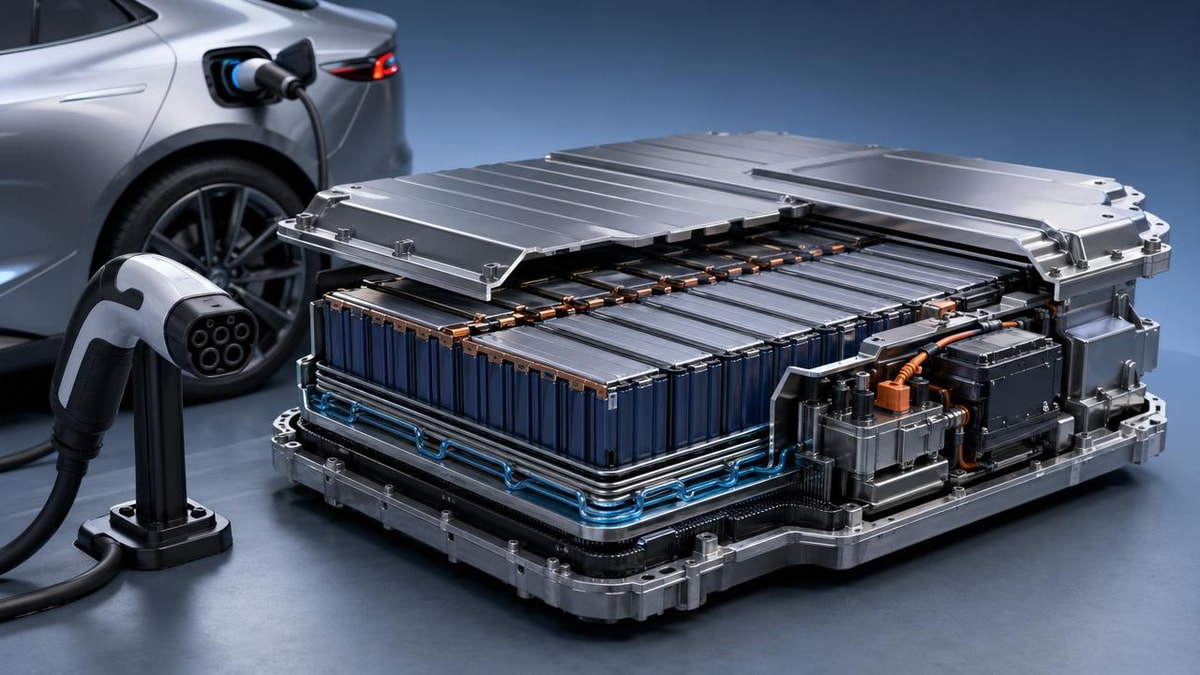
Thermal management is one of the most overlooked differentiators in lithium ion batteries for electric vehicles. A pack may perform well on a controlled test bench but become harder to manage in high-load climbing, repeated rapid acceleration, or hot-weather charging. Even a 5°C to 8°C temperature spread between module zones can accelerate uneven aging and reduce usable life.
Assessors should evaluate cooling method, sensor density, pack enclosure design, and thermal propagation containment. These features influence both daily consistency and low-probability, high-impact safety events.
The table below summarizes the most practical metrics for technical comparison and shows why a balanced scorecard is more useful than a range-first ranking.
A key conclusion is that battery quality becomes visible when metrics are connected. Fast charging without thermal control creates different risk exposure than fast charging with robust cooling and battery management logic. Likewise, long cycle life data means little without knowing the associated power loss and environmental test conditions.
Chemistry Choice, Safety Design, and Application Fit
Not all lithium ion batteries for electric vehicles are built around the same chemistry trade-offs. Different cell families prioritize different combinations of energy density, thermal tolerance, cost structure, and charging behavior. Technical assessors should avoid assuming that one chemistry is universally superior across all EV categories.
How chemistry influences decision priorities
In broad market practice, chemistry selection often comes down to balancing 3 competing targets: energy density, safety margin, and cost stability. Packs with higher energy density may support longer range or smaller package size, while more thermally stable chemistries may suit frequent cycling, hot climates, or risk-sensitive commercial deployments.
Technical teams should compare chemistry behavior under practical stress points such as 1C charging, low-temperature power delivery, and storage at high state of charge for 7 to 30 days. These operating realities often reveal more than nominal spec sheets.
Safety architecture is a system question
Battery safety does not depend on cell chemistry alone. It also depends on module spacing, separator integrity, venting pathways, software limits, sensor response speed, fuse strategy, and enclosure protection. A technically mature pack usually integrates multiple layers of protection rather than relying on one fail-safe mechanism.
For procurement and validation teams, safety review should include abuse tolerance, isolation monitoring, thermal runaway mitigation design, ingress protection, and crash-related containment logic. In many purchasing processes, these checks are best organized into 5 review blocks: cell, module, pack, BMS, and service procedures.
The comparison below is useful when matching battery configuration priorities to application needs rather than making a one-size-fits-all decision.
The main takeaway is that application fit should lead chemistry and architecture decisions. A technically strong battery is not simply the one with the highest theoretical specification, but the one whose performance profile remains stable under the exact operating pattern expected over its first 2 to 5 years of deployment.
Supply Chain Resilience and Total Cost of Ownership
For enterprise buyers, battery assessment is no longer a pure engineering exercise. It is also a supply chain and lifecycle economics exercise. Even high-performing lithium ion batteries for electric vehicles can become risky choices if sourcing is concentrated in one region, if replacement modules carry 16 to 24 week lead times, or if traceability is weak for critical materials.
What procurement teams should verify
A resilient sourcing review should cover at least 6 practical items: multi-source component strategy, documentation quality, logistics buffers, warranty process, software support continuity, and spare parts planning. Technical assessors should work with procurement rather than in isolation, because battery risk often appears at the interface of engineering, compliance, and replenishment operations.
- Lead time visibility for cells, modules, BMS components, and thermal system parts
- Regional repair or replacement support within commercially acceptable service windows
- Consistency of pack configuration across production batches over 12 to 18 months
- Documentation depth for failure analysis, firmware updates, and transport handling
- End-of-life path, reuse potential, or recycling alignment where required
Looking beyond purchase price
A lower initial unit price can be offset quickly by hidden costs in charging inefficiency, higher cooling demand, earlier capacity fade, or weak field support. Total cost of ownership should model at least 4 variables over a 24 to 60 month horizon: energy loss, maintenance events, downtime cost, and residual performance at replacement or redeployment stage.
This broader lens is especially important in B2B environments where asset utilization rates are high. In high-frequency use cases, a battery that costs 8% more upfront but delivers 15% longer useful capacity retention may represent the better commercial decision.
A Practical Evaluation Framework for Technical Assessors
A disciplined evaluation process helps decision-makers compare lithium ion batteries for electric vehicles using evidence rather than isolated claims. In many organizations, the best results come from a 3-stage framework: specification screening, controlled validation, and operational pilot review. This structure reduces the risk of overvaluing nominal figures while missing field-critical performance variables.
Stage 1: Specification screening
Start by mapping application requirements into minimum thresholds. Examples include required energy capacity, target cycle count, acceptable charging time, temperature tolerance, ingress protection level, and service response expectations. This first screen can eliminate unsuitable options before expensive testing begins.
Stage 2: Controlled technical validation
Next, validate the shortlisted packs under comparable conditions. Use repeated charge-discharge scenarios, ambient temperature variation, power demand spikes, and rest-period analysis. Even a 2-week test program can reveal charging taper behavior, thermal hotspots, or control instability that marketing documentation does not show clearly.
Stage 3: Pilot deployment and service review
Finally, monitor real-world performance over a meaningful pilot window, often 30 to 90 days depending on vehicle utilization. During this phase, track capacity drift, fault events, charging consistency, user handling issues, and vendor response speed. These observations often determine whether the battery will scale successfully in a live procurement program.
Common mistakes to avoid
Technical teams often make 4 avoidable mistakes: comparing packs tested under different conditions, overlooking thermal design because nominal capacity looks strong, separating engineering review from sourcing risk review, and treating warranty length as a substitute for proven durability data. Each of these can distort the final decision.
For organizations that need reliable sourcing intelligence, supplier comparison context, and sector-level analysis, platforms such as TradeNexus Pro can support more informed discussions across engineering, procurement, and strategic planning teams.
Range still matters, but it should sit within a wider decision framework that includes cycle behavior, charging performance, thermal stability, safety architecture, and supply chain resilience. For technical assessors, the strongest battery choice is the one that remains dependable not just on a test drive, but across thousands of operating hours, diverse temperatures, and real procurement constraints.
If you are reviewing lithium ion batteries for electric vehicles for a new sourcing program, fleet upgrade, or platform comparison, build your shortlist around measurable long-term value instead of headline mileage alone. To explore deeper market intelligence, compare supplier positioning, or get a more structured view of EV battery decision factors, contact us, request a tailored evaluation framework, or learn more about sector-specific solutions through TradeNexus Pro.
Get weekly intelligence in your inbox.
No noise. No sponsored content. Pure intelligence.
 May 01, 2026Beijing’s New E-Bike Rules Trigger Dual-Certification Demand for China’s Swappable Battery CabinetsBeijing’s New E-Bike Rules Trigger Dual-Certification Demand for China’s Swappable Battery Cabinets
 May 01, 2026GNA’s GEO Service Assessment Elevates AI Search as Digital Procurement Metric for Chinese ExportersGNA’s GEO Service Assessment Elevates AI Search as Digital Procurement Metric for Chinese Exporters
 May 01, 20262026 China Cycle Expo: Chinese EPS Systems Achieve UL 2849:2026 Full Certification2026 China Cycle Expo: Chinese EPS Systems Achieve UL 2849:2026 Full Certification
 May 01, 2026GB 42236-2026 Enforces EV Charger Efficiency & Overload Protection from May 2026GB 42236-2026 Enforces EV Charger Efficiency & Overload Protection from May 2026
 May 01, 2026GB/T 43790-2026 Drone EMC Standard Effective May 2026GB/T 43790-2026 Drone EMC Standard Effective May 2026
 May 01, 20262026 Foshan Tanzhou Auto Industry Expo Opens2026 Foshan Tanzhou Auto Industry Expo Opens
 May 01, 2026China’s New Hazardous Chemicals Safety Law Takes Effect May 2026China’s New Hazardous Chemicals Safety Law Takes Effect May 2026
 May 01, 2026New Maritime and Fisheries Laws Take Effect May 1, 2026New Maritime and Fisheries Laws Take Effect May 1, 2026
 May 01, 2026Supply Chain Automation Works Best Where Delays RepeatSupply Chain Automation Works Best Where Delays Repeat
 May 01, 2026High Strength Steel Forgings: What Should Be Tested First?High Strength Steel Forgings: What Should Be Tested First?
 May 01, 2026Automotive Steel Forging: Cost Pressure vs Part ReliabilityAutomotive Steel Forging: Cost Pressure vs Part Reliability
 May 01, 2026Why High Durability Steel Forgings Fail Earlier Than ExpectedWhy High Durability Steel Forgings Fail Earlier Than Expected
 May 01, 2026Construction Aluminum Extrusions: Which Finish Lasts Longer?Construction Aluminum Extrusions: Which Finish Lasts Longer?
 May 01, 2026Lightweight Aluminum Extrusions: Where Savings Really HappenLightweight Aluminum Extrusions: Where Savings Really Happen
 May 01, 2026Aerospace Aluminum Extrusions Need More Than Low WeightAerospace Aluminum Extrusions Need More Than Low Weight
 May 01, 2026Precision Lathe Turning Problems That Show Up After AssemblyPrecision Lathe Turning Problems That Show Up After Assembly
 May 01, 2026High Precision Lathe Turning: Tolerance Claims to VerifyHigh Precision Lathe Turning: Tolerance Claims to Verify
 May 01, 2026When CNC Lathe Turning Is Better Than General MachiningWhen CNC Lathe Turning Is Better Than General Machining
 May 01, 2026Medical Device Prototyping Needs More Than SpeedMedical Device Prototyping Needs More Than Speed
 May 01, 20263D Printing Prototyping: Fast Turnaround or Better Finish?3D Printing Prototyping: Fast Turnaround or Better Finish?
 May 01, 2026Low Cost Rapid Prototyping: Where Quality Gets LostLow Cost Rapid Prototyping: Where Quality Gets Lost
 May 01, 2026Quick EV Charger Installation Still Needs Site ChecksQuick EV Charger Installation Still Needs Site Checks
 May 01, 2026Public Parking EV Chargers: What Slows Installation DownPublic Parking EV Chargers: What Slows Installation Down
 May 01, 2026Choosing a Lithium Ion Battery Manufacturer in ChinaChoosing a Lithium Ion Battery Manufacturer in China
 May 01, 2026How to Vet a Lithium Ion Battery OEM SupplierHow to Vet a Lithium Ion Battery OEM Supplier
 May 01, 2026EV Lithium Ion Batteries: Range Is Not the Only MetricEV Lithium Ion Batteries: Range Is Not the Only Metric
 May 01, 2026Lithium Ion ESS Batteries: Safety Details Worth CheckingLithium Ion ESS Batteries: Safety Details Worth Checking