UAE Becomes Global AI Hub: New CE-ADAS+ Pathway for Chinese Smart Industrial Equipment
On April 26, 2026, the UAE was confirmed as the world’s top investor in AI infrastructure (4.2% of GDP), and a new mutual recognition arrangement between China’s CNCA and Abu Dhabi’s ADIA opened a streamlined market access route for Chinese smart industrial equipment targeting AI-enabled factories across the UAE and GCC — with implications for factory automation exporters, certification providers, and supply chain stakeholders.
Event Overview
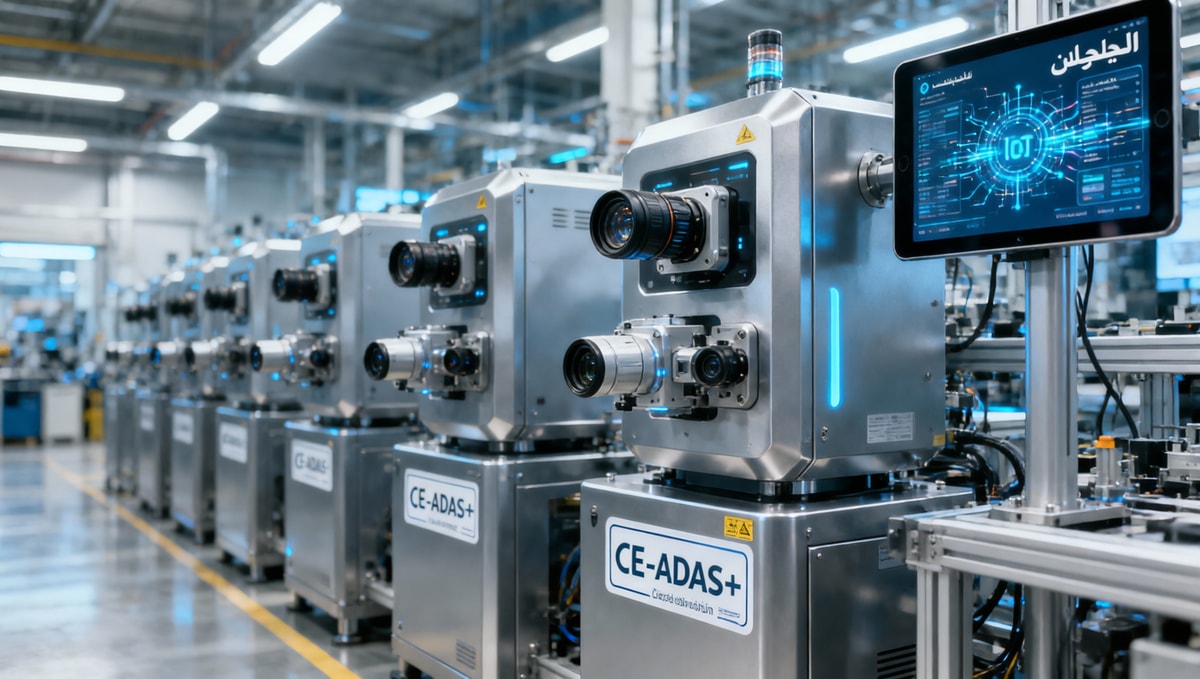
On April 26, 2026, the 2026 AI Index Report identified the United Arab Emirates as the country with the highest AI infrastructure investment intensity globally, at 4.2% of GDP. On the same day, the Abu Dhabi Artificial Intelligence Office (ADIA) and China’s Certification and Accreditation Administration (CNCA) signed a Memorandum of Understanding on mutual recognition. Under this arrangement, smart industrial equipment compliant with China’s national standard GB/T 37972—2024 Functional Safety of Intelligent Industrial Equipment, and certified by CNAS-accredited bodies, may directly apply for the CE-ADAS+ mark. This mark is accepted for deployment in AI-integrated factory projects across the UAE and Gulf Cooperation Council (GCC) countries. The pathway is specifically intended to shorten market entry timelines for Factory Automation–class equipment.
Which Subsectors Are Affected
Direct Exporters of Smart Industrial Equipment
These companies manufacture and ship programmable logic controllers (PLCs), robotic control units, AI-powered vision inspection systems, and other factory automation hardware covered under GB/T 37972—2024. They are affected because the CE-ADAS+ pathway replaces or supplements traditional EU-style conformity assessments for GCC-bound shipments — reducing reliance on third-country testing labs and eliminating redundant safety re-evaluations.
Certification and Conformity Assessment Bodies
Domestic CNAS-accredited laboratories and certification bodies authorized to assess compliance with GB/T 37972—2024 now hold eligibility to issue documentation supporting CE-ADAS+ applications. Their role shifts from purely domestic validation to enabling international market access — contingent upon adherence to ADIA’s technical acceptance criteria for the CE-ADAS+ mark.
AI-Integrated Factory Project Contractors & System Integrators
Firms bidding on or delivering AI factory infrastructure in the UAE and GCC — especially those specifying or procuring Chinese-made automation components — gain greater flexibility in sourcing. The CE-ADAS+ mark provides a recognized, locally valid safety attestation, potentially easing tender compliance requirements and reducing project approval delays tied to equipment certification.
What Relevant Companies or Practitioners Should Focus On — And How to Respond Now
Monitor official implementation guidance from ADIA and CNCA
The MoU establishes a framework, but technical annexes — including scope definitions, mark usage rules, surveillance mechanisms, and dispute resolution — have not yet been published. Companies should track ADIA’s official notices and CNCA bulletins for operational details before initiating applications.
Verify product coverage under GB/T 37972—2024 and CNAS accreditation status
Not all industrial automation products fall within the scope of GB/T 37972—2024. Exporters must confirm whether their specific device categories (e.g., motion controllers vs. edge AI gateways) are explicitly addressed in the standard’s functional safety requirements — and ensure their chosen CNAS lab holds current accreditation for that exact assessment scope.
Distinguish between CE-ADAS+ acceptance and full regulatory equivalence
CE-ADAS+ is not an extension of the EU CE mark nor does it confer automatic approval in non-GCC markets. Its validity is limited to AI-factory projects in the UAE and GCC signatory states. Companies should avoid assuming broader regional recognition or conflating it with ISO/IEC 17065 certification schemes.
Prepare technical documentation and traceability records ahead of application
CE-ADAS+ applications will require evidence of design compliance, risk analysis (per GB/T 37972—2024 Annex B), validation test reports, and production quality control records. Firms should audit internal documentation readiness now — particularly where legacy product lines lack updated functional safety dossiers.
Editorial Perspective / Industry Observation
Observably, this development signals a deliberate alignment between two national AI strategies — one focused on sovereign infrastructure deployment (UAE), the other on standards-based industrial upgrading (China). It is less a fully operational trade channel today and more a policy-level enabler whose real-world impact depends on consistent interpretation and enforcement by both sides. From an industry perspective, the arrangement reflects growing demand for interoperable, safety-assured AI hardware in next-generation manufacturing — but its near-term utility remains constrained to projects explicitly adopting the CE-ADAS+ framework. Continued observation is warranted on whether GCC member states beyond the UAE adopt harmonized recognition, and whether ADIA expands the mark’s scope to include cybersecurity or AI model assurance dimensions in future iterations.

In summary, the CE-ADAS+ pathway represents a targeted, standards-driven facilitation mechanism — not a blanket market opening. Its significance lies in formalizing a bridge between Chinese industrial safety standards and UAE-led AI factory deployment priorities. For stakeholders, it is best understood as an emerging, conditional option — valuable where aligned, but requiring careful verification and preparation before operational use.
Source: 2026 AI Index Report (Stanford HAI); Official announcement by Abu Dhabi Artificial Intelligence Office (ADIA), April 26, 2026; CNCA public notice on MoU with ADIA, April 26, 2026.
Note: Technical implementation guidelines, mark usage rules, and GCC-wide adoption status remain pending and require ongoing monitoring.
Get weekly intelligence in your inbox.
No noise. No sponsored content. Pure intelligence.
 Apr 30, 2026Tangshan Beijiao Thermal Power Unit #1 A-Grade Maintenance LaunchTangshan Beijiao Thermal Power Unit #1 A-Grade Maintenance Launch
 Apr 30, 2026SAMR to Finalize 1,800+ Standards in 2026 Affecting Industrial Materials ExportsSAMR to Finalize 1,800+ Standards in 2026 Affecting Industrial Materials Exports
 Apr 30, 2026UAE Becomes Global AI Hub: New CE-ADAS+ Pathway for Chinese Smart Industrial EquipmentUAE Becomes Global AI Hub: New CE-ADAS+ Pathway for Chinese Smart Industrial Equipment
 Apr 30, 2026Vietnam’s SMT Expansion Drives CNC Fixture Export DelaysVietnam’s SMT Expansion Drives CNC Fixture Export Delays
 Apr 30, 2026USITC Launches 337 Investigation on Wi-Fi 7 RF Modules from ChinaUSITC Launches 337 Investigation on Wi-Fi 7 RF Modules from China
 Apr 30, 2026Morocco Enforces PV Mounting Structure Certification from Q3 2026Morocco Enforces PV Mounting Structure Certification from Q3 2026
 Apr 30, 2026TÜV Rheinland Launches Fast-Track Certification for Chinese Warehouse RobotsTÜV Rheinland Launches Fast-Track Certification for Chinese Warehouse Robots
 Apr 30, 2026Red Sea Crisis Deepens: Suez Canal Fees Up 12%, China-Europe Rail Premium Hits 35%Red Sea Crisis Deepens: Suez Canal Fees Up 12%, China-Europe Rail Premium Hits 35%
 Apr 30, 2026EU Enforces Battery Passport Checks: Storage Export Delays RiseEU Enforces Battery Passport Checks: Storage Export Delays Rise
 Apr 29, 2026USITC Launches Section 337 Investigation into Chinese Wi-Fi 7 RF ModulesUSITC Launches Section 337 Investigation into Chinese Wi-Fi 7 RF Modules
 Apr 29, 2026Côte d'Ivoire Launches $500M Grid Storage Tender, Chinese BESS Fast-TrackedCôte d'Ivoire Launches $500M Grid Storage Tender, Chinese BESS Fast-Tracked
 Apr 29, 2026Morocco Enforces IEC 61427-2:2025 PV Mounting Certification from Q3 2026Morocco Enforces IEC 61427-2:2025 PV Mounting Certification from Q3 2026
 Apr 29, 2026UAE Becomes Global AI Hub: New CE-ADAS+ Path for Chinese Smart Industrial EquipmentUAE Becomes Global AI Hub: New CE-ADAS+ Path for Chinese Smart Industrial Equipment
 Apr 29, 2026Red Sea Crisis: Suez Canal Fees Up 12%, China-Europe Rail Premium at 35%Red Sea Crisis: Suez Canal Fees Up 12%, China-Europe Rail Premium at 35%
 Apr 29, 2026TÜV Rheinland Launches Fast-Track Certification for Chinese Warehouse RobotsTÜV Rheinland Launches Fast-Track Certification for Chinese Warehouse Robots
 Apr 29, 2026Vietnam's SMT Expansion Drives CNC Fixture Export DelaysVietnam's SMT Expansion Drives CNC Fixture Export Delays
![]() Apr 29, 2026NEOM Smart Infrastructure Phase II Opens Bidding: Chinese PV Mounting & BESS Pre-QualifiedNEOM Smart Infrastructure Phase II Opens Bidding: Chinese PV Mounting & BESS Pre-Qualified
Apr 29, 2026NEOM Smart Infrastructure Phase II Opens Bidding: Chinese PV Mounting & BESS Pre-QualifiedNEOM Smart Infrastructure Phase II Opens Bidding: Chinese PV Mounting & BESS Pre-Qualified Apr 29, 2026EU Enforces Battery Passport for Energy Storage Imports from July 2026EU Enforces Battery Passport for Energy Storage Imports from July 2026
 Apr 29, 2026Maine Bans New >20MW Data Centers — AI Hardware Delivery ImpactedMaine Bans New >20MW Data Centers — AI Hardware Delivery Impacted
 Apr 28, 2026Suez Canal Fee Hike & China-Europe Rail Premium: Q2 2026 ImpactSuez Canal Fee Hike & China-Europe Rail Premium: Q2 2026 Impact
 Apr 28, 2026TÜV Rheinland Launches Fast-Track Certification for Chinese Warehouse RobotsTÜV Rheinland Launches Fast-Track Certification for Chinese Warehouse Robots
 Apr 28, 2026EU Enforces Battery Passport Rule for Chinese ESS Exports from 2027EU Enforces Battery Passport Rule for Chinese ESS Exports from 2027
 Apr 28, 2026ADB Raises Vietnam GDP Forecast to 7.2%: SMT & Precision Fixture Demand RisesADB Raises Vietnam GDP Forecast to 7.2%: SMT & Precision Fixture Demand Rises
 Apr 28, 2026US ITC Launches Section 337 Investigation into Chinese Wi-Fi 7 RF FEMsUS ITC Launches Section 337 Investigation into Chinese Wi-Fi 7 RF FEMs
 Apr 28, 2026Côte d'Ivoire Opens $500M Power Tender: Chinese BESS Get Fast-Track AccessCôte d'Ivoire Opens $500M Power Tender: Chinese BESS Get Fast-Track Access
 Apr 28, 2026BP’s Algeria East Basin Permit Spurs Valve Demand, Lead Times Extend to 18 WeeksBP’s Algeria East Basin Permit Spurs Valve Demand, Lead Times Extend to 18 Weeks
") Apr 28, 2026Vietnam Mandates V-Trust for Smart Appliances Export (July 2026)Vietnam Mandates V-Trust for Smart Appliances Export (July 2026)
Apr 28, 2026Vietnam Mandates V-Trust for Smart Appliances Export (July 2026)Vietnam Mandates V-Trust for Smart Appliances Export (July 2026)