TÜV Rheinland Launches Fast-Track Certification for Chinese Warehouse Robots
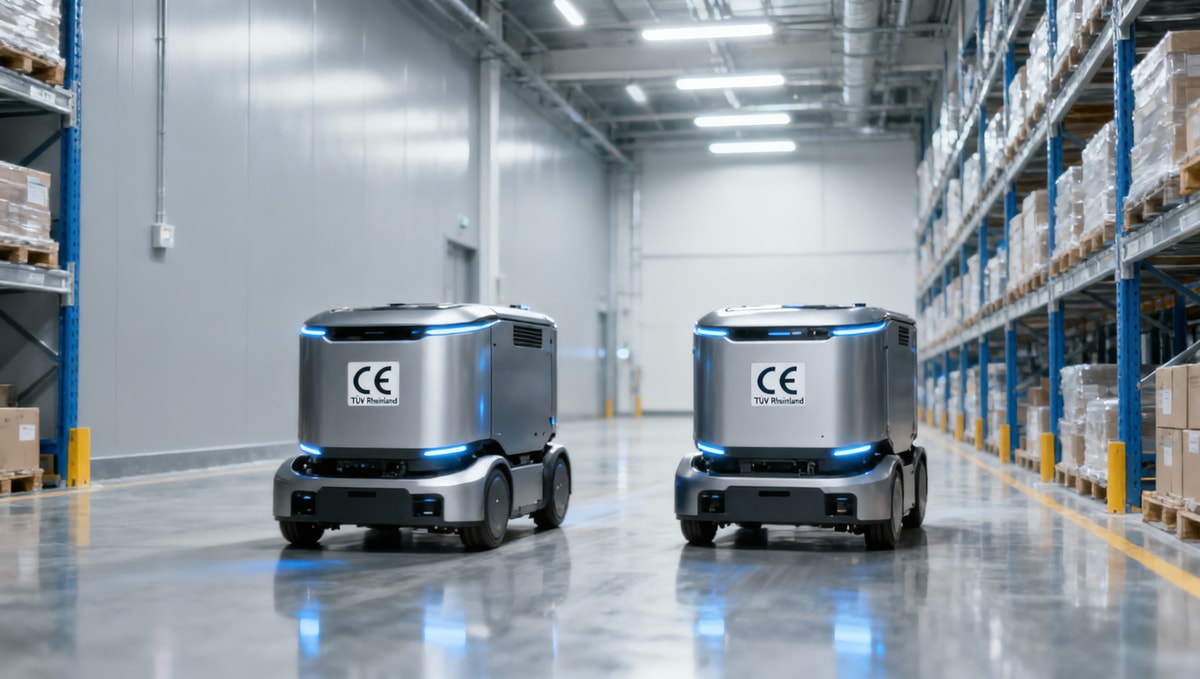
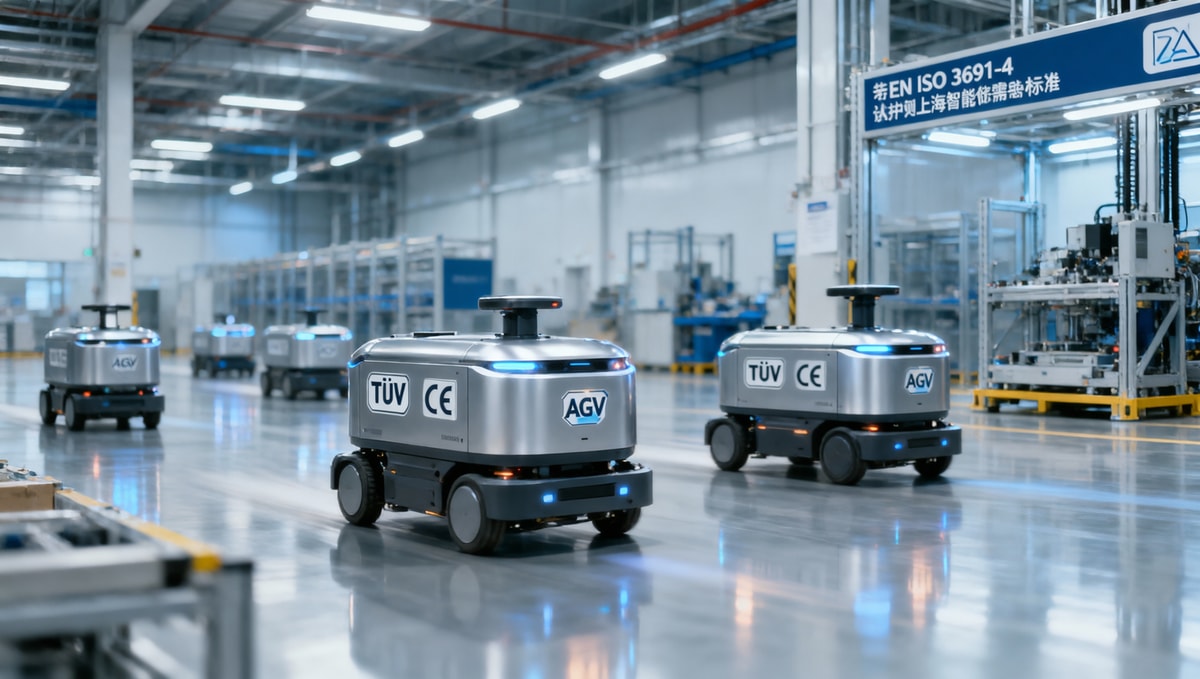
On April 28, 2026, TÜV Rheinland announced the launch of a dedicated fast-track certification pathway for intelligent warehouse robotics in China — reducing end-to-end certification time from an average of 65 working days to just 22. The initiative targets manufacturers of AGVs and AMRs seeking EU market access, particularly those already compliant with China’s GB/T 32959–2025 national standard, and is centered in Shenzhen and Suzhou.
Event Overview
On April 28, 2026, TÜV Rheinland established Warehouse Robotics专属 certification centers in Shenzhen and Suzhou, China. These centers deliver integrated testing, evaluation, and certification services for products meeting both IEC 61508 SIL2 and ISO/TS 15066 safety requirements. The certified timeline has been shortened to 22 working days, down from the previous average of 65 working days.
Industries Affected
Direct Exporters of AGVs/AMRs
Manufacturers exporting autonomous mobile robots or automated guided vehicles to the EU face tighter conformity timelines due to CE marking requirements under the Machinery Regulation (EU) 2023/1230. This accelerated pathway directly reduces time-to-market for EU logistics integrators’ tenders — especially where SIL2 functional safety and human-robot collaboration (HRC) compliance are mandatory.
Domestic Logistics System Integrators
Chinese system integrators deploying warehouse robotics for multinational clients — particularly European 3PLs or e-commerce fulfillment providers — now have faster validation support when specifying TÜV-certified hardware. Reduced certification lag improves bid responsiveness and technical alignment with EU project schedules.
Suppliers of Safety-Critical Subsystems
Vendors supplying safety-rated components (e.g., emergency stop modules, collaborative sensors, motion controllers) to AGV/AMR OEMs may experience increased demand for pre-validated, SIL2-compliant parts — as OEMs seek to compress their own internal integration testing cycles ahead of third-party assessment.
What Enterprises and Practitioners Should Monitor and Do Now
Confirm eligibility against the dual-standard requirement
Verify whether current product architecture meets both IEC 61508 SIL2 (functional safety) and ISO/TS 15066 (collaborative robot safety) — not just one. Certification under this fast-track channel is conditional on concurrent compliance; partial alignment does not qualify.
Align internal test documentation with TÜV Rheinland’s reporting templates
Prepare safety lifecycle documentation — including hazard analysis, safety requirements specification, and validation reports — using formats aligned with TÜV Rheinland’s published guidelines for warehouse robotics. Early alignment avoids rework during submission review.
Assess readiness for on-site assessment at Shenzhen or Suzhou centers
Confirm availability of prototype units, firmware versions, and operational test environments matching final production configuration. Both centers require physical unit testing; remote-only submissions are not accepted under this streamlined process.
Monitor upcoming updates to EU delegated acts on AI Act applicability
While this fast-track addresses current Machinery Regulation obligations, the EU AI Act’s upcoming delegated acts may impose additional requirements for robots with adaptive autonomy features. This certification pathway does not cover AI Act conformity — that remains a separate, pending evaluation layer.
Editorial Perspective / Industry Observation
Observably, this initiative reflects growing institutional recognition of China’s maturing warehouse robotics supply chain — not as a generic manufacturing base, but as a source of functionally sophisticated, standards-aligned hardware. Analysis shows it is less a standalone certification upgrade and more a targeted infrastructure response: TÜV Rheinland is localizing verification capacity to match the geographic concentration of R&D and pilot deployment activity in the Greater Bay Area and Yangtze River Delta. From an industry perspective, this fast-track is best understood as an operational enabler — not a regulatory relaxation. It accelerates execution within existing compliance boundaries, rather than lowering them. Continued relevance depends on sustained alignment between GB/T 32959–2025 and evolving EU harmonized standards, which remains subject to ongoing technical coordination.

In summary, the 22-day certification pathway signals tightening synchronization between China’s national robotics standards and EU market gateways — but only for vendors operating at the intersection of functional safety rigor and collaborative operation design. It does not lower entry thresholds; it shortens validated execution paths for those already meeting them. Current interpretation should emphasize capability readiness over procedural convenience.
Source: Official announcement by TÜV Rheinland, dated April 28, 2026. No additional background data, policy documents, or third-party verification sources were referenced. Ongoing observation is recommended regarding potential expansion to other certification bodies or inclusion of AI-related assessment modules beyond current scope.
Get weekly intelligence in your inbox.
No noise. No sponsored content. Pure intelligence.
 Apr 30, 2026Tangshan Beijiao Thermal Power Unit #1 A-Grade Maintenance LaunchTangshan Beijiao Thermal Power Unit #1 A-Grade Maintenance Launch
 Apr 30, 2026SAMR to Finalize 1,800+ Standards in 2026 Affecting Industrial Materials ExportsSAMR to Finalize 1,800+ Standards in 2026 Affecting Industrial Materials Exports
 Apr 30, 2026UAE Becomes Global AI Hub: New CE-ADAS+ Pathway for Chinese Smart Industrial EquipmentUAE Becomes Global AI Hub: New CE-ADAS+ Pathway for Chinese Smart Industrial Equipment
 Apr 30, 2026Vietnam’s SMT Expansion Drives CNC Fixture Export DelaysVietnam’s SMT Expansion Drives CNC Fixture Export Delays
 Apr 30, 2026USITC Launches 337 Investigation on Wi-Fi 7 RF Modules from ChinaUSITC Launches 337 Investigation on Wi-Fi 7 RF Modules from China
 Apr 30, 2026Morocco Enforces PV Mounting Structure Certification from Q3 2026Morocco Enforces PV Mounting Structure Certification from Q3 2026
 Apr 30, 2026TÜV Rheinland Launches Fast-Track Certification for Chinese Warehouse RobotsTÜV Rheinland Launches Fast-Track Certification for Chinese Warehouse Robots
 Apr 30, 2026Red Sea Crisis Deepens: Suez Canal Fees Up 12%, China-Europe Rail Premium Hits 35%Red Sea Crisis Deepens: Suez Canal Fees Up 12%, China-Europe Rail Premium Hits 35%
 Apr 30, 2026EU Enforces Battery Passport Checks: Storage Export Delays RiseEU Enforces Battery Passport Checks: Storage Export Delays Rise
 Apr 29, 2026USITC Launches Section 337 Investigation into Chinese Wi-Fi 7 RF ModulesUSITC Launches Section 337 Investigation into Chinese Wi-Fi 7 RF Modules
 Apr 29, 2026Côte d'Ivoire Launches $500M Grid Storage Tender, Chinese BESS Fast-TrackedCôte d'Ivoire Launches $500M Grid Storage Tender, Chinese BESS Fast-Tracked
 Apr 29, 2026Morocco Enforces IEC 61427-2:2025 PV Mounting Certification from Q3 2026Morocco Enforces IEC 61427-2:2025 PV Mounting Certification from Q3 2026
 Apr 29, 2026UAE Becomes Global AI Hub: New CE-ADAS+ Path for Chinese Smart Industrial EquipmentUAE Becomes Global AI Hub: New CE-ADAS+ Path for Chinese Smart Industrial Equipment
 Apr 29, 2026Red Sea Crisis: Suez Canal Fees Up 12%, China-Europe Rail Premium at 35%Red Sea Crisis: Suez Canal Fees Up 12%, China-Europe Rail Premium at 35%
 Apr 29, 2026TÜV Rheinland Launches Fast-Track Certification for Chinese Warehouse RobotsTÜV Rheinland Launches Fast-Track Certification for Chinese Warehouse Robots
 Apr 29, 2026Vietnam's SMT Expansion Drives CNC Fixture Export DelaysVietnam's SMT Expansion Drives CNC Fixture Export Delays
![]() Apr 29, 2026NEOM Smart Infrastructure Phase II Opens Bidding: Chinese PV Mounting & BESS Pre-QualifiedNEOM Smart Infrastructure Phase II Opens Bidding: Chinese PV Mounting & BESS Pre-Qualified
Apr 29, 2026NEOM Smart Infrastructure Phase II Opens Bidding: Chinese PV Mounting & BESS Pre-QualifiedNEOM Smart Infrastructure Phase II Opens Bidding: Chinese PV Mounting & BESS Pre-Qualified Apr 29, 2026EU Enforces Battery Passport for Energy Storage Imports from July 2026EU Enforces Battery Passport for Energy Storage Imports from July 2026
 Apr 29, 2026Maine Bans New >20MW Data Centers — AI Hardware Delivery ImpactedMaine Bans New >20MW Data Centers — AI Hardware Delivery Impacted
 Apr 28, 2026Suez Canal Fee Hike & China-Europe Rail Premium: Q2 2026 ImpactSuez Canal Fee Hike & China-Europe Rail Premium: Q2 2026 Impact
 Apr 28, 2026TÜV Rheinland Launches Fast-Track Certification for Chinese Warehouse RobotsTÜV Rheinland Launches Fast-Track Certification for Chinese Warehouse Robots
 Apr 28, 2026EU Enforces Battery Passport Rule for Chinese ESS Exports from 2027EU Enforces Battery Passport Rule for Chinese ESS Exports from 2027
 Apr 28, 2026ADB Raises Vietnam GDP Forecast to 7.2%: SMT & Precision Fixture Demand RisesADB Raises Vietnam GDP Forecast to 7.2%: SMT & Precision Fixture Demand Rises
 Apr 28, 2026US ITC Launches Section 337 Investigation into Chinese Wi-Fi 7 RF FEMsUS ITC Launches Section 337 Investigation into Chinese Wi-Fi 7 RF FEMs
 Apr 28, 2026Côte d'Ivoire Opens $500M Power Tender: Chinese BESS Get Fast-Track AccessCôte d'Ivoire Opens $500M Power Tender: Chinese BESS Get Fast-Track Access
 Apr 28, 2026BP’s Algeria East Basin Permit Spurs Valve Demand, Lead Times Extend to 18 WeeksBP’s Algeria East Basin Permit Spurs Valve Demand, Lead Times Extend to 18 Weeks
") Apr 28, 2026Vietnam Mandates V-Trust for Smart Appliances Export (July 2026)Vietnam Mandates V-Trust for Smart Appliances Export (July 2026)
Apr 28, 2026Vietnam Mandates V-Trust for Smart Appliances Export (July 2026)Vietnam Mandates V-Trust for Smart Appliances Export (July 2026)