When SCARA Robots Outperform Cartesian Systems on Assembly Lines
On fast-moving assembly lines, choosing the right automation architecture can directly affect speed, precision, and floor-space efficiency. While Cartesian systems remain valuable in many applications, scara robots often deliver superior performance in high-speed pick-and-place, compact workcells, and repeatable horizontal motion. For technical evaluators, understanding where these advantages translate into measurable production gains is key to smarter investment decisions.
For procurement teams, manufacturing engineers, and automation specifiers, the comparison is rarely about which robot type is universally better. The real question is where each architecture creates the strongest return under actual cycle-time targets, payload requirements, and layout constraints. In many modern electronics, medical device, and light industrial assembly environments, scara robots can outperform Cartesian systems by reducing motion overhead, simplifying workcell design, and sustaining stable throughput over long production runs.
This article examines the decision points that matter most to technical evaluators: motion profile, takt time, accuracy, integration complexity, maintenance load, and total operational fit. It also highlights the limits of scara robots, because effective capital planning depends on knowing both the performance upside and the application boundaries before equipment is specified.
Where SCARA Robots Gain a Measurable Edge
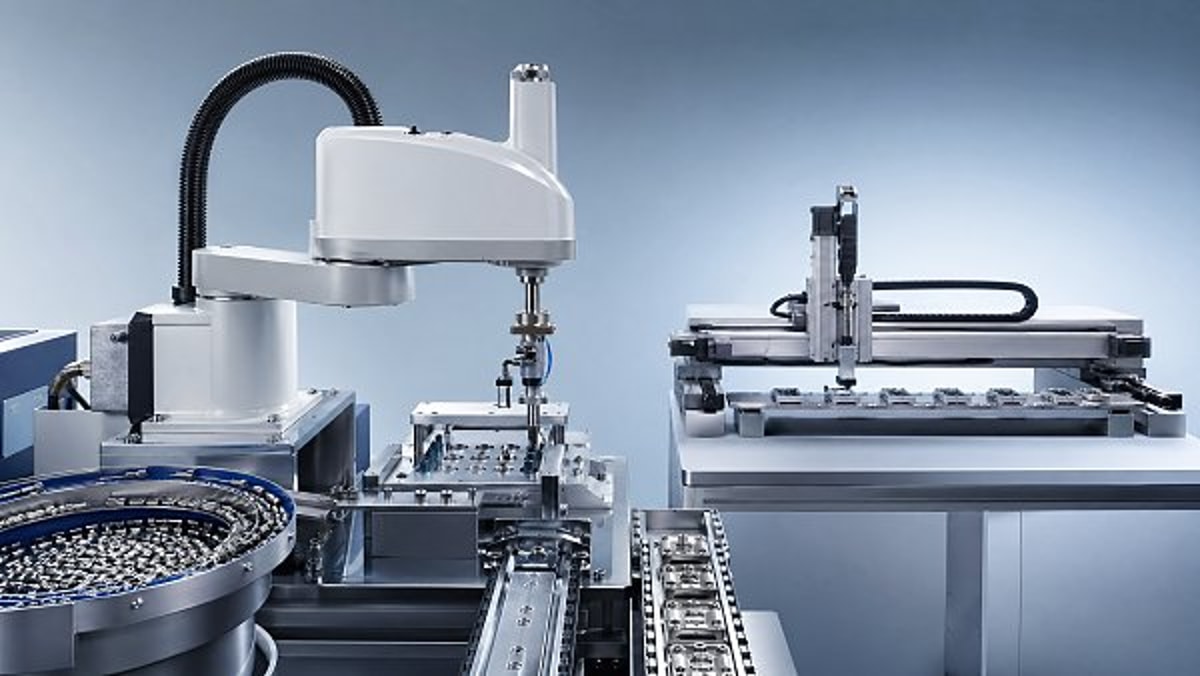
SCARA robots are strongest in assembly tasks that require rapid horizontal movement, controlled vertical insertion, and compact cell footprints. Their selective compliance design allows flexibility in the X-Y plane while remaining rigid in the Z axis, which is especially useful for press-fit, insertion, screwdriving support, and high-speed part transfer. In production cells operating at 20 to 60 picks per minute, that motion behavior can translate into a noticeable throughput advantage.
Cartesian systems, by contrast, excel when the process demands long linear travel, multi-station coverage, or a rectangular work envelope with highly predictable pathing. However, when the job is concentrated within a radius-based work area of roughly 400 mm to 1,200 mm, SCARA motion often requires fewer directional changes and less mechanical travel than a gantry-style arrangement. That reduction in travel complexity can shave fractions of a second off each cycle, which becomes meaningful across 2 shifts and thousands of units per day.
Another reason scara robots often outperform is installation density. On crowded assembly lines, floor space is no longer a minor planning detail. A compact SCARA cell can reduce occupied floor area by 20% to 40% compared with larger Cartesian framing in equivalent pick-and-place applications. For facilities balancing line expansion with limited plant footprint, that space efficiency may be as valuable as raw speed.
Typical performance conditions that favor SCARA architecture
- Cycle times below 3 seconds where acceleration and deceleration matter more than long linear reach.
- Payloads in the light-to-medium range, commonly between 1 kg and 20 kg depending on end-of-arm tooling.
- Operations involving repeated X-Y transfer with short Z-axis approach and retraction.
- Cells where machine access, guarding, and feeder placement must fit into a compact layout.
The comparison below summarizes where technical evaluators commonly see the strongest differences between scara robots and Cartesian systems on assembly lines.
For technical evaluation, the key takeaway is not speed in isolation. SCARA robots create the most value when high repetition, compact reach, and short transfer paths align. When those three conditions appear together, the architecture frequently delivers better productivity per square meter and lower motion waste per cycle.
Application Scenarios Where Cartesian Systems Fall Behind
On assembly lines, performance differences usually become visible in specific task families rather than broad categories. SCARA robots tend to outperform Cartesian systems in feeder-to-fixture transfer, tray loading, micro-assembly support, connector insertion, and synchronized part orientation. These are not unusual edge cases; they are common workflows in smart electronics, healthcare device assembly, and compact precision manufacturing.
In electronics assembly, for example, a line may require repeated pickup from vision-located trays followed by placement into nests with tolerance windows under ±0.02 mm to ±0.05 mm at the tool point, depending on process design and fixturing. A SCARA robot can often sustain that motion pattern more efficiently than a Cartesian arrangement because it pivots naturally between points rather than traversing multiple linear axes across every move.
Healthcare technology production presents another strong use case. Many disposable device components, diagnostic cartridges, and compact electromechanical modules involve short-stroke assembly sequences. In these cells, contamination control, cell enclosure size, and repeatability are as important as speed. A pedestal-mounted SCARA unit can simplify enclosure design and reduce moving frame exposure compared with larger gantry constructions.
High-fit scenarios for scara robots
Technical evaluators often prioritize application fit before comparing brands or controller options. The following matrix can help determine whether the process profile naturally favors scara robots.
What matters here is not only robot performance, but system-level fit. If the assembly cell relies on closely spaced feeders, small nests, and repetitive horizontal transfers over distances under 800 mm, scara robots often reduce both motion time and mechanical complexity. If the process requires 1.5 m to 3 m linear travel or multiple far-apart stations, Cartesian systems may still remain the more practical choice.
Common evaluation mistake
A frequent error is comparing robots by nominal repeatability alone. On real assembly lines, throughput loss often comes from feeder access, approach path inefficiency, and settling time after each move. A technically modest difference of 0.2 seconds per cycle can become 720 seconds per 3,600 cycles, or 12 minutes per shift segment. Over weeks of production, those small losses become highly visible in output and labor balancing.
Technical Selection Criteria for Evaluators
When evaluating scara robots against Cartesian systems, technical teams should move beyond broad specifications and focus on process-critical variables. A well-structured assessment typically includes 4 core groups: motion performance, mechanical fit, controls integration, and lifecycle support. Each group affects the actual return on automation investment more than brochure-level speed claims.
Motion performance should be tested against real path geometry. For instance, a nominal cycle time at 25-300-25 mm may not reflect the actual cell, where moves include vision correction, part rotation, and two-stage Z descent. Evaluators should model at least 3 representative motion sequences and compare average cycle time, peak acceleration, and positional settling under real end-effector mass. This is particularly important when tooling weight rises above 15% to 20% of rated payload.
Mechanical fit includes reach radius, mounting style, cable routing, and allowable moment load. In compact lines, the wrong cable path or controller location can create maintenance delays or interfere with guarding. A SCARA robot may appear ideal on paper, but if the application demands awkward overreach, off-center loading, or frequent tool changes, the expected speed benefit can narrow quickly.
A practical 6-point evaluation checklist
- Map real point-to-point travel distance rather than relying only on catalog reach.
- Measure required takt time with feeder, vision, and inspection delays included.
- Confirm payload, moment, and tool mass at the wrist under dynamic movement.
- Check integration with PLC, fieldbus, safety I/O, and traceability software.
- Review preventive maintenance intervals, spare parts access, and local service response.
- Run a failure-mode review for mispick recovery, jam conditions, and restart time.
Procurement and engineering teams should also define acceptance criteria before vendor comparison begins. Common thresholds include cycle time within ±5% of target, repeatability aligned to process tolerance stack-up, unplanned downtime under agreed internal benchmarks, and commissioning within a planned 2 to 6 week integration window depending on line complexity.
Integration questions that affect total value
The most reliable scara robots are not always the cheapest to deploy, and the least expensive system is not always the lowest-cost choice over 3 to 5 years. Technical evaluators should ask whether motion libraries are easy to tune, whether spare parts are regionally available within 24 to 72 hours, and whether the supplier can support validation requirements in regulated or high-traceability production environments.
For organizations using platforms like TradeNexus Pro to compare suppliers and monitor manufacturing trends across advanced manufacturing and smart electronics, the strongest purchasing decisions usually come from combining application-fit analysis with supplier ecosystem strength. Controller flexibility, integration partner quality, and support depth can influence line output just as much as raw robot speed.
Implementation, Maintenance, and Total Cost Considerations
A scara robot can win the technical comparison and still disappoint if implementation planning is weak. The best results come when the robot is specified as part of the entire cell architecture, including feeders, vision, fixtures, safety, and operator interaction. On many assembly lines, 60% or more of performance variance comes from system integration quality rather than robot selection alone.
Commissioning time is often shorter with scara robots in compact applications because fewer structural elements are required than with larger Cartesian frames. Depending on complexity, a standard single-station SCARA cell may be installed and tuned in 1 to 3 weeks, while a more customized multi-axis Cartesian solution can take longer if framing, guarding, and long-axis alignment require more site work. Actual timing depends on tooling maturity and software readiness, not only hardware type.
Maintenance is another differentiator. Cartesian systems may involve multiple linear guides, belts, screws, or rails extending across larger distances, which can increase inspection points and alignment sensitivity. Scara robots usually concentrate motion in a smaller mechanical package, which can simplify routine checks. However, compact design does not eliminate the need for periodic lubrication, cable inspection, backlash monitoring, and end-effector verification at defined intervals such as every 1,000 to 3,000 operating hours.
Cost and support factors that shape long-term performance
The table below highlights how technical teams can compare lifecycle considerations without reducing the decision to initial equipment price alone.
The most useful total cost analysis includes at least 5 dimensions: capital cost, integration labor, commissioning time, preventive maintenance hours, and downtime exposure. In high-volume assembly, a system that saves only 0.15 to 0.30 seconds per cycle may justify a higher upfront cost if production runs are stable and annual output is large enough to capture that gain consistently.
Risk areas to monitor before purchase
- Overestimating payload because tooling, cables, and vacuum hardware were not fully included.
- Assuming vendor cycle-time claims match the real path sequence on the line.
- Ignoring feeder synchronization and vision latency, which can erase robot speed benefits.
- Selecting a compact robot without planning service access clearances and maintenance zones.
When these risks are addressed early, scara robots are often easier to scale across similar workstations. Standardizing one compact automation architecture across 4 to 12 identical cells can streamline spare parts stocking, operator training, and preventive maintenance planning, which matters in multi-site manufacturing networks and globally distributed B2B production strategies.
FAQ for Technical Evaluators and Buyers
How do I know if scara robots are better than Cartesian systems for my line?
Start with path geometry and takt time. If the work area is compact, travel is repetitive, and most moves happen within a radius under about 1 meter, scara robots often deserve first consideration. If the process spans long distances, covers multiple stations, or requires extensive rectangular travel, Cartesian systems may still deliver better practical value.
What metrics should procurement teams request during technical comparison?
Request 6 concrete items: tested cycle time on a representative path, repeatability under actual tool load, payload and moment limits, controller and PLC compatibility, preventive maintenance interval, and estimated spare parts lead time. Those factors provide a much clearer purchasing basis than generic maximum speed or catalog reach alone.
Are scara robots only for electronics assembly?
No. They are common in smart electronics, but they also fit healthcare technology, precision consumer products, compact industrial sub-assemblies, and packaging-related staging tasks. The deciding factor is motion pattern, not industry label. Any line with fast, repeatable horizontal motion and controlled vertical insertion may benefit.
What is the biggest mistake during evaluation?
The most common mistake is evaluating the robot separately from the cell. A robot that looks fast in isolation can underperform if part presentation is unstable, inspection latency is high, or fixture access is awkward. Always test the combined sequence, including pick confirmation, orientation, placement, and recovery logic.
For technical evaluators, the strongest conclusion is straightforward: scara robots outperform Cartesian systems when the assembly process rewards compact reach, short cycle times, and repeatable horizontal movement. Their advantage becomes most visible in high-speed pick-and-place, insertion support, and dense cell layouts where every second and every square meter count.
The right decision, however, depends on disciplined comparison. Evaluate real motion paths, not abstract specifications. Measure system-level timing, not robot speed alone. Review service access, maintenance intervals, and supplier support with the same rigor used for payload and repeatability. That is how technical teams turn automation selection into durable production gains.
If your organization is assessing scara robots for advanced manufacturing, smart electronics, healthcare technology, or other precision assembly environments, now is the time to validate the fit with application-specific data. Contact TradeNexus Pro to explore deeper supplier intelligence, compare integration options, and get a more tailored view of automation solutions for your next assembly-line investment.
Get weekly intelligence in your inbox.
No noise. No sponsored content. Pure intelligence.
 May 02, 2026China’s '15th Five-Year Plan' Prioritizes Low-Altitude Economy, Boosting Warehouse Robotics ExportsChina’s '15th Five-Year Plan' Prioritizes Low-Altitude Economy, Boosting Warehouse Robotics Exports
 May 02, 2026Q1 2026 Industrial Profits +15.5%; CNC Machining Capacity Utilization RisesQ1 2026 Industrial Profits +15.5%; CNC Machining Capacity Utilization Rises
 May 02, 2026China Opens Green Channel for Smart Home Exporters with Int'l CertsChina Opens Green Channel for Smart Home Exporters with Int'l Certs
 May 02, 2026Solar PV Export Timeliness Rises via Western Land-Sea CorridorSolar PV Export Timeliness Rises via Western Land-Sea Corridor
 May 02, 2026UAE Tops Global AI Hub Ranking; Demand Rises for Chinese FA SolutionsUAE Tops Global AI Hub Ranking; Demand Rises for Chinese FA Solutions
 May 02, 2026ADB Raises Vietnam GDP Forecast to 7.2% for 2026ADB Raises Vietnam GDP Forecast to 7.2% for 2026
") May 02, 2026China’s Trade SaaS Export Standards Updated (2026–2030)China’s Trade SaaS Export Standards Updated (2026–2030)
May 02, 2026China’s Trade SaaS Export Standards Updated (2026–2030)China’s Trade SaaS Export Standards Updated (2026–2030) May 02, 2026World's First 10,000-Car PCTC Delivered in GuangzhouWorld's First 10,000-Car PCTC Delivered in Guangzhou
 May 02, 2026China’s 5-Dept Battery Recycling Traceability Rule Affects ESS ExportsChina’s 5-Dept Battery Recycling Traceability Rule Affects ESS Exports
 May 02, 2026WeChat Pay QR Integration for 5 Countries: Eases Cross-Border ProcurementWeChat Pay QR Integration for 5 Countries: Eases Cross-Border Procurement
 May 01, 2026Beijing’s New E-Bike Rules Trigger Dual-Certification Demand for China’s Swappable Battery CabinetsBeijing’s New E-Bike Rules Trigger Dual-Certification Demand for China’s Swappable Battery Cabinets
 May 01, 2026GNA’s GEO Service Assessment Elevates AI Search as Digital Procurement Metric for Chinese ExportersGNA’s GEO Service Assessment Elevates AI Search as Digital Procurement Metric for Chinese Exporters
 May 01, 20262026 China Cycle Expo: Chinese EPS Systems Achieve UL 2849:2026 Full Certification2026 China Cycle Expo: Chinese EPS Systems Achieve UL 2849:2026 Full Certification
 May 01, 2026GB 42236-2026 Enforces EV Charger Efficiency & Overload Protection from May 2026GB 42236-2026 Enforces EV Charger Efficiency & Overload Protection from May 2026
 May 01, 2026GB/T 43790-2026 Drone EMC Standard Effective May 2026GB/T 43790-2026 Drone EMC Standard Effective May 2026
 May 01, 20262026 Foshan Tanzhou Auto Industry Expo Opens2026 Foshan Tanzhou Auto Industry Expo Opens
 May 01, 2026China’s New Hazardous Chemicals Safety Law Takes Effect May 2026China’s New Hazardous Chemicals Safety Law Takes Effect May 2026
 May 01, 2026New Maritime and Fisheries Laws Take Effect May 1, 2026New Maritime and Fisheries Laws Take Effect May 1, 2026
 May 01, 2026Supply Chain Automation Works Best Where Delays RepeatSupply Chain Automation Works Best Where Delays Repeat
 May 01, 2026High Strength Steel Forgings: What Should Be Tested First?High Strength Steel Forgings: What Should Be Tested First?
 May 01, 2026Automotive Steel Forging: Cost Pressure vs Part ReliabilityAutomotive Steel Forging: Cost Pressure vs Part Reliability
 May 01, 2026Why High Durability Steel Forgings Fail Earlier Than ExpectedWhy High Durability Steel Forgings Fail Earlier Than Expected
 May 01, 2026Construction Aluminum Extrusions: Which Finish Lasts Longer?Construction Aluminum Extrusions: Which Finish Lasts Longer?
 May 01, 2026Lightweight Aluminum Extrusions: Where Savings Really HappenLightweight Aluminum Extrusions: Where Savings Really Happen
 May 01, 2026Aerospace Aluminum Extrusions Need More Than Low WeightAerospace Aluminum Extrusions Need More Than Low Weight
 May 01, 2026Precision Lathe Turning Problems That Show Up After AssemblyPrecision Lathe Turning Problems That Show Up After Assembly
 May 01, 2026High Precision Lathe Turning: Tolerance Claims to VerifyHigh Precision Lathe Turning: Tolerance Claims to Verify