EU SVHC Update Effective May 1, 2026: Impact on Electronic Components Exports
As of May 1, 2026, the European Chemicals Agency (ECHA) has added five new substances to the Candidate List of Substances of Very High Concern (SVHC), triggering updated REACH compliance and SCIP notification requirements for exporters of electronic components — particularly affecting PCB manufacturers, sensor module suppliers, and smart controller producers in China.
Event Overview
On May 1, 2026, ECHA officially listed five new substances on the SVHC candidate list: two flame retardants and three photoinitiators. This update mandates that all suppliers of electronic components placing products on the EU market must revise their REACH compliance declarations and submit or update SCIP notifications without delay. The change is publicly confirmed and published by ECHA as part of its regular SVHC candidate list updates.
Industries Affected by the Update
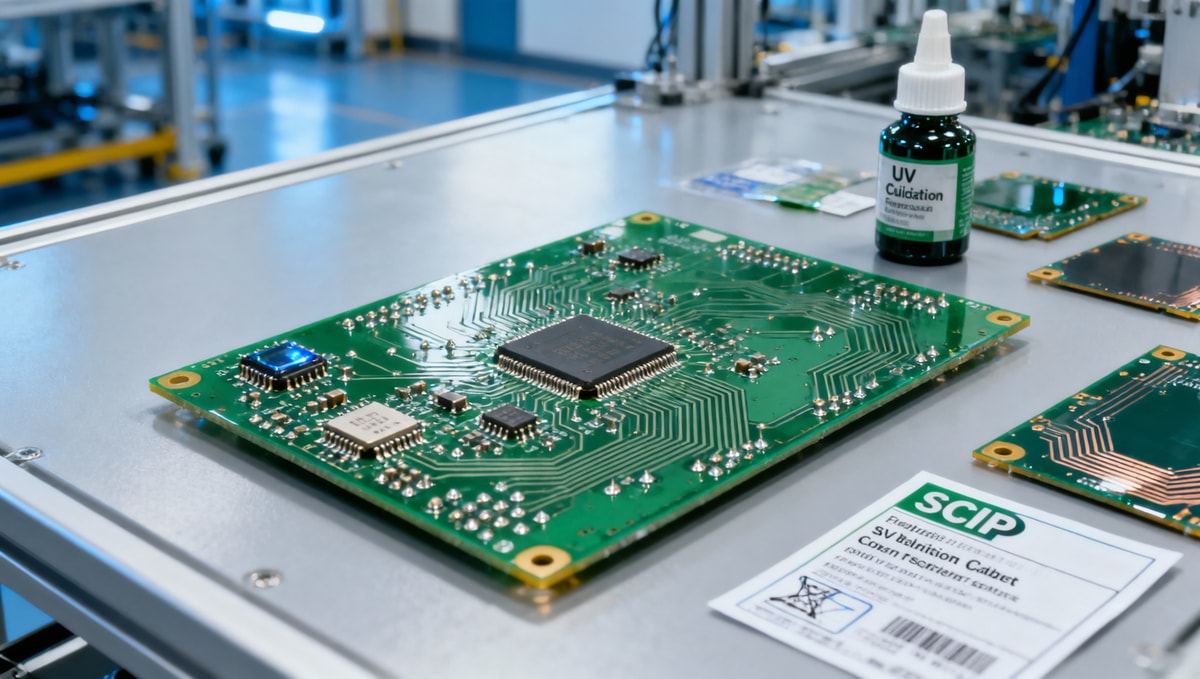
– PCB manufacturers: PCBs often incorporate flame retardants (e.g., in substrate laminates) and photoinitiators (e.g., in solder mask inks). With two of the newly listed SVHCs falling into these categories, PCB producers supplying EU-bound assemblies must verify substance presence at or above 0.1% w/w in articles and ensure SCIP data reflects current formulations.
– Sensor module and smart controller assemblers: These finished electronic components frequently contain coated or encapsulated layers where photoinitiators may be present in UV-curable adhesives or conformal coatings. As ‘articles’ under REACH, each module must undergo SVHC screening per component — not just at the board level — increasing technical documentation burden.
– Raw material and chemical suppliers to electronics OEMs: Suppliers providing flame retardant additives or photoinitiator-based resins to PCB fabricators or contract manufacturers must now provide updated Safety Data Sheets (SDS) with SVHC disclosure and support downstream SCIP reporting — even if they do not directly export to the EU.
– Export trading and logistics service providers: Customs clearance for electronic components entering the EU may face delays if SCIP submission IDs are missing or outdated in import declarations. Forwarders handling consignments from Chinese electronics exporters report increased verification requests from EU customs brokers since early April 2026.
What Relevant Enterprises or Practitioners Should Focus On and How to Respond
Verify current SCIP submissions against the updated SVHC list
Enterprises must cross-check existing SCIP dossier entries — especially those submitted before May 2026 — for inclusion of the five newly listed substances. If any of the substances are present above threshold in an article, the SCIP record must be updated; failure to do so may result in non-compliant status flagged by the ECHA database.
Review bill-of-materials (BOM) and supplier declarations for flame retardants and photoinitiators
Focus screening efforts on materials known to contain organophosphate flame retardants (e.g., TCPP, TDCPP analogues) and Type I/II photoinitiators (e.g., benzophenone derivatives, α-hydroxy ketones). Request updated substance-level declarations from Tier-2 and Tier-3 material suppliers — not only Tier-1 contract manufacturers.
Prepare for accelerated customer audits and brand-led supply chain verification
Major EU-based electronics brands have already issued internal alerts requesting updated REACH statements and SCIP IDs from key suppliers. Companies should expect tighter timelines for document submission during pre-shipment audits and may face shipment rejection if documentation lags beyond May 1, 2026 — particularly for high-volume sensor and controller SKUs.
Designate a REACH/SCIP focal point internally and align with EU-only representative (if applicable)
Non-EU companies exporting electronic components must ensure their appointed EU Only Representative (OR) is formally authorized to manage SCIP updates and maintains access to internal BOM and formulation data. Internal coordination between procurement, QA, and export compliance teams is critical to avoid fragmented or conflicting declarations.
Editorial Perspective / Industry Observation
Observably, this SVHC listing is less a sudden regulatory shock and more a predictable progression of ECHA’s ongoing prioritization of industrial photoinitiators and halogen-free flame retardants — both of which have drawn scrutiny in recent years due to persistence and endocrine disruption concerns. Analysis shows the timing aligns with ECHA’s 2025–2027 work programme, suggesting further SVHC additions targeting electronics-related chemicals are likely before 2027. From an industry perspective, the May 1, 2026 effective date signals that compliance is no longer optional for market access — but actual enforcement (e.g., customs holds, brand-led penalties) remains case-specific and dependent on traceability depth. Current enforcement appears focused on high-risk product categories and repeat non-compliant actors rather than broad-based audits.

Conclusion: This SVHC update formalizes new obligations for electronics exporters but does not introduce fundamentally new compliance logic — it extends existing REACH/SCIP frameworks to additional substances. It is best understood not as an isolated event, but as a reinforcement of long-standing regulatory expectations around chemical transparency in complex electronic articles. For affected enterprises, proactive substance mapping and cross-tier communication remain more operationally effective than reactive documentation fixes.
Source: European Chemicals Agency (ECHA) — SVHC Candidate List update published April 2026, effective May 1, 2026.
Note: Ongoing monitoring of ECHA’s official guidance documents and national enforcement practices (e.g., German BAuA, Dutch ILT) is recommended, as interpretation of ‘article’ scope for multi-layer electronic modules remains subject to national authority discretion.
Get weekly intelligence in your inbox.
No noise. No sponsored content. Pure intelligence.
 May 04, 2026FDA AI Diagnostic Software Guidance: Continuous Validation for Overseas FirmsFDA AI Diagnostic Software Guidance: Continuous Validation for Overseas Firms
 May 04, 2026MIIT Launches Export Compliance Support for Warehouse RoboticsMIIT Launches Export Compliance Support for Warehouse Robotics
 May 04, 2026India BIS Mandates ISI Certification for Smart Home Devices from July 2026India BIS Mandates ISI Certification for Smart Home Devices from July 2026
 May 04, 2026Global Shipping Alliance Raises Heavy-Lift Surcharges from May 2026Global Shipping Alliance Raises Heavy-Lift Surcharges from May 2026
 May 04, 2026GCC EV Charging Certification Unified: 35% Cost Cut for Chinese ExportersGCC EV Charging Certification Unified: 35% Cost Cut for Chinese Exporters
 May 04, 2026TÜV Rheinland Updates IoT Security Standard with AI Voice Data AnonymizationTÜV Rheinland Updates IoT Security Standard with AI Voice Data Anonymization
 May 04, 2026Yangshan Port Launches Green Energy Equipment Express LaneYangshan Port Launches Green Energy Equipment Express Lane
 May 04, 2026Vietnam Enforces Local IoT Certification for Smart Home Devices from May 2026Vietnam Enforces Local IoT Certification for Smart Home Devices from May 2026
 May 04, 2026US CBP Launches Battery Cargo Inspection: ESS Export Delays to 7–12 DaysUS CBP Launches Battery Cargo Inspection: ESS Export Delays to 7–12 Days
 May 04, 2026EU SVHC Update Effective May 1, 2026: Impact on Electronic Components ExportsEU SVHC Update Effective May 1, 2026: Impact on Electronic Components Exports
 May 04, 2026Portable power stations: what matters more than wattage on paperPortable power stations: what matters more than wattage on paper
 May 04, 2026Automotive injection molding machines and the scrap rate problemAutomotive injection molding machines and the scrap rate problem
 May 04, 2026Smart thermostats save energy only when setup is done rightSmart thermostats save energy only when setup is done right
 May 04, 2026Why TWS earbuds sound great in ads but not on callsWhy TWS earbuds sound great in ads but not on calls
 May 04, 2026Industrial robotics for material handling: where downtime startsIndustrial robotics for material handling: where downtime starts
 May 04, 2026LiFePO4 battery lifespan drops faster under these conditionsLiFePO4 battery lifespan drops faster under these conditions
 May 04, 2026Solar grid systems: when storage changes the project mathSolar grid systems: when storage changes the project math
 May 04, 2026Smart manufacturing for pharma fails when data stays isolatedSmart manufacturing for pharma fails when data stays isolated
 May 04, 2026Wearable technology trends that are finally useful in 2026Wearable technology trends that are finally useful in 2026
 May 04, 2026Bluetooth speakers: why battery life claims often miss real useBluetooth speakers: why battery life claims often miss real use
 May 04, 2026Home automation systems that solve everyday annoyances firstHome automation systems that solve everyday annoyances first
 May 04, 2026Solar street lights that underperform after the first rainy seasonSolar street lights that underperform after the first rainy season
 May 04, 2026Why sheet metal bending services in Canada cost more than expectedWhy sheet metal bending services in Canada cost more than expected
 May 04, 2026Factory automation systems for electronics and the ROI gapFactory automation systems for electronics and the ROI gap
 May 04, 2026OEM machined parts supplier Vietnam: quality checks that matterOEM machined parts supplier Vietnam: quality checks that matter
 May 04, 2026What to check before choosing a 5 axis machine for defenseWhat to check before choosing a 5 axis machine for defense
 May 04, 2026Smart grid solutions that fix peak load without major rebuildsSmart grid solutions that fix peak load without major rebuilds