Why TWS earbuds sound great in ads but not on calls
TWS earbuds often sound rich and immersive in advertisements, yet the experience can feel disappointing once you take a call. Why does music seem polished while voices become thin, muffled, or unstable? Understanding the gap between marketing claims and real-world call performance helps consumers make smarter buying decisions and choose earbuds that truly match their daily needs.
The short answer is simple: the sound you hear in ads usually highlights what TWS earbuds do best, while phone calls expose what they do worst. Music playback is easier to optimize, easier to market, and easier to make impressive in controlled demonstrations. Call quality, by contrast, depends on microphones, wireless stability, noise reduction, fit, software tuning, and the unpredictable environments of daily life.
For most consumers, that means one thing: a pair of earbuds that sounds exciting for songs is not automatically a good choice for voice calls. If calls matter to you, you need to judge TWS earbuds differently than you judge speakers, headphones, or music-focused audio products.
Why music playback sounds impressive while calls often do not
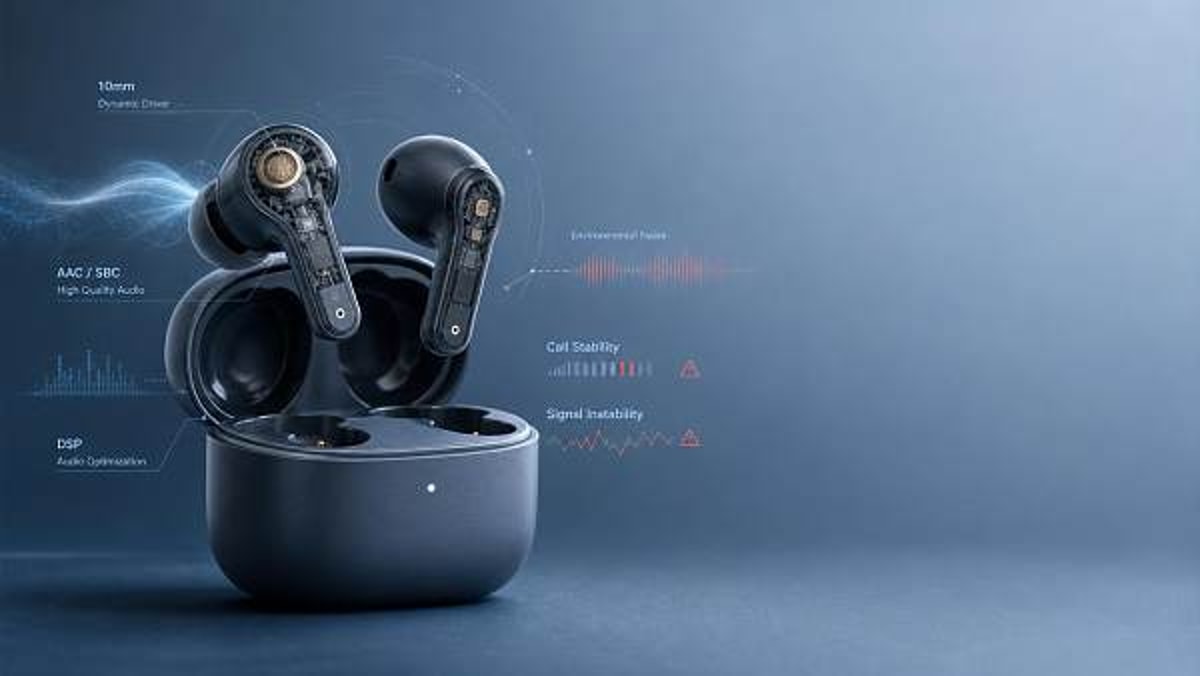
When brands advertise TWS earbuds, they usually focus on the part of the product that is easiest to control: playback. A company can tune bass, treble, and overall soundstage to create a rich listening experience for music, video, and gaming. In a polished ad, that translates into emotional language like “cinematic,” “studio-grade,” or “deep immersive sound.”
Calls are different because they are not mainly about what the earbud plays into your ears. They are about what the microphones capture from your voice and what the wireless system can transmit clearly in real time. That process is much harder to perfect, especially in a tiny product with limited battery, processing power, and microphone size.
Music also benefits from compression and mastering that are designed to sound pleasing on consumer devices. A song has already been produced, balanced, and refined before it reaches your earbuds. A live phone call has no such luxury. It must work instantly, often in traffic, wind, offices, cafés, or on crowded public transport.
That is why many TWS earbuds can make songs feel full and dynamic but still struggle to make your voice sound natural to the person on the other end. The technology challenges are simply not the same.
The biggest reason calls disappoint: microphones matter more than drivers
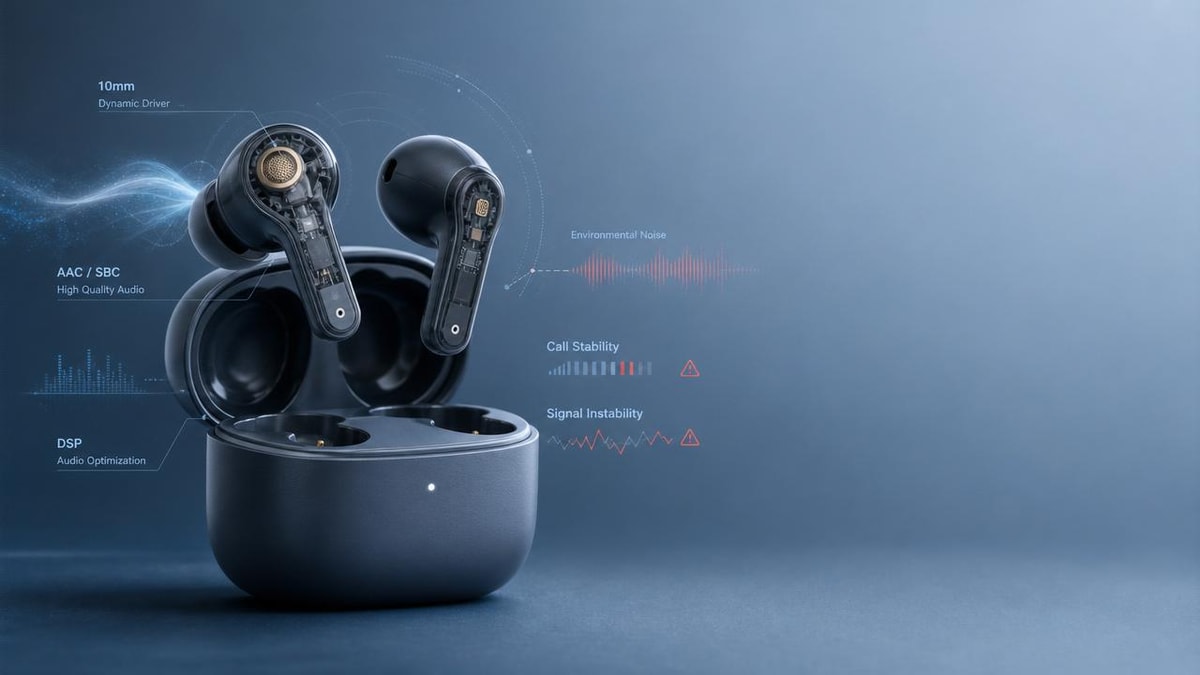
Consumers often shop for TWS earbuds based on driver size, codec support, bass performance, or active noise cancellation. Those features matter for listening, but call quality lives or dies by microphone performance. If the microphones are mediocre, no amount of marketing about “hi-fi sound” will help your calls.
Most true wireless earbuds use very small beamforming microphones. Their job is to isolate your voice from everything around you. That sounds straightforward, but in practice the earbud sits far from your mouth, which means your voice reaches the mic with less strength than it would on a wired headset or a phone held close to your face.
Because the microphone is farther away, the earbuds must rely heavily on software to guess which sounds belong to your voice and which sounds are background noise. When the software guesses well, your calls sound decent. When it guesses badly, your voice becomes robotic, thin, choppy, or distant.
This is one of the main reasons buyers feel misled. They hear “premium sound” in marketing and assume it includes premium calling. In reality, the speaker side and microphone side of TWS earbuds can perform very differently.
Noise cancellation for your ears is not the same as noise cancellation for your calls
One common source of confusion is the term “noise cancellation.” Many shoppers assume that if earbuds have strong ANC, their calls will also sound clear. But these are two separate functions.
Active noise cancellation for listening reduces the environmental noise you hear. It helps you enjoy music on a plane, in an office, or while walking outdoors. That feature improves your own listening experience. It does not guarantee that your voice will be transmitted clearly to someone else.
Call noise reduction is a microphone-processing feature. It attempts to suppress the sounds around you before your voice is sent through the call. This is much more difficult because your earbuds must identify your speech in real time and reduce noise without damaging the voice itself.
That is why some TWS earbuds with excellent ANC still perform only average on phone calls. You may hear the world less, yet the other person may still hear wind, traffic, keyboard clicks, or an unnatural version of your voice.
Bluetooth and call bandwidth create limits that ads rarely mention
Another reason TWS earbuds sound better with media than on calls is that phone calls often use lower bandwidth audio than music streaming. Even if your earbuds support advanced codecs for music, those codecs may not be used the same way during calls.
Traditional call audio is optimized for speech efficiency, stability, and low latency, not richness or full frequency detail. As a result, voices can sound flatter and less natural than music playback. This is especially noticeable if you move between devices, switch from Wi-Fi to cellular, or use communication apps with varying voice compression standards.
Bluetooth stability also matters more during calls because interruptions are more obvious. A tiny drop in signal during music may go unnoticed, but during a conversation it can create stutter, lag, or missing words. Earbuds have to maintain a stable connection between the phone and both earbuds while also processing microphones and environmental noise. That is a demanding task for such a compact device.
In short, even good TWS earbuds are working within technical limits during calls. Marketing materials rarely explain that trade-off clearly.
Real-world environments are much harsher than test labs and advertisements
Ads are made under ideal conditions. Demonstrations happen in quiet spaces, with scripted messaging, controlled lighting, and no sudden noise. Your real life is not like that. You may take calls on a windy street, in a car park, while cooking, or during a commute.
These conditions expose the weaknesses of TWS earbuds quickly. Wind is especially difficult because it hits the microphones directly and creates low-frequency rumble that can overwhelm speech. Busy roads add inconsistent traffic noise. Indoor public spaces create echoes and overlapping voices. Even air conditioning or fans can confuse voice isolation systems.
This is why reviews that only describe how earbuds sound for music are incomplete for many buyers. If you spend significant time on calls, the real question is not “Do they sound great in a quiet room?” but “Can they preserve my voice in places where I actually use them?”
That is the test environment that matters most for practical satisfaction.
Fit and earbud design affect call quality more than many people realize
Most people think fit only affects comfort or bass response, but it can also affect call performance. The way TWS earbuds sit in or around your ears influences microphone orientation, seal, stability, and how the software interprets your voice.
Stem-style earbuds often perform better on calls because the microphones sit slightly closer to the mouth. That small distance advantage can improve voice pickup. By contrast, compact bud-only designs may look cleaner and feel more discreet, but they sometimes face a bigger challenge in capturing speech clearly.
A secure fit also matters because shifting earbuds can change mic alignment and create inconsistent results. If the earbuds loosen when you walk or talk, call quality may fluctuate. Some users blame the network or the brand without realizing the issue is partly physical placement.
For consumers who prioritize meetings, voice notes, and frequent calls, design is not just a style preference. It can directly shape everyday communication quality.
Software tuning can help or hurt your voice
Modern TWS earbuds rely heavily on algorithms. Brands use AI call enhancement, beamforming, environmental detection, and voice isolation software to improve call clarity. In theory, this is a major advantage. In practice, results vary widely.
Some brands tune their software aggressively to remove background noise. That can work well in moderate environments, but it may also strip away parts of your voice. The result is speech that sounds clean but unnatural, compressed, or robotic. Other brands allow more ambient sound to remain, which can preserve vocal realism but reduce overall clarity in noisy spaces.
There is no universal “best” tuning. The ideal balance depends on how and where you use your earbuds. A person who takes calls mostly indoors may prefer more natural voice reproduction. A commuter may prefer stronger suppression, even if it makes the voice sound less full.
This is why reading or watching real call tests is more useful than trusting broad marketing claims. The details of software behavior matter, and they are often invisible on the product box.
How to evaluate TWS earbuds if call quality is important
If you care about calls, change the way you shop. Do not start with bass, battery, or fashionable design alone. Start with a shortlist of products known for strong microphone quality in real environments.
Look for reviews that include call samples recorded in multiple scenarios: quiet rooms, streets, cafés, and windy conditions. This is much more valuable than generic phrases like “good for calls” or “clear voice pickup.” Hearing comparisons reveals whether an earbud keeps your voice natural or just aggressively filters everything.
Pay attention to design clues. Stem-style TWS earbuds often have an edge for voice capture. Multiple microphones per earbud can help, though quantity alone does not guarantee quality. App settings for call enhancement can also be useful if they are implemented well.
Check whether users consistently mention complaints such as muffled voice, dropped words, poor performance outdoors, or one earbud connection issues. Repeated patterns in user feedback are often more revealing than polished specifications.
If possible, test with your own phone and your own calling apps. Some TWS earbuds behave differently across smartphones, operating systems, and platforms such as Zoom, WhatsApp, Teams, or standard mobile calls.
Who should still buy TWS earbuds, and who may need another option
TWS earbuds are still the right choice for many people. They are convenient, portable, cable-free, and often excellent for casual music listening, workouts, entertainment, and short everyday calls. If your calls are brief and usually taken indoors, even mid-range models may be perfectly acceptable.
However, if your day depends on frequent voice communication, you should be more selective. Remote workers, students in online classes, customer-facing professionals, and people who often talk outdoors may need earbuds with unusually strong microphone systems rather than earbuds that simply sound exciting for music.
In some cases, a dedicated headset, wired earphones with an in-line mic, or even the phone’s built-in microphone may outperform fashionable TWS earbuds for pure voice clarity. That may feel surprising, but it reflects the reality of physics and product priorities.
The best product is not always the one with the most dramatic sound signature. It is the one that matches your actual daily use.
The smarter takeaway for consumers
If TWS earbuds sound great in ads but disappointing on calls, that is not necessarily because the product is defective. More often, it is because advertising highlights playback strengths while everyday calling exposes microphone, software, and connectivity weaknesses.
For buyers, the lesson is clear: separate music quality from call quality when making a decision. A product can be excellent at one and only average at the other. Understanding that distinction helps you avoid unrealistic expectations and better interpret what brands are really promising.
When shopping for TWS earbuds, ask practical questions. How do they handle wind? Does your voice stay natural in a noisy café? Do they remain stable during long calls? Are reviews based on actual call recordings or just marketing language? Those answers matter more than dramatic adjectives in product ads.
In the end, the best TWS earbuds for you are not the ones that sound most impressive in a commercial. They are the ones that perform reliably in the messy, noisy, unpredictable moments where you actually need them.
Get weekly intelligence in your inbox.
No noise. No sponsored content. Pure intelligence.
 May 04, 2026FDA AI Diagnostic Software Guidance: Continuous Validation for Overseas FirmsFDA AI Diagnostic Software Guidance: Continuous Validation for Overseas Firms
 May 04, 2026MIIT Launches Export Compliance Support for Warehouse RoboticsMIIT Launches Export Compliance Support for Warehouse Robotics
 May 04, 2026India BIS Mandates ISI Certification for Smart Home Devices from July 2026India BIS Mandates ISI Certification for Smart Home Devices from July 2026
 May 04, 2026Global Shipping Alliance Raises Heavy-Lift Surcharges from May 2026Global Shipping Alliance Raises Heavy-Lift Surcharges from May 2026
 May 04, 2026GCC EV Charging Certification Unified: 35% Cost Cut for Chinese ExportersGCC EV Charging Certification Unified: 35% Cost Cut for Chinese Exporters
 May 04, 2026TÜV Rheinland Updates IoT Security Standard with AI Voice Data AnonymizationTÜV Rheinland Updates IoT Security Standard with AI Voice Data Anonymization
 May 04, 2026Yangshan Port Launches Green Energy Equipment Express LaneYangshan Port Launches Green Energy Equipment Express Lane
 May 04, 2026Vietnam Enforces Local IoT Certification for Smart Home Devices from May 2026Vietnam Enforces Local IoT Certification for Smart Home Devices from May 2026
 May 04, 2026US CBP Launches Battery Cargo Inspection: ESS Export Delays to 7–12 DaysUS CBP Launches Battery Cargo Inspection: ESS Export Delays to 7–12 Days
 May 04, 2026EU SVHC Update Effective May 1, 2026: Impact on Electronic Components ExportsEU SVHC Update Effective May 1, 2026: Impact on Electronic Components Exports
 May 04, 2026Portable power stations: what matters more than wattage on paperPortable power stations: what matters more than wattage on paper
 May 04, 2026Automotive injection molding machines and the scrap rate problemAutomotive injection molding machines and the scrap rate problem
 May 04, 2026Smart thermostats save energy only when setup is done rightSmart thermostats save energy only when setup is done right
 May 04, 2026Why TWS earbuds sound great in ads but not on callsWhy TWS earbuds sound great in ads but not on calls
 May 04, 2026Industrial robotics for material handling: where downtime startsIndustrial robotics for material handling: where downtime starts
 May 04, 2026LiFePO4 battery lifespan drops faster under these conditionsLiFePO4 battery lifespan drops faster under these conditions
 May 04, 2026Solar grid systems: when storage changes the project mathSolar grid systems: when storage changes the project math
 May 04, 2026Smart manufacturing for pharma fails when data stays isolatedSmart manufacturing for pharma fails when data stays isolated
 May 04, 2026Wearable technology trends that are finally useful in 2026Wearable technology trends that are finally useful in 2026
 May 04, 2026Bluetooth speakers: why battery life claims often miss real useBluetooth speakers: why battery life claims often miss real use
 May 04, 2026Home automation systems that solve everyday annoyances firstHome automation systems that solve everyday annoyances first
 May 04, 2026Solar street lights that underperform after the first rainy seasonSolar street lights that underperform after the first rainy season
 May 04, 2026Why sheet metal bending services in Canada cost more than expectedWhy sheet metal bending services in Canada cost more than expected
 May 04, 2026Factory automation systems for electronics and the ROI gapFactory automation systems for electronics and the ROI gap
 May 04, 2026OEM machined parts supplier Vietnam: quality checks that matterOEM machined parts supplier Vietnam: quality checks that matter
 May 04, 2026What to check before choosing a 5 axis machine for defenseWhat to check before choosing a 5 axis machine for defense
 May 04, 2026Smart grid solutions that fix peak load without major rebuildsSmart grid solutions that fix peak load without major rebuilds