OEM machined parts supplier Vietnam: quality checks that matter
Choosing an OEM machined parts supplier Vietnam offers more than cost advantages—it directly affects product safety, consistency, and compliance. For quality control and safety managers, the real differentiator lies in the supplier’s inspection discipline, material traceability, process stability, and corrective action system. This article highlights the quality checks that matter most when evaluating machining partners in Vietnam.
What quality-focused sourcing really means
For many industrial buyers, the phrase OEM machined parts supplier Vietnam initially brings to mind labor economics, export growth, and shorter regional supply routes. Those factors matter, but for quality control personnel and safety managers, they are secondary. The more important question is whether the supplier can repeatedly produce parts that meet drawing tolerances, material requirements, surface standards, and end-use safety expectations.
Machined OEM components are often small in size but high in consequence. A shaft with poor concentricity, a housing with out-of-spec threads, or a bracket made from the wrong alloy can trigger assembly failures, field breakdowns, warranty claims, or safety incidents. In sectors such as advanced manufacturing, smart electronics, healthcare technology, and green energy systems, even minor dimensional drift can create major downstream risk.
That is why evaluating an OEM machined parts supplier Vietnam should be treated as a quality systems review, not just a sourcing exercise. A capable supplier must demonstrate process control before production starts, verification discipline during machining, and documented containment when defects appear. The objective is not simply to buy parts; it is to secure repeatable conformity under real operating conditions.
Why Vietnam is attracting more OEM machining programs
Vietnam has become increasingly relevant in global industrial sourcing due to expanding manufacturing capacity, stronger integration with international supply chains, and improving technical capability in CNC turning, milling, grinding, and secondary finishing. Buyers looking for production diversification are now considering Vietnam for components used in automation assemblies, electrical enclosures, fluid systems, medical support equipment, and industrial fixtures.
However, growing capacity does not automatically equal mature quality assurance. The gap between suppliers is often wide. One factory may operate modern machining centers with calibrated metrology and disciplined document control, while another may rely on limited in-process checks and reactive inspection habits. For this reason, quality managers should avoid broad assumptions about the market and focus instead on supplier-level evidence.
A reliable OEM machined parts supplier Vietnam usually stands out through its ability to translate engineering requirements into controlled production methods. That includes process sheets, tooling plans, first article validation, control of outsourced treatments, and a formal nonconformance response loop. These are the signals that a supplier can support long-term production without unstable quality performance.
Core quality checks that deserve the most attention
When screening machining partners, quality teams should prioritize a small set of checks that strongly predict actual production reliability. These checks are more meaningful than generic claims about “strict QC” because they can be verified through records, shopfloor observation, and sample review.
1. Material traceability and incoming verification
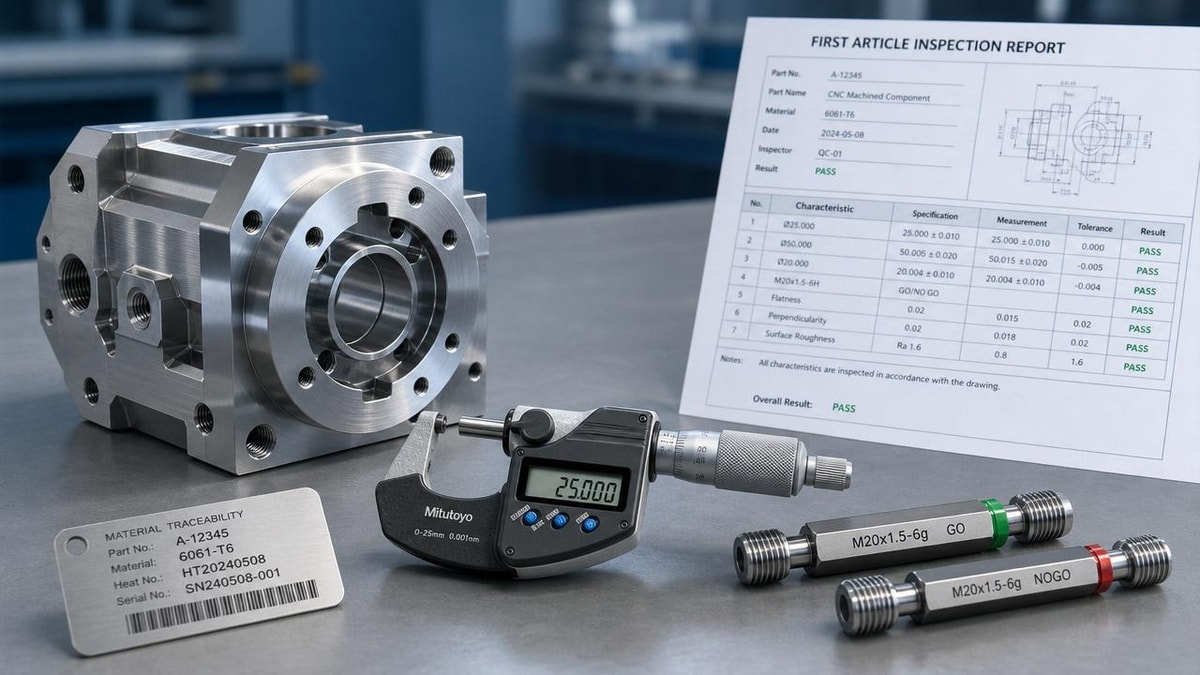
The first control point is material identity. An OEM machined parts supplier Vietnam should be able to link each production batch to mill certificates, heat numbers, and receiving records. For safety-critical or compliance-sensitive parts, this traceability is essential. Incoming inspection should confirm grade, dimensions, and visible condition. Where risk justifies it, the supplier should also use positive material identification or hardness verification to prevent mix-ups.
2. Drawing review and manufacturability alignment
Many quality issues begin before the first machine runs. Suppliers need a structured contract review process to confirm tolerances, datum strategy, critical characteristics, thread standards, burr requirements, and finish expectations. If the drawing is ambiguous, the supplier should escalate questions early rather than improvise. Strong pre-production review reduces rework, interpretation errors, and hidden safety risk.
3. First article inspection discipline
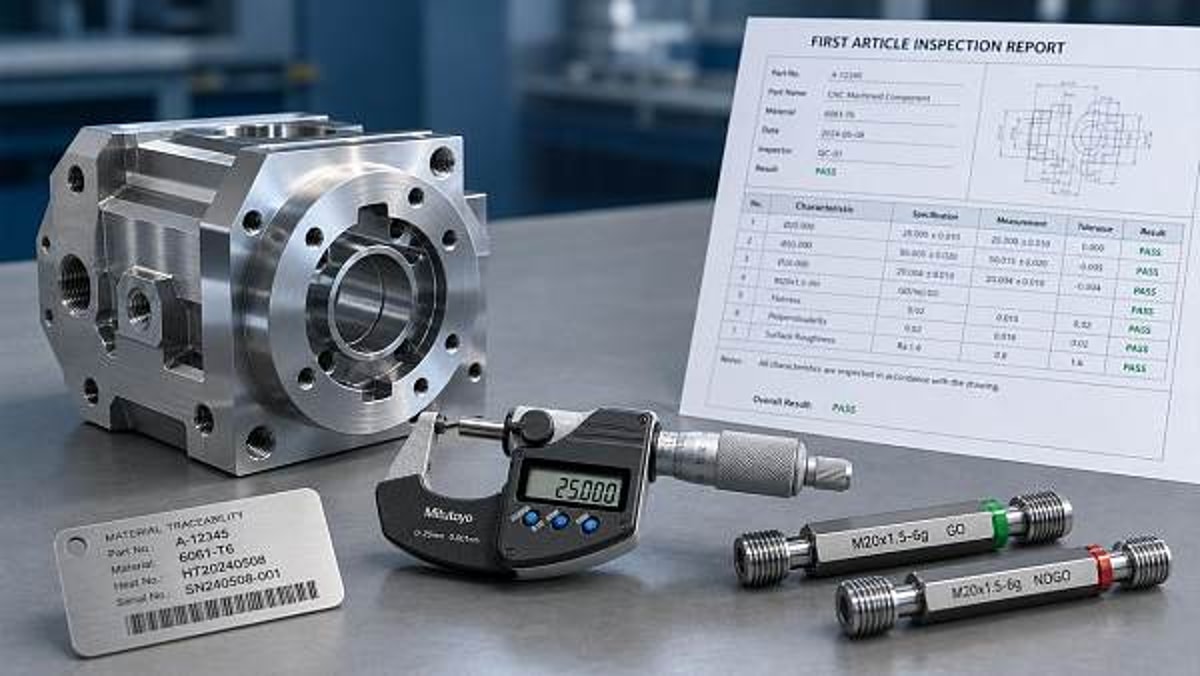
First article inspection is where capability becomes visible. The supplier should measure all specified dimensions or all agreed critical dimensions, record actual values, and compare them against drawing limits. Quality managers should ask whether the first article includes setup verification, tooling confirmation, and sign-off before mass production. Without this checkpoint, defects can scale quickly across the batch.
4. In-process inspection and process stability
End-of-line inspection alone is not enough for precision machining. A qualified OEM machined parts supplier Vietnam should monitor key dimensions during production at defined frequencies. This may include operator self-checks, patrol inspection, tool wear monitoring, and SPC on critical characteristics where volume and risk justify it. The goal is to detect drift before nonconforming parts accumulate.
5. Calibration and measurement capability
Inspection results are only credible when the measuring system is controlled. Check whether micrometers, bore gauges, height gauges, CMMs, thread gauges, and surface roughness instruments are calibrated and labeled. Also assess whether inspectors understand measurement method consistency. A supplier with equipment but weak gauge discipline may still produce unreliable data.
6. Control of secondary processes
Many machined parts require anodizing, plating, heat treatment, passivation, coating, welding, marking, or cleaning. These outsourced or post-machining steps often create hidden risk. Quality teams should confirm how the supplier approves sub-suppliers, verifies certificates, prevents part mix-up, and protects dimensions after treatment. Coating thickness, hardness, cleanliness, and corrosion resistance should be checked according to product needs.
A practical overview table for supplier evaluation
The table below summarizes the quality checks that matter most when assessing an OEM machining partner in Vietnam and why each one matters to quality and safety functions.
Where quality managers should look beyond the paperwork
Certificates and manuals are useful, but they do not tell the full story. A supplier may present ISO documentation while still operating with inconsistent floor discipline. During an audit or qualification review, quality professionals should observe how work is actually executed. Are operators following current work instructions? Are parts clearly identified between operations? Are suspect parts segregated? Are gauges stored properly? Is there evidence of preventive maintenance on machines that hold tight tolerances?
Another valuable indicator is the quality of records. A mature OEM machined parts supplier Vietnam can usually retrieve inspection reports, nonconformance logs, calibration records, and corrective action reports without delay. Slow retrieval or inconsistent formatting often signals weak control. In contrast, well-kept documentation suggests that quality is embedded into routine operations rather than assembled only for audits.
Typical risk profiles by application type
Not all machined parts carry the same risk. Quality evaluation should reflect the end-use profile of the component. The following classification helps align supplier checks with actual application exposure.
Corrective action capability is a long-term differentiator
Even strong suppliers encounter nonconformities. What matters is how they respond. Quality and safety managers should examine whether the supplier can contain suspect stock quickly, identify root causes using structured methods, implement corrective action, and prove effectiveness over time. A superficial response that only replaces parts without fixing the process should be treated as a warning sign.
Ask for examples of previous issues and how they were resolved. Did the supplier revise tooling life limits, update work instructions, train operators, add poka-yoke controls, or tighten incoming checks? A capable OEM machined parts supplier Vietnam will view corrective action as a system improvement tool, not merely a customer response form.
Practical evaluation steps before approval
To reduce qualification risk, organizations should combine document review with evidence-based validation. A practical sequence includes reviewing quality certificates, checking sample inspection reports, auditing traceability flow, validating critical measurement capability, and running a pilot order with defined acceptance criteria. If the component is high risk, consider capability studies, layered audits, and periodic quality business reviews after launch.
It is also wise to align expectations early on packaging, preservation, labeling, and shipping documentation. Damage, corrosion, and part mixing can occur after machining is complete. For safety-relevant applications, final packaging control is part of product quality, not just logistics administration.
How trusted market intelligence supports better supplier decisions
In a fast-moving sourcing environment, quality leaders benefit from more than supplier brochures and price offers. They need contextual insight into manufacturing maturity, sector-specific requirements, and recurring risk patterns across export markets. This is where platforms such as TradeNexus Pro help decision-makers move from surface-level screening to informed qualification. By combining sector expertise, technical analysis, and credible B2B intelligence, procurement and quality teams can benchmark suppliers more effectively and ask better questions during assessment.
Final takeaways for quality and safety managers
Selecting an OEM machined parts supplier Vietnam should be approached as a controlled quality decision, not a simple sourcing comparison. The suppliers most worth considering are those that can prove material traceability, disciplined first article approval, stable in-process control, trustworthy metrology, and effective corrective action. These checks directly influence product safety, compliance confidence, and production continuity.
For organizations operating in complex industrial sectors, the best results come from treating supplier qualification as an ongoing partnership built on evidence. If your team is reviewing new machining capacity in Vietnam, begin with the quality checks that matter most, validate them with records and observation, and use reliable industry intelligence to support every approval decision.
Get weekly intelligence in your inbox.
No noise. No sponsored content. Pure intelligence.
 May 04, 2026FDA AI Diagnostic Software Guidance: Continuous Validation for Overseas FirmsFDA AI Diagnostic Software Guidance: Continuous Validation for Overseas Firms
 May 04, 2026MIIT Launches Export Compliance Support for Warehouse RoboticsMIIT Launches Export Compliance Support for Warehouse Robotics
 May 04, 2026India BIS Mandates ISI Certification for Smart Home Devices from July 2026India BIS Mandates ISI Certification for Smart Home Devices from July 2026
 May 04, 2026Global Shipping Alliance Raises Heavy-Lift Surcharges from May 2026Global Shipping Alliance Raises Heavy-Lift Surcharges from May 2026
 May 04, 2026GCC EV Charging Certification Unified: 35% Cost Cut for Chinese ExportersGCC EV Charging Certification Unified: 35% Cost Cut for Chinese Exporters
 May 04, 2026TÜV Rheinland Updates IoT Security Standard with AI Voice Data AnonymizationTÜV Rheinland Updates IoT Security Standard with AI Voice Data Anonymization
 May 04, 2026Yangshan Port Launches Green Energy Equipment Express LaneYangshan Port Launches Green Energy Equipment Express Lane
 May 04, 2026Vietnam Enforces Local IoT Certification for Smart Home Devices from May 2026Vietnam Enforces Local IoT Certification for Smart Home Devices from May 2026
 May 04, 2026US CBP Launches Battery Cargo Inspection: ESS Export Delays to 7–12 DaysUS CBP Launches Battery Cargo Inspection: ESS Export Delays to 7–12 Days
 May 04, 2026EU SVHC Update Effective May 1, 2026: Impact on Electronic Components ExportsEU SVHC Update Effective May 1, 2026: Impact on Electronic Components Exports
 May 04, 2026Portable power stations: what matters more than wattage on paperPortable power stations: what matters more than wattage on paper
 May 04, 2026Automotive injection molding machines and the scrap rate problemAutomotive injection molding machines and the scrap rate problem
 May 04, 2026Smart thermostats save energy only when setup is done rightSmart thermostats save energy only when setup is done right
 May 04, 2026Why TWS earbuds sound great in ads but not on callsWhy TWS earbuds sound great in ads but not on calls
 May 04, 2026Industrial robotics for material handling: where downtime startsIndustrial robotics for material handling: where downtime starts
 May 04, 2026LiFePO4 battery lifespan drops faster under these conditionsLiFePO4 battery lifespan drops faster under these conditions
 May 04, 2026Solar grid systems: when storage changes the project mathSolar grid systems: when storage changes the project math
 May 04, 2026Smart manufacturing for pharma fails when data stays isolatedSmart manufacturing for pharma fails when data stays isolated
 May 04, 2026Wearable technology trends that are finally useful in 2026Wearable technology trends that are finally useful in 2026
 May 04, 2026Bluetooth speakers: why battery life claims often miss real useBluetooth speakers: why battery life claims often miss real use
 May 04, 2026Home automation systems that solve everyday annoyances firstHome automation systems that solve everyday annoyances first
 May 04, 2026Solar street lights that underperform after the first rainy seasonSolar street lights that underperform after the first rainy season
 May 04, 2026Why sheet metal bending services in Canada cost more than expectedWhy sheet metal bending services in Canada cost more than expected
 May 04, 2026Factory automation systems for electronics and the ROI gapFactory automation systems for electronics and the ROI gap
 May 04, 2026OEM machined parts supplier Vietnam: quality checks that matterOEM machined parts supplier Vietnam: quality checks that matter
 May 04, 2026What to check before choosing a 5 axis machine for defenseWhat to check before choosing a 5 axis machine for defense
 May 04, 2026Smart grid solutions that fix peak load without major rebuildsSmart grid solutions that fix peak load without major rebuilds