US CBP Launches Battery Cargo Inspection: ESS Export Delays to 7–12 Days
Starting May 1, 2026, U.S. Customs and Border Protection (CBP) has initiated a targeted inspection protocol for battery storage goods — including residential and commercial lithium-ion energy storage systems (ESS) — at Los Angeles, New York, and Chicago ports of entry. This measure directly affects exporters of battery-based energy infrastructure, logistics providers, and supply chain stakeholders engaged in U.S.-bound lithium battery shipments.
Event Overview
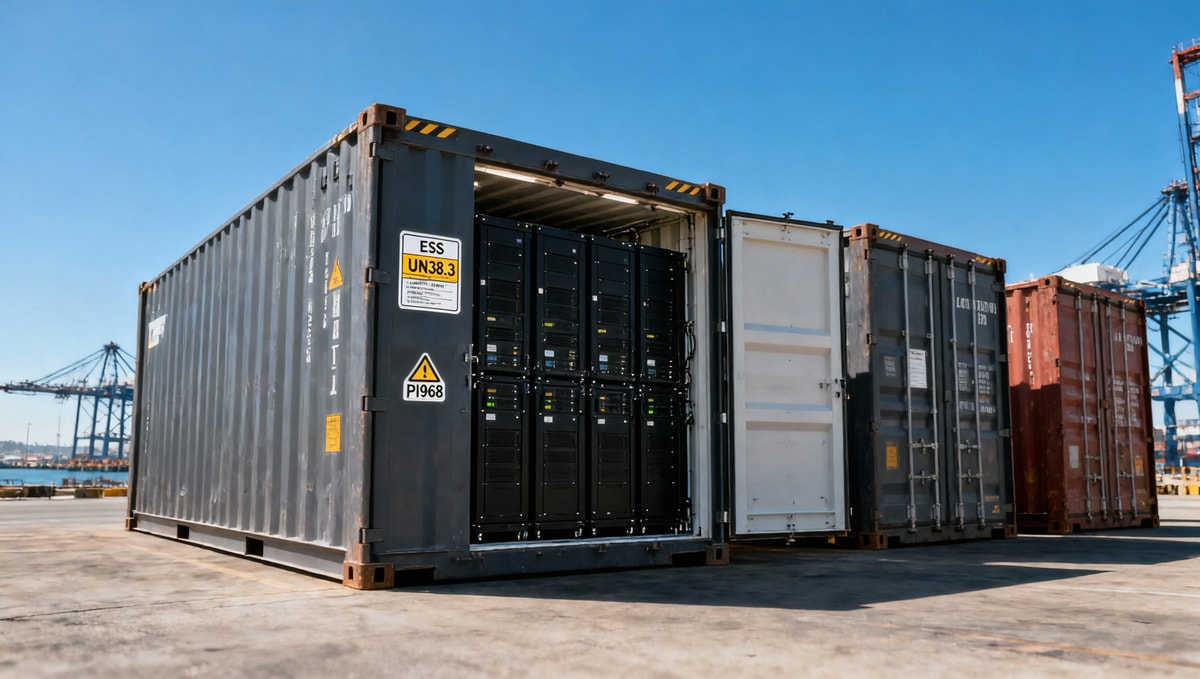
Effective May 1, 2026, U.S. CBP implemented 100% documentary pre-review and 30% physical container examination for lithium-ion battery energy storage systems (ESS) at the three major U.S. gateway ports: Los Angeles, New York, and Chicago. The inspections focus on three verifiable compliance elements: validity of UN38.3 test reports, consistency of packaging markings per PI967 (for standalone batteries) or PI968 (for equipment containing batteries), and CBP-mandated registration of battery management system (BMS) firmware versions. No further scope expansion or timeline adjustments have been publicly announced beyond this initial rollout.
Industries Affected by Segment
Direct Exporters (OEMs & Trading Companies)
Exporters shipping lithium-ion ESS units directly to U.S. importers face extended customs clearance timelines — now averaging 7–12 business days versus typical pre-May 2026 durations of 2–4 days. Delays stem from mandatory document validation and randomized physical checks, increasing demurrage, detention, and inland transportation costs.
Contract Manufacturers & System Integrators
Manufacturers assembling ESS cabinets or integrating cells, BMS, and enclosures must ensure all subcomponents — especially BMS firmware — are documented and declared in alignment with CBP’s current requirements. Inconsistent firmware version records across production batches may trigger repeat inspections or hold orders, disrupting shipment scheduling.
Logistics & Customs Brokerage Providers
Freight forwarders and licensed customs brokers handling ESS consignments now require additional verification capacity: cross-checking UN38.3 report issue dates against test validity windows (typically 5 years), validating PI967/PI968 label placement and legibility on outer packaging, and confirming BMS firmware version submissions match CBP’s internal备案 (filing) expectations — even when no formal filing portal is yet public.
Supply Chain Compliance Officers & QA Teams
Internal compliance functions must now treat BMS firmware version control as a regulated data point — not just a technical spec. Version changes between production runs require traceable documentation and proactive alignment with export documentation, as CBP explicitly lists firmware version as an inspectable element.
What Enterprises Should Monitor and Act On
Track official CBP guidance updates — not just press releases
CBP has not yet published formal notice in the Federal Register or updated its Importing Commercial Lithium Batteries guidance page. Stakeholders should monitor CBP’s official website and port-specific bulletins for clarifications on BMS firmware submission formats, acceptable UN38.3 report issuers, and whether PI967/PI968 labeling will be enforced on inner vs. outer packaging.
Verify UN38.3 report validity windows and test lab accreditation
Reports issued by labs not recognized under ILAC-MRA or lacking ISO/IEC 17025 accreditation may be rejected during pre-review. Exporters should confirm report issuance date falls within CBP’s accepted validity period (currently aligned with UN Manual of Tests and Criteria, Rev. 7, Section 38.3 — typically ≤5 years from test date).
Distinguish between policy signal and operational reality
The 30% physical inspection rate applies only at the three named ports and only to ESS shipments — not general lithium batteries in consumer electronics. This is not a nationwide blanket rule nor an expansion to other battery applications (e.g., EV traction packs or portable power stations under 100Wh). Misinterpreting scope may lead to unnecessary process overhauls.
Pre-align BMS firmware documentation across engineering, QA, and export teams
Since CBP requires firmware version as a declared field, manufacturers should standardize version-naming conventions, maintain revision logs tied to production lot numbers, and include firmware version in packing lists and commercial invoices — even if not yet required by CBP’s electronic filing systems.
Editorial Perspective / Industry Observation
Observably, this initiative signals a shift from risk-based targeting to systematic oversight for high-energy lithium battery systems entering the U.S. market. Analysis shows it reflects growing regulatory attention on post-import safety accountability — particularly where BMS behavior influences thermal runaway risk. It is currently best understood as an enforcement ramp-up phase, not yet a finalized regulatory framework: no new regulation has been codified, and CBP’s operational criteria remain partially informal. From an industry perspective, this is less a one-time compliance hurdle and more an early indicator of tightening traceability expectations across the battery supply chain — especially for firmware-controlled critical components.
Conclusion
This CBP action underscores that lithium-ion ESS exports to the U.S. are now subject to heightened, structured customs scrutiny — not merely ad hoc checks. Its significance lies not in introducing novel safety standards, but in institutionalizing verification of existing requirements (UN38.3, PI967/PI968, BMS traceability) at scale. Currently, it is more accurately interpreted as an operational enforcement intensification than a substantive regulatory change — yet one demanding immediate procedural adaptation by affected stakeholders.
Information Sources
Main source: U.S. Customs and Border Protection (CBP) port-level operational advisories issued April 2026 for Los Angeles, New York, and Chicago field offices. Note: CBP has not yet published consolidated guidance or updated its public-facing lithium battery import page; continued observation is warranted for formal notice publication and potential scope adjustments.
Get weekly intelligence in your inbox.
No noise. No sponsored content. Pure intelligence.
 May 04, 2026FDA AI Diagnostic Software Guidance: Continuous Validation for Overseas FirmsFDA AI Diagnostic Software Guidance: Continuous Validation for Overseas Firms
 May 04, 2026MIIT Launches Export Compliance Support for Warehouse RoboticsMIIT Launches Export Compliance Support for Warehouse Robotics
 May 04, 2026India BIS Mandates ISI Certification for Smart Home Devices from July 2026India BIS Mandates ISI Certification for Smart Home Devices from July 2026
 May 04, 2026Global Shipping Alliance Raises Heavy-Lift Surcharges from May 2026Global Shipping Alliance Raises Heavy-Lift Surcharges from May 2026
 May 04, 2026GCC EV Charging Certification Unified: 35% Cost Cut for Chinese ExportersGCC EV Charging Certification Unified: 35% Cost Cut for Chinese Exporters
 May 04, 2026TÜV Rheinland Updates IoT Security Standard with AI Voice Data AnonymizationTÜV Rheinland Updates IoT Security Standard with AI Voice Data Anonymization
 May 04, 2026Yangshan Port Launches Green Energy Equipment Express LaneYangshan Port Launches Green Energy Equipment Express Lane
 May 04, 2026Vietnam Enforces Local IoT Certification for Smart Home Devices from May 2026Vietnam Enforces Local IoT Certification for Smart Home Devices from May 2026
 May 04, 2026US CBP Launches Battery Cargo Inspection: ESS Export Delays to 7–12 DaysUS CBP Launches Battery Cargo Inspection: ESS Export Delays to 7–12 Days
 May 04, 2026EU SVHC Update Effective May 1, 2026: Impact on Electronic Components ExportsEU SVHC Update Effective May 1, 2026: Impact on Electronic Components Exports
 May 04, 2026Portable power stations: what matters more than wattage on paperPortable power stations: what matters more than wattage on paper
 May 04, 2026Automotive injection molding machines and the scrap rate problemAutomotive injection molding machines and the scrap rate problem
 May 04, 2026Smart thermostats save energy only when setup is done rightSmart thermostats save energy only when setup is done right
 May 04, 2026Why TWS earbuds sound great in ads but not on callsWhy TWS earbuds sound great in ads but not on calls
 May 04, 2026Industrial robotics for material handling: where downtime startsIndustrial robotics for material handling: where downtime starts
 May 04, 2026LiFePO4 battery lifespan drops faster under these conditionsLiFePO4 battery lifespan drops faster under these conditions
 May 04, 2026Solar grid systems: when storage changes the project mathSolar grid systems: when storage changes the project math
 May 04, 2026Smart manufacturing for pharma fails when data stays isolatedSmart manufacturing for pharma fails when data stays isolated
 May 04, 2026Wearable technology trends that are finally useful in 2026Wearable technology trends that are finally useful in 2026
 May 04, 2026Bluetooth speakers: why battery life claims often miss real useBluetooth speakers: why battery life claims often miss real use
 May 04, 2026Home automation systems that solve everyday annoyances firstHome automation systems that solve everyday annoyances first
 May 04, 2026Solar street lights that underperform after the first rainy seasonSolar street lights that underperform after the first rainy season
 May 04, 2026Why sheet metal bending services in Canada cost more than expectedWhy sheet metal bending services in Canada cost more than expected
 May 04, 2026Factory automation systems for electronics and the ROI gapFactory automation systems for electronics and the ROI gap
 May 04, 2026OEM machined parts supplier Vietnam: quality checks that matterOEM machined parts supplier Vietnam: quality checks that matter
 May 04, 2026What to check before choosing a 5 axis machine for defenseWhat to check before choosing a 5 axis machine for defense
 May 04, 2026Smart grid solutions that fix peak load without major rebuildsSmart grid solutions that fix peak load without major rebuilds