Ultrasonic Welding Defects That Are Easy to Miss at First
In quality-critical production, ultrasonic welding defects often go unnoticed until leaks, weak joints, or compliance risks surface downstream. For quality control and safety teams, spotting these subtle issues early is essential to preventing costly failures and protecting process reliability. This article highlights the ultrasonic welding defects that are easy to miss at first and explains why they matter in real-world inspection and risk management.
Why subtle defect detection changes by application scenario
Not every ultrasonic welding line fails in the same way. A cosmetic mark on a consumer electronics housing may be acceptable in one project but a major rejection in a sterile medical assembly. A weld that passes a quick pull test in a packaging line may still fail when exposed to vibration, fluid pressure, temperature cycling, or regulatory audit. That is why quality and safety teams should not treat ultrasonic welding defects as a single checklist item. The inspection logic must change with the product’s service environment, criticality, material combination, and downstream liability.
In practical terms, the same hidden defect can create very different business risks. Slight under-welding in an automotive sensor housing can cause field moisture ingress months later. Minor flash in a healthcare component can create contamination concerns. Energy director drift in high-volume smart electronics can quietly reduce process capability before operators notice visible problems. When inspection plans are built around these scenario differences, ultrasonic welding becomes easier to control and much harder to misjudge.
Where easy-to-miss ultrasonic welding defects usually appear
For most quality control and safety personnel, the highest-risk situations are not dramatic machine failures. They are normal-looking production runs where the weld appears acceptable at first glance. These are the common business scenarios where hidden ultrasonic welding defects tend to survive initial inspection:
- High-speed assembly lines where visual inspection is prioritized over destructive verification
- Multi-cavity tooling or multiple product variants that introduce subtle energy distribution differences
- New material lots, recycled resin content, or supplier substitutions that alter melt behavior
- Products requiring leak-tightness, electrical insulation, or long-term fatigue resistance
- Operations with infrequent horn maintenance, fixture wear, or weak process monitoring discipline
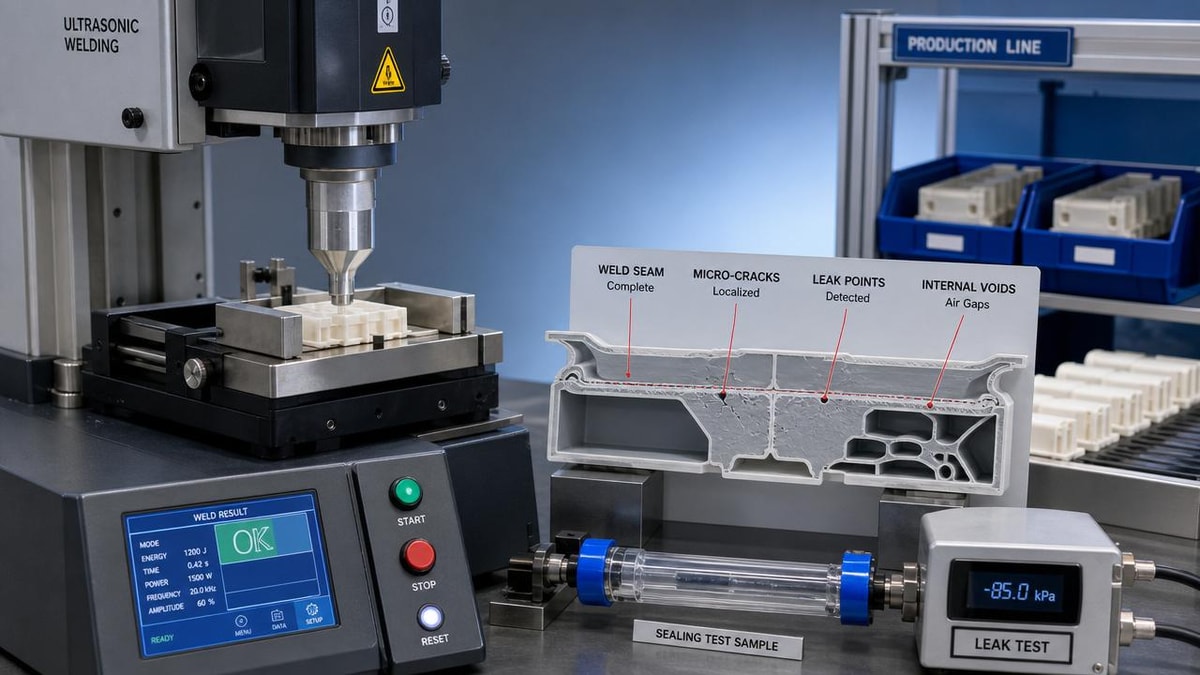
In these settings, the missed issues are often less visible than cracks or gross burn marks. They include partial bond areas, micro-gaps, internal voids, local embrittlement, uneven collapse, concealed particulate generation, and stress concentration near the weld interface. Each can pass a superficial check and still trigger serious downstream problems.
Scenario comparison: what quality teams should look for first
The table below helps inspection teams align ultrasonic welding defect priorities with the real operating context instead of relying on a generic pass/fail view.
Five ultrasonic welding defects that are often missed at first
1. Partial welds that look complete from the outside
A common ultrasonic welding issue is the joint that shows a clean external seam while only part of the intended interface is bonded. This happens when energy directors are inconsistent, fixtures allow slight tilt, or the part geometry causes uneven amplitude transfer. In low-load products, the assembly may survive initial checks. In pressure, vibration, or drop-sensitive applications, however, the unbonded zone becomes a failure origin.
This defect is especially dangerous in sensor housings, fluid paths, and protective enclosures because the external appearance can be misleading. QC teams should connect appearance checks with collapse distance trends, destructive peel or section analysis, and cavity-by-cavity data review.
2. Micro-cracking caused by over-welding or material stress
Some ultrasonic welding defects come from too much energy rather than too little. Over-welding can create localized brittleness, especially in filled polymers, thin walls, or sharp-corner designs. The weld may pass production testing but later crack under handling, assembly torque, or environmental exposure. These micro-cracks are easy to miss because they may sit under flash or appear only after aging.
This scenario matters most in green energy devices, electronics casings, and parts exposed to thermal cycling. If your product sees repeated stress after shipment, visual acceptance alone is not enough. Add magnified inspection and periodic environmental validation to detect stress-related ultrasonic welding defects early.
3. Hidden particle generation in regulated or clean-use products
In healthcare technology and other cleanliness-sensitive sectors, a weld can seem strong while generating micro-particles from flash trimming, material abrasion, or unstable energy application. Operators may not notice them without controlled lighting or magnification. Yet these particles can create severe quality and safety concerns, particularly when assemblies contact air, fluid, or sterile environments.
The risk rises when tools wear, horn surfaces degrade, or parts arrive with molding variation. In these cases, ultrasonic welding defects are not limited to bond strength. They also affect cleanliness, validation, and audit readiness. For this scenario, the right response is a combined inspection method: weld quality checks, particulate assessment, and preventive maintenance records.
4. Leak paths too small for routine visual inspection
Many teams assume that if no gap is visible, the weld is sealed. In reality, tiny discontinuities can remain at corners, around inserts, or in sections with poor energy transmission. These leak paths often appear in packaging, valve bodies, medical reservoirs, and outdoor electronics. The parts may look perfect but fail after pressure changes, humidity exposure, or shelf storage.
This is one of the most expensive ultrasonic welding defects because it may only surface after filling, shipping, or customer use. The best protection is to match the leak test method to the service condition rather than relying on occasional visual checks. Vacuum decay, bubble testing, burst tests, or pressure retention methods should be selected according to actual risk.
5. Process drift hidden by acceptable average output
Some ultrasonic welding lines produce acceptable average results while individual cavities, shifts, or material lots move out of control. Because the overall scrap rate remains low, the underlying drift may be ignored. This is common in high-volume advanced manufacturing where horn wear, anvil damage, fixture contamination, or pneumatic variation slowly alter weld behavior.
For safety and quality managers, this is a systems problem rather than a single defect. The missed signal is often in the data: changing energy signatures, rising cycle time variance, or widening collapse distance spread. Robust SPC, alarm limits, and layered audits are essential if you want to catch ultrasonic welding defects before they become batch-level exposure.
How defect priorities differ by role and business need
The same ultrasonic welding process is viewed differently by different stakeholders. That difference matters when deciding what to inspect and how often.
Scenario-based inspection strategies that work better
A stronger control plan starts by matching the inspection method to the business scenario. For low-risk cosmetic assemblies, routine visual criteria and basic pull tests may be enough. For leak-tight or safety-relevant products, that approach is too shallow. In those cases, ultrasonic welding quality should be confirmed through layered checks that combine machine data, dimensional outcomes, and product-performance verification.
A practical sequence is: first verify input stability such as material lot, moisture condition, and molded feature quality; then monitor process indicators including energy, amplitude, time, force, and collapse; finally validate output by choosing tests linked to the product’s real failure mode. This scenario-based method prevents teams from over-inspecting low-risk products while under-protecting critical ones.
Common misjudgments that allow ultrasonic welding defects to escape
- Assuming a clean outer seam means full bond integrity
- Treating initial setup approval as proof of long-term process control
- Using the same sampling plan for decorative parts and safety-critical assemblies
- Ignoring tooling wear because dimensional checks still pass
- Failing to update inspection logic after resin, geometry, or supplier changes
These mistakes are common because ultrasonic welding is fast, repeatable, and often visually neat. That creates false confidence. The more mature approach is to ask what failure would matter most in this exact application scenario and then inspect specifically for the defect pattern that could trigger it.
FAQ for quality and safety teams
Which ultrasonic welding defect is most likely to be missed during routine inspection?
Partial bonding is often the most easily missed ultrasonic welding defect because the outer seam can appear acceptable while internal bond coverage is incomplete.
Are visual checks enough for critical products?
No. For sealed, safety-related, regulated, or fatigue-loaded parts, visual checks should be supported by destructive tests, leak tests, process monitoring, or environmental validation.
When should inspection plans be upgraded?
Upgrade controls whenever there is a material change, tool wear pattern, geometry adjustment, cavity imbalance, field complaint, or increased consequence of failure in the end-use scenario.
Final takeaway: judge ultrasonic welding defects by risk, not appearance alone
The most costly ultrasonic welding defects are often the ones that look harmless at first. For quality control and safety professionals, the smarter question is not simply whether the weld looks good, but whether the inspection strategy matches the real application scenario. Products used in healthcare technology, smart electronics, advanced manufacturing, green energy, and sealed packaging all demand different priorities.
If your organization wants more reliable ultrasonic welding outcomes, start by mapping each product family to its actual failure consequences, then align sampling, machine monitoring, and verification tests to that risk profile. That scenario-based approach reduces hidden defects, improves audit confidence, and supports safer, more resilient production decisions.
Get weekly intelligence in your inbox.
No noise. No sponsored content. Pure intelligence.
 May 06, 2026Hydraulic Cylinder Fabrication Errors That Shorten Service LifeHydraulic Cylinder Fabrication Errors That Shorten Service Life
 May 06, 2026Surface Finishing Services That Reduce Warranty ComplaintsSurface Finishing Services That Reduce Warranty Complaints
 May 06, 2026Waterjet Cutting Is Better Than Laser for These MaterialsWaterjet Cutting Is Better Than Laser for These Materials
 May 06, 2026Custom Molded Rubber Choices That Affect Seal PerformanceCustom Molded Rubber Choices That Affect Seal Performance
 May 06, 2026Linear Motion Systems Fail Faster When Alignment Is OverlookedLinear Motion Systems Fail Faster When Alignment Is Overlooked
 May 06, 2026How Accurate Is Energy Forecasting When Weather Turns Volatile?How Accurate Is Energy Forecasting When Weather Turns Volatile?
 May 06, 2026Medical Device Manufacturing Delays Often Start in ValidationMedical Device Manufacturing Delays Often Start in Validation
 May 06, 2026Anodizing Services: Which Finish Holds Up Outdoors LongerAnodizing Services: Which Finish Holds Up Outdoors Longer
 May 06, 2026Solar Tracker Maintenance Issues That Hurt Long-Term OutputSolar Tracker Maintenance Issues That Hurt Long-Term Output
 May 06, 2026What Changes the Real Cost of Pneumatic Valves WholesaleWhat Changes the Real Cost of Pneumatic Valves Wholesale
 May 06, 2026Solar Microinverters vs String Inverters for Shaded RoofsSolar Microinverters vs String Inverters for Shaded Roofs
 May 06, 2026Bifacial Solar Panels: Do They Pay Off on Every Site?Bifacial Solar Panels: Do They Pay Off on Every Site?
 May 06, 2026Why Heavy Equipment Manufacturing Lead Times Keep SlippingWhy Heavy Equipment Manufacturing Lead Times Keep Slipping
 May 06, 2026Metal Stamping Parts: When Tooling Cost Stops Making SenseMetal Stamping Parts: When Tooling Cost Stops Making Sense
 May 06, 2026Energy Storage Battery Sizing Mistakes That Raise Project CostsEnergy Storage Battery Sizing Mistakes That Raise Project Costs
 May 06, 2026What Causes Revenue Gaps in a Solar Farm ProjectWhat Causes Revenue Gaps in a Solar Farm Project
 May 06, 2026Low Volume Manufacturing Works Best When Demand Is UnclearLow Volume Manufacturing Works Best When Demand Is Unclear
 May 06, 2026Automotive Parts Machining Costs That Grow With Late Design ChangesAutomotive Parts Machining Costs That Grow With Late Design Changes
 May 06, 2026AS9100 Aerospace Machining: What Fails an Audit Most OftenAS9100 Aerospace Machining: What Fails an Audit Most Often
 May 06, 2026Plastic Extrusion Tolerances That Affect Final Product FitPlastic Extrusion Tolerances That Affect Final Product Fit
 May 06, 2026Is Renewable Power Getting Easier to Finance for Industry?Is Renewable Power Getting Easier to Finance for Industry?
 May 06, 2026Ultrasonic Welding Defects That Are Easy to Miss at FirstUltrasonic Welding Defects That Are Easy to Miss at First
 May 06, 2026How to Compare Industrial Bearing Suppliers by Failure RiskHow to Compare Industrial Bearing Suppliers by Failure Risk
 May 06, 2026Custom Heatsinks: When a Standard Profile Stops WorkingCustom Heatsinks: When a Standard Profile Stops Working
 May 06, 2026Gear Manufacturing Problems That Show Up After AssemblyGear Manufacturing Problems That Show Up After Assembly
 May 06, 2026Why Thin Film Solar Cells Still Matter in 2026Why Thin Film Solar Cells Still Matter in 2026
 May 06, 2026Wire EDM Services or CNC Milling for Tight Tolerance Parts?Wire EDM Services or CNC Milling for Tight Tolerance Parts?