Why Heavy Equipment Manufacturing Lead Times Keep Slipping
Why do heavy equipment manufacturing lead times keep slipping even when demand forecasts look stable? For business evaluators, the answer lies in a widening gap between production complexity, supplier volatility, labor constraints, and capital planning. This article examines how heavy equipment manufacturing is being reshaped by global sourcing risks, component bottlenecks, and operational misalignment—and what these delays signal for cost control, delivery reliability, and long-term supplier assessment.
For decision-makers, a checklist approach is more useful than a broad industry overview. In heavy equipment manufacturing, delays rarely come from one obvious cause. They usually emerge from several smaller failures happening at once: a cast component arrives late, a control unit is requalified, a welding team is understaffed, a customer engineering change is approved too late, or inbound freight misses a transfer window. When evaluators use a structured review, they can identify whether lead-time slippage is temporary noise or a sign of deeper supplier weakness.
Start Here: What Business Evaluators Should Confirm First
Before comparing suppliers or judging a factory’s delivery promises, confirm five baseline points. These checks help separate controllable execution issues from structural capacity risk in heavy equipment manufacturing.
- Product complexity level: Determine whether the equipment uses a stable bill of materials or relies on high-variation options, customized hydraulics, controls, emissions systems, or export-specific compliance packages.
- Critical component exposure: Check dependency on engines, castings, forgings, axles, semiconductors, hydraulic valves, and large fabricated steel structures. A single constrained category can delay the entire build.
- True production capacity: Ask whether the supplier’s stated output is based on labor availability, tested line rates, and supplier-confirmed material flow, or just nominal plant capacity.
- Engineering change frequency: Frequent late-stage revisions often create hidden lead-time expansion through rework, retesting, and supplier re-approval.
- Schedule adherence history: On-time delivery percentages matter, but so does variance. A supplier that moves delivery by two weeks every month may be more risky than one with a longer but stable cycle.
Core Checklist: Why Heavy Equipment Manufacturing Lead Times Slip
The most reliable way to assess heavy equipment manufacturing performance is to review lead-time risk by category. Business evaluators should not accept “supply chain issues” as a complete explanation. They should ask what kind of issue, where it starts, how often it occurs, and whether management has reduced recurrence.
1. Supplier Network Fragility
Many OEMs still rely on multi-tier supply networks that lack full transparency. A Tier 1 supplier may appear stable while a Tier 2 foundry, electronics subcontractor, or seal manufacturer remains unstable. In heavy equipment manufacturing, long-tail components are especially dangerous because they receive less executive attention but can still stop final assembly. Evaluators should verify whether the manufacturer maps sub-tier dependencies for high-risk parts and whether alternate sources are approved before disruption occurs.
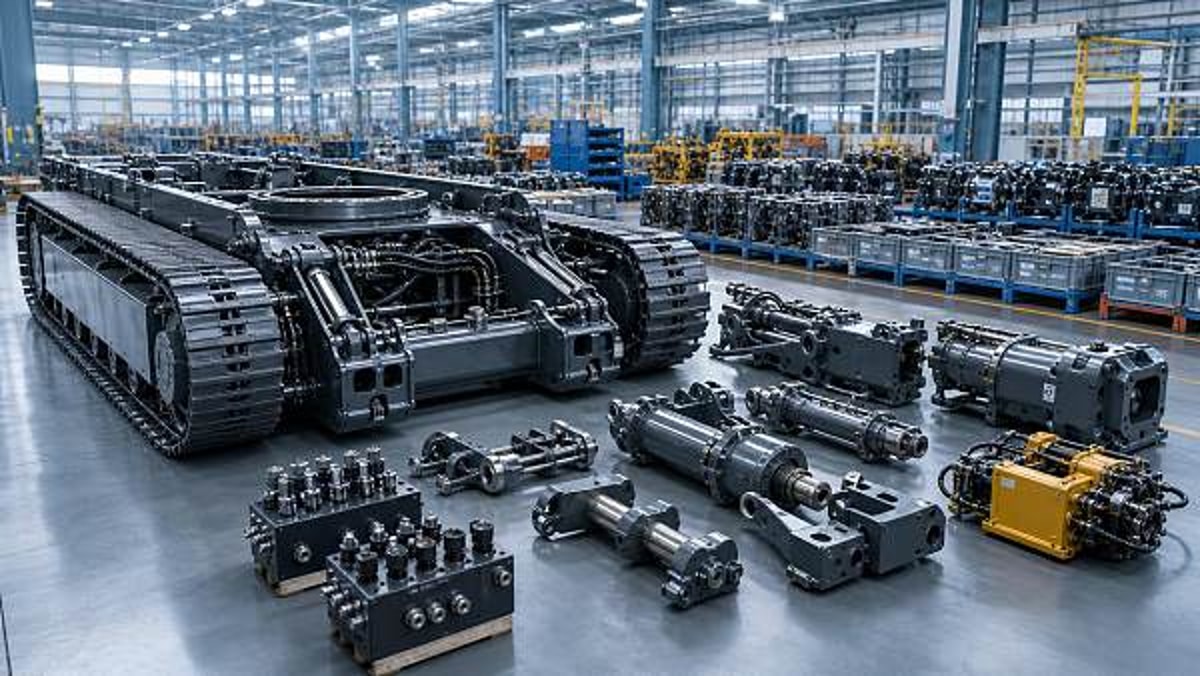
2. Bottlenecks in Castings, Forgings, and Machined Parts
Large equipment depends heavily on bulky, slow-moving, capacity-constrained components. Foundries and forging plants often face energy cost swings, environmental compliance pressure, and long tooling changeover cycles. Once backlog accumulates, recovery is slow. If a manufacturer lacks committed volume agreements or dual-sourcing for these parts, quoted lead times can quickly become unrealistic.
3. Labor Gaps and Skill Concentration
Heavy equipment manufacturing needs experienced welders, machinists, paint-line operators, controls technicians, and test personnel. Labor shortages are not just about headcount; they are about concentration of know-how. If only a small number of technicians can perform final calibration or system integration, one staffing gap can slow all shipments. Ask whether the plant has cross-training depth, retention programs, and overtime reliance levels that remain sustainable.
4. Engineering-to-Production Misalignment
A common hidden cause of late delivery is poor handoff between design, sourcing, and manufacturing teams. Equipment may be released to production before all drawings, tolerances, software versions, or serviceability issues are settled. This creates stop-start assembly, material holds, and retrofits. Evaluators should review engineering change order timing and ask how often production begins with incomplete technical release.
5. Inbound and Outbound Logistics Instability
For heavy equipment manufacturing, freight is not a simple background function. Oversized components, export packing requirements, port congestion, and specialized truck availability can all extend practical lead time beyond factory completion. Some suppliers report a unit as “finished” even though it cannot be shipped for days or weeks. Business evaluators should distinguish manufacturing completion date from customer-ready delivery date.
6. Weak Sales and Operations Planning
Stable demand forecasts do not guarantee stable output. If planning systems do not align procurement windows, labor scheduling, and plant sequencing, even moderate demand can create backlog. This is especially true when product mix shifts toward more customized models. A plant may have enough aggregate demand visibility but still fail because it cannot match the right parts and labor to the right build sequence.
Evaluation Table: What to Check and What It Signals
Scenario-Based Checks: Not Every Delay Means the Same Thing
Business evaluators should adjust their review depending on the supplier profile and equipment category. Heavy equipment manufacturing includes highly engineered, low-volume machines as well as more standardized product families. The same delivery slip can carry very different implications.
If the supplier is highly customized
Focus on configuration discipline, order freeze timing, and engineering resource load. Delays may be normal if customization is extreme, but they should still be explainable and bounded. Repeated schedule shifts after order confirmation indicate weak change control.
If the supplier is a high-volume OEM
Focus on material flow, takt adherence, and sub-supplier coordination. In this case, chronic delay is less likely to be caused by engineering uniqueness and more likely to come from planning imbalances, part shortages, or labor instability.
If the equipment contains advanced electronics or emissions systems
Check semiconductor exposure, software validation cycles, and regulatory testing dependencies. Heavy equipment manufacturing is increasingly influenced by electronic content, and a mechanical supplier may not be equally strong in controls integration.
Commonly Overlooked Risks That Distort Supplier Assessment
- Confusing backlog with strength: A full order book does not automatically indicate operational excellence. It may simply mean the supplier cannot ship on time.
- Ignoring mix complexity: Two plants with identical output volumes can have very different lead-time risk if one handles broader model variation.
- Overvaluing headline capacity: Installed machines and floor space matter less than constrained work centers and trained labor at the exact bottleneck points.
- Missing quality-delay links: Rework, field corrections, and failed inspections often consume production slots and quietly extend cycle time.
- Not separating temporary disruption from structural weakness: A one-time raw material issue is very different from repeated multi-quarter delivery volatility.
Practical Execution Advice for Procurement and Business Review Teams
To assess heavy equipment manufacturing partners more effectively, review both current performance and recovery capability. A supplier does not need perfect conditions to be investable or reliable, but it does need visibility, discipline, and credible countermeasures.
- Request a breakdown of quoted lead time into sourcing, fabrication, assembly, testing, and shipment stages.
- Ask for the top ten parts currently constraining output and what mitigation is in place for each one.
- Review lead-time performance by product family, not only plant average, to identify where slippage is concentrated.
- Check whether supplier scorecards include sub-tier resilience, engineering change discipline, and logistics execution, not just purchase price variance.
- Use scenario questions: What happens if demand rises 15%, a casting supplier fails, or a major export lane slows for four weeks?
What Lead-Time Slippage Really Signals for Cost and Long-Term Fit
Persistent lead-time slippage in heavy equipment manufacturing is rarely just a timing problem. It often signals margin pressure, expediting costs, unstable scheduling, excess safety stock, customer dissatisfaction, and weakened forecasting credibility. For business evaluators, this matters because a supplier that cannot hold dates may also struggle with working capital efficiency, quality consistency, or program scaling. Delivery reliability is therefore both an operational metric and a strategic indicator.
The best evaluation approach is to rank suppliers not only by current quoted lead time, but by lead-time transparency, root-cause control, and demonstrated recovery performance. In today’s heavy equipment manufacturing environment, shorter promises are less valuable than realistic commitments backed by resilient execution.
Final Action Checklist Before You Move Forward
If you need to validate a supplier, sourcing program, or strategic partnership in heavy equipment manufacturing, prioritize these questions in your next discussion: Which components are truly gating delivery? How often do committed dates move after order confirmation? What proportion of delay comes from engineering change, labor shortage, logistics, or sub-tier supply? Which recovery actions have already worked, and which are still theoretical? What buffers exist for critical parts, specialized labor, and export shipment readiness?
For teams using TradeNexus Pro to benchmark suppliers and identify stronger market positions, the most productive next step is to gather verified data on cycle-time structure, bottleneck categories, capacity assumptions, and sub-supplier concentration. Once those variables are visible, heavy equipment manufacturing lead times become easier to judge—not as vague delays, but as measurable indicators of operational maturity, risk exposure, and long-term commercial reliability.
Get weekly intelligence in your inbox.
No noise. No sponsored content. Pure intelligence.
 May 06, 2026Hydraulic Cylinder Fabrication Errors That Shorten Service LifeHydraulic Cylinder Fabrication Errors That Shorten Service Life
 May 06, 2026Surface Finishing Services That Reduce Warranty ComplaintsSurface Finishing Services That Reduce Warranty Complaints
 May 06, 2026Waterjet Cutting Is Better Than Laser for These MaterialsWaterjet Cutting Is Better Than Laser for These Materials
 May 06, 2026Custom Molded Rubber Choices That Affect Seal PerformanceCustom Molded Rubber Choices That Affect Seal Performance
 May 06, 2026Linear Motion Systems Fail Faster When Alignment Is OverlookedLinear Motion Systems Fail Faster When Alignment Is Overlooked
 May 06, 2026How Accurate Is Energy Forecasting When Weather Turns Volatile?How Accurate Is Energy Forecasting When Weather Turns Volatile?
 May 06, 2026Medical Device Manufacturing Delays Often Start in ValidationMedical Device Manufacturing Delays Often Start in Validation
 May 06, 2026Anodizing Services: Which Finish Holds Up Outdoors LongerAnodizing Services: Which Finish Holds Up Outdoors Longer
 May 06, 2026Solar Tracker Maintenance Issues That Hurt Long-Term OutputSolar Tracker Maintenance Issues That Hurt Long-Term Output
 May 06, 2026What Changes the Real Cost of Pneumatic Valves WholesaleWhat Changes the Real Cost of Pneumatic Valves Wholesale
 May 06, 2026Solar Microinverters vs String Inverters for Shaded RoofsSolar Microinverters vs String Inverters for Shaded Roofs
 May 06, 2026Bifacial Solar Panels: Do They Pay Off on Every Site?Bifacial Solar Panels: Do They Pay Off on Every Site?
 May 06, 2026Why Heavy Equipment Manufacturing Lead Times Keep SlippingWhy Heavy Equipment Manufacturing Lead Times Keep Slipping
 May 06, 2026Metal Stamping Parts: When Tooling Cost Stops Making SenseMetal Stamping Parts: When Tooling Cost Stops Making Sense
 May 06, 2026Energy Storage Battery Sizing Mistakes That Raise Project CostsEnergy Storage Battery Sizing Mistakes That Raise Project Costs
 May 06, 2026What Causes Revenue Gaps in a Solar Farm ProjectWhat Causes Revenue Gaps in a Solar Farm Project
 May 06, 2026Low Volume Manufacturing Works Best When Demand Is UnclearLow Volume Manufacturing Works Best When Demand Is Unclear
 May 06, 2026Automotive Parts Machining Costs That Grow With Late Design ChangesAutomotive Parts Machining Costs That Grow With Late Design Changes
 May 06, 2026AS9100 Aerospace Machining: What Fails an Audit Most OftenAS9100 Aerospace Machining: What Fails an Audit Most Often
 May 06, 2026Plastic Extrusion Tolerances That Affect Final Product FitPlastic Extrusion Tolerances That Affect Final Product Fit
 May 06, 2026Is Renewable Power Getting Easier to Finance for Industry?Is Renewable Power Getting Easier to Finance for Industry?
 May 06, 2026Ultrasonic Welding Defects That Are Easy to Miss at FirstUltrasonic Welding Defects That Are Easy to Miss at First
 May 06, 2026How to Compare Industrial Bearing Suppliers by Failure RiskHow to Compare Industrial Bearing Suppliers by Failure Risk
 May 06, 2026Custom Heatsinks: When a Standard Profile Stops WorkingCustom Heatsinks: When a Standard Profile Stops Working
 May 06, 2026Gear Manufacturing Problems That Show Up After AssemblyGear Manufacturing Problems That Show Up After Assembly
 May 06, 2026Why Thin Film Solar Cells Still Matter in 2026Why Thin Film Solar Cells Still Matter in 2026
 May 06, 2026Wire EDM Services or CNC Milling for Tight Tolerance Parts?Wire EDM Services or CNC Milling for Tight Tolerance Parts?