How to Compare Industrial Bearing Suppliers by Failure Risk
Choosing among industrial bearing suppliers is not just about price or lead time—it is about controlling failure risk across your production line. For procurement professionals, a weak supplier can trigger downtime, warranty costs, and supply instability. This guide explains how to compare industrial bearing suppliers through quality systems, material consistency, testing standards, and service reliability, helping you make lower-risk sourcing decisions with greater confidence.
Why should procurement teams compare industrial bearing suppliers by failure risk first?
Many buyers still begin supplier screening with unit price, catalog breadth, or quoted lead time. Those factors matter, but they do not explain whether a bearing will survive real operating loads, contamination, misalignment, lubrication gaps, or thermal stress. In practice, the most expensive bearing is often the one that fails early and stops a line, damages adjacent equipment, or causes emergency sourcing at premium rates.
For procurement professionals, failure risk is a business metric, not only an engineering concern. It affects maintenance costs, production continuity, customer delivery performance, and even safety exposure. Comparing industrial bearing suppliers through a risk lens helps teams move from reactive purchasing to total cost control. This approach is especially useful in advanced manufacturing, green energy equipment, smart electronics assembly, healthcare devices, and logistics automation, where downtime has direct financial consequences.
A low-risk supplier is not simply the biggest brand. It is a supplier that can prove process discipline, stable raw material sourcing, traceability, application support, and consistent performance across batches. Procurement teams that understand this distinction usually make better long-term sourcing decisions.
What are the main failure-risk signals to examine when comparing industrial bearing suppliers?
When assessing industrial bearing suppliers, buyers should look for evidence across the full chain of bearing quality. A polished website or broad catalog is not enough. The goal is to identify whether the supplier controls the variables that most often drive premature failure.
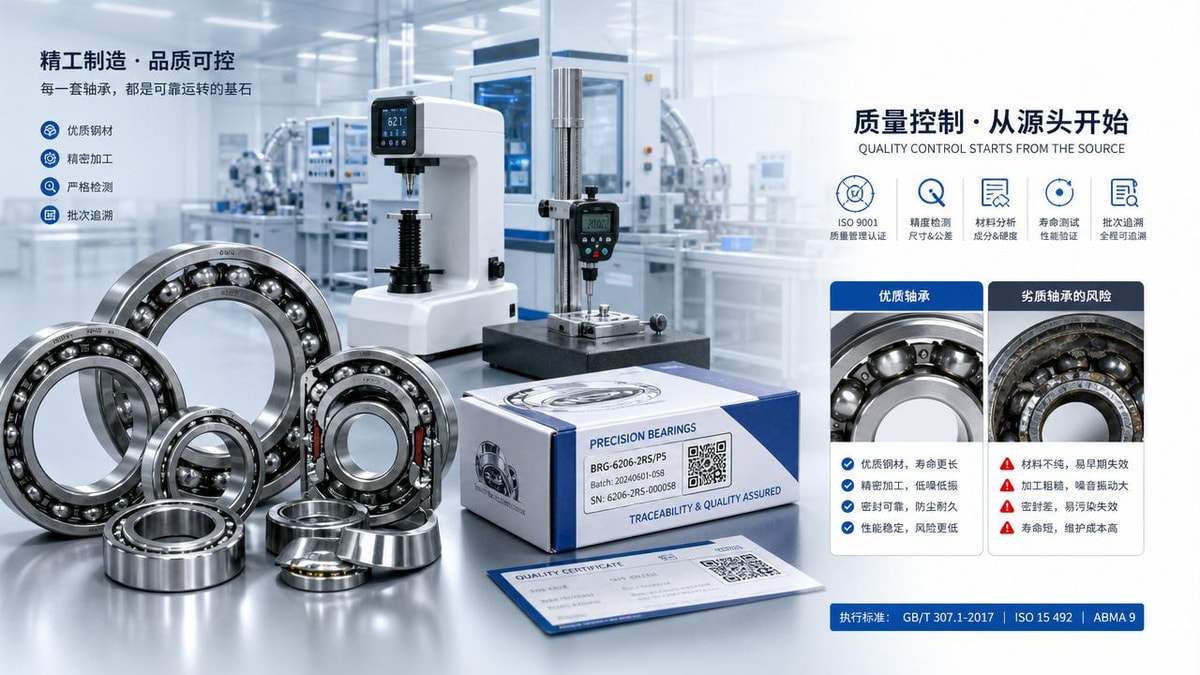
The most important signals include steel quality, heat treatment consistency, dimensional accuracy, cleanliness during manufacturing, cage and seal reliability, lubrication recommendations, packaging integrity, and post-sale technical responsiveness. If a supplier cannot explain these factors clearly, risk rises.
Procurement teams should also ask how the supplier handles nonconformance, field complaints, and corrective actions. A supplier that documents root-cause analysis and preventive action is usually more dependable than one that only offers replacements. Replacement without diagnosis may solve the invoice issue, but it does not solve recurring failure.
This simple comparison framework gives procurement a practical way to rank industrial bearing suppliers beyond surface-level commercial terms.
How can buyers verify quality systems instead of trusting marketing claims?
This is one of the most important questions in industrial sourcing. Many industrial bearing suppliers mention certifications, but procurement should verify how those systems actually operate. A certificate alone does not guarantee process discipline on the shop floor.
Start by requesting evidence of incoming inspection, in-process control, final inspection, calibration, and document retention. Ask who approves deviations, how rejected lots are quarantined, and how corrective actions are closed. Reliable suppliers usually answer these questions quickly and with specifics. Riskier suppliers tend to respond with generic statements.
Procurement can also ask for sample reports such as hardness records, roundness checks, surface finish data, noise or vibration results, and material certificates. If the bearing will be used in high-speed motors, conveyors, medical devices, or automated systems, then performance consistency matters as much as nominal specification compliance.
Supplier audits remain one of the best validation tools. Even a remote audit can reveal whether the supplier has disciplined lot segregation, proper storage conditions, trained inspectors, and a credible response to customer complaints. At TradeNexus Pro, many procurement leaders report that failure risk drops sharply when supplier qualification includes process verification rather than brochure review.
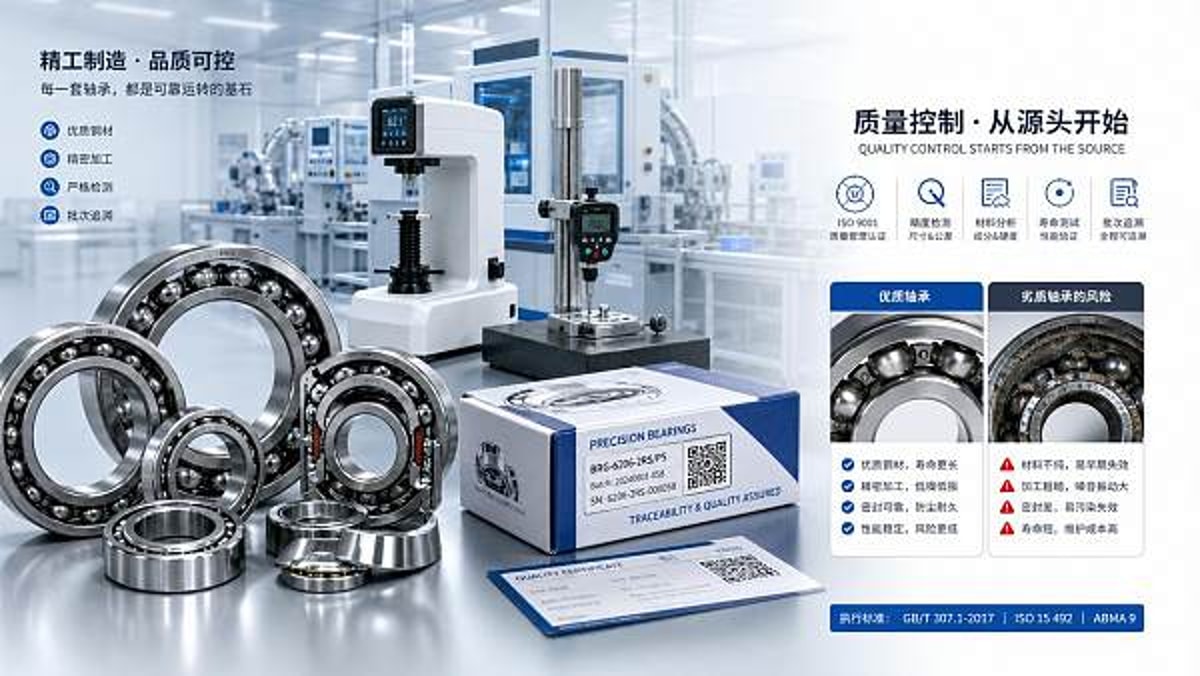
Which technical details most often separate strong industrial bearing suppliers from weak ones?
The best industrial bearing suppliers can discuss application-specific performance in detail. They understand that a bearing for a packaging line, wind subsystem, clean electronics assembly environment, or medical pump may fail for very different reasons. Their value lies in matching design and production control to the actual operating context.
Several technical details deserve close attention. First is material cleanliness. Non-metallic inclusions in bearing steel can shorten fatigue life. Second is heat treatment consistency. Poorly controlled hardness profiles increase wear, cracking, or dimensional instability. Third is geometry control, including raceway finish, internal clearance, and tolerance class. Small variation here can create noise, heat, and early breakdown in service.
Procurement should also ask about lubrication compatibility, sealing options, cage materials, and operating temperature limits. Some failures blamed on bearings are actually mismatches between the bearing configuration and the application environment. A stronger supplier will challenge incomplete specifications and suggest options; a weaker one may simply quote whatever part number was requested.
Another separator is counterfeit protection and packaging control. In global markets, industrial bearing suppliers must protect labels, lot identity, and moisture-resistant packaging. Poor packaging can introduce contamination or corrosion before the bearing even reaches production.
How should procurement compare price, lead time, and failure cost without making the wrong trade-off?
A lower quote can be attractive, especially in cost-sensitive categories, but procurement should compare total risk-adjusted cost. This means looking at price together with expected life, scrap risk, machine downtime, maintenance labor, emergency freight, warranty claims, and vendor responsiveness. A bearing that costs 8% less but fails twice as often is rarely a savings.
Lead time must be evaluated the same way. Fast delivery helps, but if the supplier shortens lead time by weakening inspection discipline or by shipping mixed lots from uncertain sources, the hidden risk is significant. Procurement teams should ask whether rush orders follow the same quality gates as standard production.
A practical method is to score industrial bearing suppliers on five weighted categories: quality assurance, technical fit, supply continuity, commercial terms, and service responsiveness. This prevents the decision from being dominated by unit price alone. It also creates an internal record showing that the sourcing choice was based on business continuity, not just short-term cost pressure.
A useful procurement scoring approach
For critical applications, many buyers assign the highest weight to quality system maturity and field reliability. For less critical applications, price can carry more weight, but it should never outweigh the minimum evidence needed to control failure risk. Segmenting suppliers by application criticality is often more effective than applying one sourcing rule to every bearing category.
What common mistakes do buyers make when evaluating industrial bearing suppliers?
One frequent mistake is assuming all bearings with the same dimensions and designation deliver the same life. They do not. Differences in metallurgy, finishing, cleanliness, and process control can lead to very different outcomes under the same load.
Another mistake is approving a supplier after one successful sample run. Sample performance is useful, but it does not prove lot-to-lot consistency. Procurement should confirm whether the supplier can maintain the same quality across scaled production and over time.
A third mistake is separating procurement from maintenance and engineering feedback. The people who install, lubricate, monitor vibration, and analyze failures often hold the most important evidence about supplier performance. Cross-functional supplier reviews can reveal recurring patterns that a purchasing spreadsheet will miss.
Finally, some buyers focus only on failure replacement terms instead of root-cause capability. Strong industrial bearing suppliers help identify whether the issue came from contamination, fit, overload, lubrication, electrical erosion, or product defects. That diagnostic support is part of supplier value.
What questions should you ask industrial bearing suppliers before approving them?
Before final approval, procurement teams should ask direct, evidence-based questions. The answers help expose whether the supplier operates with discipline or simply competes on quote speed.
- What raw material standards and traceability records do you maintain for each batch?
- Which tests are performed on every lot, and which are performed by sampling?
- How do you control heat treatment, internal clearance, and surface finish variation?
- Can you share a recent corrective action example and how recurrence was prevented?
- What application engineering support do you provide during selection and failure analysis?
- How do you manage urgent orders without bypassing inspection or lot control?
- What is your process for counterfeit prevention, packaging protection, and storage?
These questions improve comparison quality and also signal to industrial bearing suppliers that your company evaluates risk professionally. Strong suppliers usually welcome that discussion.
How can buyers build a lower-risk supplier shortlist for long-term sourcing?
The safest approach is to combine commercial analysis with technical validation and real-use monitoring. Start with a prequalification screen based on certifications, manufacturing capability, export experience, and sector fit. Then move to evidence review: test reports, traceability samples, complaint handling records, and reference cases in similar applications.
Next, run controlled trials where possible. Compare not only failure rates but also installation ease, vibration behavior, noise levels, temperature stability, and supplier response speed. A supplier that responds quickly to field data and helps optimize operating conditions may deliver more value than one offering only a lower unit cost.
For strategic categories, dual sourcing can reduce disruption risk, but only if both suppliers meet a defined technical baseline. Dual sourcing low-quality and high-quality options in parallel may create inconsistency, mixed maintenance outcomes, and hidden warranty disputes. Standardized approval criteria are essential.
What is the final takeaway for procurement professionals comparing industrial bearing suppliers?
The most effective way to compare industrial bearing suppliers is to treat failure risk as the central evaluation standard. Price, lead time, and catalog range matter, but they should be filtered through verifiable quality control, material consistency, test capability, application support, and lot traceability. Procurement teams that source this way reduce surprises, protect uptime, and make more defensible supplier decisions.
If you need to confirm a specific sourcing path, parameters, approval cycle, target price range, or cooperation model, prioritize these discussions first: application load and speed, operating environment, expected life, traceability requirements, test documentation, complaint response process, and supply continuity planning. Those questions will quickly show which industrial bearing suppliers are built for dependable long-term partnership rather than short-term transactions.
Get weekly intelligence in your inbox.
No noise. No sponsored content. Pure intelligence.
 May 06, 2026Hydraulic Cylinder Fabrication Errors That Shorten Service LifeHydraulic Cylinder Fabrication Errors That Shorten Service Life
 May 06, 2026Surface Finishing Services That Reduce Warranty ComplaintsSurface Finishing Services That Reduce Warranty Complaints
 May 06, 2026Waterjet Cutting Is Better Than Laser for These MaterialsWaterjet Cutting Is Better Than Laser for These Materials
 May 06, 2026Custom Molded Rubber Choices That Affect Seal PerformanceCustom Molded Rubber Choices That Affect Seal Performance
 May 06, 2026Linear Motion Systems Fail Faster When Alignment Is OverlookedLinear Motion Systems Fail Faster When Alignment Is Overlooked
 May 06, 2026How Accurate Is Energy Forecasting When Weather Turns Volatile?How Accurate Is Energy Forecasting When Weather Turns Volatile?
 May 06, 2026Medical Device Manufacturing Delays Often Start in ValidationMedical Device Manufacturing Delays Often Start in Validation
 May 06, 2026Anodizing Services: Which Finish Holds Up Outdoors LongerAnodizing Services: Which Finish Holds Up Outdoors Longer
 May 06, 2026Solar Tracker Maintenance Issues That Hurt Long-Term OutputSolar Tracker Maintenance Issues That Hurt Long-Term Output
 May 06, 2026What Changes the Real Cost of Pneumatic Valves WholesaleWhat Changes the Real Cost of Pneumatic Valves Wholesale
 May 06, 2026Solar Microinverters vs String Inverters for Shaded RoofsSolar Microinverters vs String Inverters for Shaded Roofs
 May 06, 2026Bifacial Solar Panels: Do They Pay Off on Every Site?Bifacial Solar Panels: Do They Pay Off on Every Site?
 May 06, 2026Why Heavy Equipment Manufacturing Lead Times Keep SlippingWhy Heavy Equipment Manufacturing Lead Times Keep Slipping
 May 06, 2026Metal Stamping Parts: When Tooling Cost Stops Making SenseMetal Stamping Parts: When Tooling Cost Stops Making Sense
 May 06, 2026Energy Storage Battery Sizing Mistakes That Raise Project CostsEnergy Storage Battery Sizing Mistakes That Raise Project Costs
 May 06, 2026What Causes Revenue Gaps in a Solar Farm ProjectWhat Causes Revenue Gaps in a Solar Farm Project
 May 06, 2026Low Volume Manufacturing Works Best When Demand Is UnclearLow Volume Manufacturing Works Best When Demand Is Unclear
 May 06, 2026Automotive Parts Machining Costs That Grow With Late Design ChangesAutomotive Parts Machining Costs That Grow With Late Design Changes
 May 06, 2026AS9100 Aerospace Machining: What Fails an Audit Most OftenAS9100 Aerospace Machining: What Fails an Audit Most Often
 May 06, 2026Plastic Extrusion Tolerances That Affect Final Product FitPlastic Extrusion Tolerances That Affect Final Product Fit
 May 06, 2026Is Renewable Power Getting Easier to Finance for Industry?Is Renewable Power Getting Easier to Finance for Industry?
 May 06, 2026Ultrasonic Welding Defects That Are Easy to Miss at FirstUltrasonic Welding Defects That Are Easy to Miss at First
 May 06, 2026How to Compare Industrial Bearing Suppliers by Failure RiskHow to Compare Industrial Bearing Suppliers by Failure Risk
 May 06, 2026Custom Heatsinks: When a Standard Profile Stops WorkingCustom Heatsinks: When a Standard Profile Stops Working
 May 06, 2026Gear Manufacturing Problems That Show Up After AssemblyGear Manufacturing Problems That Show Up After Assembly
 May 06, 2026Why Thin Film Solar Cells Still Matter in 2026Why Thin Film Solar Cells Still Matter in 2026
 May 06, 2026Wire EDM Services or CNC Milling for Tight Tolerance Parts?Wire EDM Services or CNC Milling for Tight Tolerance Parts?