
Vietnam’s Consumer Electronics Market: Demand Shifts and Sourcing Opportunities
Vietnam’s consumer electronics market is entering a more selective growth phase. Digital adoption remains broad, but the buying logic is changing: households are weighing price against durability, shoppers are comparing features more closely, and retailers are placing more value on products that can be supported after the sale. For business evaluators, tracking consumer electronics Vietnam demand shifts is no longer only about estimating sales potential. It is about identifying which product categories travel well, which supplier capabilities matter, and where a seemingly attractive sourcing opportunity may carry hidden operational risk.
The market is often discussed through the lens of manufacturing relocation, yet domestic demand deserves equal attention. Vietnam is both a production base within Asian electronics supply chains and a fast-evolving consumer market with its own preferences, channel structures, and affordability thresholds. A sourcing strategy built only around factory capacity can miss the more important question: what kind of electronics are Vietnamese consumers, distributors, and regional buyers actually willing to adopt now?
Demand Is Becoming More Practical, Not Less Digital
Consumer interest in connected devices continues to expand, supported by mobile-first habits, e-commerce access, digital entertainment, remote work patterns, and a growing appetite for home convenience. Smartphones remain central to the wider electronics ecosystem, but purchase decisions increasingly radiate outward into accessories, wearables, tablets, smart televisions, audio products, home networking equipment, security devices, and small connected appliances.
What is changing is the definition of value. In earlier growth cycles, a recognizable feature list or an aggressive launch price could be enough to generate attention. Today, buyers are more likely to ask whether the battery will remain dependable, whether a device works smoothly with existing phones or apps, whether replacement parts are available, and whether warranty handling will become a burden. This does not mean premium products have disappeared from the market. Rather, the middle of the market has become more demanding.
For companies assessing consumer electronics Vietnam opportunities, this creates a useful distinction between “affordable” and “cheap.” Products positioned for everyday use need a credible quality story: stable performance, understandable specifications, clear user instructions, and a service model that local partners can realistically deliver. The lowest ex-factory offer may be commercially weak if return rates, software issues, or missing accessories erode retailer confidence.
The categories drawing the most attention
Several segments deserve closer evaluation because they sit at the intersection of consumer need and regional sourcing potential:
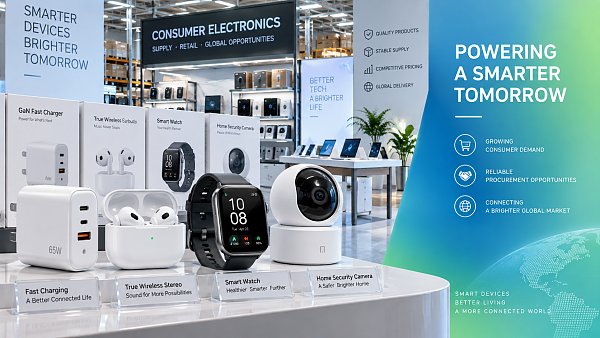
- Mobile accessories and charging products: Demand is broad, replacement cycles are relatively short, and compatibility is critical. Buyers increasingly look beyond appearance toward charging safety, cable durability, power standards, packaging accuracy, and traceability.
- Smart home and personal security devices: Cameras, video doorbells, sensors, smart lighting, and basic automation products appeal to households seeking convenience and reassurance. Installation simplicity, app stability, data handling, and local language support can determine whether the category scales.
- Entertainment and home connectivity: Televisions, streaming peripherals, wireless audio, routers, and related devices benefit from home-based media consumption. Here, reliable firmware and after-sales support often matter as much as hardware specifications.
- Wearables and personal wellness devices: Entry-level smartwatches, fitness trackers, and connected health-oriented accessories are attracting interest, but the category is crowded. Differentiation depends on usable software, battery consistency, and realistic claims rather than feature inflation.
- Small appliances with digital functions: Robotic cleaners, air-treatment products, kitchen devices, and smart energy-management accessories can find a place among urban households. They require more careful assessment of repairability, safety standards, and local electrical requirements.
These segments do not share one universal buyer profile. Urban professionals may prioritize interoperability and design, while provincial distributors may focus on affordability, product robustness, and ease of explaining the product at the point of sale. A sourcing plan should therefore begin with a customer and channel hypothesis, not merely a catalogue search.
Why Vietnam Matters Beyond Its Domestic Market
Vietnam’s role in electronics is reinforced by its position within wider East and Southeast Asian supply networks. International brands and contract manufacturers have expanded operations in the country over time, while local industrial ecosystems have developed around assembly, components, packaging, tooling, logistics, and technical services. This does not mean every electronic product can be sourced locally with the same depth of supplier choice. The supply base is uneven by category, component complexity, and required certification.
For a procurement team, Vietnam can offer three different propositions. It may be a final-assembly location for products designed elsewhere; a source of selected components, housings, cables, packaging, or subassemblies; or a commercial gateway for serving Vietnam and nearby ASEAN markets. These models demand different supplier due diligence. A factory able to assemble a mature product under established instructions is not automatically equipped to co-develop a new smart device, manage firmware revisions, or maintain long-term component continuity.
This distinction is particularly important in consumer electronics, where a product can look complete at shipment but fail commercially because of small technical gaps. An unstable Bluetooth module, an untested power adaptor, unclear language settings, or a weak packaging design can create disproportionate problems once goods reach distributors and end users.
The Sourcing Conversation Has Moved from Unit Price to Total Readiness
When evaluating electronics suppliers in Vietnam, the most useful question is rarely “Who can make this?” A stronger question is: “Who can repeatedly deliver this product to the intended market, under the required quality, documentation, and service conditions?” Total readiness brings together engineering discipline, incoming component control, production planning, testing, export documentation, and communication responsiveness.
Price remains important, especially in mass-market categories. However, a quote should be read as the starting point of an investigation rather than the conclusion. Procurement teams should test whether the price includes the actual bill of materials, appropriate testing procedures, branded or neutral packaging, export cartons, spare parts, technical files, and the expected level of inspection. A low price based on substitute components or incomplete accessory packs can distort a comparison between suppliers.
Questions worth asking before issuing a purchase order
A disciplined evaluation process may include the following areas:
- Product ownership and engineering scope: Is the supplier manufacturing an existing platform, assembling a buyer-owned design, or offering original design manufacturing services? Who controls tooling, firmware, app accounts, and technical revisions?
- Component visibility: Can the supplier identify key component sources and explain how it manages shortages or substitutions? This is especially relevant for batteries, displays, chips, wireless modules, power components, and sensors.
- Quality controls: What checks occur before, during, and after assembly? Ask for practical evidence of functional testing, aging tests where appropriate, cosmetic inspection standards, and treatment of non-conforming goods.
- Compliance pathway: Which destination-market requirements apply to the product? Depending on the category and sales geography, electrical safety, electromagnetic compatibility, radio-frequency, battery transport, environmental, labeling, and data-related obligations may all be relevant.
- After-sales preparedness: Are repair instructions, spare parts, diagnostic procedures, and replacement policies available? Consumer-facing electronics should not be evaluated as if delivery ends the commercial relationship.
- Communication under pressure: How does the supplier handle engineering changes, delivery slippage, defective batches, or documentation corrections? Early response patterns often reveal more than polished presentations.
For smart or connected products, add one more layer: software continuity. Buyers should clarify the update policy, server dependencies, data storage arrangements, user-account ownership, and the consequences if an app provider changes its service. Hardware procurement and digital-service risk are becoming inseparable.
Distribution Realities Can Reshape Product Selection
Vietnam’s consumer electronics market is served through a mix of national retail chains, independent stores, specialized dealers, online marketplaces, social commerce, and distributor networks. This variety offers reach, but it can complicate product positioning. A device that performs well in a large retail chain—with demo space, trained staff, and formal returns management—may struggle in fragmented channels where sellers need a simpler story and faster stock rotation.
Business evaluators should assess how the product will be discovered, explained, activated, and serviced. A compact home camera may require clear installation materials and reliable onboarding. A charging product may need visible safety markings and straightforward compatibility guidance. A smart wearable may need localized application support and a realistic explanation of health-related functions. These are commercial design decisions, not minor marketing details.
Packaging also carries more weight than many sourcing teams expect. It must protect the product through regional transport, communicate the correct specifications, meet labeling expectations, and reduce confusion for consumers who may be comparing several similar models. Overpromising on the box is a short route to returns and damaged channel trust.
Common Misreadings of the Vietnam Opportunity
One recurring mistake is treating Vietnam as a single, uniform market. Purchasing power, shopping behavior, and service expectations vary by city, region, and consumer segment. Another is assuming that assembly growth automatically means a deep local supply chain for every key component. Many products still rely on imported semiconductors, displays, batteries, or specialized modules, which can affect lead times, cost volatility, and origin planning.
A third misreading is to view local presence as optional. Even when sourcing is managed remotely, in-market verification can be valuable. Factory audits, sample validation, production inspections, and conversations with logistics or distribution partners help turn supplier claims into operational evidence. For products with wireless connectivity, batteries, or consumer data functions, the need for careful verification becomes stronger.
Finally, companies should avoid chasing every fast-moving device trend. Consumer electronics categories can become crowded quickly, particularly where product differentiation is shallow. A more resilient strategy may be to select a narrower range with dependable replenishment, compatible accessories, defined warranty handling, and a channel-appropriate price band.
How to Build a More Defensible Market View
Before committing to Vietnam sourcing or market entry, combine demand research with supply-side investigation. Review retail assortments and online listings to understand product positioning, but do not mistake listing volume for true sell-through. Speak with distributors about return reasons, seasonal patterns, preferred payment terms, and the products that create service headaches. Compare factory capability statements with sample performance and actual documentation. The best decisions emerge when market signals and operational evidence point in the same direction.
TradeNexus Pro approaches this kind of cross-border evaluation as an intelligence task rather than a directory exercise. For procurement leaders, exporters, and technology providers, sector-focused analysis can help connect consumer demand trends with supplier reliability, compliance awareness, and broader regional supply-chain movement. In a category where specifications change quickly and trust is earned slowly, informed context is a practical business asset.
The next phase of consumer electronics Vietnam will likely reward companies that bring discipline to both sides of the equation: products that make sense for value-conscious, digitally engaged buyers, and sourcing relationships built around transparent capability rather than headline capacity. Vietnam offers meaningful opportunity, but the strongest opportunities are rarely found by searching for the lowest quote. They are found by understanding what the market will tolerate, what the channel can support, and what the supplier can sustain after the first shipment leaves the factory.
Get weekly intelligence in your inbox.
No noise. No sponsored content. Pure intelligence.
 Oct 08, 2026How Digital Health Improves Diagnostic Accuracy and Workflow in Clinical LabsHow Digital Health Improves Diagnostic Accuracy and Workflow in Clinical Labs
 Oct 07, 2026Selecting Voice Picking Systems for German Warehouses: Integration, Languages and ROISelecting Voice Picking Systems for German Warehouses: Integration, Languages and ROI
 Oct 06, 2026How to Choose Last Mile Dispatch Software for On-Time Delivery at ScaleHow to Choose Last Mile Dispatch Software for On-Time Delivery at Scale
 Oct 05, 2026Vietnam’s Consumer Electronics Market: Demand Shifts and Sourcing OpportunitiesVietnam’s Consumer Electronics Market: Demand Shifts and Sourcing Opportunities
 Oct 04, 2026Digital Health Investment Priorities for Providers: Improving Access, Outcomes, and EfficiencyDigital Health Investment Priorities for Providers: Improving Access, Outcomes, and Efficiency
 Oct 03, 2026How to Specify an FR4 Custom PCB Board for High-Voltage and High-Heat DesignsHow to Specify an FR4 Custom PCB Board for High-Voltage and High-Heat Designs
 Oct 02, 2026ERP Software Market Intelligence: Adoption, Pricing, and Vendor Signals to WatchERP Software Market Intelligence: Adoption, Pricing, and Vendor Signals to Watch
 Oct 01, 2026How to Select Calibrated Temperature Data Loggers for GMP Cold Storage MonitoringHow to Select Calibrated Temperature Data Loggers for GMP Cold Storage Monitoring
 Sep 30, 2026Custom Molded Rubber Pricing: What Drives Unit Cost and Tooling Fees?Custom Molded Rubber Pricing: What Drives Unit Cost and Tooling Fees?
 Sep 29, 2026How to Evaluate Energy Management Software Vendors for Multi-Site OperationsHow to Evaluate Energy Management Software Vendors for Multi-Site Operations
 Sep 28, 2026How to Select a DIN Rail Smart Meter for Multi-Circuit Energy MonitoringHow to Select a DIN Rail Smart Meter for Multi-Circuit Energy Monitoring
 Sep 27, 2026TWS Earbuds in Vietnam: Demand Drivers, Price Tiers, and Retail Channel OpportunitiesTWS Earbuds in Vietnam: Demand Drivers, Price Tiers, and Retail Channel Opportunities
 Sep 26, 2026How UAE Clinics Can Qualify a Smart Glucometer Supplier for Accuracy and ComplianceHow UAE Clinics Can Qualify a Smart Glucometer Supplier for Accuracy and Compliance
 Sep 25, 2026Buying Aesthetic Lasers in the USA: FDA Status, Wavelengths, and Service SupportBuying Aesthetic Lasers in the USA: FDA Status, Wavelengths, and Service Support
 Sep 24, 2026Laser Cutting Brass Sheet: How to Prevent Burrs and Heat Marks on Thin PartsLaser Cutting Brass Sheet: How to Prevent Burrs and Heat Marks on Thin Parts
 Sep 23, 2026How to Choose Lightweight ANC Headphones for Comfortable All-Day TravelHow to Choose Lightweight ANC Headphones for Comfortable All-Day Travel
 Sep 22, 2026IPX5 TWS Bluetooth Earbuds: What Protection Do They Offer for Workouts?IPX5 TWS Bluetooth Earbuds: What Protection Do They Offer for Workouts?
 Sep 21, 2026What to Look for in a Grid Integration Company for Utility-Scale Solar ProjectsWhat to Look for in a Grid Integration Company for Utility-Scale Solar Projects
 Sep 20, 2026Microgrid Controller Pricing: What Drives Cost in Commercial Energy Projects?Microgrid Controller Pricing: What Drives Cost in Commercial Energy Projects?
 Sep 19, 2026How to Choose a GaN Charger for Laptops Without Compromising Power or PortabilityHow to Choose a GaN Charger for Laptops Without Compromising Power or Portability
 Sep 18, 2026Floating Solar Farm Costs: CAPEX, OPEX, and the Site Factors That Shape ROIFloating Solar Farm Costs: CAPEX, OPEX, and the Site Factors That Shape ROI
 Sep 17, 2026Drone Delivery Solutions for Last-Mile Routes: Site, Payload, and Range PlanningDrone Delivery Solutions for Last-Mile Routes: Site, Payload, and Range Planning
 Sep 16, 2026When Low-Volume Electronics Manufacturing Makes More Sense Than Mass ProductionWhen Low-Volume Electronics Manufacturing Makes More Sense Than Mass Production
 Sep 15, 2026Wholesale WiFi Smart Switches: What Buyers Should Verify Before OrderingWholesale WiFi Smart Switches: What Buyers Should Verify Before Ordering
 Sep 14, 2026How to Select IoT Sensors for Reliable Monitoring in Harsh Industrial EnvironmentsHow to Select IoT Sensors for Reliable Monitoring in Harsh Industrial Environments
 Sep 13, 2026How Procurement Teams Can Improve Supplier Reliability With Supply Chain VisibilityHow Procurement Teams Can Improve Supplier Reliability With Supply Chain Visibility
 Sep 12, 2026Smart Manufacturing Trends 2026: What Leaders Should Prioritize for ROISmart Manufacturing Trends 2026: What Leaders Should Prioritize for ROI



























