
Buying Aesthetic Lasers in the USA: FDA Status, Wavelengths, and Service Support
A clinic may be ready to add hair removal, pigment treatment, vascular work, resurfacing, or tattoo removal, yet the purchasing decision can stall once quotations arrive. Two systems may appear similar on a sales sheet while having very different regulatory documentation, wavelength capabilities, handpiece configurations, electrical requirements, and repair arrangements. A lower purchase price can become costly when the delivered device does not match the intended treatments, lacks a usable service pathway, or cannot be supported during downtime.
For buyers sourcing aesthetic lasers USA, the practical starting point is not “Which laser is best?” It is: Which FDA-documented device, with which wavelength and delivery method, is suitable for the clinic’s planned indications and can be kept operational with dependable support? Evaluate the device record, intended use, clinical fit, consumable and maintenance needs, supplier accountability, and ownership cost together. A laser should not be selected solely because it offers the most treatment claims or the longest list of wavelengths.
Start with the treatment mix, not the equipment brochure
Procurement becomes clearer when the team first defines the procedures the device is expected to support. “Skin rejuvenation” is too broad for a purchase specification. It may mean non-ablative fractional resurfacing, ablative resurfacing, vascular treatment, pigment reduction, acne-related indications, or a combination of procedures. Each category has different wavelength, pulse-duration, cooling, spot-size, and operator-training implications.
Ask clinical leadership to rank applications by expected use rather than listing every possible treatment. A practical brief should identify the primary indication, secondary indications worth paying for, patient skin-type range, treatment volume expectations, need for mobility between rooms, and whether the organization will offer procedures requiring stronger pain management or longer recovery discussions.
- Hair reduction: often requires a wavelength, pulse range, spot size, and epidermal cooling approach appropriate to the intended patient population.
- Vascular and superficial redness concerns: depend heavily on target vessel characteristics, pulse duration, energy delivery, and treatment technique.
- Benign pigmented lesions and photorejuvenation-related applications: require careful matching of wavelength, pulse structure, and stated indication.
- Acne scars, texture, and resurfacing: may call for fractional non-ablative, fractional ablative, or full-field ablative technology, each with distinct workflow and risk controls.
- Tattoo removal: requires an appropriate pulsed system and should be assessed against the colors, ink depth, and treatment expectations the practice plans to address.
A multi-application platform can be commercially sensible, but only when its included handpieces and software options support the services that will actually be offered. A base console described as “expandable” may require additional purchases before it can deliver the applications shown in promotional material. Request a configuration-specific quotation that lists every handpiece, wavelength module, footswitch, cooling component, smoke evacuation interface where relevant, software license, trolley, protective eyewear, and treatment accessory included at delivery.
FDA status: verify the exact device and intended use
FDA terminology is often used loosely in equipment marketing. That creates avoidable risk during purchasing. Aesthetic laser devices may be subject to different regulatory pathways, and the status of one device cannot be assumed from a manufacturer’s general reputation, a similar model, an overseas version, or a component used in another system.
In many purchasing situations, the key question is whether the specific device has been cleared for marketing under the applicable FDA process and whether the stated intended use aligns with the procedures planned by the clinic. “FDA approved” and “FDA cleared” are not interchangeable descriptions. Do not accept a generic statement that a laser is “FDA registered” as proof that the exact system, configuration, or claimed indication has been cleared or approved. Registration and listing are not the same as a determination that a particular marketing claim is supported through a clearance or approval pathway.
Request the manufacturer name, legal manufacturer address, exact model number, and the applicable FDA documentation reference. Then compare the supplier’s claims with the device’s cleared or approved intended use, not merely its marketing copy. This review should be performed before a purchase order is issued, particularly when an importer, distributor, private-label seller, or broker is involved.
Documents worth requesting before commercial negotiation is finalized
- Exact model and configuration identification, including attached modules and handpieces.
- FDA clearance or approval reference relevant to the device being offered.
- Current instructions for use, operator manual, and contraindication or warning information.
- Labeling that describes intended use and supplied accessories.
- Electrical specifications, installation requirements, and site-preparation guidance.
- Warranty terms, service scope, preventive-maintenance requirements, and exclusions.
- Evidence of the supplier’s authorization to sell and support the device in the United States.
Documentation review is not simply a legal exercise. It protects operational planning. If a treatment is outside the device’s stated intended use, the organization may face different clinical, training, insurance, protocol, and risk-management considerations. Procurement should flag such gaps for the responsible clinical and compliance stakeholders rather than treating them as a sales-detail issue.
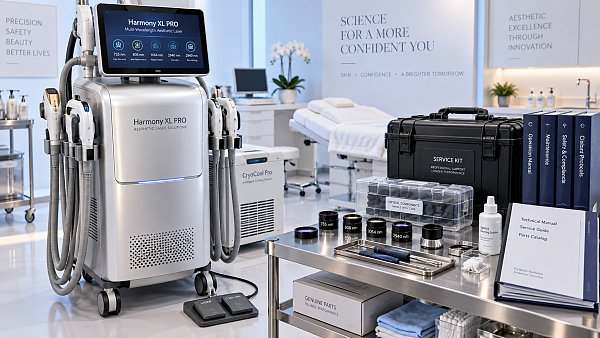
Wavelength is a selection tool, not a complete specification
Wavelength determines how laser energy is preferentially absorbed by targets such as melanin, hemoglobin, or water. That makes it fundamental, but it does not determine clinical suitability by itself. Pulse duration, fluence range, spot size, repetition rate, beam profile, cooling, fractional pattern, and operator control all affect how a system can be used.
Fractional technology also needs clarification. “Fractional” can describe a delivery pattern rather than a single wavelength or treatment depth. A fractional non-ablative device and a fractional CO2 device may both be positioned for skin-texture work, but their tissue interaction, treatment workflow, consumables, operator skill requirements, and post-treatment considerations differ substantially. A purchasing team should avoid treating them as interchangeable alternatives.
Compare the delivered configuration under real operating conditions
A vendor demonstration can show that a device fires correctly; it does not automatically prove that the proposed configuration suits the facility. Before selection, review the conditions under which the unit will operate daily. A high-volume hair-removal setting may value large spot sizes, stable cooling, ergonomic applicators, and turnaround time. A dermatology-led practice may prioritize parameter control, multiple indication-specific handpieces, documentation, and the ability to schedule different treatment types without lengthy changeovers.
Ask suppliers to distinguish standard features from options. This is especially important with platforms marketed around multiple wavelengths. The quoted system may contain only one source or handpiece, while other applications require a separate module, accessory, or software activation. Obtain a written treatment-capability matrix tied to the exact quotation.
Also examine physical integration. Confirm available power supply, plug type, circuit requirements, room dimensions, ventilation needs, heat load, equipment weight, mobility limitations, network or software dependencies, and any requirement for distilled water, replaceable filters, gas, fiber, lamps, windows, or disposable tips. These details influence both installation cost and whether the system remains usable when a minor component fails.
Service support is part of the device specification
Laser downtime is not an abstract inconvenience. It can disrupt booked treatment schedules, require patient communication, reduce room utilization, and create pressure to use another device outside its normal workflow. For that reason, a service promise should be converted into contract terms that procurement can evaluate.
First determine who performs service: the legal manufacturer, a direct U.S. subsidiary, an authorized distributor, or an independent third party. Each arrangement can work, but the responsibilities must be clear. Ask whether technicians are trained on the exact model, where spare parts are held, whether remote diagnostics are available, and what happens if a handpiece or core laser source fails.
Questions that expose weak service coverage
- What does the warranty include, and which items are treated as consumables or excluded wear parts?
- Is labor included for onsite repair, and are travel time and travel expenses included or charged separately?
- What response window applies to a device that is unable to treat patients?
- Does the supplier offer preventive maintenance, calibration checks where applicable, software updates, or loaner equipment?
- Can the clinic buy a service agreement after the warranty ends, and how is annual pricing determined?
- What documentation is provided after installation, repair, and preventive service?
- How long are replacement parts expected to remain available for the model?
Do not rely on vague phrases such as “lifetime support” without defining what is actually covered. Phone availability is different from onsite repair. A warranty covering the console may not cover a high-value handpiece. Likewise, a service contract may require mandatory preventive visits, operator refresher training, environmental conditions, or use of approved consumables. These conditions should be reviewed before the clinic commits to a device that will become central to its revenue schedule.
Build a purchase comparison around ownership risk
Price comparisons are most useful when all proposals are normalized. Create one line-item comparison rather than comparing headline quotes. Include acquisition cost, mandatory accessories, shipping and installation, facility modifications, training, warranty length, service coverage, scheduled maintenance, expected consumables, replacement handpiece terms, software fees, and any required upgrades. The purpose is not to predict an exact lifetime cost, but to reveal cost categories that one quotation may omit.
Training deserves its own line. A device may be technically capable, yet unsuitable for immediate use if initial training is limited to basic operation and does not cover the applications the clinic expects to offer. Confirm the format, duration, number of attendees, training location, documentation, follow-up access, and whether clinical protocols are the responsibility of the clinic’s licensed providers. Equipment training should not be confused with clinical credentialing or a substitute for appropriate medical oversight.
Supplier diligence should include commercial and operational checks: legal entity details, U.S. support contact, installation responsibility, return or acceptance terms, insurance requirements where relevant, and escalation contacts. A distributor can be a practical route to purchase, but buyers should understand whether that distributor controls parts access and whether support continues if the distribution relationship changes.
When a smaller system may be the more defensible choice
A broad platform is not always the best procurement outcome. A clinic with a defined hair-removal service line may benefit more from a well-supported system optimized for that task than from a multi-wavelength platform whose additional functions are rarely used. Conversely, a facility with established demand across several treatment categories may justify a modular system if the available handpieces, staff training, room setup, and service coverage are all specified in the purchase.
The decisive point is fit between planned care delivery and the equipment that arrives. A procurement file should be able to answer, in plain language: what the device is authorized and intended to do, which configuration delivers each planned procedure, what training and safety controls are required, who repairs it, and what happens when it is unavailable. When those answers are documented before contract signature, the choice between competing aesthetic laser systems becomes far less dependent on sales claims and far more defensible operationally.
Get weekly intelligence in your inbox.
No noise. No sponsored content. Pure intelligence.
 Oct 08, 2026How Digital Health Improves Diagnostic Accuracy and Workflow in Clinical LabsHow Digital Health Improves Diagnostic Accuracy and Workflow in Clinical Labs
 Oct 07, 2026Selecting Voice Picking Systems for German Warehouses: Integration, Languages and ROISelecting Voice Picking Systems for German Warehouses: Integration, Languages and ROI
 Oct 06, 2026How to Choose Last Mile Dispatch Software for On-Time Delivery at ScaleHow to Choose Last Mile Dispatch Software for On-Time Delivery at Scale
 Oct 05, 2026Vietnam’s Consumer Electronics Market: Demand Shifts and Sourcing OpportunitiesVietnam’s Consumer Electronics Market: Demand Shifts and Sourcing Opportunities
 Oct 04, 2026Digital Health Investment Priorities for Providers: Improving Access, Outcomes, and EfficiencyDigital Health Investment Priorities for Providers: Improving Access, Outcomes, and Efficiency
 Oct 03, 2026How to Specify an FR4 Custom PCB Board for High-Voltage and High-Heat DesignsHow to Specify an FR4 Custom PCB Board for High-Voltage and High-Heat Designs
 Oct 02, 2026ERP Software Market Intelligence: Adoption, Pricing, and Vendor Signals to WatchERP Software Market Intelligence: Adoption, Pricing, and Vendor Signals to Watch
 Oct 01, 2026How to Select Calibrated Temperature Data Loggers for GMP Cold Storage MonitoringHow to Select Calibrated Temperature Data Loggers for GMP Cold Storage Monitoring
 Sep 30, 2026Custom Molded Rubber Pricing: What Drives Unit Cost and Tooling Fees?Custom Molded Rubber Pricing: What Drives Unit Cost and Tooling Fees?
 Sep 29, 2026How to Evaluate Energy Management Software Vendors for Multi-Site OperationsHow to Evaluate Energy Management Software Vendors for Multi-Site Operations
 Sep 28, 2026How to Select a DIN Rail Smart Meter for Multi-Circuit Energy MonitoringHow to Select a DIN Rail Smart Meter for Multi-Circuit Energy Monitoring
 Sep 27, 2026TWS Earbuds in Vietnam: Demand Drivers, Price Tiers, and Retail Channel OpportunitiesTWS Earbuds in Vietnam: Demand Drivers, Price Tiers, and Retail Channel Opportunities
 Sep 26, 2026How UAE Clinics Can Qualify a Smart Glucometer Supplier for Accuracy and ComplianceHow UAE Clinics Can Qualify a Smart Glucometer Supplier for Accuracy and Compliance
 Sep 25, 2026Buying Aesthetic Lasers in the USA: FDA Status, Wavelengths, and Service SupportBuying Aesthetic Lasers in the USA: FDA Status, Wavelengths, and Service Support
 Sep 24, 2026Laser Cutting Brass Sheet: How to Prevent Burrs and Heat Marks on Thin PartsLaser Cutting Brass Sheet: How to Prevent Burrs and Heat Marks on Thin Parts
 Sep 23, 2026How to Choose Lightweight ANC Headphones for Comfortable All-Day TravelHow to Choose Lightweight ANC Headphones for Comfortable All-Day Travel
 Sep 22, 2026IPX5 TWS Bluetooth Earbuds: What Protection Do They Offer for Workouts?IPX5 TWS Bluetooth Earbuds: What Protection Do They Offer for Workouts?
 Sep 21, 2026What to Look for in a Grid Integration Company for Utility-Scale Solar ProjectsWhat to Look for in a Grid Integration Company for Utility-Scale Solar Projects
 Sep 20, 2026Microgrid Controller Pricing: What Drives Cost in Commercial Energy Projects?Microgrid Controller Pricing: What Drives Cost in Commercial Energy Projects?
 Sep 19, 2026How to Choose a GaN Charger for Laptops Without Compromising Power or PortabilityHow to Choose a GaN Charger for Laptops Without Compromising Power or Portability
 Sep 18, 2026Floating Solar Farm Costs: CAPEX, OPEX, and the Site Factors That Shape ROIFloating Solar Farm Costs: CAPEX, OPEX, and the Site Factors That Shape ROI
 Sep 17, 2026Drone Delivery Solutions for Last-Mile Routes: Site, Payload, and Range PlanningDrone Delivery Solutions for Last-Mile Routes: Site, Payload, and Range Planning
 Sep 16, 2026When Low-Volume Electronics Manufacturing Makes More Sense Than Mass ProductionWhen Low-Volume Electronics Manufacturing Makes More Sense Than Mass Production
 Sep 15, 2026Wholesale WiFi Smart Switches: What Buyers Should Verify Before OrderingWholesale WiFi Smart Switches: What Buyers Should Verify Before Ordering
 Sep 14, 2026How to Select IoT Sensors for Reliable Monitoring in Harsh Industrial EnvironmentsHow to Select IoT Sensors for Reliable Monitoring in Harsh Industrial Environments
 Sep 13, 2026How Procurement Teams Can Improve Supplier Reliability With Supply Chain VisibilityHow Procurement Teams Can Improve Supplier Reliability With Supply Chain Visibility
 Sep 12, 2026Smart Manufacturing Trends 2026: What Leaders Should Prioritize for ROISmart Manufacturing Trends 2026: What Leaders Should Prioritize for ROI



























