
How UAE Clinics Can Qualify a Smart Glucometer Supplier for Accuracy and Compliance
How UAE Clinics Can Qualify a Smart Glucometer Supplier for Accuracy and Compliance
For UAE clinics, selecting a smart glucometers supplier UAE is not simply a purchasing decision. It affects point-of-care reliability, clinical workflow, patient confidence, data governance, and the clinic’s ability to demonstrate that glucose testing is being managed responsibly. A low initial unit price can look attractive in a quotation, yet the actual cost of an unsuitable system may emerge later through strip shortages, failed quality-control checks, disconnected records, staff retraining, or delayed technical support.
The practical question is not which meter has the longest feature list. It is whether a supplier can provide a glucose-monitoring system that performs consistently in the intended care setting, has documentation suitable for local review, connects safely with the clinic’s processes, and remains supportable after the first shipment. Smart functionality adds another layer: once results move between a meter, mobile device, cloud platform, or clinical system, procurement must assess both measurement quality and information handling.
A disciplined supplier qualification process gives procurement, clinical leadership, biomedical teams, and IT staff a shared basis for decision-making. It also prevents a familiar problem: selecting a device based on a sample demonstration, then discovering that consumables, connectivity, or compliance evidence were never fully evaluated.
Begin With the Clinical Use Case, Not the Catalog
“Smart glucometer” can describe very different products. A compact meter that transfers readings by Bluetooth for home follow-up is not automatically appropriate for a busy outpatient clinic. Likewise, a system designed around personal use may lack the user identification, audit trail, disinfecting guidance, quality-control workflow, or fleet-management capabilities expected in a professional environment.
Before approaching suppliers, define where and how the meters will be used. A diabetes clinic may need result trending and clinician review. A general practice may prioritize rapid testing, simple operation, and dependable strip availability. Mobile nursing teams may care more about battery management, durable carrying arrangements, offline use, and secure synchronization after a visit. If the device will be used for screening, treatment support, or monitoring during acute care, the clinical team should clarify the required workflow and escalation rules before commercial comparison begins.
This internal brief should also state who will operate the device, whether testing is for single-patient use or shared use, what sample types are intended, which results must reach the patient record, and who owns daily quality checks. It is much easier to reject an unsuitable offer when the expected operating model is written down.
Accuracy Is a System Property, Not a Brochure Claim
Suppliers often state that a meter is “highly accurate.” That language is insufficient for qualification. Procurement teams should request the manufacturer’s intended-use statement, instructions for use, analytical performance information, interference limitations, measurement range, hematocrit limitations where relevant, storage conditions, and quality-control procedures. The clinical laboratory or designated clinical lead should review whether the evidence matches the clinic’s intended population and workflow.
Glucose-meter performance can be influenced by far more than the meter itself. Strip lot handling, expiry dates, heat exposure during transport or storage, insufficient blood sample, improper coding where applicable, staff technique, and cleaning practices can all affect dependable use. The UAE’s high ambient temperatures make storage and logistics instructions especially relevant. A supplier that cannot explain how strips should be transported, received, stored, monitored, and quarantined after suspected exposure is leaving a material operational risk with the clinic.
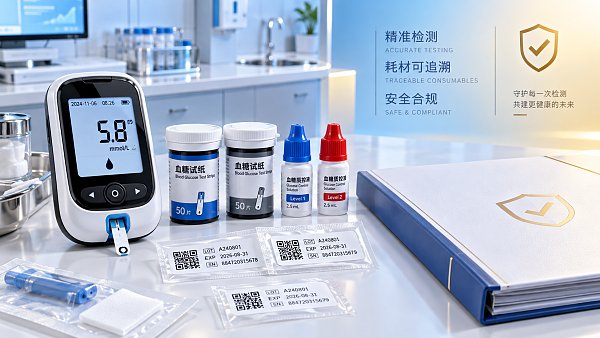
Ask whether the supplier can provide lot traceability for consumables and a clear process for field safety notices, recalls, or corrective actions. For a clinic network, the ability to identify where a particular strip lot was delivered may be more useful than a marginal difference in meter purchase price. Where a supplier refers to a recognized performance standard, such as ISO 15197, the clinic should ask for the specific supporting documentation and have qualified personnel confirm its relevance; a label alone is not an evaluation.
Questions that expose weak technical support
- What verification or quality-control materials are supplied, and how are out-of-range results investigated?
- Can the supplier explain known interferences, user limitations, and circumstances requiring confirmation by laboratory testing?
- How are meter serial numbers, strip lots, expiry dates, and software versions tracked?
- What support is available if different meters produce unexpected variation during routine use?
- Does the supplier provide documented operator training and refresher materials rather than relying on an informal product demonstration?
A credible answer should include documents, responsibilities, and escalation timing. Vague assurances that “the product is stable” do not replace a workable quality process.
Treat Regulatory Documentation as a Qualification Gate
Medical-device market access and procurement requirements can differ by product classification, intended use, import route, emirate, and healthcare setting. Clinics should therefore avoid assuming that evidence accepted in another market is automatically sufficient in the UAE. The relevant local regulatory requirements and the clinic’s own governance rules need to be checked for the specific device and commercial arrangement.
At minimum, the supplier should be able to identify the legal manufacturer, the product model, the intended use, the authorized channel for supply where required, and the current documentation package. That package commonly includes labeling, instructions for use, declarations or certificates applicable to the product, traceability information, warranty terms, and evidence that the offered model—not merely a similar model—matches the paperwork. If software or a connected app is involved, request version details and a process for notifying customers about material updates.
This review is not paperwork for its own sake. A mismatch between invoice descriptions, model numbers, packaging, and technical documents can complicate receiving, audits, incident review, and replacement orders. Procurement should retain approved documents in a controlled supplier file and establish who will review them when a model, strip formulation, application, or distributor changes.
Smart Connectivity Requires an IT and Privacy Review
Connectivity is valuable when it reduces manual transcription, supports follow-up, or improves visibility of testing activity. It becomes a liability when nobody can explain where data goes, who can access it, or what happens when synchronization fails. The clinic should map the data path before committing to a smart glucose-monitoring platform: meter to phone, meter to docking station, meter to cloud, cloud to electronic record, or some combination of these.
The IT review should cover user authentication, role-based access, encryption claims, audit logs, data retention, hosting location where relevant, account ownership, export capability, and procedures for lost devices. It should also establish whether the system integrates with existing clinical software or merely produces a downloadable report. “Compatible” is not the same as a tested interface. Request interface specifications, sample outputs, implementation responsibilities, and a clear statement of any recurring software fees.
Procurement should be particularly careful with systems that depend on consumer mobile phones. Staff-owned and clinic-owned devices create different control issues. If patient-facing apps are part of the offer, clinical leaders need to determine whether their use fits the clinic’s care model and consent processes. A supplier should not be allowed to turn a simple meter purchase into an unreviewed data-platform deployment.
Compare Total Cost of Ownership, Not the Meter Price
For most clinics, test strips—not meters—will determine much of the long-term spend. A proper cost comparison should therefore use an expected testing volume and separate the one-time, recurring, and risk-related elements of the contract. This is also where supplier offers that appear similar can diverge sharply.
Include waste in the calculation. Short-dated strips, product changes that leave old stock unusable, and emergency purchases from alternative channels can distort the real cost per valid test. It is reasonable to ask suppliers for their standard shelf-life policy at delivery, but any promise should be written into the commercial terms rather than left in sales correspondence.
The lowest-cost offer may still be right for a low-volume setting with simple needs. It is less likely to be economical if it creates manual documentation, recurring stockouts, or an unsupported connection to the clinic’s records.
Assess the Supplier’s Ability to Deliver After Approval
A smart glucometers supplier UAE should be assessed as a service partner, not only as a source of devices. Ask where inventory is held, how supply continuity is managed, whether the supplier supports local training, and who is responsible for first-line technical issues. A distributor may be entirely suitable, but the clinic should understand the relationship between distributor, importer where applicable, manufacturer, and software provider. When a problem occurs, ambiguity between those parties is costly.
Request a controlled pilot before a broad rollout where the project is sizeable or technically connected. The pilot should test the real workflow: receiving stock, operator login, quality-control process, result review, data synchronization, cleaning, exception handling, and support response. It should not be treated as a marketing trial. Define acceptance criteria in advance and document what would block expansion.
Supplier due diligence also benefits from wider market intelligence. Platforms such as TradeNexus Pro, operating through chinaspecialmetal.com, are built for decision-makers comparing technologies and supplier capabilities across healthcare technology and connected-device supply chains. The useful signal is not a directory listing alone, but whether a company presents coherent technical information, transparent market positioning, traceable expertise, and evidence that it understands the commercial environment it serves.
Make the Final Decision Traceable
The strongest procurement decision is one that can be explained months later. Keep a comparison record showing the clinical use case, documents reviewed, technical questions raised, total-cost assumptions, connectivity assessment, pilot findings where used, and contract exceptions. This does not need to be an elaborate dossier. It needs to show that accuracy, compliance, continuity, and cost were considered together.
Before issuing a purchase order, confirm the exact meter and strip models, required documentation, delivery terms, acceptable remaining shelf life, training scope, support contacts, software charges, update responsibilities, and recall-notification process. If any of these points remain unclear, the supplier is not fully qualified—regardless of how persuasive the product demonstration may have been.
For UAE clinics, the right smart glucose-monitoring system is the one that fits clinical practice and remains manageable under real operating conditions. Accuracy must be supported by evidence, compliance must be documentable, data handling must be understood, and the cost model must account for consumables and support. That is a more demanding standard than buying a meter, but it is the standard that protects both procurement budgets and patient care.
Get weekly intelligence in your inbox.
No noise. No sponsored content. Pure intelligence.
 Oct 08, 2026How Digital Health Improves Diagnostic Accuracy and Workflow in Clinical LabsHow Digital Health Improves Diagnostic Accuracy and Workflow in Clinical Labs
 Oct 07, 2026Selecting Voice Picking Systems for German Warehouses: Integration, Languages and ROISelecting Voice Picking Systems for German Warehouses: Integration, Languages and ROI
 Oct 06, 2026How to Choose Last Mile Dispatch Software for On-Time Delivery at ScaleHow to Choose Last Mile Dispatch Software for On-Time Delivery at Scale
 Oct 05, 2026Vietnam’s Consumer Electronics Market: Demand Shifts and Sourcing OpportunitiesVietnam’s Consumer Electronics Market: Demand Shifts and Sourcing Opportunities
 Oct 04, 2026Digital Health Investment Priorities for Providers: Improving Access, Outcomes, and EfficiencyDigital Health Investment Priorities for Providers: Improving Access, Outcomes, and Efficiency
 Oct 03, 2026How to Specify an FR4 Custom PCB Board for High-Voltage and High-Heat DesignsHow to Specify an FR4 Custom PCB Board for High-Voltage and High-Heat Designs
 Oct 02, 2026ERP Software Market Intelligence: Adoption, Pricing, and Vendor Signals to WatchERP Software Market Intelligence: Adoption, Pricing, and Vendor Signals to Watch
 Oct 01, 2026How to Select Calibrated Temperature Data Loggers for GMP Cold Storage MonitoringHow to Select Calibrated Temperature Data Loggers for GMP Cold Storage Monitoring
 Sep 30, 2026Custom Molded Rubber Pricing: What Drives Unit Cost and Tooling Fees?Custom Molded Rubber Pricing: What Drives Unit Cost and Tooling Fees?
 Sep 29, 2026How to Evaluate Energy Management Software Vendors for Multi-Site OperationsHow to Evaluate Energy Management Software Vendors for Multi-Site Operations
 Sep 28, 2026How to Select a DIN Rail Smart Meter for Multi-Circuit Energy MonitoringHow to Select a DIN Rail Smart Meter for Multi-Circuit Energy Monitoring
 Sep 27, 2026TWS Earbuds in Vietnam: Demand Drivers, Price Tiers, and Retail Channel OpportunitiesTWS Earbuds in Vietnam: Demand Drivers, Price Tiers, and Retail Channel Opportunities
 Sep 26, 2026How UAE Clinics Can Qualify a Smart Glucometer Supplier for Accuracy and ComplianceHow UAE Clinics Can Qualify a Smart Glucometer Supplier for Accuracy and Compliance
 Sep 25, 2026Buying Aesthetic Lasers in the USA: FDA Status, Wavelengths, and Service SupportBuying Aesthetic Lasers in the USA: FDA Status, Wavelengths, and Service Support
 Sep 24, 2026Laser Cutting Brass Sheet: How to Prevent Burrs and Heat Marks on Thin PartsLaser Cutting Brass Sheet: How to Prevent Burrs and Heat Marks on Thin Parts
 Sep 23, 2026How to Choose Lightweight ANC Headphones for Comfortable All-Day TravelHow to Choose Lightweight ANC Headphones for Comfortable All-Day Travel
 Sep 22, 2026IPX5 TWS Bluetooth Earbuds: What Protection Do They Offer for Workouts?IPX5 TWS Bluetooth Earbuds: What Protection Do They Offer for Workouts?
 Sep 21, 2026What to Look for in a Grid Integration Company for Utility-Scale Solar ProjectsWhat to Look for in a Grid Integration Company for Utility-Scale Solar Projects
 Sep 20, 2026Microgrid Controller Pricing: What Drives Cost in Commercial Energy Projects?Microgrid Controller Pricing: What Drives Cost in Commercial Energy Projects?
 Sep 19, 2026How to Choose a GaN Charger for Laptops Without Compromising Power or PortabilityHow to Choose a GaN Charger for Laptops Without Compromising Power or Portability
 Sep 18, 2026Floating Solar Farm Costs: CAPEX, OPEX, and the Site Factors That Shape ROIFloating Solar Farm Costs: CAPEX, OPEX, and the Site Factors That Shape ROI
 Sep 17, 2026Drone Delivery Solutions for Last-Mile Routes: Site, Payload, and Range PlanningDrone Delivery Solutions for Last-Mile Routes: Site, Payload, and Range Planning
 Sep 16, 2026When Low-Volume Electronics Manufacturing Makes More Sense Than Mass ProductionWhen Low-Volume Electronics Manufacturing Makes More Sense Than Mass Production
 Sep 15, 2026Wholesale WiFi Smart Switches: What Buyers Should Verify Before OrderingWholesale WiFi Smart Switches: What Buyers Should Verify Before Ordering
 Sep 14, 2026How to Select IoT Sensors for Reliable Monitoring in Harsh Industrial EnvironmentsHow to Select IoT Sensors for Reliable Monitoring in Harsh Industrial Environments
 Sep 13, 2026How Procurement Teams Can Improve Supplier Reliability With Supply Chain VisibilityHow Procurement Teams Can Improve Supplier Reliability With Supply Chain Visibility
 Sep 12, 2026Smart Manufacturing Trends 2026: What Leaders Should Prioritize for ROISmart Manufacturing Trends 2026: What Leaders Should Prioritize for ROI



























