How Predictive Maintenance AI Detects Machine Failures Before Unplanned Downtime
Predictive maintenance AI detects developing machine failures by learning how equipment behaves under normal operating conditions, then flagging patterns that depart from that baseline before a protective trip, quality defect, or mechanical breakdown occurs. The practical value lies in turning scattered signals—vibration, temperature, current draw, pressure, speed, lubricant condition, alarm history, and production context—into a prioritized maintenance question: which asset needs attention, how soon, and what evidence supports that judgment?
For a production line with tight installation, commissioning, or delivery milestones, that distinction matters. A bearing may still run while its vibration signature changes. A pump may maintain flow while requiring more electrical current. A motor may remain within a broad temperature limit while its warm-up profile steadily lengthens. Threshold alarms often miss these early changes because each individual reading appears acceptable. AI in manufacturing predictive maintenance looks for the relationship between signals, their rate of change, and the machine's actual duty cycle.
Failure Detection Begins with a Meaningful Baseline
A machine does not have one universal definition of normal. A gearbox operating at low load has a different vibration pattern from the same gearbox driving a heavy, intermittent load. A compressor's discharge temperature changes with ambient conditions, suction pressure, refrigerant state, and load demand. A CNC spindle produces different current and vibration behavior when machining aluminum, hardened steel, or a part with interrupted cuts.
Useful models therefore separate normal process variation from equipment degradation. They do this by combining sensor readings with operating context such as run state, rotational speed, product recipe, batch, tool condition, load level, and maintenance history. Without this context, a model can mistake a legitimate process change for a fault, or dismiss a real fault because the overall average still looks normal.
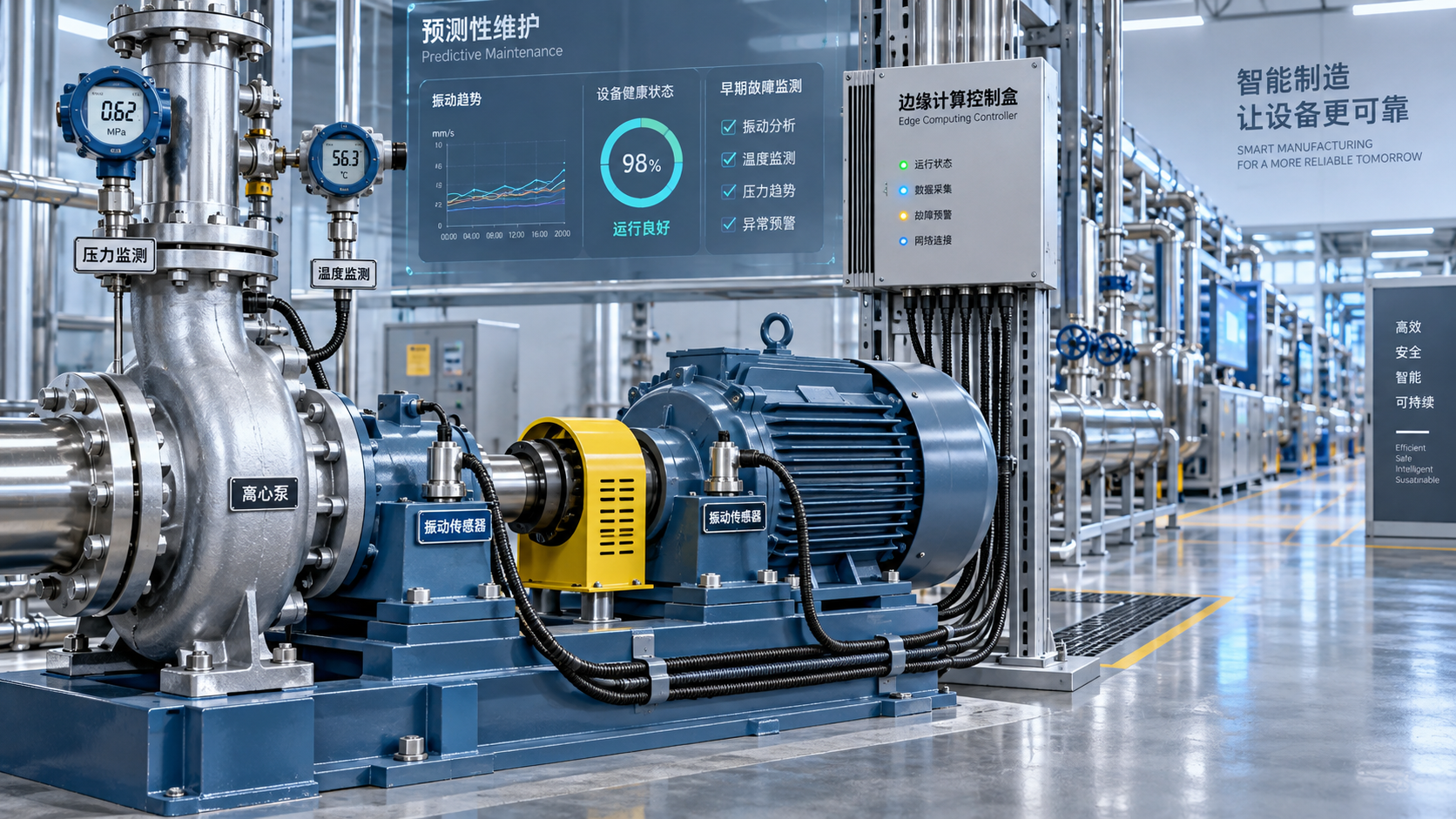
Consider a centrifugal pump. Rising vibration alone could point to bearing wear, impeller damage, misalignment, cavitation, loose mounting hardware, or a change in hydraulic conditions. If the same rise occurs alongside fluctuating suction pressure and reduced flow, cavitation becomes more plausible. If vibration concentrates near rotational frequency after coupling work, alignment or mechanical looseness deserves inspection. When motor current also rises while delivered flow falls, internal friction or hydraulic restriction may be involved. The AI output should preserve these signals and conditions instead of reducing the event to a generic red warning.
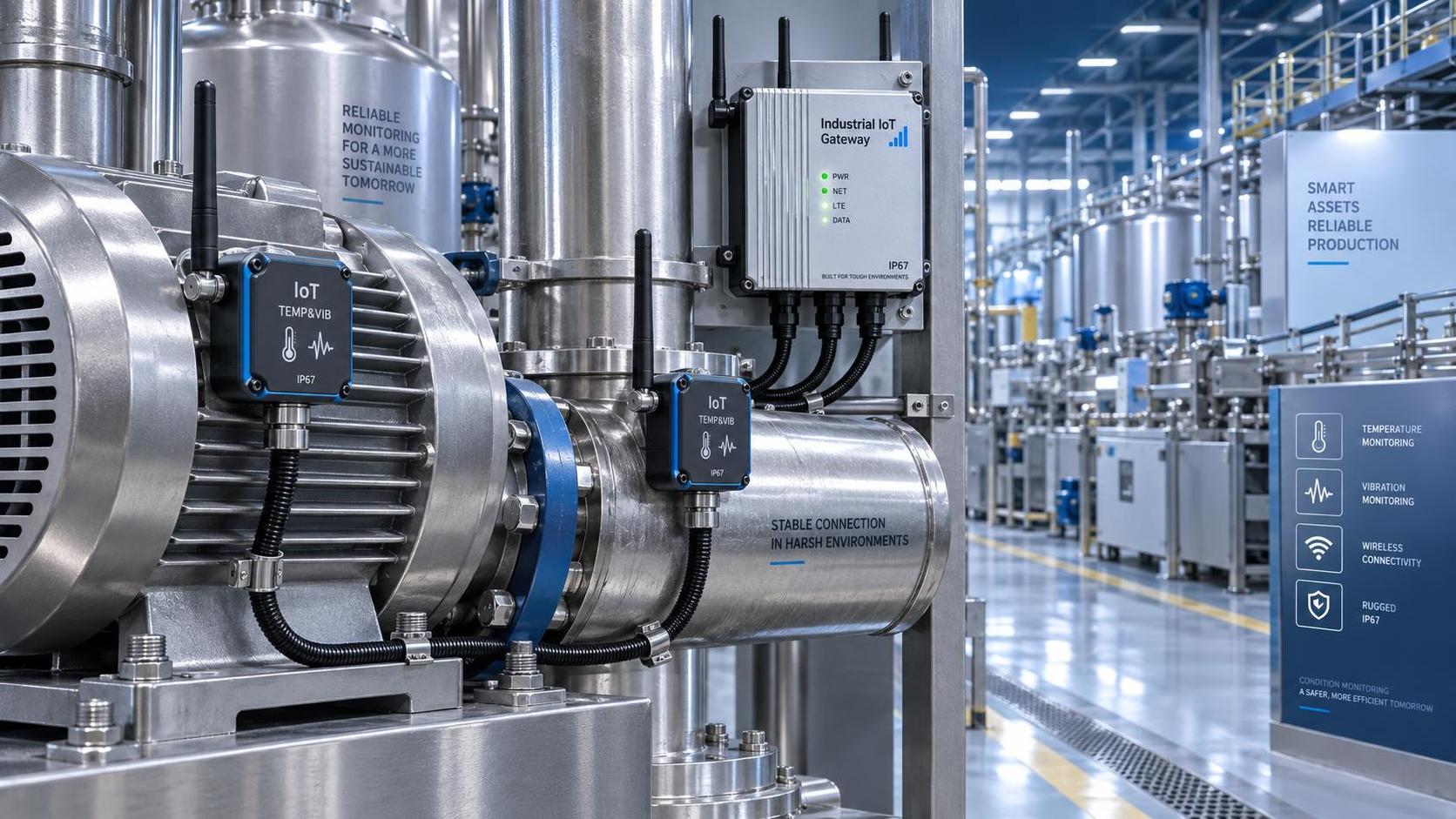
Baseline quality also depends on the condition of the source data. Sensors mounted on a thin guard panel can capture structural resonance rather than bearing behavior. A temperature probe placed near a heat source can trend with ambient heat, not winding condition. A current transformer may show distortion when variable-frequency drives change speed. During installation, sensor location, orientation, cable routing, sampling frequency, and time synchronization need to be recorded as part of the asset configuration. Changing any of them without updating the model context can create a false shift in the data.
How the Model Sees a Developing Failure
Most predictive maintenance systems use several detection methods together because no single method fits every failure mode. Rules remain useful for clear limits, such as loss of lubrication pressure or a temperature that exceeds an equipment constraint. Statistical anomaly detection identifies readings that no longer fit the established operating envelope. Machine-learning models find combinations of weak deviations that become meaningful when they occur together. Remaining-useful-life methods attempt to estimate how quickly a known degradation pattern is progressing, though their reliability depends heavily on comparable failure and repair records.
For rotating equipment, raw vibration is often transformed into features that expose behavior hidden in a simple overall amplitude reading. These can include frequency components linked to shaft rotation, harmonics, bearing defect frequencies, sidebands around gear-mesh frequency, crest factor, kurtosis, and changes in the vibration envelope. The signal must be interpreted carefully. A high-frequency vibration increase may result from bearing surface damage, but it can also arise from poor sensor coupling, electrical interference, or a recently changed lubrication regime.
Electrical signatures add a different view. Motors with deteriorating bearings or misalignment can draw extra current, yet increased current is also expected when a process load rises. Comparing current against speed, torque demand, throughput, and power factor provides a more useful picture than monitoring amperage in isolation. Thermal data can support the diagnosis: rising current with a warming bearing housing and an escalating vibration trend is stronger evidence than current alone.
Time matters as much as magnitude. A sudden step change after maintenance frequently indicates an installation, calibration, alignment, or process-setting issue. A slow monotonic trend over many operating cycles suggests wear, contamination, fatigue, or loss of lubrication effectiveness. Repeated short-lived spikes during a particular product run may reveal a process interaction rather than a permanently damaged component. AI models are valuable because they can retain and compare those temporal patterns across shifts, recipes, and seasonal ambient conditions.
From Anomaly Score to a Workable Maintenance Decision
Anomaly detection alone does not prevent downtime. The result has to be translated into an action that fits the production window, spare-part availability, isolation requirements, and consequence of failure. A high anomaly score does not automatically mean an immediate shutdown. It means the equipment is behaving differently from the reference condition; the seriousness depends on the suspected failure mode and how fast that condition can deteriorate.
A useful alert contains more than a severity color. It identifies the affected asset and subassembly, shows the trend over a relevant period, names the operating conditions under which the deviation appears, and links the alert to the signals that caused it. Where available, it should compare the current pattern with prior verified events or known healthy operation. This gives maintenance personnel a starting point for inspection instead of requiring them to trust an opaque prediction.
Failure mode is central to prioritization. A gradual bearing defect on a redundant fan may permit planned replacement during an upcoming stop. Evidence of accelerating vibration on a high-speed spindle can threaten part quality and cause secondary damage if ignored. A pressure anomaly in a hydraulic circuit may stem from a filter blockage, a relief-valve issue, a fluid-temperature effect, or a leak. Each requires different parts, access arrangements, and safe work preparation. Grouping every alert as “machine failure likely” creates unnecessary urgency in some cases and dangerous delay in others.
- Condition: Is the deviation persistent, worsening, intermittent, or confined to a known operating state?
- Failure path: Does the available evidence point toward a component that can degrade rapidly, contaminate a system, damage adjacent equipment, or affect product quality?
- Verification: Can an inspection, lubricant sample, thermal scan, alignment check, or controlled test confirm the cause before intrusive work begins?
- Execution constraint: Does the repair require a shutdown, lifting plan, calibrated replacement part, specialist access, or a lead-time-sensitive spare?
These questions turn a prediction into a maintenance package. The maintenance record should then capture what inspection found, what component was replaced or adjusted, the observed failure mechanism, and the equipment condition after restart. That feedback is not administrative detail. It distinguishes a true positive from a false alert and improves later model performance.
Common Sources of False Confidence
A dashboard can look mature while the underlying logic is weak. One frequent problem is training on alarm history alone. Alarm logs record when a control limit was crossed, not necessarily when degradation began. If a model treats historical alarms as the complete label for failure, it learns a late-stage signal and can miss the earlier progression that predictive maintenance is meant to identify.
Another problem is assuming that more sensors automatically improve detection. Redundant measurements with inconsistent calibration can inject noise. Very high sampling rates generate large files without helping a slow degradation problem. Conversely, sparse readings may miss short transient events such as impact loads, start-up friction, or unstable lubrication delivery. Sampling and feature design should match the physics of the asset: fast rotating components, thermal systems, hydraulic circuits, conveyors, furnaces, and robotic cells do not deteriorate in the same way.
Maintenance activity itself can confuse the model. Replacing a motor, changing a coupling, rebalancing a rotor, updating a drive parameter, or fitting a different bearing supplier can alter the normal signature. The system needs an asset-event log with dates, component identifiers, calibration changes, firmware updates, and major process changes. Otherwise, a successful repair can be labeled as an unexplained anomaly, while a newly introduced installation fault is treated as a harmless baseline shift.
Class imbalance creates a separate limitation. Serious failures are relatively rare in well-maintained equipment, so there may be few verified examples from which to train a supervised failure classifier. In that setting, anomaly detection and engineering rules are often more defensible than a model claiming precise failure labels. A clear statement of confidence, evidence, and uncertainty is more useful than an unsupported prediction of an exact failure date.
Designing the Data Path Around the Asset
Reliable detection depends on the complete path from sensor to work order. Data needs stable asset IDs, synchronized clocks, understandable units, and a record of missing values. A vibration stream associated with the wrong motor, or a pressure signal whose unit changes after a controller replacement, can distort trends without producing an obvious error. Edge processing is often appropriate when high-frequency signals need local feature extraction or when network interruptions are possible. Aggregated features and relevant event windows can then be sent to a central system without losing the context needed for review.
Asset criticality should shape the level of instrumentation. Monitoring every low-cost component with the same intensity can bury meaningful alerts. The stronger candidates are assets whose failure creates a production bottleneck, introduces a safety exposure, causes long restart times, risks expensive collateral damage, or requires difficult-to-source spares. Criticality is not fixed: a normally secondary conveyor can become a schedule constraint when an alternate route is unavailable or a commissioning sequence depends on it.
Start with a defined failure question rather than a general request for AI. “Detect lubrication degradation in these gearboxes before gear damage develops” is specific enough to guide sensor choice, inspection evidence, and alert response. “Monitor all equipment health” is not. A limited scope also makes it possible to validate whether alerts identify actionable conditions early enough to change maintenance timing.
Keeping Human Review Inside the Loop
Predictive maintenance works best when the system narrows attention and skilled inspection confirms the mechanism. A technician may detect loose fasteners, damaged cable shielding, a blocked cooling path, improper belt tension, or process contamination that the data model cannot directly observe. The inspection result should feed back into the alert record with enough detail to distinguish “no fault found” from “signal issue,” “process variation,” and “verified mechanical degradation.”
That discipline prevents two costly patterns: repeated emergency work caused by ignored early indicators, and repeated false alarms that lead people to stop trusting the system. When the evidence, operating context, and post-maintenance findings stay connected, predictive maintenance AI becomes a practical scheduling tool rather than a separate analytics display.
Get weekly intelligence in your inbox.
No noise. No sponsored content. Pure intelligence.
 Oct 12, 2026How Predictive Maintenance AI Detects Machine Failures Before Unplanned DowntimeHow Predictive Maintenance AI Detects Machine Failures Before Unplanned Downtime
 Oct 10, 2026How to Scope Packaging Automation for High-Mix Lines Without Creating BottlenecksHow to Scope Packaging Automation for High-Mix Lines Without Creating Bottlenecks
 Oct 08, 2026How Digital Health Improves Diagnostic Accuracy and Workflow in Clinical LabsHow Digital Health Improves Diagnostic Accuracy and Workflow in Clinical Labs
 Oct 07, 2026Selecting Voice Picking Systems for German Warehouses: Integration, Languages and ROISelecting Voice Picking Systems for German Warehouses: Integration, Languages and ROI
 Oct 06, 2026How to Choose Last Mile Dispatch Software for On-Time Delivery at ScaleHow to Choose Last Mile Dispatch Software for On-Time Delivery at Scale
 Oct 05, 2026Vietnam’s Consumer Electronics Market: Demand Shifts and Sourcing OpportunitiesVietnam’s Consumer Electronics Market: Demand Shifts and Sourcing Opportunities
 Oct 04, 2026Digital Health Investment Priorities for Providers: Improving Access, Outcomes, and EfficiencyDigital Health Investment Priorities for Providers: Improving Access, Outcomes, and Efficiency
 Oct 03, 2026How to Specify an FR4 Custom PCB Board for High-Voltage and High-Heat DesignsHow to Specify an FR4 Custom PCB Board for High-Voltage and High-Heat Designs
 Oct 02, 2026ERP Software Market Intelligence: Adoption, Pricing, and Vendor Signals to WatchERP Software Market Intelligence: Adoption, Pricing, and Vendor Signals to Watch
 Oct 01, 2026How to Select Calibrated Temperature Data Loggers for GMP Cold Storage MonitoringHow to Select Calibrated Temperature Data Loggers for GMP Cold Storage Monitoring
 Sep 30, 2026Custom Molded Rubber Pricing: What Drives Unit Cost and Tooling Fees?Custom Molded Rubber Pricing: What Drives Unit Cost and Tooling Fees?
 Sep 29, 2026How to Evaluate Energy Management Software Vendors for Multi-Site OperationsHow to Evaluate Energy Management Software Vendors for Multi-Site Operations
 Sep 28, 2026How to Select a DIN Rail Smart Meter for Multi-Circuit Energy MonitoringHow to Select a DIN Rail Smart Meter for Multi-Circuit Energy Monitoring
 Sep 27, 2026TWS Earbuds in Vietnam: Demand Drivers, Price Tiers, and Retail Channel OpportunitiesTWS Earbuds in Vietnam: Demand Drivers, Price Tiers, and Retail Channel Opportunities
 Sep 26, 2026How UAE Clinics Can Qualify a Smart Glucometer Supplier for Accuracy and ComplianceHow UAE Clinics Can Qualify a Smart Glucometer Supplier for Accuracy and Compliance
 Sep 25, 2026Buying Aesthetic Lasers in the USA: FDA Status, Wavelengths, and Service SupportBuying Aesthetic Lasers in the USA: FDA Status, Wavelengths, and Service Support
 Sep 24, 2026Laser Cutting Brass Sheet: How to Prevent Burrs and Heat Marks on Thin PartsLaser Cutting Brass Sheet: How to Prevent Burrs and Heat Marks on Thin Parts
 Sep 23, 2026How to Choose Lightweight ANC Headphones for Comfortable All-Day TravelHow to Choose Lightweight ANC Headphones for Comfortable All-Day Travel
 Sep 22, 2026IPX5 TWS Bluetooth Earbuds: What Protection Do They Offer for Workouts?IPX5 TWS Bluetooth Earbuds: What Protection Do They Offer for Workouts?
 Sep 21, 2026What to Look for in a Grid Integration Company for Utility-Scale Solar ProjectsWhat to Look for in a Grid Integration Company for Utility-Scale Solar Projects
 Sep 20, 2026Microgrid Controller Pricing: What Drives Cost in Commercial Energy Projects?Microgrid Controller Pricing: What Drives Cost in Commercial Energy Projects?
 Sep 19, 2026How to Choose a GaN Charger for Laptops Without Compromising Power or PortabilityHow to Choose a GaN Charger for Laptops Without Compromising Power or Portability
 Sep 18, 2026Floating Solar Farm Costs: CAPEX, OPEX, and the Site Factors That Shape ROIFloating Solar Farm Costs: CAPEX, OPEX, and the Site Factors That Shape ROI
 Sep 17, 2026Drone Delivery Solutions for Last-Mile Routes: Site, Payload, and Range PlanningDrone Delivery Solutions for Last-Mile Routes: Site, Payload, and Range Planning
 Sep 16, 2026When Low-Volume Electronics Manufacturing Makes More Sense Than Mass ProductionWhen Low-Volume Electronics Manufacturing Makes More Sense Than Mass Production
 Sep 15, 2026Wholesale WiFi Smart Switches: What Buyers Should Verify Before OrderingWholesale WiFi Smart Switches: What Buyers Should Verify Before Ordering
 Sep 14, 2026How to Select IoT Sensors for Reliable Monitoring in Harsh Industrial EnvironmentsHow to Select IoT Sensors for Reliable Monitoring in Harsh Industrial Environments