Monocrystalline solar panels still win where roof space is tight
When roof space is limited, efficiency becomes a strategic business decision rather than a technical preference. Monocrystalline solar panels continue to outperform alternatives in space-constrained commercial and industrial projects, delivering higher energy yield per square meter and stronger long-term value. For enterprise decision-makers evaluating clean energy investments, understanding why monocrystalline solar remains the preferred option can sharpen procurement, planning, and ROI outcomes.
Why scenario differences matter more than headline efficiency
For B2B buyers, the question is rarely whether solar works in principle. The real question is which solar configuration works best under the operational limits of a specific site. A logistics hub with a crowded roof, a hospital with uninterrupted power priorities, and a factory facing high daytime loads do not evaluate solar the same way. In these situations, monocrystalline solar is not simply a premium technology choice; it is often the most practical response to constrained usable area, demanding performance targets, and long asset life expectations.
This matters because commercial roofs are rarely empty rectangles. HVAC systems, safety walkways, skylights, drainage paths, and structural exclusion zones reduce available installation area. Once real-world constraints are mapped, many projects discover that nameplate system size is capped by roof geometry rather than by budget or power demand. That is exactly where monocrystalline solar keeps its advantage: it produces more electricity from the same footprint, making every square meter more productive.
For decision-makers, this changes procurement logic. Instead of comparing module prices alone, they must compare delivered output, lifetime value, and the strategic cost of underutilizing limited roof space. In high-demand facilities, the lost opportunity from lower-efficiency modules can outweigh their initial savings.
Where monocrystalline solar is most often the right fit
The strongest business case for monocrystalline solar appears in a set of recurring commercial and industrial scenarios. These are not niche situations. They are common across modern urban, export-oriented, and energy-conscious enterprises.
Urban commercial buildings with limited rooftop area
Office towers, retail complexes, mixed-use properties, and technology parks often have high electricity bills but relatively little uninterrupted roof space. Their owners want visible sustainability gains and measurable energy offsets, yet rooftop limitations cap installable capacity. In this setting, monocrystalline solar helps maximize annual generation without expanding the building envelope. It also aligns with premium asset strategies where lifecycle value and ESG reporting matter as much as payback.
Manufacturing plants with dense daytime consumption
Factories in advanced manufacturing or electronics production often have strong daytime loads that pair well with solar self-consumption. However, rooftop space may already be crowded by ventilation, exhaust systems, and equipment. In these projects, monocrystalline solar supports a larger share of on-site demand from the same constrained area. That improves internal energy utilization and can reduce exposure to peak daytime tariffs.
Healthcare and critical-service facilities
Hospitals, laboratories, and medical technology campuses evaluate energy projects through a reliability lens. While rooftop solar is usually only one part of a broader resilience strategy, higher-output modules are attractive where backup integration, space limits, and long-term operational continuity all matter. Monocrystalline solar supports stronger output density, which is valuable when only select roof zones are suitable for installation due to safety and access controls.
Warehouses and logistics centers planning for scale
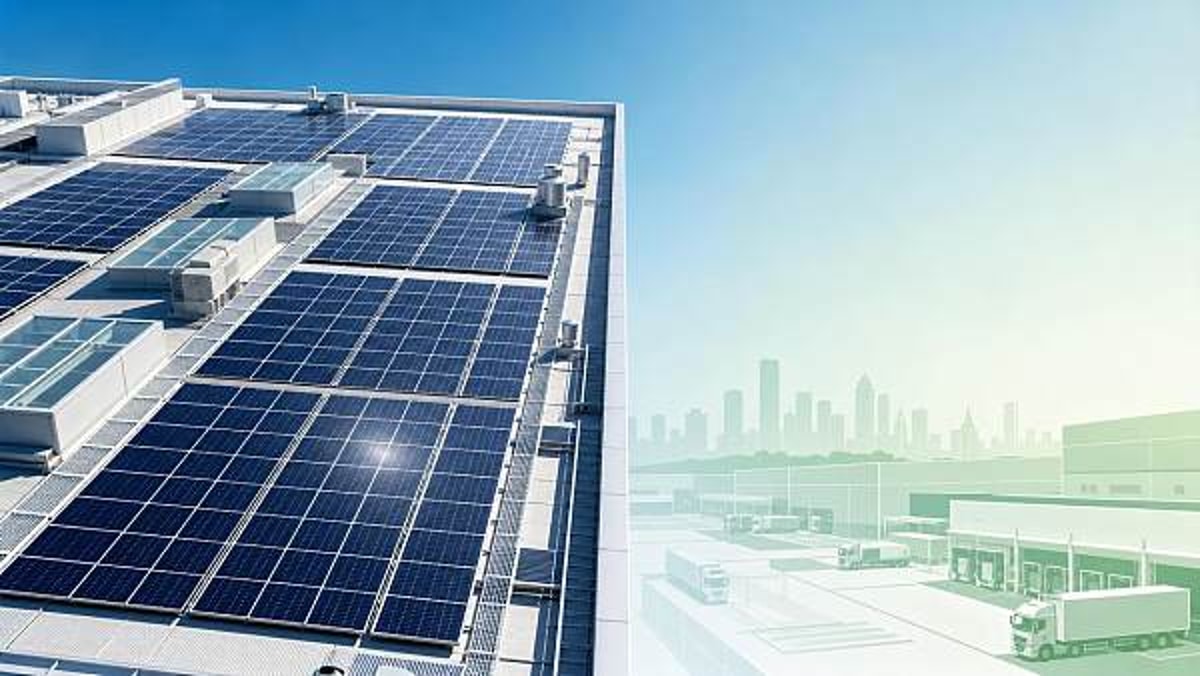
Large logistics roofs may appear spacious, but future planning complicates the picture. Operators may reserve zones for maintenance paths, rooftop automation, cooling upgrades, or later electrification support such as EV charging. In these cases, monocrystalline solar can meet current generation targets while preserving flexibility for future infrastructure. This is particularly relevant for supply chain operators balancing energy cost reduction with long-term site modernization.
A practical comparison by business scenario
The table below helps enterprise buyers assess when monocrystalline solar creates the clearest advantage compared with lower-efficiency alternatives.
How needs differ across enterprise types
Different organizations may all benefit from monocrystalline solar, but they evaluate value in different ways. Procurement teams should align technical selection with business priorities rather than assuming one justification fits all.
For cost-driven operators
If the main objective is cutting operating expenses, monocrystalline solar should be evaluated through energy yield per usable roof area and lifetime savings, not just module purchase price. In many tight-roof projects, cheaper modules can leave a meaningful share of demand uncovered, limiting bill reduction. The lower upfront cost may therefore create a weaker financial outcome over the system life.
For ESG-led enterprises
Companies with public sustainability targets often need to show measurable carbon reduction within existing assets. Monocrystalline solar is useful where facilities cannot expand physically but still need higher renewable contribution. More output from the same roof can improve reported progress without waiting for new construction or off-site procurement agreements.
For growth-stage industrial networks
Multi-site operators need repeatable decision frameworks. If several facilities have moderate to severe roof constraints, standardizing around monocrystalline solar can simplify portfolio planning. It creates consistency in expected yield density, supports benchmarking across sites, and reduces the risk of underperformance caused by varying roof conditions.
What buyers should verify before choosing monocrystalline solar
Even when monocrystalline solar is the likely winner, disciplined project screening still matters. The best outcome comes from matching the module strategy to site realities.
Confirm true usable area, not total roof size
A common mistake is using total roof dimensions as a planning reference. Procurement and engineering teams should quantify excluded zones early, including setbacks, shading, maintenance access, and future equipment reservations. This often reveals that the economics of monocrystalline solar are stronger than they first appear.
Model output under local operating conditions
Site temperature, irradiance profile, and orientation affect realized performance. Buyers should request project-specific yield modeling rather than relying only on standard test ratings. In hot climates or partially constrained layouts, nuanced modeling can show whether the efficiency premium delivers the expected business return.
Evaluate the cost of not maximizing the roof
In many boardroom discussions, the hidden comparison is not monocrystalline solar versus another panel type. It is maximizing on-site generation versus leaving strategic savings untapped for the next 20 to 30 years. If the roof cannot be expanded later, underbuilding today may carry a larger long-term cost than the initial premium of higher-efficiency modules.
Common scenario misjudgments that weaken project results
Several recurring assumptions can lead enterprises to select the wrong solution for a space-constrained project.
First, some buyers assume all roofs with large gross area have abundant installable space. In practice, operational restrictions can shrink usable area dramatically. Second, teams sometimes overemphasize module unit price and underweight energy density. This can make lower-cost alternatives appear better on paper while delivering weaker total value. Third, companies may ignore future electrification needs. If EV charging, battery storage, or process electrification is likely, maximizing current roof productivity through monocrystalline solar can become even more important.
Another misjudgment is treating all facilities in a portfolio as technically identical. A suburban warehouse with ample roof area may not require the same specification as a downtown production site. Scenario-based procurement is therefore critical. The right answer can vary by facility even within the same enterprise.
A simple decision framework for space-constrained projects
Enterprise teams can use a straightforward screening process to determine whether monocrystalline solar should lead their shortlist:
- Measure usable roof area after exclusions, not before.
- Compare projected annual kWh per square meter across module options.
- Map generation against on-site daytime consumption and tariff structure.
- Check whether future rooftop uses could reduce available area later.
- Assess lifetime value, degradation expectations, and warranty credibility.
- Prioritize solutions that support both current ROI and future energy strategy.
If a project scores high on roof constraints, high daytime demand, long holding period, or strong ESG pressure, monocrystalline solar usually remains the most defensible choice.
Frequently asked questions from enterprise buyers
Is monocrystalline solar always worth the premium?
Not always. If roof area is abundant and energy targets are modest, the premium may be less decisive. But where area is constrained, the output density of monocrystalline solar often makes the economics more compelling.
Which sectors benefit most from monocrystalline solar?
The strongest fit is often found in advanced manufacturing, healthcare technology campuses, smart electronics facilities, premium commercial real estate, and logistics assets where roof space competes with operational requirements.
What is the biggest procurement mistake in tight-roof projects?
The biggest mistake is evaluating module price without valuing roof productivity. In limited-space projects, underestimating the importance of output per square meter can reduce total savings and weaken long-term returns.
Final takeaway for decision-makers
For enterprises navigating clean energy investments, monocrystalline solar continues to win where roof space is tight because it aligns technical performance with business reality. The advantage is clearest in scenarios where every square meter must work harder: dense commercial roofs, obstruction-heavy industrial sites, critical-service facilities, and future-ready logistics assets. In these settings, choosing monocrystalline solar is less about buying a premium panel and more about protecting long-term energy value.
The best next step is to evaluate your sites through a scenario-based lens: actual usable area, demand profile, expansion plans, and strategic energy goals. With that framework, procurement teams can determine where monocrystalline solar offers not just better efficiency, but better business outcomes.
Get weekly intelligence in your inbox.
No noise. No sponsored content. Pure intelligence.
 May 04, 2026FDA AI Diagnostic Software Guidance: Continuous Validation for Overseas FirmsFDA AI Diagnostic Software Guidance: Continuous Validation for Overseas Firms
 May 04, 2026MIIT Launches Export Compliance Support for Warehouse RoboticsMIIT Launches Export Compliance Support for Warehouse Robotics
 May 04, 2026India BIS Mandates ISI Certification for Smart Home Devices from July 2026India BIS Mandates ISI Certification for Smart Home Devices from July 2026
 May 04, 2026Global Shipping Alliance Raises Heavy-Lift Surcharges from May 2026Global Shipping Alliance Raises Heavy-Lift Surcharges from May 2026
 May 04, 2026GCC EV Charging Certification Unified: 35% Cost Cut for Chinese ExportersGCC EV Charging Certification Unified: 35% Cost Cut for Chinese Exporters
 May 04, 2026TÜV Rheinland Updates IoT Security Standard with AI Voice Data AnonymizationTÜV Rheinland Updates IoT Security Standard with AI Voice Data Anonymization
 May 04, 2026Yangshan Port Launches Green Energy Equipment Express LaneYangshan Port Launches Green Energy Equipment Express Lane
 May 04, 2026Vietnam Enforces Local IoT Certification for Smart Home Devices from May 2026Vietnam Enforces Local IoT Certification for Smart Home Devices from May 2026
 May 04, 2026US CBP Launches Battery Cargo Inspection: ESS Export Delays to 7–12 DaysUS CBP Launches Battery Cargo Inspection: ESS Export Delays to 7–12 Days
 May 04, 2026EU SVHC Update Effective May 1, 2026: Impact on Electronic Components ExportsEU SVHC Update Effective May 1, 2026: Impact on Electronic Components Exports
 May 04, 2026Portable power stations: what matters more than wattage on paperPortable power stations: what matters more than wattage on paper
 May 04, 2026Automotive injection molding machines and the scrap rate problemAutomotive injection molding machines and the scrap rate problem
 May 04, 2026Smart thermostats save energy only when setup is done rightSmart thermostats save energy only when setup is done right
 May 04, 2026Why TWS earbuds sound great in ads but not on callsWhy TWS earbuds sound great in ads but not on calls
 May 04, 2026Industrial robotics for material handling: where downtime startsIndustrial robotics for material handling: where downtime starts
 May 04, 2026LiFePO4 battery lifespan drops faster under these conditionsLiFePO4 battery lifespan drops faster under these conditions
 May 04, 2026Solar grid systems: when storage changes the project mathSolar grid systems: when storage changes the project math
 May 04, 2026Smart manufacturing for pharma fails when data stays isolatedSmart manufacturing for pharma fails when data stays isolated
 May 04, 2026Wearable technology trends that are finally useful in 2026Wearable technology trends that are finally useful in 2026
 May 04, 2026Bluetooth speakers: why battery life claims often miss real useBluetooth speakers: why battery life claims often miss real use
 May 04, 2026Home automation systems that solve everyday annoyances firstHome automation systems that solve everyday annoyances first
 May 04, 2026Solar street lights that underperform after the first rainy seasonSolar street lights that underperform after the first rainy season
 May 04, 2026Why sheet metal bending services in Canada cost more than expectedWhy sheet metal bending services in Canada cost more than expected
 May 04, 2026Factory automation systems for electronics and the ROI gapFactory automation systems for electronics and the ROI gap
 May 04, 2026OEM machined parts supplier Vietnam: quality checks that matterOEM machined parts supplier Vietnam: quality checks that matter
 May 04, 2026What to check before choosing a 5 axis machine for defenseWhat to check before choosing a 5 axis machine for defense
 May 04, 2026Smart grid solutions that fix peak load without major rebuildsSmart grid solutions that fix peak load without major rebuilds