Industrial Gearboxes Fail Early for Reasons Unrelated to Load
Industrial gearboxes often fail early for reasons that have little to do with load. For aftermarket maintenance teams, hidden factors such as lubrication errors, contamination, misalignment, thermal stress, and poor installation practices can shorten service life long before rated capacity is reached. Understanding these overlooked causes is the first step toward reducing downtime, improving reliability, and making smarter maintenance decisions.
Why the failure conversation around industrial gearboxes is changing
Across advanced manufacturing, material handling, energy systems, food processing, and general plant operations, maintenance teams are seeing a clear shift: gearbox failure analysis is moving beyond simple load assumptions. In many facilities, equipment runs at only 50% to 80% of nominal torque for long periods, yet industrial gearboxes still show premature wear. That gap between expected life and actual service life is changing how reliability teams investigate root causes.
Several practical signals explain this trend. Production lines now stop and start more frequently, ambient temperatures vary more widely, lubrication intervals are often compressed by labor shortages, and mixed-brand replacement parts are more common in aftermarket service. As a result, failure patterns increasingly point to lubrication breakdown, shaft alignment deviation, mounting distortion, ingress contamination, and thermal cycling rather than overload alone.
For aftermarket maintenance personnel, this matters because the old rule of thumb—“if it failed early, it must have been overloaded”—can lead to the wrong corrective action. Replacing an industrial gearbox without correcting oil cleanliness, coupling alignment, or base flatness often leads to repeat failure in 3 to 12 months. In contrast, a broader condition-based review can extend operating intervals well beyond the next scheduled outage.
Operational signals that should not be ignored
Maintenance teams should treat the following trends as early warnings, especially when gearboxes operate in dusty, humid, washdown, or high-vibration environments. Many of these issues emerge gradually and are easy to misread as random wear.
- Oil darkening or varnish formation within 1,000 to 2,000 operating hours, even though load has not materially increased.
- Bearing temperatures rising by 8°C to 15°C after a shutdown, restart, or seasonal ambient shift.
- Repeated seal leakage after replacement, suggesting shaft surface condition, breather problems, or pressure imbalance.
- Abnormal noise under partial load, which often indicates tooth contact pattern issues rather than torque overload.
- Shortened lubricant life where contamination control and storage discipline have weakened.
These signals are especially relevant in multi-shift plants, where maintenance windows may be limited to 2 to 6 hours. Under that time pressure, teams often replace components quickly but miss the system-level conditions that continue to damage industrial gearboxes after restart.
The hidden drivers behind early gearbox failure
The biggest change in gearbox reliability practice is the recognition that service life is strongly shaped by operating environment and maintenance discipline. Even when gear tooth stress remains within design limits, small deviations in lubrication, assembly, and contamination control can reduce life significantly. For aftermarket teams, these factors are more actionable than theoretical load calculations because they can be inspected, measured, and corrected on site.
Lubrication remains the leading practical driver. Incorrect viscosity, incompatible additive packages, overfilling, underfilling, or delayed oil changes can all alter film thickness and heat dissipation. In many industrial gearboxes, an oil level that is only slightly above or below the recommended range can increase churning losses or starve critical contact zones. This becomes more severe when operating temperatures swing between 10°C winter starts and 40°C summer ambient conditions.
Contamination is another recurring issue. Fine particles, moisture ingress, gasket debris, and poor storage practices often accelerate micropitting and bearing damage. A gearbox may run with acceptable torque but still fail because particles in the 5 to 25 micron range repeatedly pass through loaded contacts. In washdown or outdoor installations, breathing cycles can also draw humid air into housings, raising corrosion risk over time.
Root causes that are often misdiagnosed as overload
The table below shows how common field symptoms in industrial gearboxes are frequently traced to non-load factors. This helps maintenance teams avoid replacing the wrong component or repeating the same installation error.
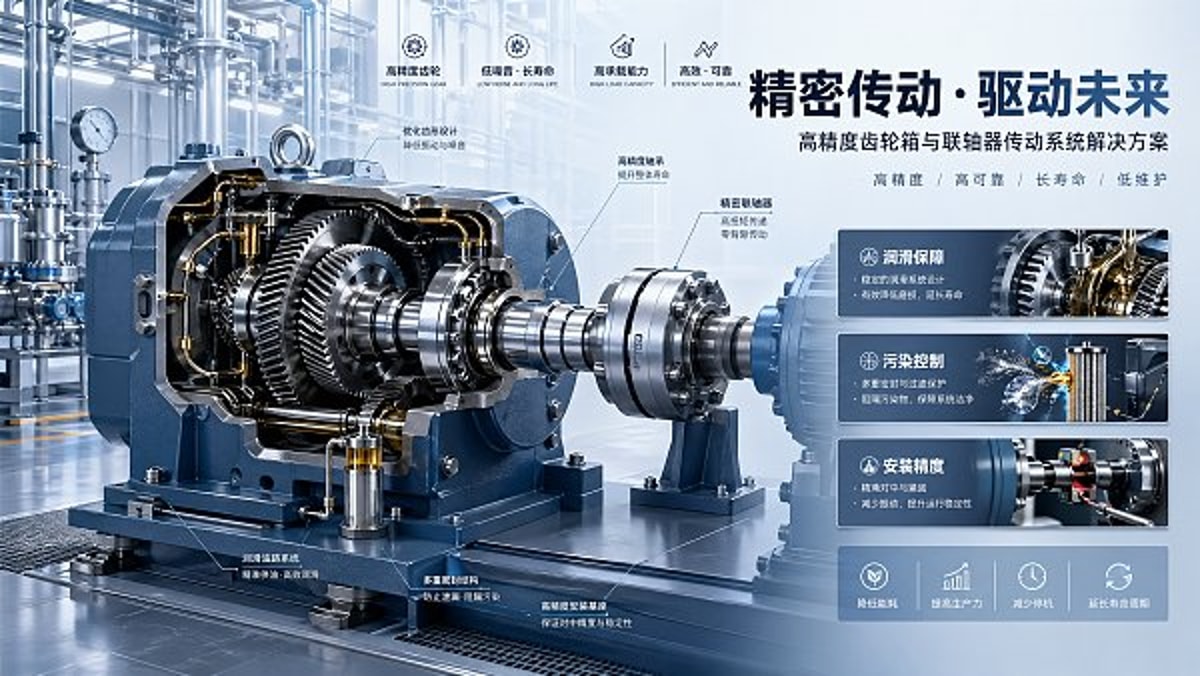
The practical lesson is that industrial gearboxes should be evaluated as part of a complete drivetrain system. If the inspection scope stops at the gearbox housing, teams may miss adjacent causes such as motor frame movement, coupling wear, poor ventilation, or process contamination entering through breathers and seals.
Why installation quality now has a bigger influence
Modern maintenance environments often rely on faster turnarounds, contractor support, and component substitution. That raises the probability of small installation defects. A base that is uneven by a fraction of a millimeter, or a coupling left outside alignment tolerance after thermal growth is considered, can alter load distribution enough to accelerate wear. In practice, many industrial gearboxes fail not because the machine asked for too much torque, but because the machine geometry was wrong from day one.
Teams that document shaft alignment, bolt torque sequence, oil fill quantity, breather orientation, and no-load temperature after startup are usually better positioned to detect these hidden issues. Even a 24-hour post-installation recheck can reveal looseness, leakage, or temperature drift that would otherwise remain unnoticed until the next breakdown.
How these changes affect aftermarket maintenance teams
For aftermarket service personnel, the market shift is not only technical; it is procedural. Reliability expectations are rising, while spare parts budgets and labor availability remain under pressure. This means industrial gearboxes are increasingly judged on total operating stability, not only purchase price or nominal rating. A lower-cost replacement that returns to failure in one quarter creates much higher lifecycle cost than a better-matched unit supported by proper commissioning checks.
The workload of maintenance teams is also changing. Instead of waiting for catastrophic failure, many plants are adopting shorter inspection cycles, such as weekly visual checks, monthly vibration reviews, and quarterly lubricant analysis for critical drives. This does not require a full predictive maintenance program in every case, but it does require more disciplined data capture around temperature, noise, leakage, and alignment history.
Another impact is on spare strategy. Facilities that stock only standard seals and bearings may still face downtime if root causes stem from housing ventilation, shaft condition, or contamination control hardware. In many operations, it is now more effective to pair spare industrial gearboxes with breathers, gaskets, approved lubricants, and installation checklists rather than treating the gearbox as a stand-alone replacement item.
Who feels the impact most
The effect of these failure drivers differs by role. The table below outlines where early gearbox failure creates the strongest operational pressure and which maintenance responses are becoming more important.
This shift is important because it changes how industrial gearboxes should be discussed internally. Instead of treating failure as a single maintenance event, plants increasingly treat it as a cross-functional reliability issue involving service procedure, parts specification, storage, installation, and operating environment.
A more useful field checklist
When a gearbox is replaced or inspected, teams should confirm more than model number and ratio. A stronger field checklist typically includes:
- Mounting surface condition and bolt torque sequence before coupling connection.
- Cold and hot alignment values, especially where thermal growth changes centerline position.
- Approved lubricant type, fill level, and storage history of the oil or grease.
- Breather, seal, and contamination barriers appropriate to dust, humidity, or washdown exposure.
- Baseline noise, temperature, and vibration readings within the first 8 to 24 operating hours.
These steps do not eliminate every risk, but they greatly improve the odds that industrial gearboxes will achieve the intended service interval without repeat intervention.
What maintenance teams should monitor next
The next stage in gearbox reliability is not necessarily full automation. In many plants, the most useful progress comes from better thresholds, clearer records, and more disciplined inspection timing. Maintenance teams should focus on a small number of trend indicators that reveal deterioration early enough for planned action. This is especially effective for conveyor drives, mixers, pumps, cooling towers, and packaging lines where industrial gearboxes operate continuously or in repeated duty cycles.
Temperature trend is one of the strongest field indicators. A stable operating pattern that suddenly shifts by 5°C to 10°C under similar process conditions should trigger review. The same applies to leakage rate, vibration pattern, and oil appearance. None of these measurements is sufficient on its own, but together they provide a practical picture of whether service life is being shortened by friction, contamination, or geometry issues.
Maintenance planning should also reflect operating reality. A gearbox installed in a clean indoor line may tolerate standard intervals, while the same size unit in a dusty aggregate environment or humid coastal facility may need much shorter checks. The trend in industrial gearboxes is toward environment-specific maintenance rather than one universal schedule for every asset.
Suggested monitoring priorities by condition
The matrix below helps teams match operating conditions to practical monitoring actions. It is designed for aftermarket maintenance use rather than laboratory analysis.
The key message is that industrial gearboxes should be monitored according to consequence and environment, not just nameplate size. Even modest assets can create major disruption if they sit at a single-point production bottleneck.
Signals worth escalating quickly
Teams should escalate review when they observe a combination of factors rather than waiting for total failure. Useful triggers include a temperature rise above the asset’s normal band, sudden oil discoloration, repeated leakage within one maintenance cycle, or vibration increases after a recent installation. Acting on these signals within days rather than weeks can often shift the response from emergency replacement to planned correction.
Where budgets allow, even simple handheld tools can support this process. The value is not in having the most advanced system, but in keeping trend records consistent enough to compare readings across 30, 90, or 180 days.
How to respond: smarter decisions for industrial gearboxes in the aftermarket
The strongest response to early gearbox failure is a decision framework that combines specification review, installation control, and operating feedback. Aftermarket teams should ask not only whether the replacement unit matches torque and ratio, but also whether it matches the thermal environment, duty pattern, mounting arrangement, seal demands, and lubricant practice of the application.
This is where procurement and maintenance need closer coordination. If an urgent replacement is sourced without checking shaft orientation, input speed, mounting position, oil grade, or environmental sealing, the new unit may inherit the exact conditions that damaged the old one. For industrial gearboxes, the best buying decision is often the one that reduces failure risk after installation, not simply the one that arrives fastest.
A useful trend in the market is the growing preference for maintenance-ready support: clearer documentation, application review before shipment, and practical guidance on commissioning checks. This helps teams reduce the gap between part replacement and long-term reliability, especially when internal maintenance resources are limited.
Why choose us
TradeNexus Pro helps buyers, plant teams, and service decision-makers make better judgments around industrial gearboxes by connecting technical market intelligence with practical sourcing support. Instead of treating replacement drives as generic items, we help you compare application fit, operating risks, supplier communication quality, and aftermarket support expectations across global B2B options.
If your team is dealing with early gearbox failure, we can help you clarify the questions that matter before the next order or shutdown. That includes parameter confirmation, replacement selection logic, typical delivery cycle considerations, environment-specific recommendations, documentation expectations, and quotation communication points relevant to cross-border procurement and industrial maintenance planning.
Contact us if you want support with industrial gearboxes for maintenance replacement or strategic sourcing. We can help you review ratio and mounting details, operating conditions, lubricant compatibility, lead time options, sample or evaluation support, and supplier comparison criteria so your next decision is based on reliability, not only urgency.
Get weekly intelligence in your inbox.
No noise. No sponsored content. Pure intelligence.
 May 03, 2026AI Boom Drives Data Center Power Demand, Liquid Cooling Gains UrgencyAI Boom Drives Data Center Power Demand, Liquid Cooling Gains Urgency
 May 03, 2026Low-Altitude Economy in China's 15th Five-Year Plan Boosts Warehouse Robotics ExportsLow-Altitude Economy in China's 15th Five-Year Plan Boosts Warehouse Robotics Exports
 May 03, 2026EU REACH Adds 5 Organotin Compounds to SVHC List for ElectronicsEU REACH Adds 5 Organotin Compounds to SVHC List for Electronics
 May 03, 2026Western Land-Sea Expressway Boosts Solar PV Exports to ASEANWestern Land-Sea Expressway Boosts Solar PV Exports to ASEAN
 May 03, 2026Southeast Asia Smart Home E-commerce Grows 27.4% Amid New Matter 1.3+ Certification RulesSoutheast Asia Smart Home E-commerce Grows 27.4% Amid New Matter 1.3+ Certification Rules
 May 03, 2026FDA Updates IVD Software Guidance: AI Diagnostic Tools Require Independent Algorithm ValidationFDA Updates IVD Software Guidance: AI Diagnostic Tools Require Independent Algorithm Validation
 May 03, 2026Global Methanol EV Ecosystem Alliance LaunchedGlobal Methanol EV Ecosystem Alliance Launched
 May 03, 2026Vietnam GDP Growth Forecast Raised to 7.2% for 2026Vietnam GDP Growth Forecast Raised to 7.2% for 2026
 May 03, 2026UAE Emerges as Global AI Hub, Driving Demand for AI-Quality Inspection SystemsUAE Emerges as Global AI Hub, Driving Demand for AI-Quality Inspection Systems
 May 03, 2026OFID $500M Funding for Côte d'Ivoire Energy ProjectsOFID $500M Funding for Côte d'Ivoire Energy Projects
 May 03, 20265 Axis Milling Machines for Automotive: Buy New or Retrofit?5 Axis Milling Machines for Automotive: Buy New or Retrofit?
 May 03, 2026What to Check Before Sourcing OEM Machined Parts from IndiaWhat to Check Before Sourcing OEM Machined Parts from India
 May 03, 2026Why Sheet Metal Bending Machine Price Varies So MuchWhy Sheet Metal Bending Machine Price Varies So Much
 May 03, 2026Plastic Injection Molding Process Guide for Common Defect ControlPlastic Injection Molding Process Guide for Common Defect Control
 May 03, 2026Smart Manufacturing Technology Trends Reshaping Factory UpgradesSmart Manufacturing Technology Trends Reshaping Factory Upgrades
 May 03, 2026Automotive Die Casting Parts and the Hidden Cost of PorosityAutomotive Die Casting Parts and the Hidden Cost of Porosity
 May 03, 2026Assembly Line Robots: Flexibility Can Matter More Than SpeedAssembly Line Robots: Flexibility Can Matter More Than Speed
 May 03, 2026Smart Manufacturing in Energy: Which Upgrades Pay Back FasterSmart Manufacturing in Energy: Which Upgrades Pay Back Faster
 May 03, 2026Why Robotics Integration Fails After a Successful DemoWhy Robotics Integration Fails After a Successful Demo
 May 03, 2026How to Spot a Reliable Precision Components ManufacturerHow to Spot a Reliable Precision Components Manufacturer
 May 03, 2026Sheet Metal Bending Machine Specifications That Affect AccuracySheet Metal Bending Machine Specifications That Affect Accuracy
 May 03, 2026Oil and Gas Fabrication: Where Material Mismatch Gets ExpensiveOil and Gas Fabrication: Where Material Mismatch Gets Expensive
 May 03, 2026Construction Fabrication Delays Often Start at the Drawing StageConstruction Fabrication Delays Often Start at the Drawing Stage
 May 03, 2026Industrial Robotics Maintenance Guide for Fewer Surprise StopsIndustrial Robotics Maintenance Guide for Fewer Surprise Stops
 May 03, 2026Smart Manufacturing Technology Benefits Beyond Labor SavingsSmart Manufacturing Technology Benefits Beyond Labor Savings
 May 03, 2026Defense Components Need More Than Tight TolerancesDefense Components Need More Than Tight Tolerances
 May 03, 2026How to Vet a Die Casting Parts Supplier in MexicoHow to Vet a Die Casting Parts Supplier in Mexico