Sheet Metal Bending Machine Specifications That Affect Accuracy
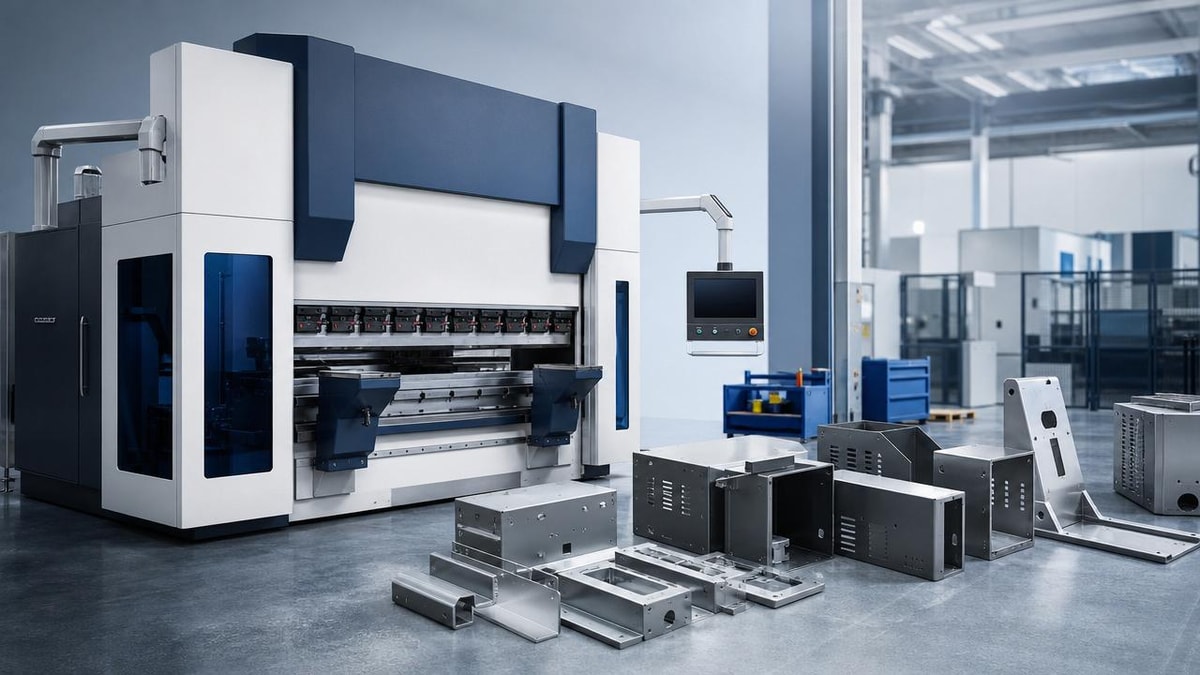
Choosing the right sheet metal bending machine specifications can make the difference between consistent precision and costly rework. For operators and production teams, understanding how factors like tonnage, backgauge accuracy, crowning, and control systems influence bending results is essential. This guide explains the key specifications that directly affect accuracy, helping you improve part quality, reduce setup errors, and make better equipment decisions.
What sheet metal bending machine specifications really mean in daily production
In practical manufacturing, sheet metal bending machine specifications are not just numbers on a brochure. They define how reliably a machine can turn flat material into repeatable parts with the intended angle, flange length, and dimensional tolerance. For operators, these specifications affect setup time, correction frequency, tool selection, and whether the first part matches the drawing. For production supervisors, they influence scrap rates, throughput, and downstream assembly quality.
Across advanced manufacturing, smart electronics enclosures, healthcare technology housings, green energy cabinets, and industrial frames, precision bending is increasingly important because parts often need tighter fit-up and less manual adjustment. A machine may be powerful enough to bend metal, but if key specifications are poorly matched to the job, accuracy suffers. That is why understanding sheet metal bending machine specifications is now a core skill for users and operators rather than a topic reserved only for engineers or buyers.
Why the industry pays close attention to bending accuracy
Modern sheet metal work is judged by more than whether a part can be bent. Customers expect uniformity across batches, interchangeable components, and faster delivery with less rework. In sectors supported by data-driven sourcing and quality control platforms such as TradeNexus Pro, manufacturers are also evaluated on process capability, documentation discipline, and repeatable output. This makes machine accuracy a strategic issue, not only a shop-floor concern.
When a bend angle drifts by even one degree, the result can be larger assembly gaps, misaligned fastener holes, poor door sealing, or stress on welded joints. In thin-gauge electronics panels, a small backgauge error can affect visual quality and component mounting. In thicker structural parts, inconsistent crowning or tonnage can create angle variation from one side of the part to the other. These problems often trace back to misunderstood or underestimated sheet metal bending machine specifications.
Core sheet metal bending machine specifications that affect accuracy most
Tonnage and frame rigidity
Tonnage is often the first specification people notice, but accuracy depends on using it correctly. The machine must provide enough force for the material type, thickness, bend length, and die opening. If tonnage is too low, the machine may struggle to reach the target angle consistently. If operators push the machine near or beyond safe limits, frame deflection and tooling stress can reduce precision and shorten equipment life.
Rigidity matters just as much as nominal tonnage. A strong frame with stable side housings helps maintain alignment under load. This is especially important for long parts, stainless steel work, and mixed production where setup conditions change frequently. When reviewing sheet metal bending machine specifications, operators should connect tonnage ratings with real production scenarios instead of treating the number as a simple indicator of machine quality.
Backgauge design and repeatability
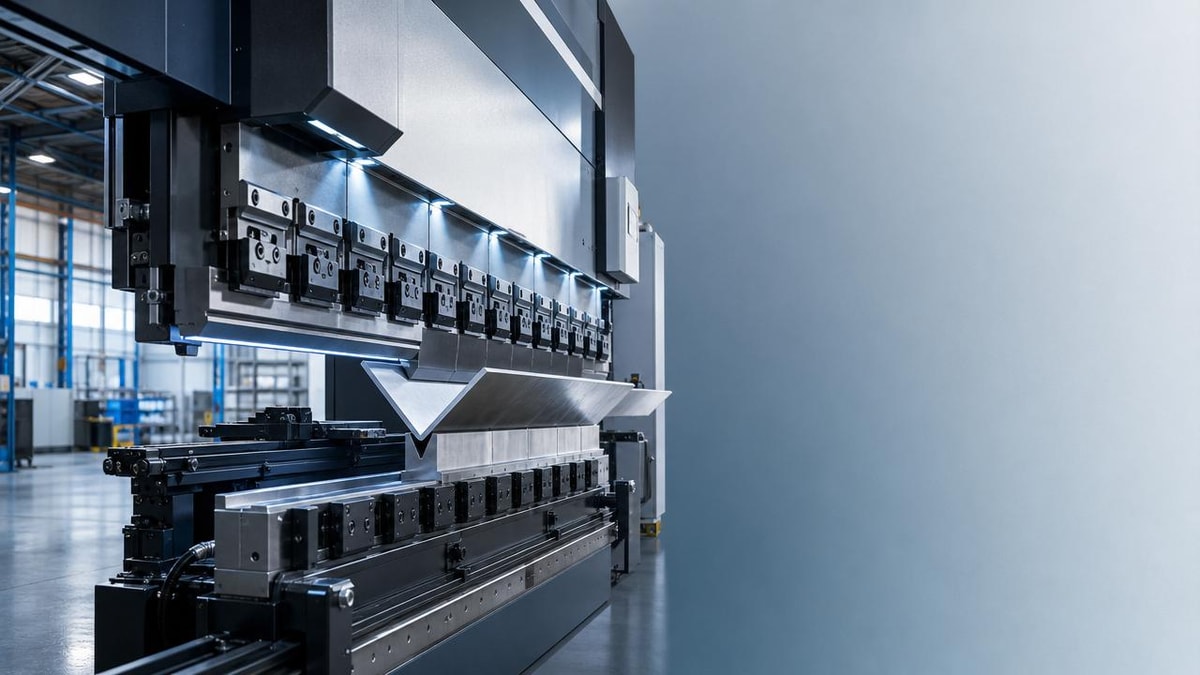
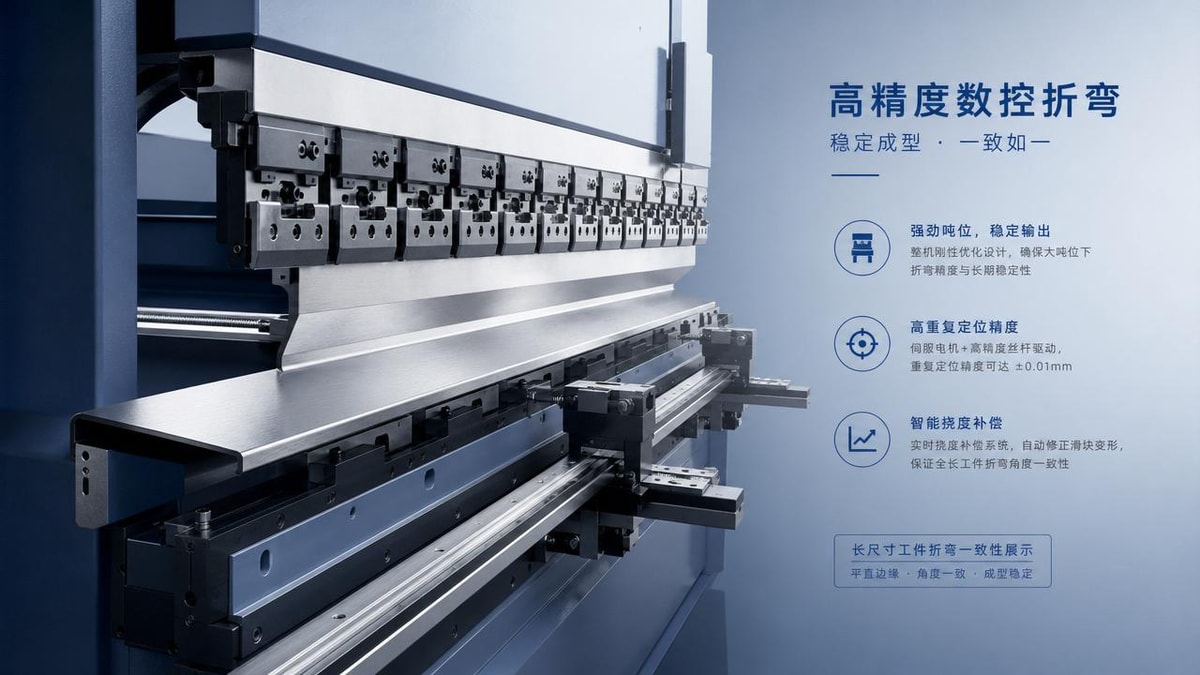
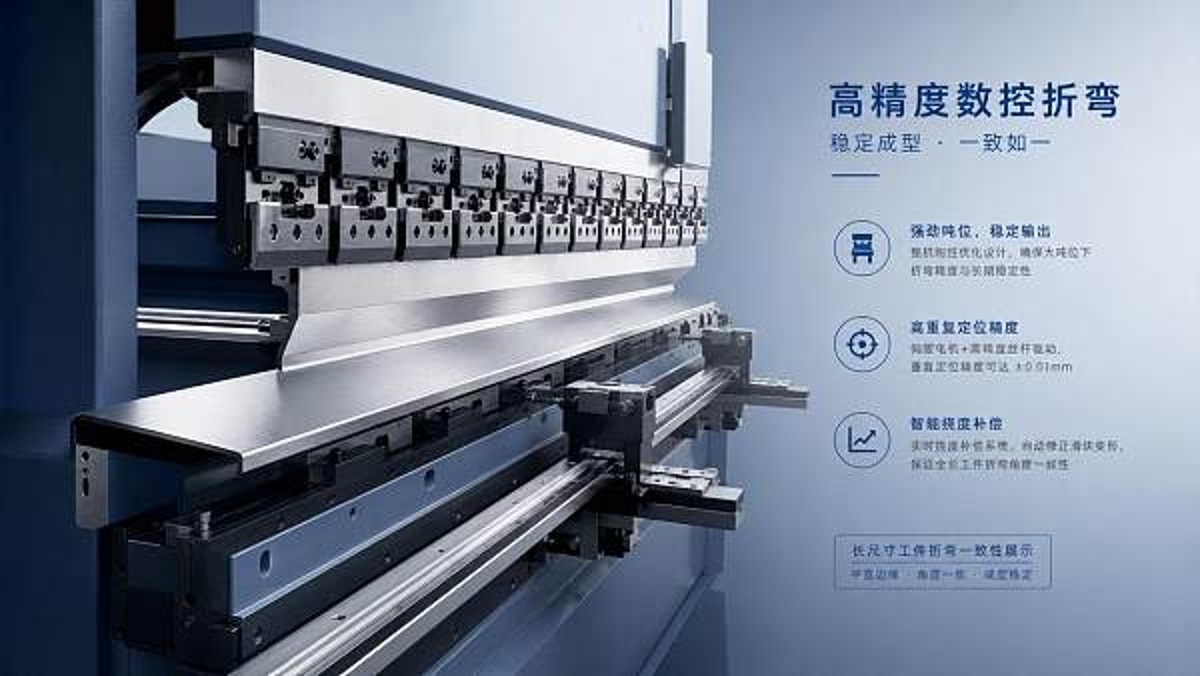
Backgauge accuracy has a direct and visible effect on flange dimensions. Even if bend angle is correct, a poor backgauge system will place the bend in the wrong location. Important details include axis count, positioning speed, repeatability, finger stability, and resistance to vibration. For parts with multiple bends, complex returns, or narrow tolerances, backgauge quality often becomes the limiting factor in production accuracy.
Operators should also consider part handling. Long or flexible blanks may sag, and small parts may shift if the gauge fingers do not provide stable contact. In this sense, sheet metal bending machine specifications should be interpreted together with operator technique, support accessories, and workpiece geometry.
Ram accuracy, repeatability, and synchronization
Ram movement determines how precisely the punch enters the die. On modern machines, ram repeatability is a critical metric because bend angle depends heavily on depth control. Small variations in ram position can create meaningful angle changes, especially in thin materials or tight-tolerance jobs. Machines with well-controlled hydraulic or servo systems usually deliver better repeatability over long production runs.
Synchronization between left and right sides of the ram is equally important. If the ram is not parallel during the bend, one side of the part may open more than the other. For operators, this shows up as angle variation that seems random but is actually linked to machine geometry or calibration. Strong sheet metal bending machine specifications in this area reduce manual correction and support stable first-piece approval.
Crowning and deflection compensation
During bending, both the machine and tooling can deflect under load. Without compensation, long bends often show different angles at the center and ends. Crowning systems solve this by introducing controlled compensation so force is distributed more evenly across the length of the bend. Manual, hydraulic, and CNC crowning options exist, and the right choice depends on job variety, part length, and required consistency.
For operators producing cabinets, panels, and structural channels, crowning is one of the most valuable yet sometimes overlooked sheet metal bending machine specifications. It has a major effect on whether long parts can be run accurately without repeated trial bends and angle tweaking.
Control system and programming intelligence
A capable control system improves accuracy by reducing human input error. Modern controllers can calculate bend sequence, material compensation, springback adjustment, and tool setup. Some systems support offline programming, graphics-based setup, and automatic angle correction. For operators managing varied jobs, these functions help translate sheet metal bending machine specifications into repeatable real-world performance.
However, advanced controls only help when data entry is correct and tooling libraries are maintained. A high-end controller cannot fully compensate for worn tools, poor material consistency, or skipped calibration. That is why control capability should be seen as part of a complete accuracy system rather than a standalone solution.
How material and tooling interact with machine specifications
Even the best machine cannot deliver precise bends if material behavior is ignored. Thickness variation, grain direction, hardness, coating, and springback all influence the final result. Operators should understand that sheet metal bending machine specifications describe machine capability, but actual bend accuracy also depends on the relationship between machine, tooling, and material lot variation.
Tooling quality is another major factor. Punch and die alignment, wear condition, surface finish, and proper V-opening selection all shape the result. A machine with excellent ram repeatability may still produce poor parts if segmented tooling is mismatched or clamping is unstable. For this reason, accuracy discussions should always include the full bending system, not the machine alone.
Typical production scenarios and the specifications that matter most
Practical ways operators can improve accuracy from existing equipment
Understanding sheet metal bending machine specifications is only useful if it changes shop-floor behavior. In many factories, accuracy improves significantly when operators apply a few disciplined practices:
- Verify material thickness and grade before setup instead of relying only on job history.
- Use tooling that matches the bend requirement and inspect it regularly for wear or damage.
- Check backgauge alignment and finger condition, especially after crashes or tooling changes.
- Apply crowning correctly for long bends rather than compensating by operator guesswork.
- Maintain accurate controller libraries for material data, tooling dimensions, and bend deductions.
- Calibrate the machine on a planned schedule and document recurring angle deviation patterns.
These steps matter because machine specifications describe potential, while operator discipline unlocks that potential. In high-mix environments, setup quality often has a bigger effect on daily results than raw machine capacity.
What to evaluate when comparing or using sheet metal bending machine specifications
When reviewing machine data, operators and production teams should avoid looking at a single metric in isolation. A balanced evaluation asks whether the machine’s tonnage fits the intended material range, whether backgauge precision supports target tolerances, whether crowning is adequate for longer parts, and whether the controller can simplify repeat jobs. It is also worth asking how the machine performs under real production conditions, not just in ideal demonstration settings.
For enterprises seeking stronger process control and digital trust, well-documented performance around sheet metal bending machine specifications also supports supplier credibility. Repeatable bending capability can influence audit outcomes, customer confidence, and long-term production planning. That makes specification literacy valuable not just for operators, but for the broader manufacturing organization.
Frequently asked questions about bending accuracy
Is higher tonnage always better for accuracy?
No. Higher tonnage helps only when it matches the material and tooling requirement. Excessive focus on tonnage can distract from other critical sheet metal bending machine specifications such as ram repeatability, backgauge precision, and crowning.
Why do long parts show angle variation across the bend?
This is often caused by deflection in the machine or tooling. A properly adjusted crowning system is usually the key specification and setup factor for solving the problem.
Can a CNC controller eliminate all bending errors?
No. It can reduce setup and programming mistakes, but it cannot fully overcome poor tooling, inconsistent material, or lack of maintenance.
A practical closing perspective
For operators, the most useful way to think about sheet metal bending machine specifications is as a connected system of force, positioning, compensation, and control. Accuracy is not created by one feature alone. It comes from the interaction between machine design, tooling condition, material behavior, setup discipline, and operator understanding.
If your team wants better part consistency, fewer corrections, and more confidence in production output, start by reviewing the specifications that most directly influence bend results: tonnage, backgauge performance, ram repeatability, crowning, and controller capability. From there, align those specifications with your actual parts and process habits. That approach will help you turn machine data into measurable accuracy gains on the shop floor.
Get weekly intelligence in your inbox.
No noise. No sponsored content. Pure intelligence.
 May 03, 20265 Axis Milling Machines for Automotive: Buy New or Retrofit?5 Axis Milling Machines for Automotive: Buy New or Retrofit?
 May 03, 2026What to Check Before Sourcing OEM Machined Parts from IndiaWhat to Check Before Sourcing OEM Machined Parts from India
 May 03, 2026Why Sheet Metal Bending Machine Price Varies So MuchWhy Sheet Metal Bending Machine Price Varies So Much
 May 03, 2026Plastic Injection Molding Process Guide for Common Defect ControlPlastic Injection Molding Process Guide for Common Defect Control
 May 03, 2026Smart Manufacturing Technology Trends Reshaping Factory UpgradesSmart Manufacturing Technology Trends Reshaping Factory Upgrades
 May 03, 2026Automotive Die Casting Parts and the Hidden Cost of PorosityAutomotive Die Casting Parts and the Hidden Cost of Porosity
 May 03, 2026Assembly Line Robots: Flexibility Can Matter More Than SpeedAssembly Line Robots: Flexibility Can Matter More Than Speed
 May 03, 2026Smart Manufacturing in Energy: Which Upgrades Pay Back FasterSmart Manufacturing in Energy: Which Upgrades Pay Back Faster
 May 03, 2026Why Robotics Integration Fails After a Successful DemoWhy Robotics Integration Fails After a Successful Demo
 May 03, 2026How to Spot a Reliable Precision Components ManufacturerHow to Spot a Reliable Precision Components Manufacturer
 May 03, 2026Sheet Metal Bending Machine Specifications That Affect AccuracySheet Metal Bending Machine Specifications That Affect Accuracy
 May 03, 2026Oil and Gas Fabrication: Where Material Mismatch Gets ExpensiveOil and Gas Fabrication: Where Material Mismatch Gets Expensive
 May 03, 2026Construction Fabrication Delays Often Start at the Drawing StageConstruction Fabrication Delays Often Start at the Drawing Stage
 May 03, 2026Industrial Robotics Maintenance Guide for Fewer Surprise StopsIndustrial Robotics Maintenance Guide for Fewer Surprise Stops
 May 03, 2026Smart Manufacturing Technology Benefits Beyond Labor SavingsSmart Manufacturing Technology Benefits Beyond Labor Savings
 May 03, 2026Defense Components Need More Than Tight TolerancesDefense Components Need More Than Tight Tolerances
 May 03, 2026How to Vet a Die Casting Parts Supplier in MexicoHow to Vet a Die Casting Parts Supplier in Mexico
 May 03, 2026Food Processing Automation Systems and the Cost of DowntimeFood Processing Automation Systems and the Cost of Downtime
 May 03, 20265 Axis Milling for Aerospace: When Extra Precision Is Worth It5 Axis Milling for Aerospace: When Extra Precision Is Worth It
 May 03, 2026How OEM Medical Equipment Parts Affect Validation TimelinesHow OEM Medical Equipment Parts Affect Validation Timelines
 May 03, 2026Packaging Robotics Integration Problems That Slow CommissioningPackaging Robotics Integration Problems That Slow Commissioning
 May 03, 2026What Causes Rework in OEM Aerospace Machined PartsWhat Causes Rework in OEM Aerospace Machined Parts
 May 03, 2026Choosing Sheet Metal Bending Services in Europe Without DelaysChoosing Sheet Metal Bending Services in Europe Without Delays
 May 03, 2026Die Casting Parts for Electronics: Tolerance or Heat Control?Die Casting Parts for Electronics: Tolerance or Heat Control?
 May 03, 2026Marine Metal Fabrication Mistakes That Raise Corrosion RiskMarine Metal Fabrication Mistakes That Raise Corrosion Risk
 May 03, 2026When Welding Robots Improve Quality More Than ThroughputWhen Welding Robots Improve Quality More Than Throughput
 May 03, 2026Medical Device Molding Machines: What Specs Matter MostMedical Device Molding Machines: What Specs Matter Most