When Welding Robots Improve Quality More Than Throughput
In many fabrication environments, the biggest gain from industrial robotics for welding applications is not speed alone, but tighter quality control, safer operations, and more consistent weld integrity. For quality and safety leaders, understanding where robots reduce defects, standardize output, and support compliance can reveal a far stronger business case than simple throughput metrics ever could.
Why scenario differences matter more than headline automation claims
For quality managers and safety officers, the decision to deploy industrial robotics for welding applications should not start with cycle time charts alone. It should start with the operational context: part variability, weld criticality, operator exposure, documentation needs, and the cost of rework or field failure. A robotic welding cell in a high-mix fabrication shop creates a very different value profile than one in a repeatable chassis line.
This is why the same robot can look underwhelming in one plant and transformational in another. In some settings, throughput rises only modestly, yet first-pass yield improves sharply. In others, the main return comes from reducing arc inconsistency, heat input variation, spatter-related defects, and weld-to-weld deviation that manual processes struggle to control over long shifts. For teams responsible for audit readiness, operator protection, and product integrity, those quality gains often outweigh raw output.
The practical question is not whether industrial robotics for welding applications are “better” in general. It is where they are better, why they are better, and what conditions must be present for quality improvement to exceed productivity improvement in measurable business terms.
Where quality-first robotic welding usually delivers the strongest value
Several common manufacturing and fabrication scenarios consistently show stronger quality and safety returns than throughput gains. These are the environments where robotic welding becomes a control tool, not just an output tool.
1. Safety-critical welded structures
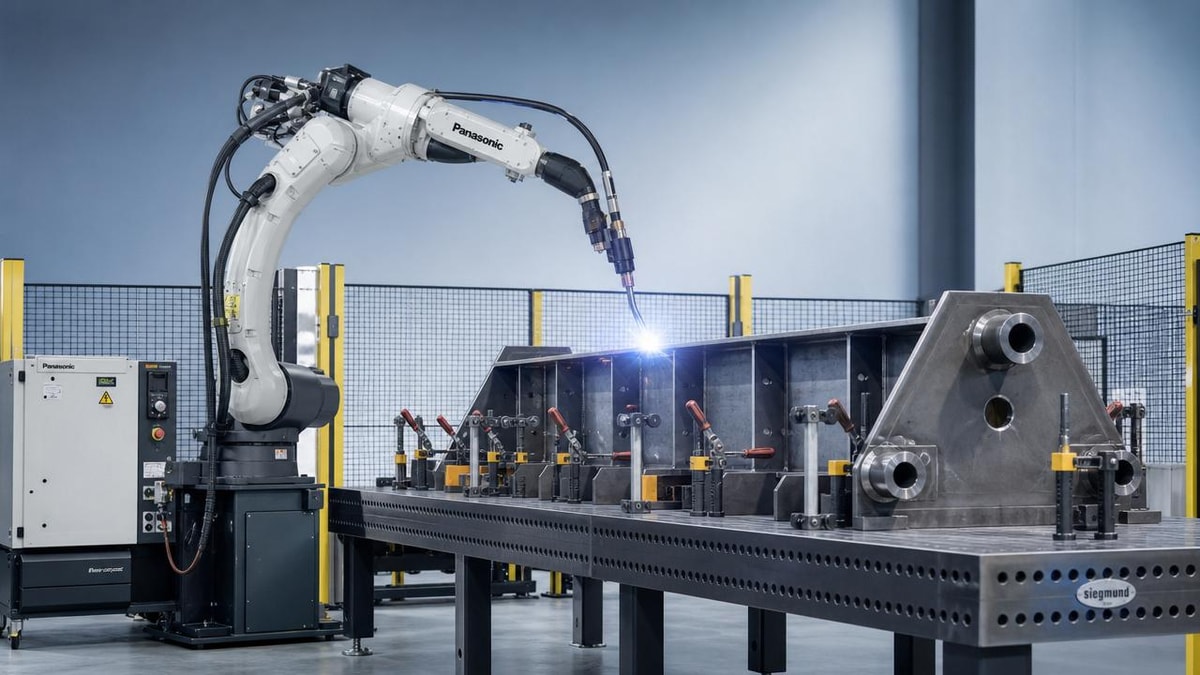
In products where weld failure can create severe safety consequences, consistency matters more than speed. Examples include structural frames, pressure-bearing assemblies, transportation components, and load-supporting fabrications. In these cases, industrial robotics for welding applications help maintain programmed torch angles, travel speeds, and path repeatability that reduce undercut, incomplete fusion, and inconsistent bead profiles.
Quality teams in this scenario usually prioritize process stability, traceability, and lower defect escape rates. Safety leaders also value the reduced human exposure to fumes, ultraviolet radiation, hot work proximity, and awkward postures.
2. High-volume, repeatable part families
When part geometry is stable and fixtures are robust, robotic welding can produce highly uniform results over long runs. While throughput often improves, the larger strategic benefit may be lower variation across shifts, fewer operator-dependent quality swings, and more predictable inspection outcomes. For plants that suffer from end-of-shift quality drift or inconsistent weld appearance between teams, this scenario often justifies automation on defect reduction alone.
3. Difficult-to-staff or high-fatigue welding operations
Some welds are technically simple but physically punishing. Long seams, repetitive joints, overhead positions, and enclosed spaces can lead to fatigue-related inconsistency in manual welding. In these environments, industrial robotics for welding applications improve quality by removing human variability caused by strain and repetition. Even if cycle times remain similar, the reduction in fatigue-linked defects can materially improve process capability.
4. Compliance-heavy production environments
In regulated or customer-audited environments, documentation and standardization are critical. Robotic welding cells can support parameter consistency, weld recipe control, and easier process validation. This does not replace procedure qualification or inspection discipline, but it strengthens the ability to hold the process inside approved limits. For quality assurance teams, that may be more valuable than a headline increase in units per hour.
A practical comparison of common application scenarios
The table below helps quality and safety decision-makers compare where industrial robotics for welding applications are most likely to improve quality more than throughput.
What quality teams should look at in different scenarios
The evaluation criteria for industrial robotics for welding applications change significantly depending on the production context. A quality-first review should focus on failure modes, process capability, and inspection burden, not just labor substitution.
If rework is expensive
Prioritize repeatability, fit-up tolerance handling, and fixture quality. A robot can follow a programmed path precisely, but if upstream part consistency is poor, it may reproduce the same error very efficiently. In these environments, the strongest benefit comes when robotic welding is paired with better fixturing, seam tracking, or pre-weld verification.
If safety incidents are a major concern
Look beyond PPE reduction. Assess arc exposure zones, fume concentration at operator position, hot material handling, pinch-point design, and lockout procedures around the cell. Industrial robotics for welding applications can improve safety substantially, but only when risk assessment, guarding, interlocks, and maintenance access are designed correctly.
If visual weld uniformity affects customer acceptance
Evaluate bead appearance consistency, spatter control, torch access, and parameter repeatability. In customer-facing fabricated products, visual consistency can influence acceptance even when structural performance is adequate. Robots often outperform manual welding in maintaining a stable visual standard across long production runs.
If traceability is part of the customer requirement
Check whether the robotic system can integrate with weld data capture, production records, and quality documentation. The value of industrial robotics for welding applications increases when process parameters can be tied to part IDs, inspection results, and corrective action workflows.
When companies overestimate throughput and underestimate quality gains
A common planning mistake is to justify robotic welding mainly on labor speed, then discover that part presentation, changeovers, or tack-up still constrain output. That does not mean the project failed. It may mean the true value lies elsewhere: fewer rejects, less grinding, lower repair welding, better conformance to procedure, and safer work conditions.
For example, a fabricator with frequent porosity or inconsistent penetration may see only a modest throughput increase after automation. However, if first-pass acceptance rises, downstream inspection workload falls, and warranty risk drops, the operational impact can be more strategic than a simple pieces-per-hour gain. Quality and safety leaders should frame the investment with metrics that reflect real plant pain points.
Scenarios where caution is necessary
Industrial robotics for welding applications are not automatically the best solution in every welding environment. There are cases where the quality case is weaker or highly dependent on surrounding process discipline.
- Very high-mix, low-volume work with frequent part changes and unstable fixtures
- Jobs where fit-up variation exceeds the robot’s ability to compensate
- Operations lacking process engineering support, preventive maintenance, or programming discipline
- Facilities expecting automation to solve poor upstream quality without fixing root causes
In these scenarios, manual or collaborative approaches may remain more practical until fixturing, part consistency, and process control mature. For quality professionals, this is an important distinction: robots amplify process stability, but they do not create it out of nothing.
How safety managers and quality managers can assess fit together
The best evaluation of industrial robotics for welding applications is cross-functional. Quality may focus on defect categories, process capability, and audit control. Safety may focus on exposure reduction, guarding, ergonomics, and incident prevention. Procurement may look at total cost and supplier support. Operations may emphasize uptime and staffing. A stronger decision emerges when these perspectives are evaluated together rather than in isolation.
A practical plant-level review should include: current defect map by weld type, rework hours, inspection bottlenecks, injury or exposure risks, training dependency, fixture capability, part variation data, and expected validation requirements. This approach moves the conversation from “Will the robot be faster?” to “In our specific scenario, where will the robot reduce risk, variation, and avoidable cost?”
FAQ: scenario-based questions about industrial robotics for welding applications
Are robotic welding systems mainly for mass production?
No. High-volume work is a strong fit, but industrial robotics for welding applications also make sense in lower-volume settings when weld quality, safety exposure, or compliance demands are especially important.
Can robots improve weld quality if parts vary a lot?
Only to a point. If part variation is significant, quality improvement depends on better fixturing, upstream controls, or adaptive technologies such as seam finding and sensing.
What metric should quality teams prioritize first?
First-pass yield is often the most revealing starting metric because it connects weld consistency, rework burden, inspection efficiency, and downstream quality risk.
Do robotic cells automatically make welding safer?
Not automatically. They reduce direct exposure to many hazards, but safe outcomes still depend on cell design, guarding, maintenance procedures, and operator training.
Final takeaway for quality and safety decision-makers
The strongest business case for industrial robotics for welding applications often appears in plants where inconsistency, safety exposure, and compliance pressure are more costly than simple labor minutes. In those environments, robots improve more than throughput: they stabilize weld quality, reduce avoidable variation, support safer work design, and make process control easier to defend internally and externally.
If your organization is evaluating robotic welding, begin with your actual scenario. Identify which welds carry the highest quality risk, which operations create the most exposure, and where rework or audit pressure is most expensive. That scenario-based review will reveal whether industrial robotics for welding applications are merely a speed upgrade—or a deeper quality and safety advantage worth prioritizing now.
Get weekly intelligence in your inbox.
No noise. No sponsored content. Pure intelligence.
 May 03, 20265 Axis Milling Machines for Automotive: Buy New or Retrofit?5 Axis Milling Machines for Automotive: Buy New or Retrofit?
 May 03, 2026What to Check Before Sourcing OEM Machined Parts from IndiaWhat to Check Before Sourcing OEM Machined Parts from India
 May 03, 2026Why Sheet Metal Bending Machine Price Varies So MuchWhy Sheet Metal Bending Machine Price Varies So Much
 May 03, 2026Plastic Injection Molding Process Guide for Common Defect ControlPlastic Injection Molding Process Guide for Common Defect Control
 May 03, 2026Smart Manufacturing Technology Trends Reshaping Factory UpgradesSmart Manufacturing Technology Trends Reshaping Factory Upgrades
 May 03, 2026Automotive Die Casting Parts and the Hidden Cost of PorosityAutomotive Die Casting Parts and the Hidden Cost of Porosity
 May 03, 2026Assembly Line Robots: Flexibility Can Matter More Than SpeedAssembly Line Robots: Flexibility Can Matter More Than Speed
 May 03, 2026Smart Manufacturing in Energy: Which Upgrades Pay Back FasterSmart Manufacturing in Energy: Which Upgrades Pay Back Faster
 May 03, 2026Why Robotics Integration Fails After a Successful DemoWhy Robotics Integration Fails After a Successful Demo
 May 03, 2026How to Spot a Reliable Precision Components ManufacturerHow to Spot a Reliable Precision Components Manufacturer
 May 03, 2026Sheet Metal Bending Machine Specifications That Affect AccuracySheet Metal Bending Machine Specifications That Affect Accuracy
 May 03, 2026Oil and Gas Fabrication: Where Material Mismatch Gets ExpensiveOil and Gas Fabrication: Where Material Mismatch Gets Expensive
 May 03, 2026Construction Fabrication Delays Often Start at the Drawing StageConstruction Fabrication Delays Often Start at the Drawing Stage
 May 03, 2026Industrial Robotics Maintenance Guide for Fewer Surprise StopsIndustrial Robotics Maintenance Guide for Fewer Surprise Stops
 May 03, 2026Smart Manufacturing Technology Benefits Beyond Labor SavingsSmart Manufacturing Technology Benefits Beyond Labor Savings
 May 03, 2026Defense Components Need More Than Tight TolerancesDefense Components Need More Than Tight Tolerances
 May 03, 2026How to Vet a Die Casting Parts Supplier in MexicoHow to Vet a Die Casting Parts Supplier in Mexico
 May 03, 2026Food Processing Automation Systems and the Cost of DowntimeFood Processing Automation Systems and the Cost of Downtime
 May 03, 20265 Axis Milling for Aerospace: When Extra Precision Is Worth It5 Axis Milling for Aerospace: When Extra Precision Is Worth It
 May 03, 2026How OEM Medical Equipment Parts Affect Validation TimelinesHow OEM Medical Equipment Parts Affect Validation Timelines
 May 03, 2026Packaging Robotics Integration Problems That Slow CommissioningPackaging Robotics Integration Problems That Slow Commissioning
 May 03, 2026What Causes Rework in OEM Aerospace Machined PartsWhat Causes Rework in OEM Aerospace Machined Parts
 May 03, 2026Choosing Sheet Metal Bending Services in Europe Without DelaysChoosing Sheet Metal Bending Services in Europe Without Delays
 May 03, 2026Die Casting Parts for Electronics: Tolerance or Heat Control?Die Casting Parts for Electronics: Tolerance or Heat Control?
 May 03, 2026Marine Metal Fabrication Mistakes That Raise Corrosion RiskMarine Metal Fabrication Mistakes That Raise Corrosion Risk
 May 03, 2026When Welding Robots Improve Quality More Than ThroughputWhen Welding Robots Improve Quality More Than Throughput
 May 03, 2026Medical Device Molding Machines: What Specs Matter MostMedical Device Molding Machines: What Specs Matter Most