Can Supply Chain Traceability Lower Compliance Risk in 2026?
In 2026, compliance risk is no longer just a legal issue—it is a strategic supply chain challenge. As regulations tighten across sourcing, ESG, product safety, and cross-border trade, supply chain traceability is becoming essential for enterprise resilience. For decision-makers, the real question is not whether visibility matters, but whether stronger traceability can reduce exposure, protect reputation, and improve operational control.
Why 2026 Feels Different for Compliance and Supply Chain Visibility
The compliance environment entering 2026 is materially different from what most enterprises faced just 3 to 5 years ago. Regulatory expectations are moving beyond final-product declarations and toward evidence-based oversight across multi-tier suppliers, logistics flows, raw material origin, emissions reporting, and product stewardship. For procurement leaders and operations executives, this means that undocumented assumptions are becoming a measurable liability.
This shift is especially visible across globally exposed sectors such as advanced manufacturing, green energy, smart electronics, healthcare technology, and supply chain SaaS. These sectors share several risk factors: cross-border sourcing, frequent component changes, technical documentation requirements, and growing pressure to verify upstream practices. In many supply chains, tier-1 visibility is no longer sufficient; enterprises increasingly need reliable data from tier-2 and tier-3 nodes within 30, 60, or 90 days of a customer request or audit trigger.
As a result, supply chain traceability is shifting from a quality control support tool into a board-level risk control capability. The issue is not simply knowing where goods are, but proving how materials moved, who handled them, whether specifications changed, and whether declarations can be substantiated under review. When documentation gaps appear, the cost is no longer limited to internal rework; it can affect shipment release, customer retention, contract eligibility, and insurance exposure.
Key signals that are changing enterprise priorities
Several practical signals explain why supply chain traceability is moving higher on the executive agenda. First, enterprise buyers increasingly require documented source-to-delivery evidence before approving new vendors. Second, customs, ESG, and product compliance reviews are becoming more data-intensive. Third, digital procurement teams now expect traceability data to integrate with ERP, PLM, quality systems, and supplier portals rather than sit in isolated spreadsheets.
- Supplier onboarding cycles are expanding from basic qualification to document-backed traceability checks.
- Audit preparation now often includes lot tracking, chain-of-custody records, and version history of compliance documents.
- Customer contracts increasingly include response-time expectations, often requiring evidence retrieval within 24 to 72 hours.
- Risk management teams are linking traceability maturity with continuity planning, recall readiness, and reputational protection.
For decision-makers, the strategic implication is straightforward: weak traceability does not merely create data inconvenience; it extends the duration and severity of compliance incidents. Stronger supply chain traceability cannot eliminate every regulatory risk, but it can shorten investigation time, improve document accuracy, and reduce the chance that a small deviation becomes a major commercial event.
What Is Driving the Rise of Supply Chain Traceability in 2026?
The pressure behind supply chain traceability is not coming from a single regulation or market event. It is the combined effect of policy tightening, digital accountability, investor scrutiny, and customer procurement standards. Enterprises that operate across multiple regions now face overlapping compliance demands, and each demand increases the value of having a single, verifiable source of operational truth.
In practical terms, traceability has become the common infrastructure that supports several compliance domains at once. The same data foundation can help a company verify supplier origin claims, support restricted substance checks, document quality incidents, validate sustainability disclosures, and confirm shipment-level movements. This convergence matters because fragmented compliance workflows tend to fail at handoff points, especially when five or more systems, teams, or suppliers are involved.
Another important driver is the decline of tolerance for unverifiable declarations. A statement from a supplier may still be useful, but by 2026 many enterprise buyers will expect supporting records, timestamped updates, and a clear audit trail. The higher the product risk, the more likely a company will need batch-level, lot-level, or component-level proof rather than broad annual certifications alone.
Main forces shaping the trend
The following table summarizes the strongest market and operational drivers behind the growth of supply chain traceability across complex B2B industries.
The pattern is clear: traceability is being pulled forward by multiple functions at once, not pushed by compliance teams alone. Legal, procurement, quality, sustainability, and logistics teams all benefit when records are standardized, time-stamped, and linked to actual material or shipment events. That is why supply chain traceability is increasingly treated as operational infrastructure rather than a narrow reporting task.
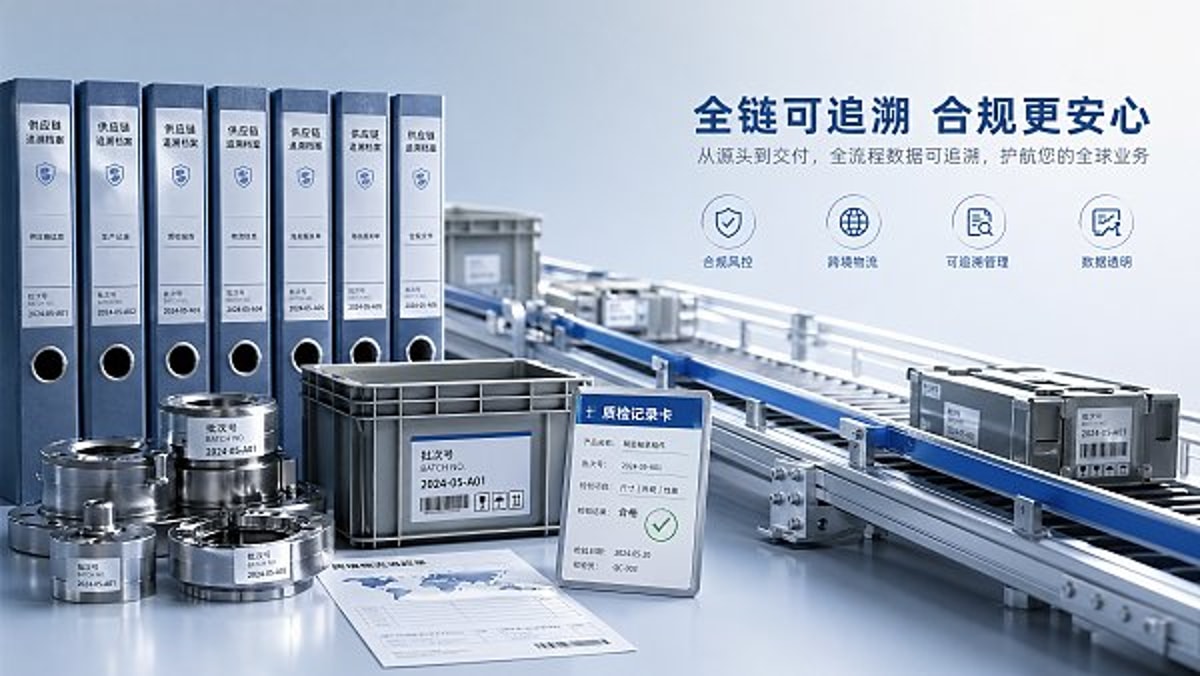
Why fragmented systems increase risk
Many enterprises still manage traceability through a mix of spreadsheets, shared folders, supplier emails, and disconnected software tools. That model may function during stable periods, but it becomes fragile when a regulatory question requires historical proof across 12 months, 20 suppliers, and multiple product revisions. Response quality often depends on who is available, which version of a document is current, and whether supplier data was collected in a consistent format.
In 2026, the burden of proof is becoming more operationally demanding. Companies that cannot quickly map a product to its components, suppliers, locations, and declarations may face a higher probability of over-disclosure, under-disclosure, or delayed disclosure. Each of those outcomes raises compliance risk in a different way, even if the underlying product itself is technically conforming.
Where Stronger Traceability Lowers Compliance Risk Most Clearly
Not every compliance problem can be solved by traceability, but several high-frequency risk areas are directly affected by the quality of supply chain records. The practical value lies in faster verification, tighter exception control, and stronger accountability across supplier networks. For enterprise decision-makers, the most useful question is where traceability creates the largest reduction in uncertainty per investment dollar.
The strongest impact typically appears in four areas: source verification, product safety and quality events, trade documentation, and ESG-related due diligence. In each case, supply chain traceability does not replace compliance judgment; it improves the evidence base behind that judgment. That distinction is important because regulators and enterprise customers increasingly evaluate not only outcomes, but also whether a company had reasonable control systems in place.
For example, if a company can isolate affected lots within 2 to 6 hours instead of several days, the operational and reputational consequences of a quality issue may be significantly lower. If sourcing documentation can be reconciled at the component level before shipment, customs and customer disputes become easier to manage. If supplier declarations are linked to effective dates and product revisions, compliance teams can reduce the risk of relying on outdated records.
High-impact compliance areas
The table below shows where supply chain traceability most often lowers compliance exposure in complex B2B operations.
The common feature across these areas is response quality under pressure. When a customer, regulator, or internal audit team asks for proof, traceability determines whether the company can answer with confidence, speed, and consistency. In that sense, supply chain traceability lowers compliance risk by reducing the number of unresolved questions that remain open during a critical event.
Where traceability alone is not enough
It is equally important to be realistic. Traceability cannot compensate for poor supplier governance, weak specification control, or unclear ownership between departments. If document review criteria are vague or approval rules are inconsistent, a digital trail may simply capture a flawed process more efficiently. The best results come when traceability is paired with supplier risk segmentation, document standards, escalation paths, and periodic validation.
For many enterprises, a practical maturity target is not total end-to-end perfection but risk-based coverage. That may mean full lot-level traceability for high-risk components, shipment-level visibility for medium-risk categories, and periodic declaration checks for low-risk items. This tiered approach often delivers better returns within 6 to 18 months than attempting to digitize every supply node at once.
Which Enterprises and Functions Will Feel the Impact First?
The impact of supply chain traceability is not evenly distributed. Companies with global sourcing, regulated products, frequent engineering changes, or high customer audit exposure will feel the pressure sooner. Likewise, certain internal functions will experience the effects more directly because they sit at the intersection of data, risk, and execution.
In advanced manufacturing and smart electronics, traceability pressure often begins with component complexity and supplier variability. In green energy, it tends to center on source documentation, sustainability expectations, and project-level reporting. In healthcare technology, quality records, product history, and document control are usually more sensitive. Across all of these sectors, supply chain SaaS adoption is rising because enterprises want more automated evidence collection and fewer manual reconciliations.
Within the organization, procurement, quality, compliance, logistics, and IT all have a stake in the outcome. Procurement wants supplier accountability. Quality needs lot genealogy and corrective action traceability. Compliance teams need defensible records. Logistics needs shipment event integrity. IT must ensure that data models, integrations, and access controls support daily use rather than just audit preparation.
Functions most affected by the traceability shift
- Procurement leaders need supplier onboarding standards that capture traceability requirements at contract stage, not after nonconformities appear.
- Quality managers need batch, lot, and revision visibility that supports investigation windows ranging from 24 hours to several weeks.
- Compliance officers need documented retention periods, approval logs, and evidence consistency across regions and business units.
- Supply chain managers need event-level visibility to identify where data breaks occur between production, warehousing, and international transport.
- Technology teams need interoperable systems that can connect ERP, MES, QMS, PLM, and supplier-facing workflows without excessive manual intervention.
A practical way to prioritize by risk tier
Enterprises often get more value by ranking supply categories into three tiers. Tier 1 may include regulated products, critical components, or high-audit customers. Tier 2 may include operationally important but lower-regulation categories. Tier 3 may cover low-impact indirect spend. This kind of segmentation helps leaders focus investments where supply chain traceability can reduce the most material compliance exposure first.
That approach also makes governance more manageable. Instead of rolling out one universal control model across hundreds of suppliers, teams can define different documentation thresholds, review frequencies, and evidence depth by category. For example, a high-risk supplier may require monthly updates and lot-linked records, while a lower-risk supplier may be reviewed quarterly with document sampling.
How Decision-Makers Should Respond in the Next 12 Months
The most effective response is not to launch a broad transformation without a control map. Instead, enterprise decision-makers should begin by identifying where compliance exposure, supplier complexity, and data fragmentation overlap. That intersection usually reveals the highest-priority traceability gaps and the fastest value opportunities.
A useful first step is to measure current traceability maturity across 5 dimensions: supplier data capture, document version control, event visibility, lot or batch linkage, and audit retrieval speed. Many organizations discover that they are strong in one area and weak in another. For example, they may have adequate supplier files but poor change-history controls, or strong internal production data but limited upstream visibility beyond tier-1 suppliers.
Once the baseline is clear, leaders can move toward a phased roadmap. In most cases, a 90-day diagnostic, a 6-month process upgrade, and a 12-month integration plan are more realistic than a single enterprise-wide launch. This phased model helps control cost, increase adoption, and produce measurable compliance improvements without overloading supplier relationships.
Decision framework for 2026 planning
The table below outlines a pragmatic evaluation sequence for companies that want to use supply chain traceability to lower compliance risk.
The most important takeaway is that supply chain traceability should be measured by business response capability, not only by software deployment status. If teams can retrieve accurate records quickly, identify affected materials precisely, and coordinate supplier evidence efficiently, compliance risk usually becomes more controllable. If they cannot, the organization remains vulnerable even if a new platform has been purchased.
What to watch next
Over the next 12 to 24 months, decision-makers should monitor four signals closely: whether customer traceability requirements become more contractually specific, whether supplier response times improve or deteriorate, whether regional compliance demands begin to conflict, and whether internal data ownership remains fragmented. These signals often reveal whether traceability is becoming a competitive capability or staying a reactive burden.
For enterprises that depend on complex international supply networks, the strategic direction is becoming clearer. Supply chain traceability is no longer a narrow visibility feature; it is part of how companies defend market access, maintain trust, and reduce the operational cost of compliance uncertainty in 2026.
Why Work With TradeNexus Pro
For enterprise leaders evaluating the next phase of supply chain traceability, the challenge is rarely a lack of information. The challenge is identifying which signals matter, which supplier and compliance risks deserve immediate attention, and which digital or process changes will create practical control within a reasonable timeline. That is where TradeNexus Pro supports decision-making with sector-focused insight and commercially relevant analysis.
Our coverage is built for procurement directors, supply chain managers, and enterprise teams operating across advanced manufacturing, green energy, smart electronics, healthcare technology, and supply chain SaaS. We focus on the intersection of market change, operational execution, and compliance exposure so that your team can assess not only what is changing, but what to prioritize next.
If your organization is reviewing supply chain traceability strategy for 2026, contact us to discuss the questions that matter most to your business. We can help you evaluate supplier risk prioritization, traceability model selection, data integration direction, expected implementation phases, document control requirements, and response-time targets for audits or customer requests. We also welcome conversations around sourcing structure, delivery timelines, tailored research needs, and broader market intelligence for traceability-driven decision planning.
Get weekly intelligence in your inbox.
No noise. No sponsored content. Pure intelligence.
 May 03, 2026AI Boom Drives Data Center Power Demand, Liquid Cooling Gains UrgencyAI Boom Drives Data Center Power Demand, Liquid Cooling Gains Urgency
 May 03, 2026Low-Altitude Economy in China's 15th Five-Year Plan Boosts Warehouse Robotics ExportsLow-Altitude Economy in China's 15th Five-Year Plan Boosts Warehouse Robotics Exports
 May 03, 2026EU REACH Adds 5 Organotin Compounds to SVHC List for ElectronicsEU REACH Adds 5 Organotin Compounds to SVHC List for Electronics
 May 03, 2026Western Land-Sea Expressway Boosts Solar PV Exports to ASEANWestern Land-Sea Expressway Boosts Solar PV Exports to ASEAN
 May 03, 2026Southeast Asia Smart Home E-commerce Grows 27.4% Amid New Matter 1.3+ Certification RulesSoutheast Asia Smart Home E-commerce Grows 27.4% Amid New Matter 1.3+ Certification Rules
 May 03, 2026FDA Updates IVD Software Guidance: AI Diagnostic Tools Require Independent Algorithm ValidationFDA Updates IVD Software Guidance: AI Diagnostic Tools Require Independent Algorithm Validation
 May 03, 2026Global Methanol EV Ecosystem Alliance LaunchedGlobal Methanol EV Ecosystem Alliance Launched
 May 03, 2026Vietnam GDP Growth Forecast Raised to 7.2% for 2026Vietnam GDP Growth Forecast Raised to 7.2% for 2026
 May 03, 2026UAE Emerges as Global AI Hub, Driving Demand for AI-Quality Inspection SystemsUAE Emerges as Global AI Hub, Driving Demand for AI-Quality Inspection Systems
 May 03, 2026OFID $500M Funding for Côte d'Ivoire Energy ProjectsOFID $500M Funding for Côte d'Ivoire Energy Projects
 May 03, 20265 Axis Milling Machines for Automotive: Buy New or Retrofit?5 Axis Milling Machines for Automotive: Buy New or Retrofit?
 May 03, 2026What to Check Before Sourcing OEM Machined Parts from IndiaWhat to Check Before Sourcing OEM Machined Parts from India
 May 03, 2026Why Sheet Metal Bending Machine Price Varies So MuchWhy Sheet Metal Bending Machine Price Varies So Much
 May 03, 2026Plastic Injection Molding Process Guide for Common Defect ControlPlastic Injection Molding Process Guide for Common Defect Control
 May 03, 2026Smart Manufacturing Technology Trends Reshaping Factory UpgradesSmart Manufacturing Technology Trends Reshaping Factory Upgrades
 May 03, 2026Automotive Die Casting Parts and the Hidden Cost of PorosityAutomotive Die Casting Parts and the Hidden Cost of Porosity
 May 03, 2026Assembly Line Robots: Flexibility Can Matter More Than SpeedAssembly Line Robots: Flexibility Can Matter More Than Speed
 May 03, 2026Smart Manufacturing in Energy: Which Upgrades Pay Back FasterSmart Manufacturing in Energy: Which Upgrades Pay Back Faster
 May 03, 2026Why Robotics Integration Fails After a Successful DemoWhy Robotics Integration Fails After a Successful Demo
 May 03, 2026How to Spot a Reliable Precision Components ManufacturerHow to Spot a Reliable Precision Components Manufacturer
 May 03, 2026Sheet Metal Bending Machine Specifications That Affect AccuracySheet Metal Bending Machine Specifications That Affect Accuracy
 May 03, 2026Oil and Gas Fabrication: Where Material Mismatch Gets ExpensiveOil and Gas Fabrication: Where Material Mismatch Gets Expensive
 May 03, 2026Construction Fabrication Delays Often Start at the Drawing StageConstruction Fabrication Delays Often Start at the Drawing Stage
 May 03, 2026Industrial Robotics Maintenance Guide for Fewer Surprise StopsIndustrial Robotics Maintenance Guide for Fewer Surprise Stops
 May 03, 2026Smart Manufacturing Technology Benefits Beyond Labor SavingsSmart Manufacturing Technology Benefits Beyond Labor Savings
 May 03, 2026Defense Components Need More Than Tight TolerancesDefense Components Need More Than Tight Tolerances
 May 03, 2026How to Vet a Die Casting Parts Supplier in MexicoHow to Vet a Die Casting Parts Supplier in Mexico