Selecting Industrial IoT Gateways for Remote Assets With Unreliable Connectivity
A remote pumping station goes silent at 2 a.m. The field team does not immediately know whether the pump has stopped, the sensor has failed, or the cellular signal has disappeared behind a weather front. In distributed industrial operations, this uncertainty is familiar. Water utilities, mining operations, renewable energy sites, agricultural systems, rail infrastructure, and remote storage facilities all depend on data that must travel through networks that are often intermittent, expensive, or simply unavailable.
Selecting industrial IoT gateways for remote assets is therefore not a matter of choosing the device with the longest specification sheet. Technical evaluators need to understand how a gateway behaves when communication drops, how it protects and stores data at the edge, whether it can connect to legacy equipment, and how it will be maintained after hundreds or thousands of units are deployed. A gateway that performs well in a lab with stable Ethernet may fail the real test when installed in a hot enclosure, on a wind farm, or beside a remote compressor with only weak cellular coverage.
The right selection begins with a practical question: what must continue happening at the site when the cloud cannot be reached?
Start with the operating consequence of a lost connection
Not every remote asset has the same tolerance for communication loss. A solar inverter may continue operating safely while telemetry is delayed. A chemical dosing system may require local alarms and immediate control logic even if all external links are down. A refrigerated storage unit may need a complete, time-stamped record of temperature conditions for compliance purposes, regardless of whether it can transmit that record in real time.
Before comparing hardware, classify each data stream and command by its operational importance:
- Mission-critical control: functions that must remain local and deterministic, such as emergency shutdown interlocks or safety limits.
- Operational monitoring: pressure, vibration, power quality, fuel levels, runtime, and other signals used to manage performance.
- Exception reporting: alarms or threshold breaches that should be prioritized when bandwidth becomes available.
- Historical records: data that can be transmitted later but must not be lost, including compliance logs and maintenance evidence.
This classification changes the gateway requirement. If a site only needs periodic status updates, a simple store-and-forward gateway may be sufficient. If the gateway must coordinate local logic, filter sensor noise, detect abnormal behavior, and queue different traffic classes, edge computing capacity becomes a central requirement rather than an optional feature.
Unreliable connectivity is a design condition, not an exception
A common procurement mistake is to treat disconnection as a rare event. For remote assets, it is often part of normal operation. Cellular service may fluctuate with terrain, weather, antenna placement, tower congestion, or changes in carrier coverage. Satellite communications can have high latency and strict data-cost limits. Private radio networks may have line-of-sight gaps. Even an apparently stable industrial Ethernet connection can be interrupted by power quality issues or upstream network maintenance.
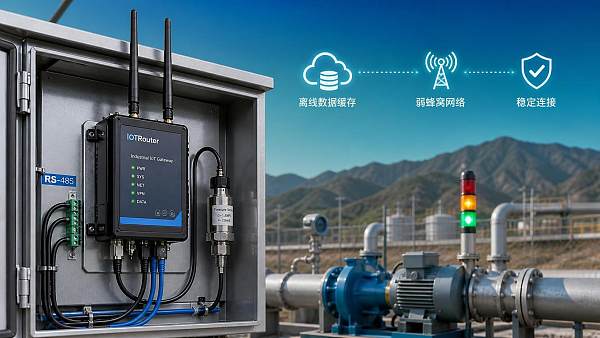
When evaluating industrial IoT gateways for remote assets, investigate their offline behavior in concrete terms. “Supports buffering” is not enough. Technical teams should ask how much data can be retained, whether storage is non-volatile, what happens when local memory reaches capacity, and whether queued records preserve timestamps and sequence. The gateway should also recover gracefully after a restart rather than sending duplicate or corrupted information that complicates downstream analysis.
A robust design usually includes store-and-forward capability: the gateway collects data locally, buffers it securely during an outage, then transmits it once a usable connection returns. For some applications, the gateway should also compress, aggregate, or filter information before sending it. Sending every raw vibration sample through a costly satellite link is rarely sensible; transmitting an anomaly score, summary statistics, and a limited diagnostic sample may be far more useful.
Connection management deserves similar scrutiny. Look for configurable retry policies, backoff intervals, network health monitoring, automatic reconnection, and the ability to prioritize alarms over routine telemetry. A gateway that reconnects aggressively may waste power and consume expensive mobile data. One that retries too slowly may leave operators blind longer than necessary. The best setting is shaped by the asset’s risk profile and the economics of the available link.
Choose communications by resilience, not by a single preferred network
Remote deployments often benefit from a layered connectivity strategy. Cellular may be the primary path, with Ethernet, Wi-Fi, LoRaWAN, private LTE, radio, or satellite used where appropriate. The exact combination depends on the geography, traffic volume, power availability, and criticality of each site.
Multi-WAN or dual-SIM capability can be valuable, but it should not be treated as an automatic answer. Two SIM cards using the same carrier may share the same regional outage risk. Dual-carrier support, external antenna options, and clear visibility into signal quality may matter more. In isolated locations, satellite fallback can protect basic alarm visibility, while bulk operational records wait for the lower-cost cellular path to recover.
Evaluate the gateway at the antenna and enclosure level, not only at the modem level. A capable cellular module inside a poorly installed metal cabinet can still deliver poor performance. Check antenna connector type, supported antenna diversity, cable-length constraints, grounding guidance, and whether the supplier provides realistic deployment recommendations. For assets in motion—such as rail equipment, mobile mining units, or maritime support systems—consider handover performance and coverage transitions as well.
Protocol compatibility determines whether the gateway becomes useful quickly
Remote industrial sites rarely begin with a clean, uniform technology stack. A single installation may contain a PLC speaking Modbus TCP, an older controller using Modbus RTU over RS-485, an energy meter using DLMS/COSEM, a CAN-based subsystem, and sensors with analog or digital outputs. Replacing all of that equipment just to establish connectivity is usually impractical.
A gateway should bridge operational technology and enterprise or cloud environments without forcing unnecessary redesign. Assess support for the protocols actually present in the field, including serial interfaces, Ethernet-based industrial protocols, and messaging standards such as MQTT, OPC UA, or HTTPS where relevant. Equally important is the quality of the protocol implementation. Can the device poll registers efficiently? Does it support data mapping, tag normalization, timestamping, and conversion from field protocols to the payload model required by the receiving platform?
Do not assume that a long protocol list guarantees compatibility. Request a test with representative devices, register maps, baud rates, and error conditions. Legacy serial communication is particularly prone to surprises: termination, grounding, noise, addressing conflicts, and undocumented controller behavior can all affect a deployment.
Edge processing should solve a site problem
“Edge intelligence” can sound abstract until it is connected to a practical constraint. At a remote water site, it may mean calculating flow totals locally so the cloud receives meaningful operational values rather than a flood of raw pulses. At a solar farm, it may mean detecting inverter faults and escalating the alarm through the best available path. At a mining site, it may mean applying rules that distinguish a brief vibration spike from a sustained mechanical issue.
For technical evaluators, the key question is not whether the gateway supports edge computing, but whether its processing environment is appropriate for the intended workload. Consider:
- CPU, memory, and local storage capacity under the expected number of connected devices and data points;
- rules-engine capabilities, local scripting, container support, or application runtime requirements;
- the ability to update edge applications safely without interrupting critical operations;
- local dashboards, alarm outputs, or digital I/O options when a cloud service is unreachable;
- clear separation between safety functions and non-safety analytics.
It is usually wise to keep safety-critical logic in dedicated controllers designed for that purpose. The gateway can enrich operational awareness and support local response, but it should not quietly become an undocumented single point of failure in a safety chain.
Environmental suitability is more than an IP rating
Remote assets are often installed where technicians would prefer not to spend time: exposed cabinets, roadside enclosures, agricultural pump houses, offshore structures, desert solar sites, and vibration-prone machinery rooms. A gateway selected solely on network and processor specifications may have a short service life in these conditions.
Review the full environmental profile: operating temperature range, humidity tolerance, ingress protection, vibration and shock resistance, EMC performance, power input range, surge protection, and mounting method. Temperature claims should be considered alongside enclosure ventilation and direct solar exposure. A gateway rated for a wide ambient range may still overheat when mounted beside a power supply in a sealed cabinet.
Power behavior is equally important. Remote installations may experience brownouts, generator switching, solar battery cycling, or temporary loss of mains power. Look for wide-range DC input, reverse-polarity protection, controlled shutdown behavior, watchdog functions, and options for backup power where data continuity is essential. If the gateway is solar-powered, calculate its normal and peak consumption rather than relying on an average figure that ignores cellular transmission bursts.
Cybersecurity must remain manageable after deployment
A remote gateway expands the operational network boundary. It can create meaningful value, but it also creates an entry point that may remain deployed for many years. Security should therefore be evaluated as an operating capability, not merely a checklist of encryption terms.
At minimum, assess secure boot, signed firmware, encrypted communications, certificate handling, role-based access control, unique device credentials, firewalling, disabled-by-default unused services, and audit logs. Remote access should be deliberate and traceable. A field engineer may need troubleshooting access, but that does not require a permanently exposed administrative interface.
The harder question is lifecycle management. How will certificates be renewed? Can firmware updates be staged, verified, rolled back, and scheduled around site operations? Can devices be grouped by region, asset type, or firmware version? Is there a reliable inventory of installed gateways and their security posture? A technically strong device is less useful if the fleet cannot be managed without manual visits to remote sites.
Build the evaluation around a failure-mode test
Datasheets are useful, but remote deployments should be validated through scenarios that resemble field reality. A structured proof of concept can reveal issues before they become expensive truck rolls. Rather than testing only successful data transmission, deliberately create failure conditions.
Disconnect the primary network. Power-cycle the device while records are queued. Reduce signal strength. Simulate a cloud endpoint outage. Introduce a malformed field message. Fill the local data buffer. Test remote firmware deployment over a slow connection. Confirm what operators see when the gateway is functioning locally but cannot reach the central platform.
Document the expected behavior for each event before the test begins. This turns a demonstration into an acceptance process. It also makes supplier comparisons more meaningful, especially when multiple gateway vendors claim similar connectivity and edge capabilities.
Look beyond unit price to the cost of keeping visibility
The purchase price of a gateway is only one part of the decision. A lower-cost device that requires frequent site visits, consumes unnecessary data, lacks remote diagnostics, or cannot be updated securely can become expensive over its life. Conversely, a more capable model may be excessive for a low-risk asset that sends a few readings each day.
Use total cost of ownership as a practical lens: hardware, mounting accessories, antennas, SIM or satellite plans, cloud integration effort, engineering time, maintenance visits, software licensing, and expected replacement cycles. Availability of documentation, long-term product support, regional service channels, and transparent firmware policy should also influence the decision.
For procurement and technology teams working across global markets, this disciplined approach matters. Reliable industrial connectivity is not created by a gateway alone; it emerges from the fit between field equipment, network conditions, local operating practices, cybersecurity governance, and supportability. Platforms such as TradeNexus Pro help decision-makers place these technical choices in a wider industrial context, where supplier credibility, technology maturity, and lifecycle risk deserve the same attention as feature lists.
Ultimately, the best gateway is the one that preserves trustworthy operational visibility when conditions are least convenient. It should collect the right data, make sensible local decisions, protect itself and the network, and recover predictably when connectivity returns. For remote assets, that consistency is often more valuable than the promise of perfect connectivity.
Get weekly intelligence in your inbox.
No noise. No sponsored content. Pure intelligence.
 Oct 12, 2026How Predictive Maintenance AI Detects Machine Failures Before Unplanned DowntimeHow Predictive Maintenance AI Detects Machine Failures Before Unplanned Downtime
 Oct 10, 2026How to Scope Packaging Automation for High-Mix Lines Without Creating BottlenecksHow to Scope Packaging Automation for High-Mix Lines Without Creating Bottlenecks
 Oct 08, 2026How Digital Health Improves Diagnostic Accuracy and Workflow in Clinical LabsHow Digital Health Improves Diagnostic Accuracy and Workflow in Clinical Labs
 Oct 07, 2026Selecting Voice Picking Systems for German Warehouses: Integration, Languages and ROISelecting Voice Picking Systems for German Warehouses: Integration, Languages and ROI
 Oct 06, 2026How to Choose Last Mile Dispatch Software for On-Time Delivery at ScaleHow to Choose Last Mile Dispatch Software for On-Time Delivery at Scale
 Oct 05, 2026Vietnam’s Consumer Electronics Market: Demand Shifts and Sourcing OpportunitiesVietnam’s Consumer Electronics Market: Demand Shifts and Sourcing Opportunities
 Oct 04, 2026Digital Health Investment Priorities for Providers: Improving Access, Outcomes, and EfficiencyDigital Health Investment Priorities for Providers: Improving Access, Outcomes, and Efficiency
 Oct 03, 2026How to Specify an FR4 Custom PCB Board for High-Voltage and High-Heat DesignsHow to Specify an FR4 Custom PCB Board for High-Voltage and High-Heat Designs
 Oct 02, 2026ERP Software Market Intelligence: Adoption, Pricing, and Vendor Signals to WatchERP Software Market Intelligence: Adoption, Pricing, and Vendor Signals to Watch
 Oct 01, 2026How to Select Calibrated Temperature Data Loggers for GMP Cold Storage MonitoringHow to Select Calibrated Temperature Data Loggers for GMP Cold Storage Monitoring
 Sep 30, 2026Custom Molded Rubber Pricing: What Drives Unit Cost and Tooling Fees?Custom Molded Rubber Pricing: What Drives Unit Cost and Tooling Fees?
 Sep 29, 2026How to Evaluate Energy Management Software Vendors for Multi-Site OperationsHow to Evaluate Energy Management Software Vendors for Multi-Site Operations
 Sep 28, 2026How to Select a DIN Rail Smart Meter for Multi-Circuit Energy MonitoringHow to Select a DIN Rail Smart Meter for Multi-Circuit Energy Monitoring
 Sep 27, 2026TWS Earbuds in Vietnam: Demand Drivers, Price Tiers, and Retail Channel OpportunitiesTWS Earbuds in Vietnam: Demand Drivers, Price Tiers, and Retail Channel Opportunities
 Sep 26, 2026How UAE Clinics Can Qualify a Smart Glucometer Supplier for Accuracy and ComplianceHow UAE Clinics Can Qualify a Smart Glucometer Supplier for Accuracy and Compliance
 Sep 25, 2026Buying Aesthetic Lasers in the USA: FDA Status, Wavelengths, and Service SupportBuying Aesthetic Lasers in the USA: FDA Status, Wavelengths, and Service Support
 Sep 24, 2026Laser Cutting Brass Sheet: How to Prevent Burrs and Heat Marks on Thin PartsLaser Cutting Brass Sheet: How to Prevent Burrs and Heat Marks on Thin Parts
 Sep 23, 2026How to Choose Lightweight ANC Headphones for Comfortable All-Day TravelHow to Choose Lightweight ANC Headphones for Comfortable All-Day Travel
 Sep 22, 2026IPX5 TWS Bluetooth Earbuds: What Protection Do They Offer for Workouts?IPX5 TWS Bluetooth Earbuds: What Protection Do They Offer for Workouts?
 Sep 21, 2026What to Look for in a Grid Integration Company for Utility-Scale Solar ProjectsWhat to Look for in a Grid Integration Company for Utility-Scale Solar Projects
 Sep 20, 2026Microgrid Controller Pricing: What Drives Cost in Commercial Energy Projects?Microgrid Controller Pricing: What Drives Cost in Commercial Energy Projects?
 Sep 19, 2026How to Choose a GaN Charger for Laptops Without Compromising Power or PortabilityHow to Choose a GaN Charger for Laptops Without Compromising Power or Portability
 Sep 18, 2026Floating Solar Farm Costs: CAPEX, OPEX, and the Site Factors That Shape ROIFloating Solar Farm Costs: CAPEX, OPEX, and the Site Factors That Shape ROI
 Sep 17, 2026Drone Delivery Solutions for Last-Mile Routes: Site, Payload, and Range PlanningDrone Delivery Solutions for Last-Mile Routes: Site, Payload, and Range Planning
 Sep 16, 2026When Low-Volume Electronics Manufacturing Makes More Sense Than Mass ProductionWhen Low-Volume Electronics Manufacturing Makes More Sense Than Mass Production
 Sep 15, 2026Wholesale WiFi Smart Switches: What Buyers Should Verify Before OrderingWholesale WiFi Smart Switches: What Buyers Should Verify Before Ordering
 Sep 14, 2026How to Select IoT Sensors for Reliable Monitoring in Harsh Industrial EnvironmentsHow to Select IoT Sensors for Reliable Monitoring in Harsh Industrial Environments