Why vr headsets wholesale pricing varies more than expected
Why do vr headsets wholesale quotes differ so sharply between suppliers that seem similar on paper? For buyers comparing smart electronics with adjacent sourcing categories like smart plugs wholesale, iot energy monitors, and energy auditing tools, the answer goes far beyond unit cost. This guide breaks down the hidden factors shaping pricing, quality, compliance, logistics, and supplier risk so procurement teams and decision-makers can evaluate offers with greater confidence.
In B2B sourcing, a VR headset is not a simple commodity. Two devices that look nearly identical in listing photos can differ in display resolution, optical stack, chip platform, firmware maturity, thermal design, battery stability, packaging standard, after-sales support, and export readiness. Those differences directly affect wholesale pricing, landed cost, failure rate, and deployment success.
For procurement directors, distributors, project managers, and financial approvers, the practical question is not only “Which quote is lower?” but also “What is included, what is missing, and what risks are transferred to the buyer?” In smart electronics sourcing, the lowest visible price can sometimes create 10%–25% higher downstream cost through returns, delays, compatibility issues, or compliance rework.
What drives VR headset wholesale price gaps at the factory and supplier level
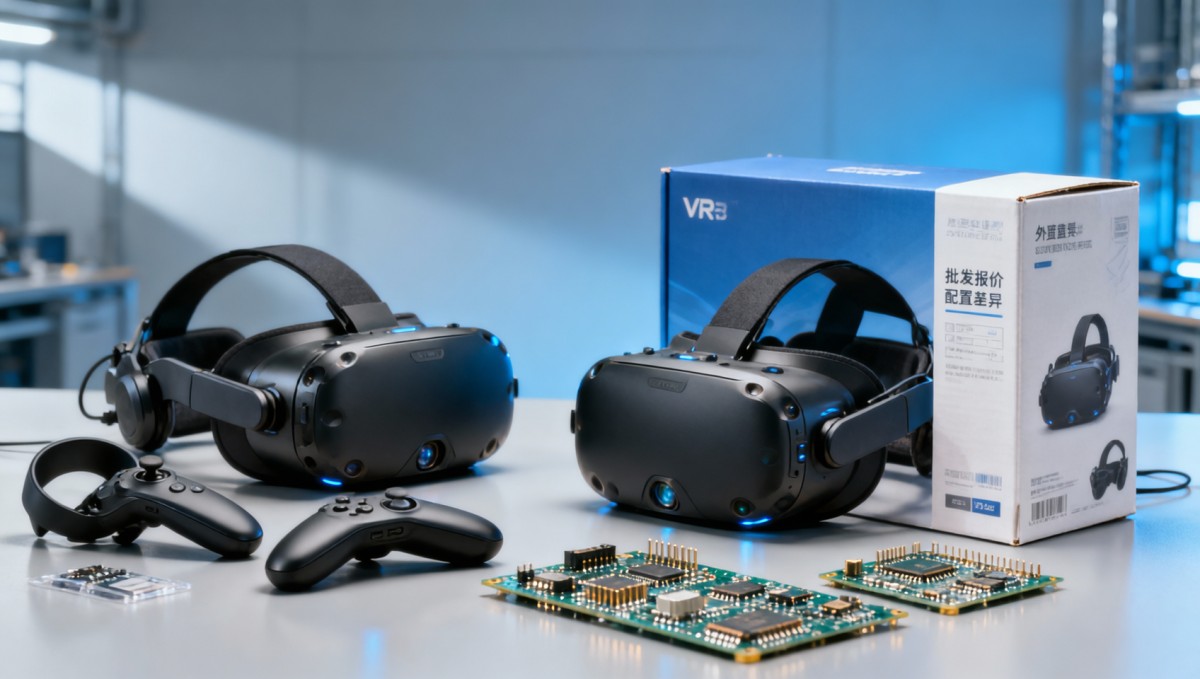
A wide pricing spread often begins at the bill of materials. VR headsets sold in wholesale channels may use LCD or OLED panels, pancake or Fresnel lenses, entry-level or higher-grade processors, and different memory configurations such as 4GB/64GB, 6GB/128GB, or 8GB/256GB. Even when housings look similar, internal component choices can shift cost by 15%–40% before packaging and logistics are added.
Display performance is one of the biggest price variables. A headset with 1832×1920 per eye, a 72Hz refresh rate, and a standard field of view will usually be priced differently from one targeting 90Hz or 120Hz, improved brightness, and lower motion blur. For training applications, retail demos, or enterprise visualization, the lower-priced option may still be suitable, but only if the use case does not demand longer sessions or higher visual clarity.
Sensor quality and tracking architecture also matter. Basic 3DoF configurations remain cheaper than 6DoF systems with multiple cameras, improved inside-out tracking, and better controller latency. A buyer sourcing 500 units for educational content may accept fewer tracking features, while a distributor supplying simulation centers or healthcare training environments may need tighter motion accuracy and lower drift over sessions lasting 30–90 minutes.
Another overlooked factor is software readiness. Some suppliers quote only hardware. Others include firmware localization, pre-installed applications, MDM compatibility, SDK access, or branding support. In enterprise projects, these add-ons can account for 8%–20% of the quoted value. If one vendor includes integration support and another does not, comparing unit prices alone produces a distorted picture.
Core component differences that affect cost
The table below summarizes common hardware-level variables that create visible price divergence in VR headset wholesale sourcing. These ranges are indicative and should be validated against the target application, volume, and compliance requirements.
The key takeaway is that “similar-looking” products often carry very different cost structures. In wholesale negotiations, asking for a detailed configuration sheet is more useful than asking for a lower headline price. Without that transparency, quote comparisons are unreliable.
Questions buyers should ask before comparing quotes
- Is the quote based on 100 units, 500 units, or 1,000+ units, and how does pricing step down at each tier?
- Are controllers, chargers, cables, face cushions, and carrying accessories included or quoted separately?
- Does the supplier include firmware support, language packs, or app preload services?
- What is the expected defect threshold at shipment and within the first 90 days of use?
Why compliance, testing, and quality control can reshape the final quote
Many pricing gaps are created not by visible hardware alone, but by the hidden cost of compliance and quality assurance. If a VR headset is destined for different markets, suppliers may need to address electrical safety, battery transport rules, radio frequency requirements, labeling standards, and packaging documentation. For one shipment, these steps may seem administrative. Across repeated orders, they materially affect cost and lead time.
Battery systems are a common example. Devices with integrated lithium batteries require careful handling in air freight and often trigger stricter documentation. If one supplier has mature packaging validation and another is relying on less controlled subcontracting, the lower quote can expose buyers to customs delay, repacking fees, or partial shipment holds. In practice, a 5% unit saving can be erased by a single logistics disruption.
Quality control depth also varies widely. Some suppliers perform only basic power-on checks. Others run a 100% functional test, sensor verification, charging test, cosmetic inspection, and carton-level drop review. For projects involving 300–2,000 units, better quality screening can reduce installation-day failure and field returns. That is particularly important for distributors and system integrators that cannot afford high RMA rates after deployment.
Buyers in adjacent smart electronics categories already understand this pattern. The sourcing logic behind smart plugs wholesale, IoT energy monitors, and energy auditing tools is similar: the quote reflects not just parts, but process control, certification readiness, and consistency from batch to batch. VR headsets follow the same rule, especially when purchased for education, industrial training, demo fleets, or healthcare simulation programs.
Typical compliance and QC factors buyers should verify
Use the following framework to identify where quote differences may actually reflect lower risk and stronger delivery reliability rather than simple margin variation.
If a supplier can clearly explain test coverage, acceptable defect limits, and shipment control steps, the quote is easier to trust. For procurement teams, that reduces the need to absorb risk later through emergency replacement stock or manual reinspection on arrival.
Common sourcing mistake
A frequent mistake is treating all “certified” or “export-ready” claims as equal. Buyers should ask whether the provided documentation matches the exact configuration being ordered, including battery type, wireless module, power adapter, and packaging version. A document prepared for one hardware revision may not fully protect a different batch.
How logistics, MOQ, and order structure change wholesale pricing
Wholesale pricing is strongly affected by order architecture. A factory may offer a very attractive quote at 1,000 units but a much higher one at 100 units because tooling allocation, component reservation, assembly scheduling, and packaging setup costs must be spread differently. In many electronics projects, the difference between a pilot run and a repeat order can exceed 12%–18% per unit.
MOQ is especially important when buyers request private labeling, customized inserts, software preload, or channel-specific packaging. A standard white-box shipment may be available at 100–200 units, while branded packaging or language-specific manuals may require 500 units or more. If one supplier is quoting a generic configuration and another is quoting a market-ready pack-out, the two numbers are not directly comparable.
Freight mode also shifts economics. Air freight is faster for urgent launches, often in the 5–12 day range after handover, but it becomes expensive for battery-powered electronics and can force stricter carton optimization. Ocean freight lowers cost for larger volumes, but total lead time may extend to 25–45 days depending on route, customs clearance, and inland handling. For project managers, the right comparison is landed cost plus timing risk, not ex-works price alone.
Incoterms matter as well. EXW, FOB, CIF, and DDP shift responsibility for freight booking, insurance, customs, and tax exposure. A lower EXW quote can still produce a higher total procurement cost if the buyer needs to manage complex pickup, export filing, and destination clearance. Finance teams reviewing VR headset wholesale contracts should request side-by-side landed-cost modeling under at least 2 shipping scenarios.
Typical order structures and their pricing implications
The table below shows how commercial structure often influences pricing and lead time in practical B2B transactions.
This is why experienced buyers separate price discussions into at least three layers: factory unit price, logistics and import cost, and post-delivery operating cost. That approach produces a more accurate commercial decision than focusing on one visible number.
A practical 4-step quote comparison process
- Normalize the configuration: same memory, same accessories, same software scope, same packaging assumptions.
- Compare MOQ tiers: sample, pilot, standard batch, and annual forecast volume.
- Model landed cost under air and sea options, including duties and handling.
- Estimate after-sales exposure using expected defect rate, spare ratio, and support terms.
How buyers should evaluate supplier risk beyond the headline quote
A low quote can reflect genuine efficiency, but it can also reflect incomplete scope, unstable sourcing, or weak after-sales capability. In VR headset wholesale projects, supplier risk should be evaluated across at least 5 dimensions: production consistency, technical support, communication speed, traceability, and replacement handling. These factors become critical once the first 100 units turn into a multi-batch program.
Procurement teams should pay attention to component sourcing resilience. If a supplier depends on spot-market chips, display panels, or batteries, pricing may fluctuate sharply from month to month. That creates quotation volatility and can result in mid-project substitutions. Asking whether key components are reserved for 60–90 days is often more useful than negotiating a small discount on the first order.
After-sales structure is another differentiator. Some vendors offer only remote troubleshooting, while others can support spare-part allocation, dead-on-arrival replacement thresholds, serialized warranty tracking, and response commitments within 24–72 hours. For distributors, service terms may influence profitability more than a minor purchase-price advantage. For enterprise users, delayed replacements can stall training plans or rollout milestones.
This is where strategic sourcing intelligence platforms add value. Decision-makers need more than catalog access; they need context on supplier credibility, operational maturity, and category-specific risk. In smart electronics, including VR hardware and adjacent connected devices, successful buying depends on understanding how technical details, supply chain control, and commercial terms interact over time.
Risk indicators that deserve close review
- Quote validity shorter than 7 days in a supposedly stable configuration, which may indicate weak component control.
- No clear statement on spare ratio, dead-on-arrival handling, or warranty workflow.
- Inability to explain QC steps, packaging method, or shipment documentation for battery-powered devices.
- Reluctance to share batch traceability logic, serial management, or software revision information.
FAQ for procurement and project teams
Below are common questions raised by sourcing managers, resellers, and approval teams when comparing VR headset wholesale offers.
How many samples should buyers test before placing a wholesale order?
For a new supplier, testing 2–5 units is usually the minimum. If the deployment involves education, healthcare training, or multi-site enterprise use, a pilot of 20–50 units is more reliable because it reveals charging consistency, pairing stability, and packaging damage risk under real handling conditions.
What lead time is typical for standard versus customized orders?
For standard configurations already in production, lead time may fall in the 2–4 week range after deposit and confirmation. Customized packaging, branding, or software loading can extend this to 4–8 weeks, especially if manuals, carton labels, or accessories require separate approvals.
Which commercial terms matter most to finance approvers?
Finance teams should review payment structure, quote validity, Incoterms, replacement responsibility, and penalty exposure from delays. A favorable unit price has limited value if the contract does not define who absorbs freight rework, customs delay costs, or early failure replacements.
A smarter sourcing framework for comparing VR headset wholesale offers
The most reliable way to compare offers is to build a total-value scorecard. Instead of ranking suppliers only by unit cost, assign weighted scores to configuration fit, compliance readiness, quality control depth, logistics practicality, and service response. A 5-factor model often gives procurement teams a clearer decision path than a simple three-quote exercise.
For example, a buyer can assign 30% weight to hardware suitability, 20% to compliance and documentation, 20% to supply reliability, 15% to landed cost, and 15% to after-sales support. This approach is especially useful when evaluating vendors that also supply related smart electronics categories such as smart plugs wholesale programs, IoT monitoring devices, or energy auditing tools, where technical and regulatory details similarly influence real commercial outcomes.
For distributors and channel partners, consistency may be more important than achieving the lowest opening order price. For enterprise users, deployment stability and software support often matter more. For financial approvers, predictable landed cost and lower return exposure can justify a moderately higher quote. The “best” supplier depends on which risk the organization is least willing to carry.
TradeNexus Pro supports this style of decision-making by focusing on practical B2B intelligence rather than surface-level listings. When buyers can interpret price variation through the lens of product architecture, compliance, delivery, and supplier capability, they negotiate with more confidence and choose partners with stronger long-term fit.
Recommended scorecard categories
- Configuration alignment: display, memory, tracking, comfort, runtime, accessory completeness.
- Documentation and compliance: battery shipment readiness, labeling, manuals, product traceability.
- Operational execution: MOQ fit, lead time realism, quote validity, communication response speed.
- After-sales model: spare policy, warranty handling, technical escalation, replacement timing.
VR headset wholesale pricing varies more than expected because the quote reflects far more than physical hardware. Component grade, software scope, testing depth, compliance readiness, MOQ structure, freight model, and supplier maturity all influence the final number. Buyers who compare offers on a normalized, landed-cost basis are far more likely to avoid hidden cost traps and execution risk.
If your team is evaluating VR hardware, connected smart electronics, or adjacent sourcing categories across global supply markets, a structured intelligence-led approach can shorten evaluation cycles and improve supplier selection. Contact TradeNexus Pro to discuss sourcing benchmarks, category analysis, or a tailored decision framework for your next procurement project.
Get weekly intelligence in your inbox.
No noise. No sponsored content. Pure intelligence.
 Apr 18, 2026TradeNexus Pro Launches Global Compliance RadarTradeNexus Pro Launches Global Compliance Radar
 Apr 18, 2026JIS T 2304:2026 Takes Effect June 1, 2026 for IVD SoftwareJIS T 2304:2026 Takes Effect June 1, 2026 for IVD Software
 Pathway for Rehab Devices with AI Modules") Apr 18, 2026FDA Updates 510(k) Pathway for Rehab Devices with AI ModulesFDA Updates 510(k) Pathway for Rehab Devices with AI Modules
Apr 18, 2026FDA Updates 510(k) Pathway for Rehab Devices with AI ModulesFDA Updates 510(k) Pathway for Rehab Devices with AI Modules Apr 18, 2026India BIS Approves 3 Chinese IoT Labs for IS 16444:2026 CertificationIndia BIS Approves 3 Chinese IoT Labs for IS 16444:2026 Certification
 Apr 18, 2026THE Alliance Launches Green Slot Priority for China PortsTHE Alliance Launches Green Slot Priority for China Ports
 Apr 18, 2026TÜV Rheinland Releases Dual-Standard ESS Certification Guide for ChinaTÜV Rheinland Releases Dual-Standard ESS Certification Guide for China
 Apr 18, 2026Vietnam Imposes AD Duties on Chinese Electronic ComponentsVietnam Imposes AD Duties on Chinese Electronic Components
 Apr 18, 2026SASO Launches PV Carbon Footprint Labeling from July 2026SASO Launches PV Carbon Footprint Labeling from July 2026
 Apr 18, 2026U.S. Adds 17 Smart Warehouse Robot Components to Export Control ListU.S. Adds 17 Smart Warehouse Robot Components to Export Control List
 Apr 18, 2026EU Enforces EN IEC 62443-4-2:2026 for Industrial Control Devices from 18 Apr 2026EU Enforces EN IEC 62443-4-2:2026 for Industrial Control Devices from 18 Apr 2026
 Apr 17, 2026Temperature data loggers drift unpredictably inside lithium-ion battery storage enclosuresTemperature data loggers drift unpredictably inside lithium-ion battery storage enclosures
 Apr 17, 2026Are solar microinverters really worth the extra cost?Are solar microinverters really worth the extra cost?
 Apr 17, 2026Bifacial solar panels: How much more energy can they generate?Bifacial solar panels: How much more energy can they generate?
 Apr 17, 2026Gear manufacturing: How to optimize production for high precision?Gear manufacturing: How to optimize production for high precision?
 Apr 17, 2026Why power transmission components fail earlier than expectedWhy power transmission components fail earlier than expected
 Apr 17, 2026Linear motion systems: belt drive or ball screw for speed?Linear motion systems: belt drive or ball screw for speed?
 Apr 17, 2026Industrial bearing suppliers: what signals reliable quality?Industrial bearing suppliers: what signals reliable quality?
 Apr 17, 2026When pneumatic valves wholesale gets expensive laterWhen pneumatic valves wholesale gets expensive later
 Apr 17, 2026Hydraulic cylinder fabrication mistakes that cause oil leaksHydraulic cylinder fabrication mistakes that cause oil leaks
 Apr 17, 2026Heavy equipment manufacturing delays often start hereHeavy equipment manufacturing delays often start here
 Apr 17, 2026Custom heatsinks: when a larger size solves nothingCustom heatsinks: when a larger size solves nothing
 Apr 17, 2026Electronic enclosure fabrication: steel or aluminum?Electronic enclosure fabrication: steel or aluminum?
 Apr 17, 2026Automotive parts machining tolerances that drive up scrapAutomotive parts machining tolerances that drive up scrap
 Apr 17, 2026Medical device manufacturing changes under tighter traceabilityMedical device manufacturing changes under tighter traceability
 Apr 17, 2026How to Choose Solid State Batteries in 2026How to Choose Solid State Batteries in 2026
 Apr 17, 2026Are Solid State Batteries Worth the Cost Yet?Are Solid State Batteries Worth the Cost Yet?
 Apr 17, 2026Commercial Energy Storage Sizing: What Matters Most?Commercial Energy Storage Sizing: What Matters Most?