V2G Technology Is Moving Fast, but What Still Holds It Back?
V2G technology is advancing from pilot programs to grid-scale strategy, promising new value for fleets, utilities, and energy-intensive enterprises. Yet for business evaluators, the real question is not whether the concept works, but what still limits commercial adoption. From regulatory fragmentation to battery concerns and infrastructure readiness, understanding these barriers is essential to judging where V2G can deliver measurable returns.
The market signal has changed: V2G technology is no longer just a pilot story
The most important shift around v2g technology is not technical possibility, but market positioning. A few years ago, the discussion centered on demonstration projects, innovation grants, and early utility partnerships. Today, the conversation is moving toward asset monetization, grid flexibility, fleet resilience, and distributed energy strategy. That change matters for procurement teams and commercial decision-makers because it reframes electric vehicles from transport assets into energy assets.
Several trends are pushing this transition. Corporate electrification targets are rising, grid congestion is becoming more visible, renewable energy variability is increasing, and time-of-use pricing is sharpening the value of flexible load. At the same time, more organizations are managing larger EV fleets, from logistics operators to municipal services and campus transport providers. In that context, v2g technology is gaining attention not as a futuristic concept, but as a possible tool for demand response, backup support, and energy cost optimization.
However, faster visibility does not mean faster adoption everywhere. Commercial momentum is real, but deployment remains uneven. Business evaluators now face a more practical question: where is the business case strong enough to justify capital, integration effort, and operational change?
What is accelerating interest in v2g technology now
The recent rise in interest is being driven by a combination of energy economics, infrastructure pressure, and enterprise risk management. In many markets, electricity systems are under strain during peak periods. Utilities need flexible resources, while businesses need better control over energy costs and uptime. V2G technology sits at that intersection.
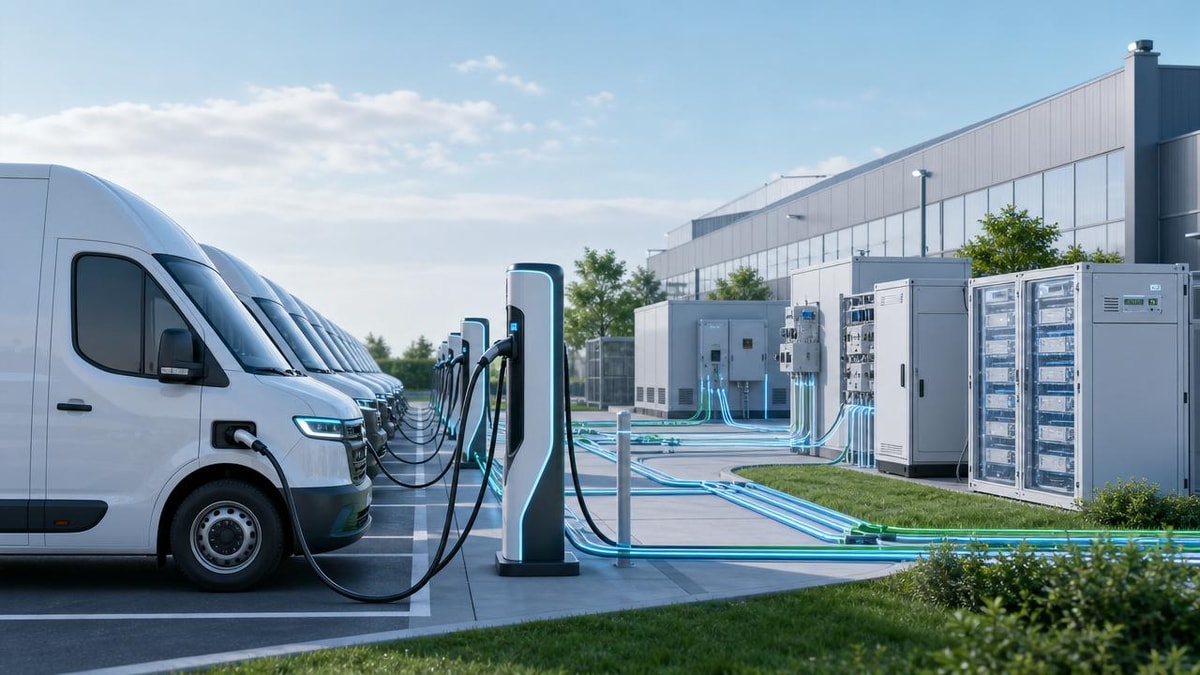
For fleet owners, the appeal is straightforward. Vehicles often remain parked for long periods, especially overnight or between scheduled routes. If those parked vehicles can discharge electricity back to the grid or to a building when needed, they can create a secondary value stream beyond mobility. For utilities, aggregated EV batteries may help support balancing services, peak shaving, or local grid support. For enterprises, especially those with large sites and predictable vehicle dwell times, v2g technology may support broader energy management goals.
Another important signal is strategic convergence. V2G is increasingly discussed alongside microgrids, on-site solar, stationary storage, and energy management software. That makes adoption decisions less about a single charger purchase and more about system architecture. As a result, evaluation is becoming more cross-functional, involving procurement, operations, energy teams, IT, and finance.
What still holds v2g technology back from commercial scale
Despite momentum, the barriers remain substantial. Most of them are not basic engineering failures. They are commercial, regulatory, operational, and ecosystem-level constraints that make scaling slower than headlines suggest.
1. Regulatory fragmentation is still the biggest structural brake
In many regions, market rules have not fully caught up with bidirectional charging. Interconnection requirements, participation rules for distributed resources, metering standards, utility approval processes, and compensation structures can differ widely across territories. That creates uncertainty for enterprises operating across multiple sites or countries. A use case that works economically in one service area may fail in another simply because export rules, grid fees, or aggregator access are different.
2. Battery degradation concerns still affect board-level confidence
Even where technical studies suggest controlled cycling can be manageable, decision-makers remain cautious. Commercial operators want clarity on how bidirectional charging affects battery warranty terms, residual vehicle value, maintenance planning, and total cost of ownership. If OEM policies are inconsistent or unclear, many buyers will delay full deployment. For business evaluators, this is a core diligence issue, not a minor technical footnote.
3. Charger and vehicle interoperability is improving, but not solved
A scalable v2g technology strategy depends on more than one compatible charger. It requires alignment between vehicle hardware, communication protocols, software controls, site infrastructure, and utility interfaces. Standards are progressing, but the installed base remains mixed. That means buyers must evaluate whether a solution is broadly deployable or narrowly locked to specific vehicles and operating environments.
4. Revenue models remain volatile
The value stack for v2g technology can include peak shaving, capacity support, frequency response, demand response, backup resilience, and tariff optimization. But not every site can access all of those benefits. In many cases, returns depend on local market design, utility programs, and usage patterns. If projected revenue relies heavily on a single incentive program or short-term tariff condition, the business case may be fragile.
5. Operational complexity can outweigh theoretical gains
A fleet only creates value when its vehicles are available at the right time, with the right state of charge, under predictable dispatch conditions. That is easier for some operations than others. School buses, fixed-route fleets, and depot-based service vehicles may fit well. High-utilization delivery fleets or highly variable field-service operations may find fewer stable windows for energy export. As a result, the viability of v2g technology is strongly linked to duty cycle discipline.
The impact is not equal across all business types
One of the clearest market signals is that v2g technology is becoming a segmented opportunity. It is unlikely to scale in a uniform way across all sectors at the same speed. The most attractive use cases tend to combine three conditions: predictable vehicle dwell time, significant electricity cost exposure, and the capability to manage energy digitally.
The next phase will be shaped less by hype and more by integration quality
As the market matures, the winners are unlikely to be the organizations that simply install bidirectional chargers first. More likely, they will be the ones that integrate vehicles, charging, software, site loads, and commercial participation models with discipline. That is why the next phase of v2g technology should be viewed as an integration challenge rather than a stand-alone equipment trend.
This has important implications for strategic sourcing. Buyers should increasingly compare providers on interoperability, controls, cybersecurity, data visibility, and service support rather than charger specifications alone. In practical terms, the quality of orchestration may determine whether v2g technology delivers a measurable return or becomes an underused pilot asset.
What business evaluators should watch over the next 12 to 24 months
For decision-makers assessing future readiness, several signals deserve close attention. First, track whether local utilities and regulators are clarifying market participation rules for distributed storage and vehicle export. Second, monitor OEM warranty language and formal support for bidirectional use. Third, assess whether software vendors can provide transparent dispatch logic, settlement reporting, and operational safeguards. Fourth, test whether projected savings depend on one narrow incentive stream or a diversified value stack.
It is also wise to watch standardization progress. A market with stronger protocol consistency and lower integration friction will scale faster. For global B2B buyers, this matters because fragmented technical pathways can raise deployment risk across regions and suppliers.
A practical decision framework for near-term evaluation
Rather than asking whether v2g technology is ready in general, enterprises should ask whether it is ready for a specific fleet, site, and market context. A disciplined evaluation framework can reduce over-optimism and improve procurement timing.
FAQ: the questions commercial teams are asking most about v2g technology
Is v2g technology commercially viable today?
In selected use cases, yes. The strongest cases usually involve depot-based fleets, supportive utility structures, and clear integration with broader energy management. It is not yet a uniform opportunity across all markets.
What is the main non-technical barrier?
Regulatory inconsistency is often the biggest constraint. Even where the hardware works, revenue certainty and grid participation rules can remain unclear.
Should enterprises wait or pilot now?
Organizations with predictable fleet usage, high peak electricity costs, and digital energy capability may benefit from targeted pilots now. Others may be better served by preparing infrastructure and supplier criteria while monitoring policy and standards development.
How should procurement teams compare vendors?
Look beyond charger hardware. Compare interoperability, software control, cybersecurity, warranty alignment, service support, reporting quality, and the realism of projected revenue assumptions.
Where the smart judgment lies now
The direction of travel is clear: v2g technology is moving from innovation narrative toward selective commercial deployment. But the pace of scale-up will depend less on enthusiasm and more on market rules, integration maturity, and operational fit. For business evaluators, the key is not to ask whether the technology is exciting, but whether a specific deployment can withstand commercial scrutiny.
If an enterprise wants to judge the impact of v2g technology on its own strategy, it should confirm five things first: whether vehicles sit long enough to create dispatch value, whether local regulations support monetization, whether battery and warranty risks are contractually clear, whether software orchestration is enterprise-grade, and whether expected returns remain attractive without relying on optimistic assumptions. That is where practical readiness will be decided.
Get weekly intelligence in your inbox.
No noise. No sponsored content. Pure intelligence.
 May 07, 2026Sustainable Building Materials That Cut Carbon Without Cutting DurabilitySustainable Building Materials That Cut Carbon Without Cutting Durability
 May 07, 2026Green Hydrogen Production: What Decides Whether a Project ScalesGreen Hydrogen Production: What Decides Whether a Project Scales
 May 07, 2026Wind Turbine Blades: Why Repairs Cost More Than PlannedWind Turbine Blades: Why Repairs Cost More Than Planned
 May 07, 2026Folding Solar Chargers: What Real Output Looks Like OutdoorsFolding Solar Chargers: What Real Output Looks Like Outdoors
 May 07, 2026Vehicle to Grid Revenue Looks Attractive, but What Are the Limits?Vehicle to Grid Revenue Looks Attractive, but What Are the Limits?
 May 07, 2026Wireless EV Charging Sounds Easy, So Why Is Adoption Slow?Wireless EV Charging Sounds Easy, So Why Is Adoption Slow?
 May 07, 2026Floating Solar Farms: The Hidden Tradeoffs Behind Water SavingsFloating Solar Farms: The Hidden Tradeoffs Behind Water Savings
 May 07, 2026Geothermal Heat Pumps: Why Installation Quotes Differ So WidelyGeothermal Heat Pumps: Why Installation Quotes Differ So Widely
 May 07, 2026Sodium Ion Batteries: Where They Make Sense Before 2030Sodium Ion Batteries: Where They Make Sense Before 2030
 May 07, 2026EV Battery Recycling Is Growing, but the Supply Chain Isn’t ReadyEV Battery Recycling Is Growing, but the Supply Chain Isn’t Ready
 May 07, 2026BMS Boards Selection Problems That Show Up After InstallationBMS Boards Selection Problems That Show Up After Installation
 May 07, 2026Deep Cycle Batteries: Why Runtime Estimates Often Miss the MarkDeep Cycle Batteries: Why Runtime Estimates Often Miss the Mark
 May 07, 2026Carbon Capture Technology Projects Often Stall at This StageCarbon Capture Technology Projects Often Stall at This Stage
 May 07, 2026What Makes Offshore Wind Technology So Expensive to Deploy?What Makes Offshore Wind Technology So Expensive to Deploy?
 May 07, 2026EV Charging Cables: Small Spec Differences, Big Fit ProblemsEV Charging Cables: Small Spec Differences, Big Fit Problems
 May 07, 2026Solid State Batteries: Progress Is Real, Timelines Are Not SimpleSolid State Batteries: Progress Is Real, Timelines Are Not Simple
 May 07, 2026Microgrid Controllers: What Changes Once Systems Scale UpMicrogrid Controllers: What Changes Once Systems Scale Up
 May 07, 2026Energy Efficient HVAC Claims That Deserve a Closer LookEnergy Efficient HVAC Claims That Deserve a Closer Look
 May 07, 2026Biomass Energy Equipment: Why Maintenance Costs Vary So MuchBiomass Energy Equipment: Why Maintenance Costs Vary So Much
 May 07, 2026Smart Meters Wholesale: Which Specs Matter Most in Bulk OrdersSmart Meters Wholesale: Which Specs Matter Most in Bulk Orders
 May 07, 2026Commercial Energy Storage Sizing Mistakes That Raise CostsCommercial Energy Storage Sizing Mistakes That Raise Costs
 May 07, 2026Residential Solar Kits: What Gets Overlooked Before BuyingResidential Solar Kits: What Gets Overlooked Before Buying
 May 07, 2026V2G Technology Is Moving Fast, but What Still Holds It Back?V2G Technology Is Moving Fast, but What Still Holds It Back?
 May 07, 2026Smart Street Lighting Upgrades: Where Savings Often SlipSmart Street Lighting Upgrades: Where Savings Often Slip
 May 07, 2026Portable Solar Panels That Work Better in Real Travel UsePortable Solar Panels That Work Better in Real Travel Use
 May 07, 2026How to Compare AGM Batteries Wholesale Beyond Unit PriceHow to Compare AGM Batteries Wholesale Beyond Unit Price
 May 07, 2026Do Solar Water Heaters Still Pay Off in Mild Climates?Do Solar Water Heaters Still Pay Off in Mild Climates?