How to Compare Solar Panels Wholesale Offers in Europe
Comparing solar panels wholesale Europe offers requires more than checking unit price. For procurement teams, the real value lies in supplier reliability, certification compliance, logistics efficiency, warranty terms, and long-term supply stability. This guide helps buyers evaluate wholesale options with a strategic lens, so you can reduce sourcing risk, improve cost performance, and secure the right solar panel partners across the European market.
Why a checklist approach works better for solar procurement
For procurement professionals, wholesale buying decisions often fail when offers are compared too narrowly. A lower module price may hide weaker bankability, uncertain delivery schedules, incomplete technical documents, or warranty terms that are difficult to enforce across borders. In the solar panels wholesale Europe market, these details can materially affect project ROI, installation timelines, and after-sales exposure.
A checklist-based review creates consistency across suppliers. It helps buyers compare like-for-like quotes, identify risk early, and align technical, financial, and operational criteria before negotiation starts. This is especially important in Europe, where compliance requirements, importer obligations, grid standards, and documentation expectations can vary by country, project type, and customer segment.
Start with these five priority checks before comparing prices
Before analyzing discounts, freight, or payment terms, confirm the fundamentals. These first-pass checks prevent time being wasted on suppliers that look competitive on paper but are not suitable for your sourcing strategy.
- Verify the exact product specification: module type, wattage range, efficiency, dimensions, frame color, connector brand, and cell technology.
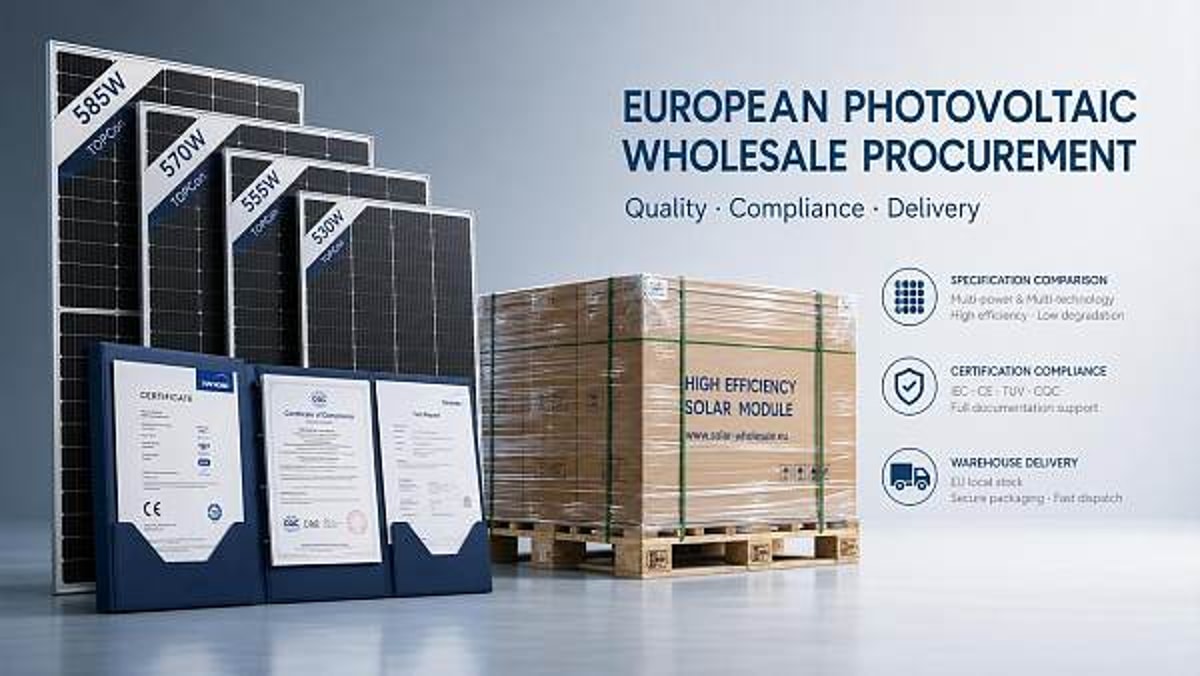
- Confirm EU-relevant certifications and test reports, including IEC standards, CE-related documentation, and fire or mechanical load data where applicable.
- Check supplier identity and role: manufacturer, authorized distributor, trading company, or stockholder located within Europe.
- Review delivery capability: available stock, production lead time, Incoterms, warehouse location, and transport routing.
- Assess warranty structure: product warranty, performance warranty, claim process, replacement policy, and local service support.
If a supplier cannot provide clear answers to these five points, that offer should not move into final commercial comparison. In the solar panels wholesale Europe segment, incomplete early validation is one of the biggest sources of avoidable procurement risk.
Core comparison checklist for solar panels wholesale Europe offers
1. Product performance and technical fit
Do not compare only watt-peak pricing. Procurement teams should request a technical data sheet and compare module efficiency, temperature coefficient, degradation assumptions, bifaciality if relevant, wind and snow load resistance, and compatibility with the target mounting system and inverter setup. A panel that performs better under local climate conditions may generate stronger lifecycle value than a slightly cheaper alternative.
2. Compliance and documentation readiness
For Europe-focused sourcing, document readiness matters almost as much as the product itself. Ask for declarations of conformity, test reports, warranty files, factory audit information, packaging specifications, HS code confirmation, and palletization details. If your projects serve public tenders, utility-scale assets, or regulated installers, missing documentation can delay customs clearance, handover, and financing approval.
3. Supplier credibility and supply continuity
A strong quote should come from a supplier with traceable operating history, export records, stable production output, and a realistic channel strategy in Europe. Buyers should review company registration, manufacturing footprint, reference projects, insurance coverage, and whether the supplier has local stock or service support. In volatile market cycles, continuity is often more valuable than a one-time low price.
4. Commercial structure beyond module price
The most effective way to compare solar panels wholesale Europe offers is to build a total landed cost view. Include ex-works or FOB pricing, freight, insurance, customs exposure, VAT implications if relevant, unloading, storage, breakage allowance, payment fees, and possible cost of delays. Also check whether the quote is tied to a minimum order quantity, mixed-container limits, or batch-specific pricing validity.
5. Warranty enforceability and after-sales process
Long warranty periods are attractive, but only if they are enforceable. Procurement teams should ask where claims are processed, how defective modules are verified, who bears testing and transport costs, and how replacement timing is handled. A supplier with a clear European claims pathway may be preferable to one offering a longer warranty with unclear execution.
A practical scoring model buyers can use
Instead of debating offers informally, assign weighted scores to each supplier. This improves internal alignment between procurement, engineering, finance, and operations teams.
The exact weighting can change by project type, but a structured scorecard reduces emotional buying and improves auditability for enterprise sourcing teams.
Different buying scenarios require different comparison priorities
For EPC and utility-scale procurement
Large projects should prioritize volume security, batch consistency, bankability, and claim predictability. Ask for factory capacity details, production reservation options, serial traceability, and evidence that future replacement modules can match performance classes. Price still matters, but project interruption costs are usually much larger than modest panel savings.
For distributors and importers
If you serve installers or resellers, flexibility becomes more important. Compare packaging efficiency, mixed SKU availability, local warehousing, reorder cycles, marketing support, and the supplier’s ability to deliver multiple panel tiers. In solar panels wholesale Europe channels, distributors often benefit from partners that combine steady stock with clear product segmentation.
For commercial rooftop and installer-led buying
Installers and project aggregators usually need dependable lead times, fast document access, and manageable warranty support. In these cases, a supplier with stock inside Europe and strong operational responsiveness can outperform a lower-cost offshore-only option.
Commonly overlooked risk items in wholesale offers
Even experienced buyers sometimes overlook details that later create disputes or hidden cost. Review these risk points carefully before issuing a purchase order.
- Quote ambiguity: the offer references a model family, but not the exact SKU or power bin.
- Short price validity: attractive rates may expire before internal approval or logistics booking.
- Freight assumptions: inland transport, terminal handling, or delivery appointment costs are excluded.
- Packaging mismatch: pallet or container format may not suit your warehouse or jobsite handling process.
- Claims friction: warranty language exists, but no documented workflow, timeline, or regional contact point is provided.
- Substitution risk: the supplier reserves the right to replace the quoted model with a “similar” one.
Execution checklist before supplier negotiation
To compare solar panels wholesale Europe offers efficiently, prepare your own sourcing file before requesting best-and-final terms. This strengthens your negotiating position and helps suppliers quote more accurately.
- Define the annual or project-based volume requirement and acceptable delivery windows.
- Fix the technical baseline, including approved panel technologies and power range.
- List mandatory certifications, documentation standards, and project country requirements.
- Choose the target Incoterm and preferred payment structure.
- Decide whether local stock, drop-shipping, or scheduled batch delivery is necessary.
- Set internal scoring criteria so every bid is reviewed on the same basis.
When suppliers receive a clear request package, they are more likely to submit realistic and comparable proposals, reducing back-and-forth and shortening procurement cycles.
FAQ for buyers comparing solar panels wholesale Europe offers
Should buyers always prefer manufacturers over traders?
Not necessarily. Manufacturers may offer stronger pricing and direct technical insight, but experienced European stockholders or distributors can provide faster delivery, smaller lot flexibility, and easier claims handling. The better choice depends on your volume, urgency, and support needs.
How important is local European inventory?
Very important when project schedules are tight or demand is unpredictable. Local inventory can lower lead-time risk, reduce port-related uncertainty, and simplify replacement logistics. It may come at a higher unit price, but the operational value can outweigh the premium.
What is the biggest mistake in comparing wholesale panel quotes?
The biggest mistake is treating the procurement decision as a price-only exercise. In the solar panels wholesale Europe market, a quote should be judged as a full supply solution, not just a module figure per watt.
Final buying guidance for procurement teams
The strongest solar panels wholesale Europe strategy combines disciplined technical screening, verified compliance checks, realistic landed-cost analysis, and rigorous supplier due diligence. Buyers who follow a checklist approach are more likely to avoid hidden cost, project disruption, and warranty exposure while securing better long-term sourcing outcomes.
If your organization is preparing to shortlist suppliers, the next step is to align internally on required specifications, documentation thresholds, delivery expectations, and acceptable commercial terms. Then ask each candidate to confirm model details, stock status, certifications, warranty workflow, and logistics commitments in writing. That level of preparation will make your comparison sharper, your negotiation stronger, and your final solar procurement decision far more resilient.
Get weekly intelligence in your inbox.
No noise. No sponsored content. Pure intelligence.
 May 01, 2026Beijing’s New E-Bike Rules Trigger Dual-Certification Demand for China’s Swappable Battery CabinetsBeijing’s New E-Bike Rules Trigger Dual-Certification Demand for China’s Swappable Battery Cabinets
 May 01, 2026GNA’s GEO Service Assessment Elevates AI Search as Digital Procurement Metric for Chinese ExportersGNA’s GEO Service Assessment Elevates AI Search as Digital Procurement Metric for Chinese Exporters
 May 01, 20262026 China Cycle Expo: Chinese EPS Systems Achieve UL 2849:2026 Full Certification2026 China Cycle Expo: Chinese EPS Systems Achieve UL 2849:2026 Full Certification
 May 01, 2026GB 42236-2026 Enforces EV Charger Efficiency & Overload Protection from May 2026GB 42236-2026 Enforces EV Charger Efficiency & Overload Protection from May 2026
 May 01, 2026GB/T 43790-2026 Drone EMC Standard Effective May 2026GB/T 43790-2026 Drone EMC Standard Effective May 2026
 May 01, 20262026 Foshan Tanzhou Auto Industry Expo Opens2026 Foshan Tanzhou Auto Industry Expo Opens
 May 01, 2026China’s New Hazardous Chemicals Safety Law Takes Effect May 2026China’s New Hazardous Chemicals Safety Law Takes Effect May 2026
 May 01, 2026New Maritime and Fisheries Laws Take Effect May 1, 2026New Maritime and Fisheries Laws Take Effect May 1, 2026
 May 01, 2026Supply Chain Automation Works Best Where Delays RepeatSupply Chain Automation Works Best Where Delays Repeat
 May 01, 2026High Strength Steel Forgings: What Should Be Tested First?High Strength Steel Forgings: What Should Be Tested First?
 May 01, 2026Automotive Steel Forging: Cost Pressure vs Part ReliabilityAutomotive Steel Forging: Cost Pressure vs Part Reliability
 May 01, 2026Why High Durability Steel Forgings Fail Earlier Than ExpectedWhy High Durability Steel Forgings Fail Earlier Than Expected
 May 01, 2026Construction Aluminum Extrusions: Which Finish Lasts Longer?Construction Aluminum Extrusions: Which Finish Lasts Longer?
 May 01, 2026Lightweight Aluminum Extrusions: Where Savings Really HappenLightweight Aluminum Extrusions: Where Savings Really Happen
 May 01, 2026Aerospace Aluminum Extrusions Need More Than Low WeightAerospace Aluminum Extrusions Need More Than Low Weight
 May 01, 2026Precision Lathe Turning Problems That Show Up After AssemblyPrecision Lathe Turning Problems That Show Up After Assembly
 May 01, 2026High Precision Lathe Turning: Tolerance Claims to VerifyHigh Precision Lathe Turning: Tolerance Claims to Verify
 May 01, 2026When CNC Lathe Turning Is Better Than General MachiningWhen CNC Lathe Turning Is Better Than General Machining
 May 01, 2026Medical Device Prototyping Needs More Than SpeedMedical Device Prototyping Needs More Than Speed
 May 01, 20263D Printing Prototyping: Fast Turnaround or Better Finish?3D Printing Prototyping: Fast Turnaround or Better Finish?
 May 01, 2026Low Cost Rapid Prototyping: Where Quality Gets LostLow Cost Rapid Prototyping: Where Quality Gets Lost
 May 01, 2026Quick EV Charger Installation Still Needs Site ChecksQuick EV Charger Installation Still Needs Site Checks
 May 01, 2026Public Parking EV Chargers: What Slows Installation DownPublic Parking EV Chargers: What Slows Installation Down
 May 01, 2026Choosing a Lithium Ion Battery Manufacturer in ChinaChoosing a Lithium Ion Battery Manufacturer in China
 May 01, 2026How to Vet a Lithium Ion Battery OEM SupplierHow to Vet a Lithium Ion Battery OEM Supplier
 May 01, 2026EV Lithium Ion Batteries: Range Is Not the Only MetricEV Lithium Ion Batteries: Range Is Not the Only Metric
 May 01, 2026Lithium Ion ESS Batteries: Safety Details Worth CheckingLithium Ion ESS Batteries: Safety Details Worth Checking