MPPT controllers vs PWM in low-light charging conditions
In low-light charging conditions, choosing between mppt controllers and solar charge controllers built on PWM can significantly affect energy yield, battery health, and project ROI. For buyers, engineers, and system operators evaluating iot energy monitors, bms boards, or broader net zero solutions, understanding this difference is essential before specifying components for reliable off-grid or hybrid power systems.
Low irradiance is not a niche issue. It shapes real-world performance in warehouses, telecom cabinets, remote monitoring stations, healthcare backup nodes, portable industrial systems, and small commercial solar installations exposed to cloud cover, haze, winter sun angles, or shaded rooftops. In these environments, controller selection is often the difference between a battery bank that reaches a healthy daily charge window and one that remains undercharged for weeks.
For procurement teams and project managers, the MPPT vs PWM decision should not be framed as a simple price comparison. It is a system-level choice involving panel voltage, battery chemistry, cable losses, expected charging hours, duty cycle, maintenance burden, and future expansion plans. A lower upfront component cost can translate into higher energy deficits, more battery replacements, and reduced operational resilience over a 3–5 year project horizon.
How MPPT and PWM Controllers Work Under Weak Solar Input
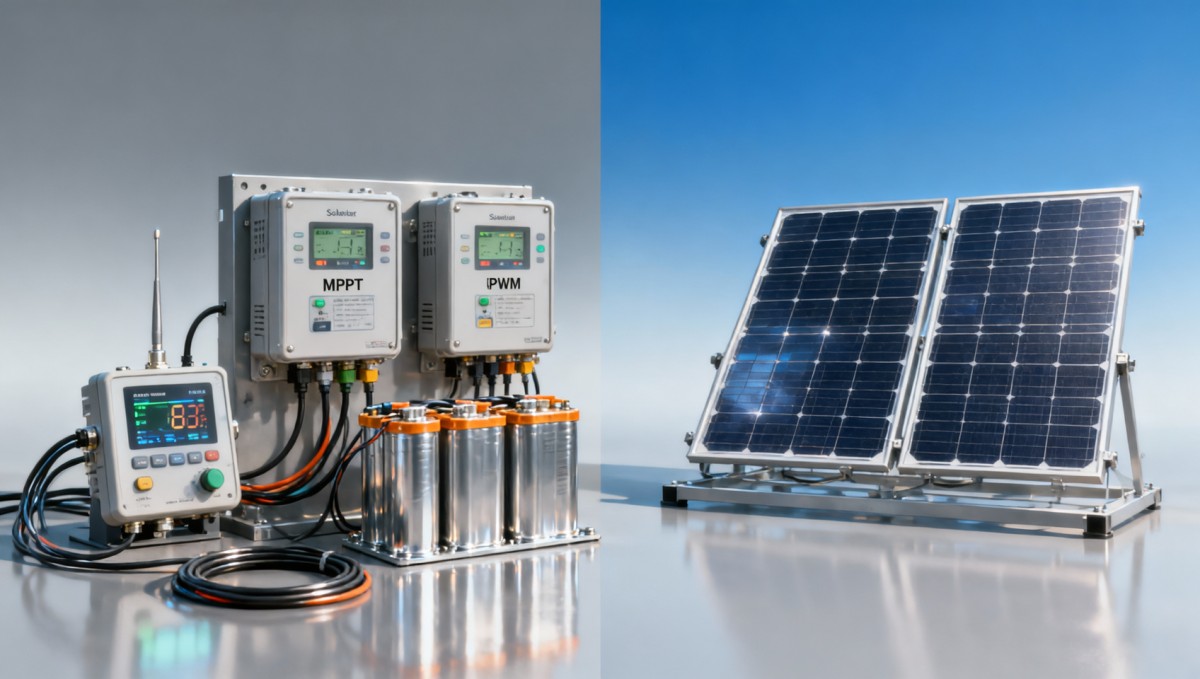
At a basic level, PWM and MPPT controllers regulate the flow of energy from solar panels to batteries, but they do so in very different ways. A PWM controller effectively connects the panel to the battery in pulses, pulling the panel voltage closer to battery voltage. This simple approach works adequately in stable sunlight and with carefully matched panel-to-battery configurations, especially in 12V or 24V entry-level systems.
An MPPT controller, by contrast, continuously tracks the panel’s maximum power point and converts excess panel voltage into usable charging current. In low-light conditions, that matters because panel voltage may still remain above battery voltage even when irradiance drops to 100–400 W/m². Instead of wasting the voltage differential, the controller can harvest more of the available power and deliver a higher effective charge current to the battery.
This operational difference becomes more visible with modern high-voltage modules, long cable runs, and lithium battery banks. A 36-cell or 72-cell panel string feeding a PWM controller may spend much of the morning outside its ideal charging window. An MPPT unit can usually use that higher panel voltage more efficiently, especially during the first 2–4 hours after sunrise and the last 1–3 hours before sunset.
For B2B users deploying remote IoT infrastructure, the practical question is not whether energy can be harvested at noon on a clear day, but how much energy can be recovered during marginal production periods. If a monitoring device, edge gateway, or low-power actuator runs 24 hours a day and the battery is only recharged within a 5–6 hour weak-sun window, even a 10%–20% gain in harvest can materially improve uptime and state-of-charge stability.
Why low-light behavior differs in the field
Low light does not only mean cloudy weather. It also includes partial shading from nearby structures, panel soiling, winter irradiance, oblique sun angles, and elevated panel temperature combined with low insolation. In these conditions, panel voltage-current curves shift rapidly. MPPT control is designed to adapt to that movement in seconds or minutes, while PWM has limited optimization capability beyond switching regulation.
Field technicians also see another difference: PWM systems tend to require tighter voltage matching. If the panel’s operating voltage is not close to the battery charging voltage, a meaningful portion of potential power is left unused. With MPPT, designers have more freedom to use higher-voltage strings, which can also reduce copper losses on cable runs longer than 10–20 meters.
The following table summarizes how the two controller types typically behave in low-light charging scenarios relevant to distributed commercial and industrial systems.
The core takeaway is straightforward: PWM can still be a valid choice for small, well-matched, budget-limited systems, but MPPT is generally better aligned with low-light variability, longer wiring distances, and enterprise applications where daily energy margin matters.
Energy Yield, Battery Health, and ROI in Real Operating Conditions
In purchasing discussions, teams often focus on the controller price delta while overlooking the cost of missed energy. In low-light charging conditions, the real issue is cumulative underperformance. If a site loses even 40–80 Wh per day because the controller cannot optimize weak solar input, that can amount to 14.6–29.2 kWh over one year. For a small remote system, that energy gap can directly affect autonomy days, battery depth of discharge, and service intervals.
Battery health is equally important. Lead-acid batteries, AGM systems, and even lithium packs perform best when charging profiles are properly managed. Repeated partial charging can shorten useful life, especially when the battery seldom reaches absorption or balancing thresholds. In many off-grid deployments, a battery bank designed for 3–5 years may degrade faster if charging remains chronically incomplete during low-irradiance seasons.
From an ROI standpoint, MPPT controllers are often easier to justify in systems above 200W–300W, in 24V or 48V architectures, or where battery replacement costs are significant. If a field battery replacement requires technician travel, site access coordination, and 2–6 hours of downtime, the indirect cost can exceed the controller premium. This is particularly true in healthcare monitoring, smart manufacturing telemetry, agricultural pumping control, and distributed logistics infrastructure.
Project financiers and approvers should also consider seasonal resilience. Many systems are sized using average sunlight assumptions, yet the real design stress occurs during the lowest-production month. A controller that improves harvest during winter mornings, haze events, and cloudy days can reduce the need to oversize panels by a full design step, such as 100W–200W in small systems or more in larger installations.
Cost impact beyond the controller invoice
A useful way to assess value is to compare total operating cost over 36 months instead of comparing component prices on day one. That broader view captures battery wear, maintenance visits, cable sizing, missed uptime, and generator backup use where applicable. In remote or regulated environments, one avoided truck roll can offset much of the difference between PWM and MPPT pricing.
Typical ROI evaluation criteria
- Daily energy margin during low-sun periods, often expressed in Wh/day or Ah/day over a 30-day cycle.
- Battery replacement frequency, especially where battery packs represent 25%–40% of small system lifecycle cost.
- Downtime risk for critical loads such as sensors, gateways, refrigeration alarms, or security devices.
- Cabling and array design flexibility, particularly when panel placement is 15–30 meters from the battery enclosure.
- Expansion readiness if the site may later add additional panels, communications modules, or higher-capacity BMS boards.
For enterprise buyers, the most cost-effective controller is not always the one with the lowest unit price. It is the one that protects the energy budget of the entire system under the least favorable, but highly predictable, operating conditions.
When to Choose MPPT or PWM for B2B Projects
The right controller depends on system scale, battery chemistry, array voltage, environmental conditions, and the business consequence of low charging performance. PWM remains reasonable for simple, low-cost systems where panel voltage is tightly matched to the battery, cable runs are short, and occasional energy shortfall is acceptable. Typical examples include very small lighting kits, isolated signage, or seasonal monitoring devices with low duty cycles.
MPPT is usually the stronger option when the project has year-round loads, higher-value batteries, variable weather exposure, or operational penalties for downtime. This includes industrial data loggers, telecom cabinets, security systems, medical support equipment, smart agriculture nodes, and transport refrigeration monitors. In these use cases, the system is often expected to deliver stable charging in suboptimal conditions for 8–12 months per year, not only during ideal summer performance.
Another important decision factor is system voltage architecture. In 12V projects under 100W with very short cable lengths, PWM may still be acceptable if cost control is the dominant priority. In 24V and 48V systems, or where array voltage is significantly higher than battery voltage, MPPT delivers both energy and design advantages. It can support more flexible panel selection and often simplifies expansion planning.
Procurement teams should also assess risk tolerance. If a missed charge cycle could result in lost telemetry, delayed compliance reporting, or a site visit costing several hundred dollars, controller selection should be treated as a reliability decision, not a commodity buy. In many B2B contexts, the controller sits at the intersection of asset protection, data continuity, and field service economics.
Decision matrix for common commercial scenarios
The table below provides a practical guide for matching controller type to common deployment profiles.
This matrix should be used as a starting point rather than a fixed rule. Final selection still depends on load profile, battery charging requirements, local climate, and whether the system integrates with IoT energy monitors for performance tracking and alarms.
Four procurement checkpoints
- Confirm panel open-circuit voltage and operating voltage against controller input limits at the lowest expected ambient temperature.
- Match the controller’s charge profile to battery type, such as flooded lead-acid, AGM, gel, or lithium with BMS coordination.
- Estimate worst-month solar yield rather than average annual sunshine only.
- Review communications, logging, and remote diagnostic features if the site is difficult or costly to access.
Implementation, Monitoring, and Common Mistakes in Low-Light Systems
Even the right controller can underperform if the system is poorly implemented. One common mistake is oversimplifying the array-to-battery relationship. Teams may specify a PWM controller because the load appears small, then later add a modem, sensor package, heater, or edge processor that raises daily consumption by 20%–50%. What started as a borderline design becomes chronically undercharged in winter or cloudy conditions.
Another frequent issue is ignoring the role of monitoring. Low-light charging problems are often gradual, not dramatic. Battery state of charge may decline 3%–5% per day over a long overcast period, and the site may continue operating until a final threshold is crossed. Integrating IoT energy monitors can help teams track panel voltage, charge current, battery temperature, load consumption, and alarm states in near real time, allowing intervention before service interruption occurs.
Installation quality also matters. Voltage drop from undersized cabling can erase much of the advantage of a good controller. For cable runs beyond 10 meters, design teams should calculate conductor size based on current, voltage class, and acceptable loss, often targeting no more than 2%–3% drop on critical paths. Connector quality, terminal torque, and enclosure temperature management are also important in outdoor or industrial environments.
Maintenance strategy should be defined from the beginning. A system supporting remote logistics tracking or industrial telemetry may need monthly data review, quarterly physical inspection, and battery health checks every 6–12 months. These intervals vary by climate, dust exposure, battery chemistry, and site criticality, but a formal inspection schedule is more reliable than reactive maintenance after repeated undercharging events.
Common mistakes to avoid
- Selecting a PWM controller for a high-voltage solar module simply because the battery is only 12V or 24V.
- Using average sun-hour data without modeling the worst 30-day production window.
- Skipping battery temperature compensation or lithium charging coordination with the BMS board.
- Failing to reserve at least 15%–25% charging margin for cloudy periods, dust, aging, and future load growth.
- Assuming controller efficiency can offset poor panel orientation, chronic shading, or undersized storage capacity.
Practical implementation workflow
A disciplined rollout process improves both purchasing accuracy and field performance. A typical B2B workflow includes five steps: load audit, seasonal solar assessment, controller and battery matching, pilot validation, and remote performance review during the first 30–60 days. This approach is especially useful for companies standardizing solutions across multiple sites or distributors managing repeat deployments in different geographies.
For organizations responsible for quality or safety, documentation should include controller input range, charging stages, protection logic, enclosure rating, and maintenance instructions. These details support internal approval, reduce installation errors, and make future service more predictable.
FAQ for Buyers, Engineers, and Decision-Makers
Because low-light charging performance affects technical, financial, and operational outcomes at the same time, buyers often ask similar questions during specification and vendor comparison. The answers below focus on practical selection criteria rather than generic product claims.
Is MPPT always better than PWM in low-light charging conditions?
Not always, but often. MPPT is generally better when panel voltage exceeds battery voltage by a meaningful margin, when the site experiences variable irradiance, or when system uptime matters. PWM can still be appropriate in very small 12V systems with short cables, low daily energy demand, and limited budget. The stronger the penalty for undercharging, the more compelling MPPT becomes.
How much extra solar panel capacity can reduce the need for MPPT?
Adding panel capacity can help, but it is not always the most efficient substitute. In some systems, an extra 20%–30% of panel wattage may compensate for controller limitations during part of the year. However, this can increase structural, cabling, and enclosure costs, and it may still not solve low-light voltage mismatch. In space-constrained projects, a better controller is often easier than adding more modules.
What should procurement teams request from suppliers?
Ask for rated current, maximum PV input voltage, supported battery types, temperature compensation behavior, charge-stage logic, communication interfaces, logging functions, and protection features such as reverse polarity, over-temperature, and short-circuit safeguards. If the controller will work with lithium storage, request confirmation of compatibility with the relevant BMS communication or charge-control method.
How do IoT energy monitors improve controller selection and operation?
They make weak-sun performance visible. Instead of guessing whether the controller is adequate, operators can review charge current curves, battery state trends, load patterns, and alarm frequency over 7-day, 30-day, or seasonal periods. This supports better controller sizing, earlier fault detection, and more accurate ROI measurement after deployment.
What is the safest recommendation for mission-critical remote systems?
For sites where downtime has operational or financial consequences, the safer starting point is usually MPPT paired with verified battery compatibility, a realistic seasonal energy model, and remote monitoring. That combination provides a stronger buffer against cloud cover, shading, and changing field conditions than a low-cost controller selected only on initial budget.
In low-light charging conditions, MPPT controllers typically offer stronger energy capture, more flexible system design, and better protection against chronic undercharging than PWM alternatives. PWM still has a place in compact, cost-sensitive systems with tight voltage matching and low operational risk, but many B2B applications benefit from the additional control, monitoring compatibility, and lifecycle value that MPPT can bring.
For organizations evaluating solar charge controllers alongside IoT energy monitors, BMS boards, and broader net zero infrastructure, the right decision starts with load analysis, worst-month performance modeling, and a clear view of service costs over time. If you need support comparing controller options for your project pipeline, remote assets, or distribution portfolio, contact us to get a tailored specification review and explore more practical energy system solutions.
Get weekly intelligence in your inbox.
No noise. No sponsored content. Pure intelligence.
 Apr 18, 2026TradeNexus Pro Launches Global Compliance RadarTradeNexus Pro Launches Global Compliance Radar
 Apr 18, 2026JIS T 2304:2026 Takes Effect June 1, 2026 for IVD SoftwareJIS T 2304:2026 Takes Effect June 1, 2026 for IVD Software
 Pathway for Rehab Devices with AI Modules") Apr 18, 2026FDA Updates 510(k) Pathway for Rehab Devices with AI ModulesFDA Updates 510(k) Pathway for Rehab Devices with AI Modules
Apr 18, 2026FDA Updates 510(k) Pathway for Rehab Devices with AI ModulesFDA Updates 510(k) Pathway for Rehab Devices with AI Modules Apr 18, 2026India BIS Approves 3 Chinese IoT Labs for IS 16444:2026 CertificationIndia BIS Approves 3 Chinese IoT Labs for IS 16444:2026 Certification
 Apr 18, 2026THE Alliance Launches Green Slot Priority for China PortsTHE Alliance Launches Green Slot Priority for China Ports
 Apr 18, 2026TÜV Rheinland Releases Dual-Standard ESS Certification Guide for ChinaTÜV Rheinland Releases Dual-Standard ESS Certification Guide for China
 Apr 18, 2026Vietnam Imposes AD Duties on Chinese Electronic ComponentsVietnam Imposes AD Duties on Chinese Electronic Components
 Apr 18, 2026SASO Launches PV Carbon Footprint Labeling from July 2026SASO Launches PV Carbon Footprint Labeling from July 2026
 Apr 18, 2026U.S. Adds 17 Smart Warehouse Robot Components to Export Control ListU.S. Adds 17 Smart Warehouse Robot Components to Export Control List
 Apr 18, 2026EU Enforces EN IEC 62443-4-2:2026 for Industrial Control Devices from 18 Apr 2026EU Enforces EN IEC 62443-4-2:2026 for Industrial Control Devices from 18 Apr 2026
 Apr 17, 2026Temperature data loggers drift unpredictably inside lithium-ion battery storage enclosuresTemperature data loggers drift unpredictably inside lithium-ion battery storage enclosures
 Apr 17, 2026Are solar microinverters really worth the extra cost?Are solar microinverters really worth the extra cost?
 Apr 17, 2026Bifacial solar panels: How much more energy can they generate?Bifacial solar panels: How much more energy can they generate?
 Apr 17, 2026Gear manufacturing: How to optimize production for high precision?Gear manufacturing: How to optimize production for high precision?
 Apr 17, 2026Why power transmission components fail earlier than expectedWhy power transmission components fail earlier than expected
 Apr 17, 2026Linear motion systems: belt drive or ball screw for speed?Linear motion systems: belt drive or ball screw for speed?
 Apr 17, 2026Industrial bearing suppliers: what signals reliable quality?Industrial bearing suppliers: what signals reliable quality?
 Apr 17, 2026When pneumatic valves wholesale gets expensive laterWhen pneumatic valves wholesale gets expensive later
 Apr 17, 2026Hydraulic cylinder fabrication mistakes that cause oil leaksHydraulic cylinder fabrication mistakes that cause oil leaks
 Apr 17, 2026Heavy equipment manufacturing delays often start hereHeavy equipment manufacturing delays often start here
 Apr 17, 2026Custom heatsinks: when a larger size solves nothingCustom heatsinks: when a larger size solves nothing
 Apr 17, 2026Electronic enclosure fabrication: steel or aluminum?Electronic enclosure fabrication: steel or aluminum?
 Apr 17, 2026Automotive parts machining tolerances that drive up scrapAutomotive parts machining tolerances that drive up scrap
 Apr 17, 2026Medical device manufacturing changes under tighter traceabilityMedical device manufacturing changes under tighter traceability
 Apr 17, 2026How to Choose Solid State Batteries in 2026How to Choose Solid State Batteries in 2026
 Apr 17, 2026Are Solid State Batteries Worth the Cost Yet?Are Solid State Batteries Worth the Cost Yet?
 Apr 17, 2026Commercial Energy Storage Sizing: What Matters Most?Commercial Energy Storage Sizing: What Matters Most?