Solar Charge Controllers: PWM or MPPT for Small Systems?
For small off-grid and backup power setups, choosing between PWM and MPPT solar charge controllers can directly affect battery life, charging efficiency, and system cost. Whether you are pairing portable solar panels, folding solar chargers, or deep cycle batteries with modern mppt controllers, the right decision depends on load profile, climate, and expansion plans. This guide helps buyers, project managers, and technical teams evaluate practical trade-offs with confidence.
How do PWM and MPPT solar charge controllers differ in small systems?
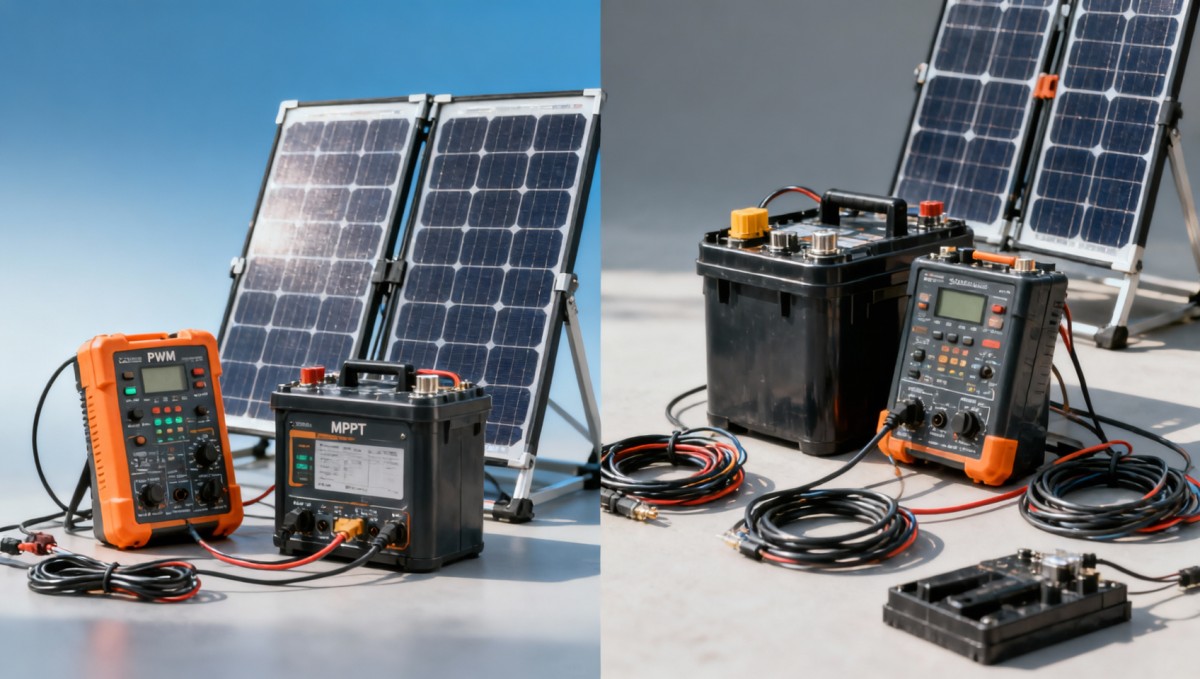
In small solar systems, the solar charge controller is the link between the PV module and the battery bank. Its job is not only to prevent overcharging, but also to manage charging stages, protect battery health, and stabilize energy transfer. For 12V and 24V systems commonly used in cabins, telecom backup boxes, mobile workstations, and portable energy kits, the choice usually comes down to PWM or MPPT.
A PWM controller works by matching the solar panel voltage closer to battery voltage during charging. This makes it simpler and often lower in upfront cost, especially in smaller wattage ranges such as 20W–200W. An MPPT controller, by contrast, tracks the panel’s maximum power point and converts higher input voltage into usable charging current. That design usually improves harvest when panel voltage is significantly above battery voltage.
For operators and buyers, the real question is not which controller is more advanced in theory, but which one fits the installation conditions. A compact backup box used for light loads over 4–8 hours may not justify the extra electronics cost of MPPT. A remote system exposed to cold mornings, variable irradiance, or longer cable runs may benefit more from MPPT’s conversion advantages.
For procurement teams, this distinction matters because small systems are often purchased in batches, bundled with panels, batteries, and enclosures, then deployed across multiple sites. A controller decision that saves only a modest amount per unit can affect total project cost, service intervals, and usable daily energy across 20, 50, or 100 field installations.
Core operating difference in practical terms
PWM is usually best understood as a direct, battery-voltage-oriented charging method. It performs adequately when the panel’s nominal voltage is well matched to the battery system, such as a “12V nominal” panel charging a 12V battery. In these cases, the gap between panel operating voltage and battery voltage is limited, so wasted potential is smaller.
MPPT is more valuable when the panel voltage is higher than the battery charging voltage by a meaningful margin. That can happen with modern modules, cold-weather output, or series-wired panel strings. Instead of losing that extra voltage headroom, the controller converts it into additional current, which can help recover energy during short winter daylight windows or cloudy periods.
- PWM is usually simpler for small, fixed, low-cost systems with matched panel and battery voltage.
- MPPT is typically favored when energy harvest, seasonal performance, or future expansion matters more than minimum first cost.
- Battery type also matters. Flooded, AGM, gel, and lithium chemistries may require different charging profiles, voltage setpoints, and temperature handling.
This is where data-driven sourcing becomes important. On TradeNexus Pro, buyers and technical evaluators often compare not just controller labels, but the broader system context: battery chemistry, panel Vmp range, expected daily autonomy, field service access, and replacement cycle. That approach reduces the risk of buying a controller based only on headline claims.
Which controller fits your application scenario and load profile?
Application context changes the answer. A solar charge controller for a camping light kit is not evaluated the same way as one used in roadside sensing, remote monitoring, marine backup, or a compact agricultural pumping control box. In small systems, daily load may range from under 100Wh to over 1kWh, and that difference can reshape the economics of PWM versus MPPT.
If the system runs intermittent DC loads, such as LED lighting, signal equipment, or low-power communications, buyers often prioritize simplicity, easy replacement, and stable battery charging over advanced conversion. If the system supports critical runtime windows, such as overnight sensors, emergency communications, or field instrumentation, the additional energy capture from MPPT may reduce battery stress and improve continuity.
Climate also has a direct effect. In colder environments, panel voltage tends to rise, which can increase the benefit of MPPT. In hot climates, battery charging conditions can become more sensitive, making temperature compensation and accurate charging stages more important. Systems deployed outdoors for 12–24 months without frequent technician visits need stronger attention to controller settings and protective functions.
For distributors and project managers, one practical strategy is to classify applications into three buckets: basic low-cost fixed systems, efficiency-sensitive remote systems, and scalable installations with future expansion. This avoids using one controller type across every project simply for administrative convenience.
The table below compares common small-system scenarios where PWM or MPPT is typically preferred. It is not a substitute for electrical design, but it gives procurement teams a faster first-pass screen before technical review.
A common mistake is to evaluate controller type without modeling the load profile. A system using 30W peak loads for 2 hours behaves very differently from one drawing 8W continuously for 24 hours. The second case often puts more pressure on energy recovery and battery state of charge, which can make MPPT more attractive even when the total installed wattage looks modest.
Three scenario checks before you buy
- Check operating hours per day. Loads that run 8–16 hours daily need tighter energy budgeting than occasional-use systems.
- Check environment. Cold mornings, partial shading, and cable distance over several meters can shift the benefit toward MPPT.
- Check upgrade intent. If panel wattage may increase within 6–18 months, selecting a scalable controller early can reduce rework.
This structured scenario mapping is useful for enterprise buyers managing multiple installation types across regions. It also helps agents and channel partners create clearer product tiers instead of selling a one-size-fits-all package.
What technical and procurement factors matter most?
Controller selection should not start with price alone. A practical B2B evaluation usually covers at least five items: system voltage, maximum charging current, panel input voltage range, battery chemistry compatibility, and protection functions. In small systems, many avoidable failures come from mismatched voltage windows or inadequate controller current margin rather than from the PWM or MPPT architecture itself.
A useful engineering rule is to size the controller with reasonable headroom above expected current, especially where irradiance spikes or panel expansion are possible. For example, if the charging current is expected near 15A, buyers may review 20A-class products instead of sourcing exactly at the operating threshold. This does not replace design calculations, but it reduces stress in real field conditions.
Battery support is another critical differentiator. Small systems increasingly use lithium iron phosphate alongside AGM and gel batteries. A controller that supports configurable charging stages, low-voltage disconnect logic, and temperature-aware charging can reduce service issues over a 12–36 month deployment cycle. This matters to project managers who need fewer truck rolls and lower maintenance labor.
Procurement personnel also need to verify what “rated” values really mean. Some controllers are marketed by nominal current class without clear disclosure of ambient conditions, derating behavior, or open-circuit PV limits. Product comparison should therefore include the full electrical window, not only a front-label amp number.
The table below highlights technical and commercial checkpoints that help buyers compare PWM and MPPT solar charge controllers in a more disciplined way.
For sourcing teams, the strongest purchasing decision often comes from balancing three core indicators: watt-hour demand, battery chemistry, and site variability. If two of those three point toward tighter energy margins, MPPT usually deserves closer consideration. If all three point toward stable, low-demand, matched-voltage operation, PWM may be the more economical option.
Checklist for RFQ and vendor review
Electrical checks
- Confirm supported system voltage, such as 12V or 24V auto recognition, and verify the actual PV input limits.
- Check rated charging current and whether the figure assumes a specific ambient temperature range, such as 25°C or 40°C conditions.
- Verify battery charging profiles for flooded, AGM, gel, or lithium, including float, absorption, or custom setpoint options.
Commercial and field-service checks
- Ask about lead time for standard units and for customized firmware, terminals, or communication options, which may vary from 7–15 days to 3–6 weeks.
- Review support for manuals, wiring diagrams, and remote deployment troubleshooting, especially when systems will be installed by regional partners.
- Check enclosure suitability, terminal robustness, and labeling clarity for repeat installations across multiple teams.
TradeNexus Pro is especially useful at this stage because enterprise buyers rarely compare controllers in isolation. They need linked intelligence: component sourcing trends, battery compatibility considerations, and supplier positioning across green energy and smart electronics ecosystems. That broader context improves both negotiation and deployment planning.
How should you compare cost, lifecycle value, and alternatives?
The first-cost difference between PWM and MPPT often attracts the most attention, but total value should include energy capture, battery wear, maintenance visits, and future redesign. In a very small matched system, PWM may deliver a sound cost-performance balance. In a harder-to-access location, even a modest gain in charging effectiveness can matter if it reduces low-battery events or emergency service calls.
Lifecycle thinking becomes even more important when installations are replicated. A project with 30 remote units does not absorb service inefficiency the same way as a single hobby system. If one controller type leads to fewer undervoltage complaints during 2–3 low-sun weeks per season, the operational savings may justify a higher unit price. Buyers should therefore consider both capex and field-support implications.
There are also alternatives beyond a strict PWM-versus-MPPT choice. Some projects can improve overall performance by resizing the panel, optimizing cable gauge, adjusting battery capacity, or refining load scheduling. In other words, the controller is only one of four major levers in a small power system: generation, conversion, storage, and consumption.
This is especially relevant for business evaluators. If the objective is reliable overnight operation, adding a slightly larger panel or improving battery matching may solve the problem at lower complexity than changing controller type alone. A disciplined system review often avoids overspending on one premium component while neglecting the rest of the design.
Common cost-value decision paths
- Choose PWM when the system is small, panel and battery voltage are well matched, the budget is tight, and replacement access is easy.
- Choose MPPT when daily energy margin is narrow, site visits are expensive, panel voltage is higher, or the system may scale within the next 1–2 phases.
- Review alternatives when runtime issues are mainly caused by undersized panels, aged batteries, poor wiring, or unrealistic load assumptions.
For distributors and resellers, packaging strategy also matters. Many buyers respond better to solution bundles such as panel plus controller plus battery compatibility guidance rather than a controller-only quote. This shortens the decision cycle and reduces post-sale mismatch claims.
What are the most common misconceptions and buyer questions?
Many purchasing errors come from simplified assumptions. One frequent misconception is that MPPT is always the better option. It is often the better-performing option under certain conditions, but not always the most sensible commercial choice for every small system. Another misconception is that PWM automatically harms battery life. In a correctly matched system with proper charging setpoints, PWM can still be a reliable choice.
Another buyer mistake is focusing only on the controller while ignoring battery behavior. A deeply cycled battery used every day in a low-sun location can fail early regardless of controller type if charge recovery is consistently inadequate. Similarly, a good controller cannot compensate for a panel that is too small by 20%–40% relative to actual energy demand.
Project teams should also avoid assuming that all small controllers offer the same protections. Features such as reverse polarity protection, load output control, temperature sensing, communication ports, or programmable low-voltage disconnect may vary substantially. These details become critical in integrated B2B deployments where consistency across units matters.
The FAQ below addresses the most common search and procurement questions raised by operators, technical buyers, and channel partners evaluating solar charge controllers for small systems.
Is MPPT worth it for a 100W or 200W solar setup?
It depends on voltage relationship, climate, and system criticality. In a basic 100W matched 12V setup used occasionally, PWM may be sufficient. In a 200W remote system with variable weather, higher panel voltage, or critical overnight loads, MPPT may provide enough additional harvest to justify the extra cost. The smaller the energy margin, the more valuable MPPT can become.
Which controller is better for lithium batteries?
Neither type is automatically better just because of battery chemistry. What matters is whether the controller supports the required charging profile and protection logic. For lithium systems, buyers should confirm charge voltage settings, low-temperature charging behavior, and whether communication or external battery management integration is needed.
What should procurement teams ask before placing an order?
At minimum, confirm five points: battery type, nominal system voltage, panel open-circuit voltage, expected charging current, and installation environment. Then ask about standard lead time, warranty terms, documentation package, and any configuration support for bulk orders. For projects spanning several regions, also verify labeling, packaging, and after-sales response process.
Are there compliance or standard issues to review?
Yes. While exact requirements vary by market and application, buyers should review general electrical safety expectations, environmental suitability, terminal design, and documentation traceability. For integrated equipment exports, the controller may also need to align with the broader compliance pathway of the final assembled system, not just standalone component handling.
Why work with TradeNexus Pro when evaluating solar charge controllers?
Choosing between PWM and MPPT is rarely a single-product decision for B2B teams. It usually sits inside a larger sourcing question involving batteries, portable solar panels, field deployment conditions, delivery timing, documentation quality, and long-term service risk. TradeNexus Pro supports that broader decision process by connecting market intelligence, sector-specific analysis, and supplier-side visibility across green energy and related technology chains.
For procurement directors and project leaders, this means faster evaluation of practical trade-offs instead of relying on fragmented product claims. For distributors and agents, it means clearer positioning of solution bundles by scenario, not just by price tier. For enterprise decision-makers, it improves confidence when comparing small-system strategies across pilot projects, regional rollouts, or channel programs.
If you are reviewing solar charge controllers for small systems, you can use TradeNexus Pro to narrow decisions around 3 core areas: electrical fit, deployment economics, and supply-side credibility. That is especially useful when the project includes multiple battery types, mixed climates, or phased procurement over 2–4 quarters.
Contact us if you need support with controller parameter confirmation, PWM versus MPPT selection logic, expected lead-time planning, battery compatibility review, bundled solution comparison, compliance-related questions, sample evaluation pathways, or quotation discussions for multi-site projects. A well-scoped inquiry at the start can prevent redesign, delivery friction, and field performance disputes later.
Get weekly intelligence in your inbox.
No noise. No sponsored content. Pure intelligence.
 Apr 18, 2026TradeNexus Pro Launches Global Compliance RadarTradeNexus Pro Launches Global Compliance Radar
 Apr 18, 2026JIS T 2304:2026 Takes Effect June 1, 2026 for IVD SoftwareJIS T 2304:2026 Takes Effect June 1, 2026 for IVD Software
 Pathway for Rehab Devices with AI Modules") Apr 18, 2026FDA Updates 510(k) Pathway for Rehab Devices with AI ModulesFDA Updates 510(k) Pathway for Rehab Devices with AI Modules
Apr 18, 2026FDA Updates 510(k) Pathway for Rehab Devices with AI ModulesFDA Updates 510(k) Pathway for Rehab Devices with AI Modules Apr 18, 2026India BIS Approves 3 Chinese IoT Labs for IS 16444:2026 CertificationIndia BIS Approves 3 Chinese IoT Labs for IS 16444:2026 Certification
 Apr 18, 2026THE Alliance Launches Green Slot Priority for China PortsTHE Alliance Launches Green Slot Priority for China Ports
 Apr 18, 2026TÜV Rheinland Releases Dual-Standard ESS Certification Guide for ChinaTÜV Rheinland Releases Dual-Standard ESS Certification Guide for China
 Apr 18, 2026Vietnam Imposes AD Duties on Chinese Electronic ComponentsVietnam Imposes AD Duties on Chinese Electronic Components
 Apr 18, 2026SASO Launches PV Carbon Footprint Labeling from July 2026SASO Launches PV Carbon Footprint Labeling from July 2026
 Apr 18, 2026U.S. Adds 17 Smart Warehouse Robot Components to Export Control ListU.S. Adds 17 Smart Warehouse Robot Components to Export Control List
 Apr 18, 2026EU Enforces EN IEC 62443-4-2:2026 for Industrial Control Devices from 18 Apr 2026EU Enforces EN IEC 62443-4-2:2026 for Industrial Control Devices from 18 Apr 2026
 Apr 17, 2026Temperature data loggers drift unpredictably inside lithium-ion battery storage enclosuresTemperature data loggers drift unpredictably inside lithium-ion battery storage enclosures
 Apr 17, 2026Are solar microinverters really worth the extra cost?Are solar microinverters really worth the extra cost?
 Apr 17, 2026Bifacial solar panels: How much more energy can they generate?Bifacial solar panels: How much more energy can they generate?
 Apr 17, 2026Gear manufacturing: How to optimize production for high precision?Gear manufacturing: How to optimize production for high precision?
 Apr 17, 2026Why power transmission components fail earlier than expectedWhy power transmission components fail earlier than expected
 Apr 17, 2026Linear motion systems: belt drive or ball screw for speed?Linear motion systems: belt drive or ball screw for speed?
 Apr 17, 2026Industrial bearing suppliers: what signals reliable quality?Industrial bearing suppliers: what signals reliable quality?
 Apr 17, 2026When pneumatic valves wholesale gets expensive laterWhen pneumatic valves wholesale gets expensive later
 Apr 17, 2026Hydraulic cylinder fabrication mistakes that cause oil leaksHydraulic cylinder fabrication mistakes that cause oil leaks
 Apr 17, 2026Heavy equipment manufacturing delays often start hereHeavy equipment manufacturing delays often start here
 Apr 17, 2026Custom heatsinks: when a larger size solves nothingCustom heatsinks: when a larger size solves nothing
 Apr 17, 2026Electronic enclosure fabrication: steel or aluminum?Electronic enclosure fabrication: steel or aluminum?
 Apr 17, 2026Automotive parts machining tolerances that drive up scrapAutomotive parts machining tolerances that drive up scrap
 Apr 17, 2026Medical device manufacturing changes under tighter traceabilityMedical device manufacturing changes under tighter traceability
 Apr 17, 2026How to Choose Solid State Batteries in 2026How to Choose Solid State Batteries in 2026
 Apr 17, 2026Are Solid State Batteries Worth the Cost Yet?Are Solid State Batteries Worth the Cost Yet?
 Apr 17, 2026Commercial Energy Storage Sizing: What Matters Most?Commercial Energy Storage Sizing: What Matters Most?