Thin Film Solar Cells vs Silicon: Key Tradeoffs
As solar buyers compare thin film solar cells with silicon, the real decision goes beyond efficiency alone. From off grid solar systems to commercial energy storage, panel choice affects cost, flexibility, integration with solar microinverters, and long-term project value. This guide breaks down the core tradeoffs so technical teams, procurement leaders, and investors can make smarter energy decisions.
For operators, engineering teams, distributors, and financial approvers, the thin film versus silicon debate is rarely about one specification in isolation. It is about matching technology to rooftop constraints, climate exposure, balance-of-system design, maintenance capacity, and target payback. In B2B procurement, a panel that looks weaker on paper can still create a stronger project outcome when transport, installation, energy yield, and replacement risk are evaluated together.
This article focuses on practical tradeoffs that matter in commercial selection: conversion efficiency, temperature behavior, structural load, durability, supply chain considerations, and system integration. The goal is not to crown one technology as universally superior, but to help decision-makers choose the right module architecture for the right project profile.
Technology Basics and Why the Comparison Still Matters
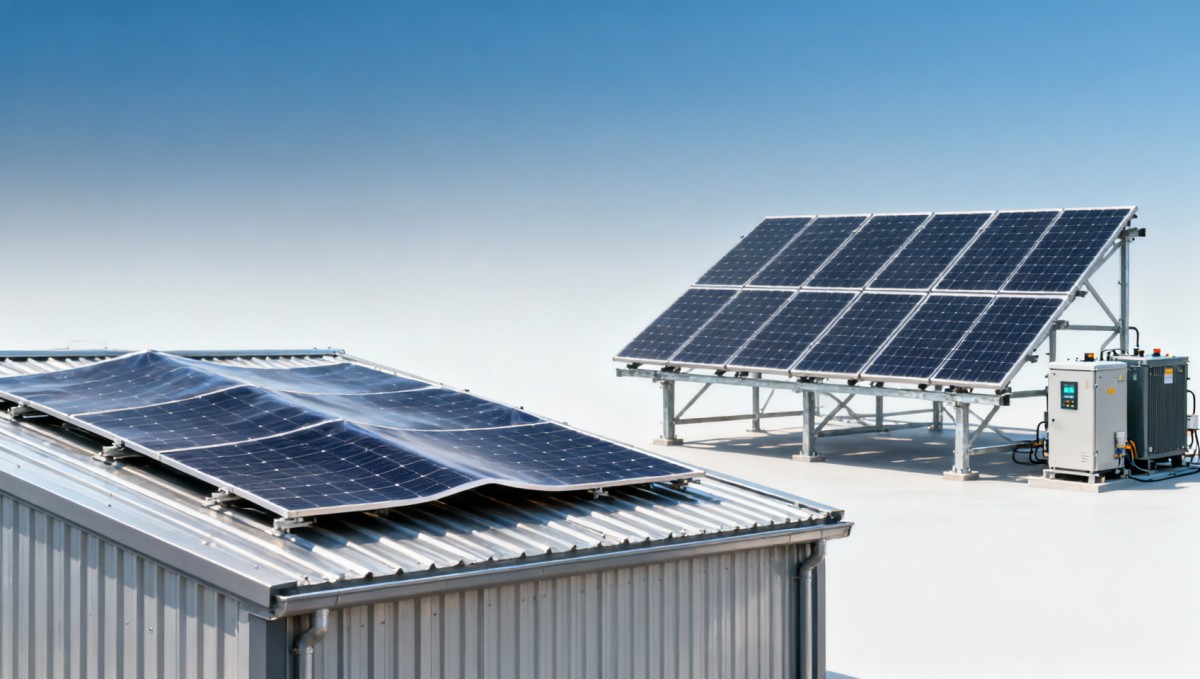
Silicon solar panels remain the dominant choice in most utility, commercial, and residential markets. They are usually divided into monocrystalline and polycrystalline formats, with monocrystalline now leading many projects because it commonly delivers module efficiencies in the 20% to 23% range. Thin film solar cells, by contrast, are built by depositing photovoltaic material in very thin layers onto glass, metal, or flexible substrates. Common thin film families include CdTe, CIGS, and amorphous silicon.
The reason this comparison remains important is that deployment conditions are becoming more diverse. A logistics warehouse with a load-limited roof, a mining site using off grid solar systems, and a façade-integrated building do not share the same technical priorities. In some cases, lower weight, better low-light response, or flexibility can be more valuable than top-tier efficiency per square meter.
For enterprise buyers, the technology decision also influences downstream equipment selection. String design, inverter sizing, solar microinverters, racking strategy, cable routing, storage coupling, and cleaning schedules can all change depending on the panel type. That is why procurement teams should evaluate module choice as part of the whole system architecture, not as a standalone line item.
Another reason the topic matters is portfolio risk. A project manager may approve a lower module cost only to face higher structural reinforcement spending, longer installation time, or lower lifetime output. Conversely, a higher-efficiency silicon panel may be the wrong fit if roof curvature, shading patterns, or heat exposure undermine real-world generation.
Core material and design distinction
Silicon modules are rigid and typically heavier, but they provide strong bankability and broad installer familiarity. Thin film modules can be lighter and, in some configurations, flexible. That difference shapes where each technology performs best, especially in projects under 500 kW where roof condition and installation complexity directly affect return on investment.
What buyers should screen first
- Available installation area in square meters versus target system size in kW or MW.
- Roof load capacity, often measured in kg/m², especially for retrofit projects over 10 years old.
- Ambient heat profile, such as sites regularly operating above 35°C.
- Electrical architecture, including compatibility with string inverters or solar microinverters.
- Service access and expected maintenance cycle, commonly every 6 to 12 months.
The table below summarizes the baseline differences that procurement and technical review teams normally assess before moving into detailed modeling.
The key takeaway is simple: silicon usually wins on output density, while thin film can win on installation flexibility and project-specific operating conditions. Buyers should therefore start with site constraints, then validate economics.
Efficiency, Temperature Performance, and Real-World Energy Yield
Efficiency is the most visible specification, but it is not the same as annual energy yield. A 22% silicon panel may produce more power per square meter under standard test conditions, yet the actual field result depends on irradiance profile, module temperature, soiling, shading, and electrical losses. In hot regions, performance degradation above 25°C becomes a material planning factor.
Thin film technologies are often valued for stronger temperature behavior. Depending on the chemistry, their temperature coefficient can be less negative than conventional crystalline silicon. In practical terms, this means that when rooftop temperatures rise to 45°C or even 60°C in summer, some thin film modules lose a smaller share of output compared with standard silicon alternatives. That does not erase the efficiency gap, but it can narrow the annual yield difference in hot climates.
Low-light and diffuse-light response also matters for certain projects. Industrial zones with persistent haze, cloud cover, or partial shading may see more stable generation from some thin film products. For distributors and project owners, this is especially relevant when forecast models are tied to monthly cash flow expectations and debt servicing schedules.
Real-world yield should be assessed using at least 3 layers of comparison: nameplate efficiency, performance ratio under local climate, and annualized energy output per installed kW. A difference of 2% to 4% in yearly yield can materially affect projects with a 10- to 15-year payback horizon.
Why high efficiency does not always mean best value
If roof space is limited, high-efficiency silicon is often the logical choice because every square meter counts. But where space is abundant and roof loading is restrictive, thin film may reduce structural costs enough to offset lower module efficiency. The true decision metric is cost per useful kWh delivered over the system life, not just watts on a datasheet.
Performance factors technical teams should compare
- Nominal module efficiency and power tolerance.
- Temperature coefficient and expected summer loss profile.
- Low-light response during morning, evening, or cloudy periods.
- Degradation behavior over 5, 10, and 20 years.
- Mismatch losses when integrated with string inverters or solar microinverters.
The following comparison helps project reviewers translate panel specifications into field performance considerations.
For financial approvers, the table highlights a critical point: field yield modeling should include local weather data, not just module brochure values. That is often the difference between a stable cash-flow asset and an underperforming installation.
Structural Load, Installation Complexity, and System Integration
Installation conditions frequently determine whether thin film or silicon is more practical. Traditional silicon modules are robust and familiar to EPC teams, but they are usually heavier and mounted on conventional racking systems. On older commercial roofs, that may trigger reinforcement work, engineering review, or restrictions on module density. A lightweight thin film solution can reduce dead load and simplify deployment where structural margins are tight.
For project managers, installation speed is not only a labor issue. It affects site disruption, safety planning, lifting equipment, and weather risk. A project delayed by 2 to 3 weeks can affect procurement timing for inverters, combiner boxes, batteries, and switchgear. In distributed commercial solar, balance-of-system coordination often drives more cost variance than the module itself.
Integration with solar microinverters and optimizers also deserves attention. Silicon panels are widely supported by established mounting and electrical ecosystems, which can simplify product matching. Thin film may require more careful design review depending on operating voltage, grounding approach, or connector compatibility. That does not make integration difficult by default, but it makes pre-engineering more important.
In off grid solar systems and hybrid storage projects, module selection also changes array layout. Lower efficiency modules may require more strings or larger footprints, which in turn affects cable runs, combiner sizing, and land utilization. For remote sites, even a 5% increase in transport volume can influence logistics cost and installation scheduling.
Where thin film can create structural advantages
Thin film is often worth reviewing for membrane roofs, curved surfaces, façades, temporary structures, and retrofit projects where added weight must be minimized. In these settings, the ability to avoid extensive reinforcement can materially improve total project economics.
A practical integration checklist
- Verify roof load reserve and wind uplift requirements before module shortlist approval.
- Check electrical compatibility with inverter MPPT range and microinverter input limits.
- Confirm connector, cable, and grounding standards during the pre-award phase.
- Review access for cleaning, inspection, and replacement over a 10- to 25-year service life.
- Model installation sequence to avoid delays in battery and PCS commissioning.
From a quality and safety perspective, the right panel is the one that fits the site with the fewest hidden adjustments. A lower module price can quickly lose its advantage if it adds structural work, custom mounting, or extended commissioning time.
Procurement Economics, Supply Chain Risk, and Lifetime Cost
B2B buyers should evaluate solar modules through total landed cost and lifetime value, not factory-gate price alone. Module purchase cost is only one layer. Freight, packaging density, installation labor, structural materials, inverter matching, maintenance access, degradation profile, and replacement availability all affect the final economics. In many mid-scale commercial projects, module cost may be only part of the total system spend, while design and installation decisions drive the rest.
Silicon typically benefits from scale, mature global distribution, and broader supplier competition. That can support shorter sourcing cycles, easier specification benchmarking, and more predictable service support. Thin film, depending on product type and region, may involve a narrower supplier pool. For procurement directors, this means supplier concentration risk and continuity planning should be reviewed before contract finalization.
Financial approvers should also separate short-term capital cost from long-term levelized value. A project with a 7- to 10-year target payback can be more sensitive to degradation, warranty claim handling, and maintenance events than to a small upfront price difference. This is especially true for portfolios with multiple rooftops or remote industrial assets where service dispatch is expensive.
Distributors and resellers need a slightly different lens. Stocking silicon products can be easier because demand is broad and replacement requests are more standardized. Thin film may be strategically attractive in niche segments, but channel partners should confirm training needs, application fit, and after-sales expectations before committing inventory.
Decision factors that often change the financial answer
A module that saves 3% on purchase price but extends installation time by 10 days or adds roof reinforcement may not be the lower-cost option. Conversely, a technology with lower nominal efficiency may still improve lifecycle economics if it lowers structural spending or delivers better output in site-specific heat conditions.
Procurement matrix for cross-functional review
The matrix below is useful when technical, finance, operations, and quality teams need a shared framework for module approval.
The procurement lesson is that module selection should be approved only after technical and commercial stakeholders align on the same cost model. That model should cover at least 4 areas: capital cost, generation profile, service risk, and future replacement flexibility.
Best-Fit Use Cases, Common Mistakes, and Selection Framework
Thin film solar cells are often best suited to projects where flexibility, lower weight, or high-temperature operation has more value than maximum efficiency. Examples include lightweight industrial rooftops, building-integrated solar surfaces, mobile or temporary energy systems, and some remote sites where installation simplicity matters. Silicon panels are usually the better fit for area-constrained rooftops, standardized commercial deployments, and projects seeking familiar sourcing and service pathways.
One common mistake is choosing solely on module efficiency. Another is assuming that all thin film products behave the same way. Product family matters. A third mistake is ignoring replacement strategy. If a system is expected to operate for 20 to 25 years, buyers should think in advance about spare inventory, model continuity, and compatible electrical performance. These details matter to quality managers as much as to financiers.
A disciplined selection process usually takes 5 steps: define site constraints, estimate energy target, compare module technologies, model balance-of-system implications, and validate lifecycle economics. For projects above 100 kW, this should be supported by a formal review involving engineering, procurement, operations, and HSE functions.
For enterprise decision-makers, the most reliable outcome comes from matching the technology to the business objective. If the objective is maximum output from limited roof area, silicon is often favored. If the objective is deployability on difficult surfaces with lower structural impact, thin film deserves serious evaluation.
Quick-use selection guide
- Choose silicon first when roof area is tight, standardization is important, and bankable sourcing options are a priority.
- Review thin film first when the roof or façade has weight limits, curved geometry, or sustained high heat exposure.
- Use site-specific simulation if the expected yield difference could change payback by more than 1 year.
- Include O&M, spare strategy, and inverter compatibility in every approval workflow.
FAQ: questions buyers often ask
Is thin film better for off grid solar systems?
It can be, but only in specific conditions. If the site faces high temperatures, difficult transport, or low-load mounting surfaces, thin film may support a better field deployment. If available installation area is limited and every kW must fit into a compact footprint, silicon is usually more practical.
Do thin film panels work well with solar microinverters?
They can, provided voltage and current windows match the microinverter specification. Engineering teams should verify input ranges, grounding requirements, and connector compatibility before finalizing the bill of materials. This check is especially important in mixed-technology retrofit sites.
Which option is easier for distributors to stock?
In most markets, silicon is easier to stock and support because demand is broader and replacement requests are more standardized. Thin film can still be commercially attractive, but it typically works best when channel partners serve a clear niche such as lightweight roofing, architectural integration, or specialized industrial deployments.
How long should the evaluation cycle take?
For a commercial or industrial project, an initial technical and procurement review often takes 1 to 3 weeks, followed by energy modeling and supplier clarification. More complex sites involving storage, retrofit roofs, or nonstandard mounting can require an additional 2 to 4 weeks for confident decision-making.
Thin film solar cells versus silicon is not a simple winner-takes-all comparison. Silicon usually leads on efficiency, space utilization, and broad procurement familiarity. Thin film can create advantages in heat tolerance, low-weight installation, specialized surfaces, and some diffuse-light conditions. The best choice depends on site physics, system design, procurement strategy, and long-term operating priorities.
For B2B buyers navigating solar procurement, the smartest path is a cross-functional review that combines engineering data, structural realities, supply chain risk, and lifecycle economics. TradeNexus Pro helps decision-makers cut through generic claims and focus on commercially relevant technology fit. To evaluate the right module pathway for your next project, contact us for tailored market insight, sourcing guidance, and solution analysis.
Get weekly intelligence in your inbox.
No noise. No sponsored content. Pure intelligence.
 Apr 18, 2026TradeNexus Pro Launches Global Compliance RadarTradeNexus Pro Launches Global Compliance Radar
 Apr 18, 2026JIS T 2304:2026 Takes Effect June 1, 2026 for IVD SoftwareJIS T 2304:2026 Takes Effect June 1, 2026 for IVD Software
 Pathway for Rehab Devices with AI Modules") Apr 18, 2026FDA Updates 510(k) Pathway for Rehab Devices with AI ModulesFDA Updates 510(k) Pathway for Rehab Devices with AI Modules
Apr 18, 2026FDA Updates 510(k) Pathway for Rehab Devices with AI ModulesFDA Updates 510(k) Pathway for Rehab Devices with AI Modules Apr 18, 2026India BIS Approves 3 Chinese IoT Labs for IS 16444:2026 CertificationIndia BIS Approves 3 Chinese IoT Labs for IS 16444:2026 Certification
 Apr 18, 2026THE Alliance Launches Green Slot Priority for China PortsTHE Alliance Launches Green Slot Priority for China Ports
 Apr 18, 2026TÜV Rheinland Releases Dual-Standard ESS Certification Guide for ChinaTÜV Rheinland Releases Dual-Standard ESS Certification Guide for China
 Apr 18, 2026Vietnam Imposes AD Duties on Chinese Electronic ComponentsVietnam Imposes AD Duties on Chinese Electronic Components
 Apr 18, 2026SASO Launches PV Carbon Footprint Labeling from July 2026SASO Launches PV Carbon Footprint Labeling from July 2026
 Apr 18, 2026U.S. Adds 17 Smart Warehouse Robot Components to Export Control ListU.S. Adds 17 Smart Warehouse Robot Components to Export Control List
 Apr 18, 2026EU Enforces EN IEC 62443-4-2:2026 for Industrial Control Devices from 18 Apr 2026EU Enforces EN IEC 62443-4-2:2026 for Industrial Control Devices from 18 Apr 2026
 Apr 17, 2026Temperature data loggers drift unpredictably inside lithium-ion battery storage enclosuresTemperature data loggers drift unpredictably inside lithium-ion battery storage enclosures
 Apr 17, 2026Are solar microinverters really worth the extra cost?Are solar microinverters really worth the extra cost?
 Apr 17, 2026Bifacial solar panels: How much more energy can they generate?Bifacial solar panels: How much more energy can they generate?
 Apr 17, 2026Gear manufacturing: How to optimize production for high precision?Gear manufacturing: How to optimize production for high precision?
 Apr 17, 2026Why power transmission components fail earlier than expectedWhy power transmission components fail earlier than expected
 Apr 17, 2026Linear motion systems: belt drive or ball screw for speed?Linear motion systems: belt drive or ball screw for speed?
 Apr 17, 2026Industrial bearing suppliers: what signals reliable quality?Industrial bearing suppliers: what signals reliable quality?
 Apr 17, 2026When pneumatic valves wholesale gets expensive laterWhen pneumatic valves wholesale gets expensive later
 Apr 17, 2026Hydraulic cylinder fabrication mistakes that cause oil leaksHydraulic cylinder fabrication mistakes that cause oil leaks
 Apr 17, 2026Heavy equipment manufacturing delays often start hereHeavy equipment manufacturing delays often start here
 Apr 17, 2026Custom heatsinks: when a larger size solves nothingCustom heatsinks: when a larger size solves nothing
 Apr 17, 2026Electronic enclosure fabrication: steel or aluminum?Electronic enclosure fabrication: steel or aluminum?
 Apr 17, 2026Automotive parts machining tolerances that drive up scrapAutomotive parts machining tolerances that drive up scrap
 Apr 17, 2026Medical device manufacturing changes under tighter traceabilityMedical device manufacturing changes under tighter traceability
 Apr 17, 2026How to Choose Solid State Batteries in 2026How to Choose Solid State Batteries in 2026
 Apr 17, 2026Are Solid State Batteries Worth the Cost Yet?Are Solid State Batteries Worth the Cost Yet?
 Apr 17, 2026Commercial Energy Storage Sizing: What Matters Most?Commercial Energy Storage Sizing: What Matters Most?