What Makes Photovoltaic Modules Truly Waterproof?
For quality control and safety teams, understanding photovoltaic modules waterproof technology is essential to preventing moisture ingress, electrical failure, and long-term performance loss. True waterproofing goes far beyond surface sealing—it depends on material integrity, lamination quality, junction box protection, and rigorous testing standards that determine whether a module can withstand real-world environmental stress.
Why a checklist-based approach is the smartest way to evaluate waterproof performance
For procurement, QA, and EHS teams, the biggest mistake is treating waterproofing as a single feature rather than a system-level outcome. In practice, photovoltaic modules waterproof technology is only reliable when multiple barriers work together: front glass, encapsulant, backsheet or glass-glass structure, frame sealing, cable entry design, and junction box protection. A module may pass a sales demo yet still fail after thermal cycling, humidity exposure, ultraviolet aging, or poor installation handling.
A checklist method helps teams verify what matters first, compare suppliers consistently, and detect hidden risk before field deployment. It also supports better cross-functional decisions. Quality teams focus on process capability, safety teams review electrical protection and fire-related concerns, while sourcing teams need evidence that claimed waterproof performance is repeatable at scale. That is why a structured review of photovoltaic modules waterproof technology is more useful than relying on brochures or a simple IP rating.
Start with these priority checks before accepting any waterproof claim
Before going deep into lab reports, confirm the core items below. These checks quickly reveal whether a manufacturer understands waterproof durability or is only emphasizing superficial sealing.
- Confirm the module architecture: glass-backsheet, glass-glass, framed, or frameless. Different structures manage moisture pathways differently.
- Review encapsulant type and thickness. EVA, POE, and co-extruded materials offer different moisture resistance and adhesion behavior.
- Check the lamination process window and process control records. Poor lamination can create voids, edge defects, and weak adhesion zones.
- Verify junction box ingress protection, potting quality, and cable gland design. This is one of the most common moisture entry points.
- Ask for humidity-freeze, damp heat, thermal cycling, and insulation resistance test data from recognized standards.
- Inspect edge sealing strategy, especially for high-humidity, coastal, agricultural, or floating PV environments.
- Confirm whether waterproof performance is validated only on prototypes or on mass-production batches as well.
These first-pass checks provide a fast screening framework for photovoltaic modules waterproof technology and reduce the risk of approving a module that looks compliant on paper but is vulnerable in service.
Core judgment criteria: what truly determines waterproof reliability
1. Material stack integrity matters more than surface sealant
A common misunderstanding is that waterproofing depends mainly on edge silicone or external sealant. In reality, long-term performance depends on the full laminate stack. Front glass permeability is low, but moisture can still penetrate through interfaces, backsheet defects, microcracks, or weakly bonded areas. High-quality photovoltaic modules waterproof technology starts with compatible materials that maintain adhesion after heat, UV, and humidity stress.
Quality teams should ask whether the encapsulant has proven resistance to hydrolysis, delamination, and acetic acid-related degradation. Safety teams should also check whether moisture exposure could reduce insulation performance or increase leakage current risk over time.
2. Lamination quality is a make-or-break process control point
Even good materials can fail if lamination is inconsistent. Incomplete curing, trapped air, edge lift, and local contamination can create channels for water ingress. For this reason, photovoltaic modules waterproof technology should always be reviewed together with lamination capability. Ask to see process controls for temperature, vacuum, pressure, cycle time, and post-lamination inspection criteria.
A strong supplier should have clear rejection criteria for bubbles, wrinkles, offset layers, and edge defects. Electroluminescence and visual inspection are useful, but they should be paired with adhesion testing and aging validation.
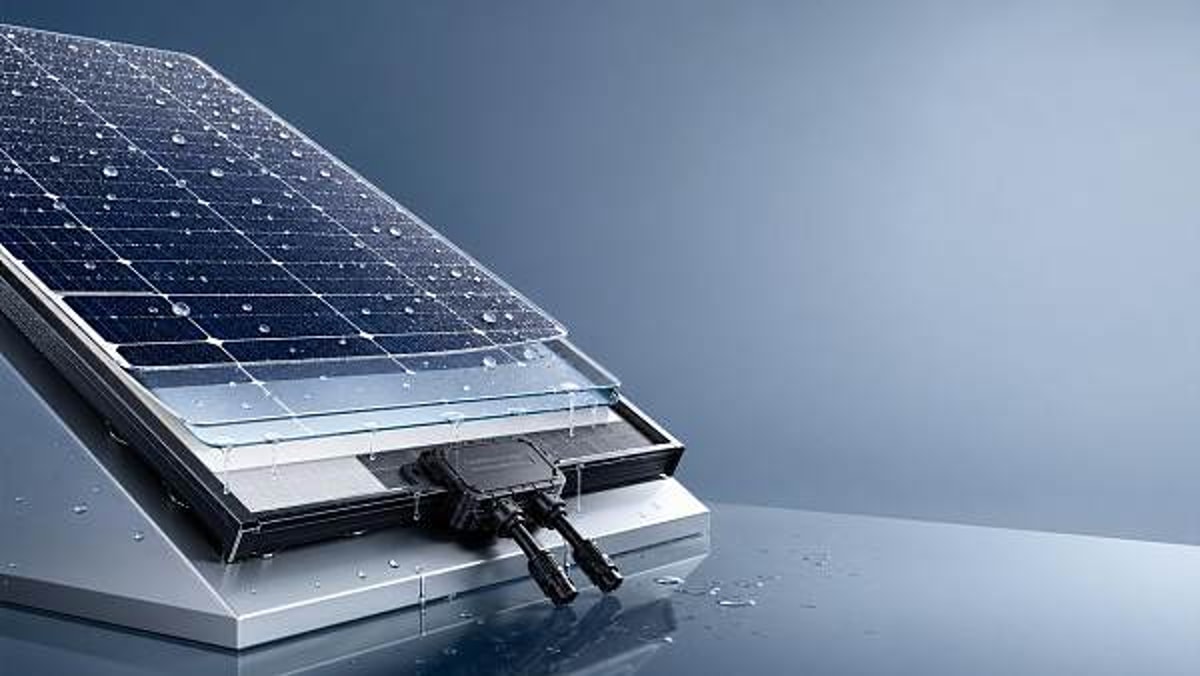
3. Junction box protection often separates durable modules from risky ones
If QC teams only inspect the laminate and ignore the junction box, they may miss the highest-risk area. The junction box includes electrical interfaces, solder joints, bypass diodes, potting material, and cable exits. Inadequate potting, poor adhesive bonding, or unstable gland sealing can allow water entry even when the panel laminate looks excellent.
When evaluating photovoltaic modules waterproof technology, review the junction box IP rating, but do not stop there. Check the test basis, material aging behavior, and whether the rating applies under long-term UV and thermal exposure. Also confirm whether field cable movement or installation stress can weaken the seal.
4. Test reports must reflect real environmental stress, not ideal conditions
Waterproof claims are credible only when linked to recognized reliability tests. Teams should prioritize IEC-related evidence such as damp heat, humidity-freeze, thermal cycling, wet leakage current, and insulation resistance. For harsh deployment, salt mist, ammonia, dust, hail, and PID-related evaluation may also be relevant. A module can be “water-resistant” in a controlled lab and still degrade quickly in humid or polluted field conditions.
A practical review table for quality and safety teams
Use the following table as a quick internal guide when comparing photovoltaic modules waterproof technology across suppliers or project options.
What changes by application scenario
Not all modules face the same water-related risk. The right assessment of photovoltaic modules waterproof technology should reflect installation environment, cleaning method, climate profile, and maintenance access.
- Rooftop commercial systems: Focus on ponding risk, cable routing, roof drainage patterns, and installer-induced stress around connectors and junction boxes.
- Utility-scale projects: Prioritize batch consistency, long-term aging data, and resistance to thermal cycling plus wet leakage under broad environmental variation.
- Coastal or island locations: Add salt mist evaluation, corrosion control, and stronger scrutiny of frame, fasteners, and electrical enclosure sealing.
- Agricultural or livestock settings: Check ammonia resistance, frequent washdown exposure, and contamination effects on seals and cable interfaces.
- Floating or high-humidity installations: Demand enhanced moisture barrier design, validated edge durability, and more conservative maintenance intervals.
Common blind spots that weaken waterproof performance
Many failures come from issues that were technically visible during review but were not treated as critical. The following blind spots deserve extra attention:
- Overreliance on IP ratings: An IP label alone does not prove whole-module moisture durability across decades of UV, heat, and vibration.
- Ignoring manufacturing variation: One qualified sample is not enough. Waterproof consistency must be maintained across volume production.
- Neglecting connector and cable interfaces: Water problems often begin outside the laminate, especially in poor field assembly conditions.
- Underestimating microcracks: Mechanical damage can change moisture paths and accelerate electrical degradation.
- Separating quality from safety review: Moisture ingress is not only a reliability issue; it can become a shock, arc, or fire-related hazard.
Execution advice: how to build a stronger supplier assessment process
For organizations sourcing modules at scale, the best approach is to create a gated review process. First, define mandatory documentation: bill of materials summary, key material brands, IEC test reports, process control records, and junction box specifications. Second, require evidence that photovoltaic modules waterproof technology has been validated on current production, not on outdated sample designs. Third, perform incoming inspection and, for critical projects, conduct third-party reliability verification on retained samples.
It is also wise to align technical review with field risk mapping. If a project is exposed to standing water, marine air, aggressive cleaning, or high humidity, raise the acceptance threshold rather than applying a generic pass/fail logic. Quality and safety teams should jointly define escalation criteria for any signs of delamination, junction box inconsistency, abnormal insulation results, or undocumented material substitution.
FAQ for teams evaluating photovoltaic modules waterproof technology
Is a higher IP rating enough to prove better waterproofing?
No. IP ratings usually apply to specific enclosures, often the junction box, and do not fully represent laminate durability, adhesion stability, or long-term wet electrical safety. Use IP data as one input, not the final judgment.
Which failure mode should be prioritized first?
For many teams, the highest-priority checks are junction box sealing, lamination defects, and insulation resistance after humidity-related aging. These areas often connect directly to both performance loss and safety risk.
Are glass-glass modules automatically more waterproof?
Not automatically. Glass-glass construction can improve barrier performance, but actual waterproof reliability still depends on encapsulant selection, edge integrity, junction box design, and manufacturing control.
What to clarify next before choosing a module or supplier
If your team needs to move from screening to decision-making, prioritize a focused discussion with suppliers around six points: material stack details, lamination control limits, junction box sealing method, reliability test scope, batch consistency controls, and environment-specific adaptation. These questions reveal whether photovoltaic modules waterproof technology is engineered for long-term field resilience or simply presented as a marketing feature.
For procurement directors, plant QA leaders, and safety managers using strategic market intelligence platforms such as TradeNexus Pro, the practical goal is clear: compare waterproof performance as a measurable reliability system, not a vague product promise. When specifications, test evidence, and process discipline align, teams can reduce warranty exposure, improve installation safety, and make more confident sourcing decisions across global solar supply chains.
Get weekly intelligence in your inbox.
No noise. No sponsored content. Pure intelligence.
 May 01, 2026Beijing’s New E-Bike Rules Trigger Dual-Certification Demand for China’s Swappable Battery CabinetsBeijing’s New E-Bike Rules Trigger Dual-Certification Demand for China’s Swappable Battery Cabinets
 May 01, 2026GNA’s GEO Service Assessment Elevates AI Search as Digital Procurement Metric for Chinese ExportersGNA’s GEO Service Assessment Elevates AI Search as Digital Procurement Metric for Chinese Exporters
 May 01, 20262026 China Cycle Expo: Chinese EPS Systems Achieve UL 2849:2026 Full Certification2026 China Cycle Expo: Chinese EPS Systems Achieve UL 2849:2026 Full Certification
 May 01, 2026GB 42236-2026 Enforces EV Charger Efficiency & Overload Protection from May 2026GB 42236-2026 Enforces EV Charger Efficiency & Overload Protection from May 2026
 May 01, 2026GB/T 43790-2026 Drone EMC Standard Effective May 2026GB/T 43790-2026 Drone EMC Standard Effective May 2026
 May 01, 20262026 Foshan Tanzhou Auto Industry Expo Opens2026 Foshan Tanzhou Auto Industry Expo Opens
 May 01, 2026China’s New Hazardous Chemicals Safety Law Takes Effect May 2026China’s New Hazardous Chemicals Safety Law Takes Effect May 2026
 May 01, 2026New Maritime and Fisheries Laws Take Effect May 1, 2026New Maritime and Fisheries Laws Take Effect May 1, 2026
 May 01, 2026Supply Chain Automation Works Best Where Delays RepeatSupply Chain Automation Works Best Where Delays Repeat
 May 01, 2026High Strength Steel Forgings: What Should Be Tested First?High Strength Steel Forgings: What Should Be Tested First?
 May 01, 2026Automotive Steel Forging: Cost Pressure vs Part ReliabilityAutomotive Steel Forging: Cost Pressure vs Part Reliability
 May 01, 2026Why High Durability Steel Forgings Fail Earlier Than ExpectedWhy High Durability Steel Forgings Fail Earlier Than Expected
 May 01, 2026Construction Aluminum Extrusions: Which Finish Lasts Longer?Construction Aluminum Extrusions: Which Finish Lasts Longer?
 May 01, 2026Lightweight Aluminum Extrusions: Where Savings Really HappenLightweight Aluminum Extrusions: Where Savings Really Happen
 May 01, 2026Aerospace Aluminum Extrusions Need More Than Low WeightAerospace Aluminum Extrusions Need More Than Low Weight
 May 01, 2026Precision Lathe Turning Problems That Show Up After AssemblyPrecision Lathe Turning Problems That Show Up After Assembly
 May 01, 2026High Precision Lathe Turning: Tolerance Claims to VerifyHigh Precision Lathe Turning: Tolerance Claims to Verify
 May 01, 2026When CNC Lathe Turning Is Better Than General MachiningWhen CNC Lathe Turning Is Better Than General Machining
 May 01, 2026Medical Device Prototyping Needs More Than SpeedMedical Device Prototyping Needs More Than Speed
 May 01, 20263D Printing Prototyping: Fast Turnaround or Better Finish?3D Printing Prototyping: Fast Turnaround or Better Finish?
 May 01, 2026Low Cost Rapid Prototyping: Where Quality Gets LostLow Cost Rapid Prototyping: Where Quality Gets Lost
 May 01, 2026Quick EV Charger Installation Still Needs Site ChecksQuick EV Charger Installation Still Needs Site Checks
 May 01, 2026Public Parking EV Chargers: What Slows Installation DownPublic Parking EV Chargers: What Slows Installation Down
 May 01, 2026Choosing a Lithium Ion Battery Manufacturer in ChinaChoosing a Lithium Ion Battery Manufacturer in China
 May 01, 2026How to Vet a Lithium Ion Battery OEM SupplierHow to Vet a Lithium Ion Battery OEM Supplier
 May 01, 2026EV Lithium Ion Batteries: Range Is Not the Only MetricEV Lithium Ion Batteries: Range Is Not the Only Metric
 May 01, 2026Lithium Ion ESS Batteries: Safety Details Worth CheckingLithium Ion ESS Batteries: Safety Details Worth Checking