Common Tolerance Issues in Laser Cutting Services
In laser cutting services, tolerance issues can quietly undermine product quality, assembly fit, and workplace safety. For quality control and safety managers, understanding the most common causes of dimensional variation—from material behavior to machine calibration—is essential to preventing costly defects and compliance risks. This article explores where tolerance problems begin and how to reduce them through smarter process control.
Why Tolerance Problems Look Different Across Real Production Scenarios
Tolerance control in laser cutting services is never a one-size-fits-all issue. A flat decorative panel, a medical enclosure bracket, and a battery tray component may all be cut on similar equipment, yet the acceptable dimensional window can differ from ±0.05 mm to ±0.50 mm depending on function, downstream assembly, regulatory expectations, and scrap cost. For quality control teams, this means tolerance risk must be evaluated in context rather than by machine capability alone.
Safety managers should also view tolerance variation as more than a quality metric. Poor edge consistency, warped cut parts, oversized slots, and unstable hole positions can create rework hazards, sharp edge exposure, fixture misalignment, and assembly stress. In operations with multiple shifts, even a 0.20 mm drift over 6 to 8 hours can change how parts fit, how often operators intervene, and whether finished goods remain safe to handle and install.
In practice, the same tolerance issue can originate from different sources: material thickness variation, thermal distortion, focus position, nozzle condition, assist gas instability, poor nesting strategy, or inaccurate part inspection. That is why laser cutting services should be assessed by scenario, material type, and downstream use. A procurement or supplier quality decision based only on quoted tolerance can miss the process discipline required to hold that number consistently.
Scenario-driven questions quality teams should ask first
- Is the cut part cosmetic, structural, electrical, or safety-related in the final assembly?
- What is the real functional tolerance: profile accuracy, hole position, slot width, or flatness after cutting?
- Will the part be welded, bent, powder coated, fastened, or inserted into an automated assembly line?
- Does the production run involve 20 prototypes, 2,000 service parts, or 200,000 repeat pieces?
- How often are process checks needed to detect drift before nonconforming product reaches the next operation?
These questions help define whether the main risk in laser cutting services is dimensional nonconformance, process instability, operator safety, or all three. For global sourcing teams and plant-level quality functions, that distinction matters because inspection planning, first article approval, and supplier monitoring frequency should be scaled to the business scenario rather than copied across all cut parts.
Typical Application Scenarios Where Tolerance Issues Commonly Appear
The most effective way to understand tolerance problems in laser cutting services is to look at the environments where they appear. In broad industrial supply chains, three scenarios show up repeatedly: precision-fit assemblies, heavy-duty fabricated parts, and high-mix low-volume custom runs. Each has a different failure mode, and each demands a different control strategy from the supplier and the buying organization.
For precision-fit assemblies, the key concern is not just whether the outer profile matches a drawing, but whether holes, tabs, and slots align during assembly without forcing. In heavy-duty parts, thermal input and plate variation often matter more than fine cosmetic edges. In custom runs, inconsistency between batches can be the biggest concern because setup changes occur more often and process learning may be limited.
The table below compares common scenarios and the tolerance risks quality and safety managers should expect when evaluating laser cutting services for different business needs.
This comparison shows why tolerance control cannot be judged by a single generic claim. A supplier that performs well on 1.0 mm stainless cosmetic parts may not be equally strong on 8 mm carbon steel plates where flatness, pierce quality, and thermal distortion become more significant. For quality managers, matching the supplier’s process discipline to the application scenario is often more important than comparing price alone.
Scenario 1: Precision-fit assemblies
In this scenario, small deviations quickly become visible at assembly. A tab that is 0.10 mm oversized or a mounting hole pattern shifted by 0.15 mm may cause force-fitting, cross-threading, gasket compression issues, or failure in automated insertion steps. For sectors such as smart electronics and healthcare technology, tolerance failure often appears downstream rather than at the cutting station, which makes traceability especially important.
Quality teams should focus on cut path compensation, nozzle wear, assist gas cleanliness, and inspection methods for features smaller than 5 mm. Safety managers should also pay attention to micro-burrs and sharp edge conditions, particularly when operators manually load assemblies or route parts to secondary bending stations. Even when dimensions are nominally acceptable, poor edge condition can increase glove damage and handling incidents.
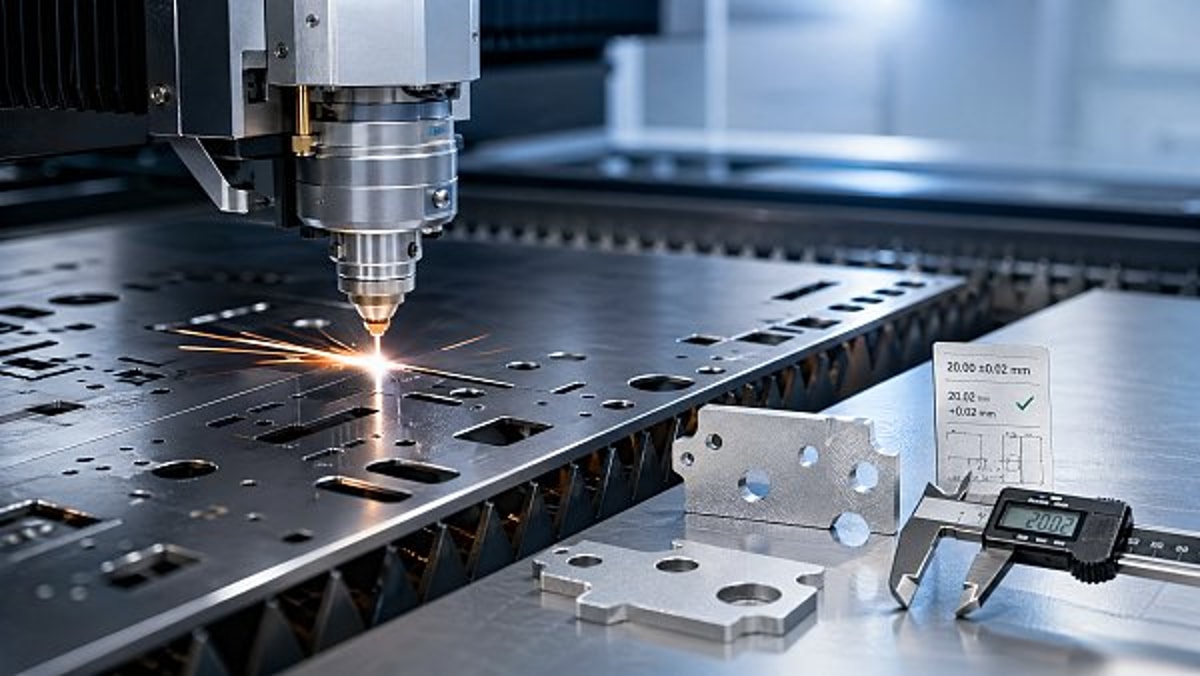
For these jobs, effective laser cutting services usually include tighter first-piece validation, feature-level measurement, and periodic checks during long runs. A practical checkpoint interval may be every 30 to 60 parts for critical dimensions, or every 1 to 2 production hours if the job is stable and material batches are controlled.
Scenario 2: Thick material and structural fabrication
When cutting thicker plate or large-format structural parts, tolerance problems often come from heat input and material variability rather than pure machine positioning. Thickness can vary by supplier lot, residual stress can release during cutting, and parts with long unsupported contours may move slightly before completion. In these conditions, a profile may pass on one side but fail at the opposite corner due to distortion.
QC personnel should verify whether the supplier controls cutting sequence, micro-joints, support strategy, and post-cut handling. On parts above 6 mm thickness, thermal effects may influence hole roundness and taper more than on sheet parts under 3 mm. If the next operation is welding or fixture assembly, profile accuracy alone is not enough; flatness and squareness must also be reviewed.
From a safety perspective, thick-part rework is often higher risk. Manual grinding, forced repositioning, or torch touch-up may be introduced if laser cutting services do not hold the required fit. That increases noise, sparks, hot work exposure, and operator fatigue. Preventing tolerance drift upstream is therefore also a safety control.
Scenario 3: High-mix custom and low-volume production
In custom fabrication environments, the biggest tolerance threat is inconsistency between setups. Different drawings, frequent material changes, and short production windows create more opportunities for program revision errors, wrong offset assumptions, or incorrect material orientation. The challenge is less about machine capability and more about process discipline from order review to first-piece release.
Laser cutting services supporting this scenario should have strong document control and clear job travelers. For quality managers, revision status, sample approval, and lot segregation may matter as much as dimensional measurement itself. On low-volume runs of 10 to 50 pieces, one wrong setup can affect the entire order before drift is noticed.
Safety managers should ask whether nonconforming parts are clearly quarantined and whether custom jobs trigger extra setup checks before production starts. Because these runs change rapidly, error-proofing at the setup stage often prevents both quality escapes and unsafe manual adjustment later in the process.
Where Common Tolerance Issues in Laser Cutting Services Begin
Most dimensional problems do not start at final inspection. They start earlier in the process chain, often at the interaction point between drawing requirements, material condition, and machine setup. Quality teams evaluating laser cutting services should trace root causes by category so that corrective action is specific and sustainable rather than broad and reactive.
A useful way to classify tolerance causes is by source: machine, material, method, measurement, and environment. This allows both supplier and buyer to separate a one-time program mistake from a recurring process weakness. For example, a 0.25 mm profile deviation in one batch may be due to warped incoming sheet, while repeated hole drift over 3 shifts may point to calibration or consumable wear.
The following table organizes common tolerance issues in laser cutting services by likely cause and by the most relevant preventive action for quality and safety stakeholders.
This root-cause view helps prevent a common mistake: treating all tolerance escapes as operator error. In many cases, the issue is systemic. If material flatness varies beyond a manageable range or if nesting places too many heat-sensitive parts in one zone, operators may only be responding to an unstable process. Strong laser cutting services identify and control these factors before they become customer complaints.
Machine-related causes
Machine-related tolerance loss often appears gradually. Nozzle wear, focus shift, assist gas pressure instability, and axis calibration drift can build over time. A process may hold tolerance during the first 100 parts, then begin to vary after several hours. That is why preventive maintenance intervals and setup verification records should be part of supplier audits for laser cutting services.
Practical machine control points
- Verify focus and nozzle condition before high-precision or safety-critical jobs.
- Track consumable replacement intervals by run time, not only by visual condition.
- Use trial cuts when changing between thin stainless, aluminum, and thicker carbon steel.
- Set escalation rules if dimensional drift exceeds a defined threshold such as 70% to 80% of tolerance.
These controls are especially valuable in mixed-material environments where machine settings can shift several times in a single day. For quality personnel, recorded setup discipline is often a better indicator of future consistency than a single sample report.
How Quality and Safety Managers Should Judge Fit by Scenario
Different organizations need different decision criteria when selecting or monitoring laser cutting services. A contract manufacturer may emphasize repeatability across recurring orders, while an equipment OEM may care more about weld-ready geometry and low rework. Quality and safety teams should define fit using scenario-based acceptance logic rather than generic supplier claims.
One practical method is to align each part family to a control tier. For example, Tier 1 parts may be safety-related or assembly-critical and require 100% first-piece approval plus periodic dimensional verification every hour. Tier 2 parts may need sampling every 2 to 3 hours. Tier 3 noncritical covers or guards may rely on standard batch inspection if the process has demonstrated stability over time.
This approach gives procurement, production, and supplier quality teams a common language. It also helps justify when more expensive process controls are necessary and when standard commercial tolerance is acceptable. In laser cutting services, over-controlling low-risk parts can waste time, while under-controlling critical features can create expensive escapes.
A practical evaluation checklist
- Confirm the critical-to-function dimensions before quoting or releasing production.
- Ask which materials and thickness ranges the supplier controls most consistently, such as 0.8 to 3.0 mm sheet or 6 to 12 mm plate.
- Review first article and in-process inspection frequency for long runs.
- Check whether revision control, nesting approval, and nonconforming material segregation are documented.
- Assess whether edge condition and burr control are included in acceptance criteria, not treated as secondary concerns.
For safety managers, one additional question matters: what happens when a tolerance issue is detected mid-run? The response should include stop rules, containment, identification of affected lots, and communication to downstream teams. Without those controls, even a small dimensional issue can spread across multiple operations and increase handling or rework exposure.
Common Misjudgments That Lead to Costly Tolerance Escapes
Several recurring misjudgments cause companies to underestimate tolerance risk in laser cutting services. The first is assuming that a tight quoted tolerance means the same thing across all geometries. A straight external cut is usually easier to control than a small internal feature, a cluster of holes, or a long thin profile that can move during cutting.
A second mistake is focusing only on dimensional numbers without reviewing downstream process sensitivity. A part may technically measure within tolerance but still fail in bending, welding, or assembly because of heat input, edge condition, or local distortion. Quality teams should therefore compare cut-part performance against actual use conditions, not only against isolated drawing values.
A third mistake is using the same control plan for all jobs. In laser cutting services, a repeat order of 5,000 pieces and a one-time prototype set of 15 pieces have different risk profiles. The first may need trend monitoring for drift over time, while the second needs stronger setup review and drawing clarification before the first cut begins.
Warning signs that the process is not suited to the scenario
- Supplier can state a generic tolerance but cannot explain how it changes by material, thickness, and feature type.
- Inspection records show only final checks and no in-process monitoring during runs longer than 4 hours.
- Critical dimensions are measured inconsistently or with tools not suited to the feature geometry.
- Edge quality and burr limits are left undefined even though operators manually handle the parts.
- Program revision control is weak in high-mix production environments.
These warning signs do not always mean the supplier is unsuitable, but they do mean additional clarification is necessary. For purchasing teams on global platforms, this kind of structured questioning is often what separates a low-risk sourcing decision from a short-term price win that later turns into rework, delays, or safety concerns.
How to Reduce Tolerance Problems Through Smarter Process Control
Reducing tolerance issues in laser cutting services depends on matching controls to the scenario. Precision assemblies benefit from tighter first-piece checks, frequent feature verification, and stricter consumable management. Heavy structural parts need better material screening, cutting sequence control, and distortion review. High-mix custom work requires disciplined revision control and setup confirmation before release.
For most organizations, the best results come from building a layered control plan. Start with design and quote review, then add material validation, setup verification, in-process inspection, and nonconformance containment. Even modest improvements at each stage can reduce scrap and rework significantly over a 3- to 6-month period.
Laser cutting services are most reliable when expectations are explicit. If a hole location is more critical than the outer profile, say so. If edge burr must stay below a practical internal threshold for safe handling, define it in the purchase or quality specification. Vague requirements often create the very variability that buyers later describe as supplier inconsistency.
Recommended control actions by function
- Quality control: define critical dimensions, sampling frequency, datum strategy, and escalation thresholds before production starts.
- Safety management: include burr condition, rework exposure, manual handling risk, and containment practices in supplier reviews.
- Procurement: compare suppliers by process capability, material range, inspection discipline, and communication speed, not by unit price alone.
- Engineering: identify which features truly drive function so that the supplier can prioritize process control where it matters most.
When these roles align, tolerance management becomes more predictable and easier to audit. That is especially valuable in advanced manufacturing, green energy systems, smart electronics assemblies, healthcare devices, and supply chain programs where repeatability and traceability influence both product quality and operational confidence.
Contact Us for Scenario-Based Support on Laser Cutting Services
If your team is evaluating laser cutting services for precision assemblies, structural fabricated parts, or high-mix custom production, the most useful next step is a scenario-based review rather than a generic quote comparison. Different applications require different tolerance strategies, inspection methods, and risk controls.
TradeNexus Pro supports global decision-makers who need clearer technical judgment before supplier selection or production release. You can contact us to discuss parameter confirmation, material and thickness fit, tolerance expectations by feature type, delivery cycle questions, custom sourcing scenarios, sample support, and quotation communication for cross-border industrial procurement.
If you are comparing suppliers or planning a new project, reach out with your drawing conditions, target tolerances, production volume, and downstream process requirements. We can help frame the right questions so your quality, safety, and sourcing teams evaluate laser cutting services with stronger confidence and fewer costly surprises.
Get weekly intelligence in your inbox.
No noise. No sponsored content. Pure intelligence.
 May 01, 2026Beijing’s New E-Bike Rules Trigger Dual-Certification Demand for China’s Swappable Battery CabinetsBeijing’s New E-Bike Rules Trigger Dual-Certification Demand for China’s Swappable Battery Cabinets
 May 01, 2026GNA’s GEO Service Assessment Elevates AI Search as Digital Procurement Metric for Chinese ExportersGNA’s GEO Service Assessment Elevates AI Search as Digital Procurement Metric for Chinese Exporters
 May 01, 20262026 China Cycle Expo: Chinese EPS Systems Achieve UL 2849:2026 Full Certification2026 China Cycle Expo: Chinese EPS Systems Achieve UL 2849:2026 Full Certification
 May 01, 2026GB 42236-2026 Enforces EV Charger Efficiency & Overload Protection from May 2026GB 42236-2026 Enforces EV Charger Efficiency & Overload Protection from May 2026
 May 01, 2026GB/T 43790-2026 Drone EMC Standard Effective May 2026GB/T 43790-2026 Drone EMC Standard Effective May 2026
 May 01, 20262026 Foshan Tanzhou Auto Industry Expo Opens2026 Foshan Tanzhou Auto Industry Expo Opens
 May 01, 2026China’s New Hazardous Chemicals Safety Law Takes Effect May 2026China’s New Hazardous Chemicals Safety Law Takes Effect May 2026
 May 01, 2026New Maritime and Fisheries Laws Take Effect May 1, 2026New Maritime and Fisheries Laws Take Effect May 1, 2026
 May 01, 2026Supply Chain Automation Works Best Where Delays RepeatSupply Chain Automation Works Best Where Delays Repeat
 May 01, 2026High Strength Steel Forgings: What Should Be Tested First?High Strength Steel Forgings: What Should Be Tested First?
 May 01, 2026Automotive Steel Forging: Cost Pressure vs Part ReliabilityAutomotive Steel Forging: Cost Pressure vs Part Reliability
 May 01, 2026Why High Durability Steel Forgings Fail Earlier Than ExpectedWhy High Durability Steel Forgings Fail Earlier Than Expected
 May 01, 2026Construction Aluminum Extrusions: Which Finish Lasts Longer?Construction Aluminum Extrusions: Which Finish Lasts Longer?
 May 01, 2026Lightweight Aluminum Extrusions: Where Savings Really HappenLightweight Aluminum Extrusions: Where Savings Really Happen
 May 01, 2026Aerospace Aluminum Extrusions Need More Than Low WeightAerospace Aluminum Extrusions Need More Than Low Weight
 May 01, 2026Precision Lathe Turning Problems That Show Up After AssemblyPrecision Lathe Turning Problems That Show Up After Assembly
 May 01, 2026High Precision Lathe Turning: Tolerance Claims to VerifyHigh Precision Lathe Turning: Tolerance Claims to Verify
 May 01, 2026When CNC Lathe Turning Is Better Than General MachiningWhen CNC Lathe Turning Is Better Than General Machining
 May 01, 2026Medical Device Prototyping Needs More Than SpeedMedical Device Prototyping Needs More Than Speed
 May 01, 20263D Printing Prototyping: Fast Turnaround or Better Finish?3D Printing Prototyping: Fast Turnaround or Better Finish?
 May 01, 2026Low Cost Rapid Prototyping: Where Quality Gets LostLow Cost Rapid Prototyping: Where Quality Gets Lost
 May 01, 2026Quick EV Charger Installation Still Needs Site ChecksQuick EV Charger Installation Still Needs Site Checks
 May 01, 2026Public Parking EV Chargers: What Slows Installation DownPublic Parking EV Chargers: What Slows Installation Down
 May 01, 2026Choosing a Lithium Ion Battery Manufacturer in ChinaChoosing a Lithium Ion Battery Manufacturer in China
 May 01, 2026How to Vet a Lithium Ion Battery OEM SupplierHow to Vet a Lithium Ion Battery OEM Supplier
 May 01, 2026EV Lithium Ion Batteries: Range Is Not the Only MetricEV Lithium Ion Batteries: Range Is Not the Only Metric
 May 01, 2026Lithium Ion ESS Batteries: Safety Details Worth CheckingLithium Ion ESS Batteries: Safety Details Worth Checking