Custom Molded Rubber: How to Choose the Right Grade
Selecting the right material for custom molded rubber can directly affect product life, sealing performance, compliance, and total cost. For engineers, buyers, and quality teams, understanding rubber grades means balancing temperature resistance, chemical exposure, compression set, and application demands. This guide explains how to evaluate options with confidence and make smarter sourcing decisions for reliable, high-performance results.
In B2B supply chains, rubber grade selection is rarely a simple material choice. It influences maintenance intervals, warranty exposure, production uptime, inspection outcomes, and even approval speed across procurement, technical, finance, and quality teams. A seal that fails after 6 months in a hot oil environment can create far higher downstream costs than a component that initially appears 8% to 15% more expensive.
For molded gaskets, grommets, bellows, bushings, vibration isolators, and custom sealing parts, the right grade depends on a combination of operating temperature, media contact, dynamic stress, hardness, regulatory needs, and tooling practicality. The goal is not to buy the “best” rubber in abstract terms, but the most suitable grade for the specific duty cycle, risk profile, and commercial target.
Understand What a Rubber Grade Really Means in Industrial Sourcing
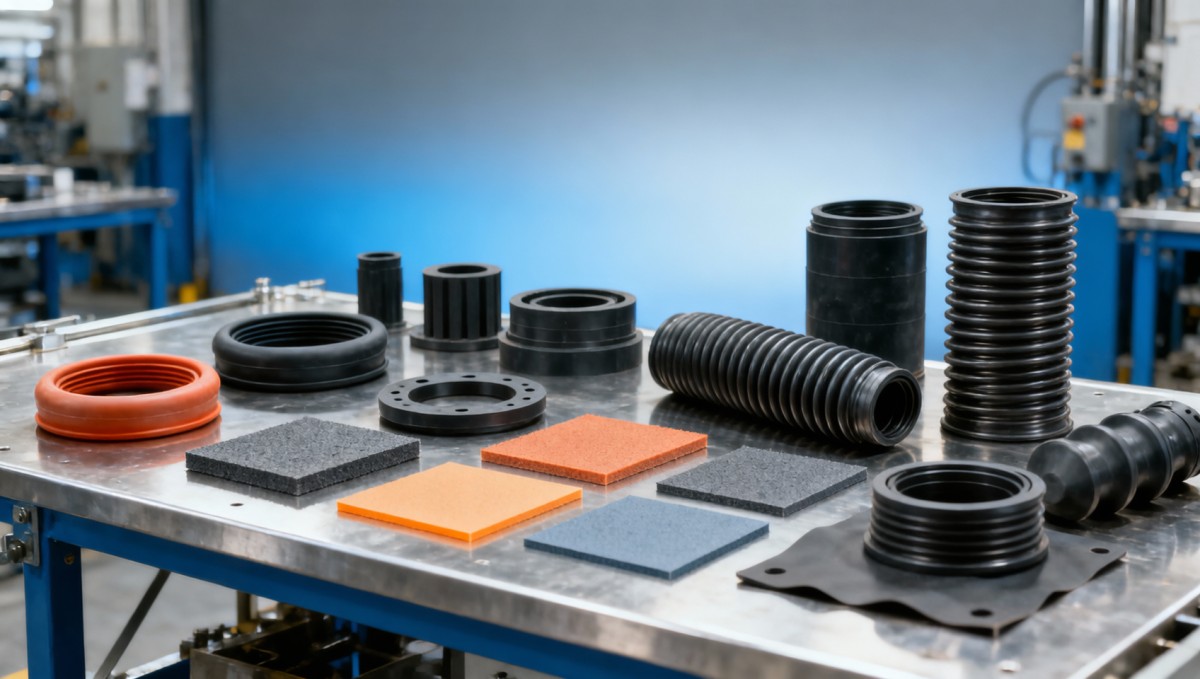
A rubber grade is more than a generic family label such as EPDM, NBR, silicone, or FKM. In real sourcing practice, it refers to a formulation with a specific hardness range, filler system, curing method, tensile properties, elongation, compression set behavior, and resistance profile. Two compounds within the same polymer family can perform very differently over a 12- to 36-month service period.
This matters because many procurement problems start with incomplete specifications. A drawing may call out “NBR 70 Shore A,” but omit whether the part will face ozone, aromatic oils, steam cleaning, or intermittent peaks above 120°C. Without that detail, suppliers may quote compounds that meet the nominal hardness requirement yet fail under actual service conditions.
Technical evaluators should therefore treat rubber grade selection as a functional engineering decision with cost consequences. For example, a low-cost compound with poor compression set can lose sealing force after repeated thermal cycling. In valves, pumps, battery enclosures, electronics housings, or medical support devices, that can increase replacement frequency from once every 24 months to once every 6 to 9 months.
Across advanced manufacturing and smart electronics applications, molded rubber also supports vibration control, ingress protection, acoustic damping, and electrical isolation. In green energy or healthcare technology systems, the grade can affect weather resistance, biocompatibility screening, sterilization tolerance, or low-outgassing behavior. That is why project managers should align grade selection with application risk rather than focusing on raw material price alone.
Core factors that define performance
Before requesting quotes, teams should define the 5 most important performance variables. These usually include operating temperature, media exposure, motion type, sealing load, and compliance requirement. If even 1 of these is unclear, sample approval may be delayed by 2 to 4 weeks because test criteria cannot be finalized.
- Temperature range: continuous and peak conditions, such as -40°C to 120°C or short spikes to 150°C.
- Chemical exposure: oils, fuels, acids, alkalis, steam, cleaning fluids, UV, or ozone.
- Mechanical demand: static sealing, dynamic flexing, abrasion, tear resistance, or vibration isolation.
- Physical requirements: hardness, compression set, tensile strength, elongation, and tolerance stability.
- Regulatory or quality needs: food contact, medical review, RoHS, REACH, flame resistance, or traceability.
The table below shows why rubber family selection should start with operating conditions rather than familiarity or habit.
The key takeaway is that no single material wins across every condition. A lower-cost EPDM may outperform FKM in outdoor water-service applications, while FKM can be justified in aggressive chemical or high-heat duty where failure costs are severe.
Match the Rubber Grade to Temperature, Media, and Mechanical Stress
The most reliable selection process starts by mapping the actual operating environment. Many failures happen because teams specify based on average temperature instead of continuous maximum exposure, or based on the main fluid while ignoring cleaning chemicals, intermittent solvents, or outdoor weathering. A molded part that sees 90°C most of the time may still fail early if it faces 130°C washdown cycles twice per day.
Mechanical stress is just as important as chemical resistance. A static gasket in a control box requires a different grade than a bellows exposed to repeated flexing 20,000 times per month. Similarly, a vibration isolator may need better rebound and fatigue behavior than a sealing ring, even if both operate in the same enclosure and at the same hardness level.
For quality and safety teams, compression set deserves close attention. If a gasket remains compressed for long periods, poor compression set retention can reduce sealing force and lead to leakage, dust ingress, or unstable enclosure performance. In many molded rubber programs, selecting a grade with better long-term sealing behavior can reduce service complaints by preventing loss of elasticity after thermal aging.
Project owners should also check whether the part is exposed continuously, intermittently, or only during abnormal events. A compound that performs well under occasional splash contact may not survive immersion. This distinction can shift the correct choice from a general-purpose grade to a premium compound, especially in battery systems, fluid transfer assemblies, industrial pumps, and electronic device sealing.
Typical application mapping by condition
The following table provides a practical starting point for comparing application conditions with common custom molded rubber options.
This matrix is a decision aid, not a substitute for validation. Compound formulation, part geometry, cure system, and production tolerances still affect field performance. For critical programs, teams should request test samples and define acceptance criteria before moving into volume tooling.
A 4-step technical screening checklist
- Define continuous temperature, peak temperature, and cycle frequency over a 24-hour or 7-day operating window.
- List all media contacts, including process fluids, cleaners, lubricants, condensation, and outdoor exposure.
- Identify whether the part works in static compression, dynamic movement, vibration, or abrasion-heavy contact.
- Set measurable acceptance points such as hardness tolerance, leakage standard, compression set target, and test duration.
Using this 4-step screening process reduces ambiguity during supplier comparison. It also helps finance approvers understand why a premium grade may be justified when replacement cost, stoppage risk, and warranty exposure are materially higher than the initial price difference.
Evaluate Key Material Properties Before Approving a Custom Molded Rubber Compound
After identifying the polymer family, buyers and engineers should examine compound-level properties. Hardness is often the first number discussed, usually within 40 to 90 Shore A for many molded parts, but hardness alone does not predict full performance. A 70 Shore A material may still vary widely in tensile strength, elongation, tear resistance, or compression set behavior depending on formulation.
Compression set is one of the most practical indicators for sealing reliability. Lower compression set generally means the part better retains its ability to recover after long-term compression. In enclosure seals, pump gaskets, or interface rings, that can directly influence leakage risk, dust ingress, and maintenance timing. For long dwell applications, teams should pay special attention to heat-aged compression performance rather than only room-temperature data.
Tensile strength and elongation matter when installation stress, stretching, or mechanical distortion is expected. Thin molded parts, snap-fit seals, and diaphragms may fail during assembly if elongation is too low. Likewise, abrasion and tear resistance become more important for cable protection parts, moving interfaces, or vibration-heavy industrial modules.
Dimensional stability and tolerance capability should also be reviewed early. In many custom molded rubber projects, the part itself is low cost, but the risk comes from fit inconsistency. A tolerance mismatch of even ±0.3 mm can affect clamp load, sealing force, or assembly speed in high-volume lines. That is why process capability, tooling design, and post-cure control should be part of the grade review.
Properties that should appear on a supplier data review
- Hardness range, for example 60 ±5 Shore A, matched to compression and installation needs.
- Tensile strength and elongation values sufficient for assembly and service deformation.
- Compression set under defined temperature and time, such as 22 hours or 70 hours at elevated heat.
- Specific resistance needs, including oil, ozone, UV, steam, or cleaning chemicals.
- Tolerance feasibility for the part geometry, flash control, and any secondary trimming requirement.
A disciplined review of these values prevents the common mistake of approving a material solely because the prototype “looks right.” For industrial procurement, a successful custom molded rubber program is not judged by first-sample appearance alone, but by repeatability across batch production, incoming inspection, and field service life.
Common approval mistakes to avoid
One frequent error is relying on generic material names without compound data. Another is failing to align lab tests with actual operating conditions. For example, approving an oil-resistant grade after a short bench test may be misleading if the real application includes 3 variables at once: heat, compression, and chemical exposure. The more severe the application, the more valuable it is to request molded sample validation before final release.
A second mistake is overlooking manufacturing practicality. Some premium compounds offer excellent resistance profiles but increase molding difficulty, scrap rate, or lead time. For enterprise buyers and distributors, the right grade is often the one that balances 3 dimensions together: required performance, stable manufacturability, and acceptable landed cost.
Build a Better Procurement Process: Supplier Qualification, Cost Control, and Lead Time
Even the right custom molded rubber grade can become a sourcing problem if supplier controls are weak. Procurement teams should evaluate not only quoted unit price, but also tooling readiness, compound consistency, sampling process, batch traceability, and inspection discipline. In cross-border B2B purchasing, these factors often affect total cost more than a nominal 5% to 10% difference in piece price.
Lead time planning is especially important for new molds. A typical path may involve 1 to 2 weeks for design review, 2 to 4 weeks for tooling, and another 1 to 2 weeks for sample approval depending on complexity. If the grade is unusual or requires special compliance review, the timeline can extend further. Project managers should therefore build approval gates early rather than treating rubber components as last-minute commodities.
Finance approvers often ask when a higher-grade compound is commercially justified. A useful answer is to compare annualized cost of failure. If a lower-grade gasket saves $0.20 per part but causes one shutdown, one field repair, or one rejected batch, the apparent savings disappear quickly. This is particularly relevant in healthcare equipment interfaces, advanced manufacturing lines, and smart electronics housings where downtime costs are disproportionate to part value.
For distributors and regional agents, consistency matters just as much as performance. A stable grade with predictable lead times, clear documentation, and repeatable molding outcomes is easier to stock, resell, and support. That reduces claims handling and improves confidence among end users who care about long-term availability over one-off pricing.
Practical supplier evaluation criteria
Use the following procurement matrix when comparing suppliers for custom molded rubber programs.
This comparison makes it easier to move from quote collection to actual source approval. It also gives technical, procurement, and finance stakeholders a shared framework for decision-making instead of treating material selection and supplier selection as separate discussions.
Recommended sourcing workflow
- Confirm application conditions and drawing requirements.
- Shortlist 2 to 3 suitable rubber grades with compound-level data.
- Request DFM feedback, tooling plan, sample timing, and test recommendations.
- Validate molded samples under real or simulated service conditions.
- Approve mass production only after material, dimension, and performance checks align.
This 5-step process is particularly effective for multi-site enterprises that need cross-functional approval and predictable rollout timing.
FAQ and Final Selection Tips for Decision-Makers
By the time a custom molded rubber part reaches final approval, most delays come from unanswered practical questions rather than lack of material options. The final stage should focus on fit-for-purpose confirmation, test clarity, and commercial readiness. Decision-makers who address these points early usually reduce rework, shorten qualification cycles, and improve long-term supplier performance.
A strong final decision should answer 4 questions clearly: what conditions the part will face, which grade best matches those conditions, how that grade will be validated, and what supply arrangement supports stable delivery. When those answers are documented, teams are better positioned to balance risk, cost, and implementation speed.
For organizations sourcing across sectors such as advanced manufacturing, green energy, smart electronics, and healthcare technology, the selection logic remains consistent: define the environment, verify material behavior, test critical dimensions, and choose suppliers with dependable process control. That approach supports both product reliability and procurement accountability.
How do I choose between NBR, EPDM, silicone, and FKM?
Start with media and temperature. NBR is often preferred for oil and fuel contact, EPDM for water, weather, and ozone, silicone for broad temperature exposure such as -60°C to 200°C, and FKM for high heat plus aggressive chemicals. The final choice still depends on actual duty cycle, sealing load, and cost tolerance.
What hardness is best for custom molded rubber parts?
There is no universal answer, but many industrial molded parts fall between 50 and 80 Shore A. Lower hardness may improve conformability, while higher hardness can support shape retention and load resistance. The correct range should be matched to compression level, assembly force, and dimensional stability needs.
How long does a typical custom molded rubber project take?
For many programs, initial evaluation and DFM can take 3 to 7 days, tooling 2 to 4 weeks, and first sample validation another 1 to 2 weeks. Complex geometries, compliance review, or multiple material trials can extend the timeline. Early technical clarification is the fastest way to avoid schedule drift.
What should procurement and quality teams check before approval?
At minimum, review compound data, hardness tolerance, dimensional capability, compression set relevance, environmental compatibility, and sample validation method. Also confirm MOQ, lead time, traceability, and response process for nonconformance. These checks help prevent expensive changes after tooling is released.
Choosing the right grade for custom molded rubber is a cross-functional decision that affects service life, compliance, maintenance frequency, and sourcing efficiency. The best results come from combining application data, material property review, realistic testing, and disciplined supplier qualification instead of relying on generic material labels.
If your team is evaluating molded seals, gaskets, vibration parts, or other rubber components for industrial, energy, electronics, healthcare, or supply chain applications, a structured selection process can reduce technical risk and improve total cost control. Contact TradeNexus Pro to explore more solution insights, compare sourcing approaches, and get support for smarter supplier and material decisions.
Get weekly intelligence in your inbox.
No noise. No sponsored content. Pure intelligence.
 Apr 18, 2026TradeNexus Pro Launches Global Compliance RadarTradeNexus Pro Launches Global Compliance Radar
 Apr 18, 2026JIS T 2304:2026 Takes Effect June 1, 2026 for IVD SoftwareJIS T 2304:2026 Takes Effect June 1, 2026 for IVD Software
 Pathway for Rehab Devices with AI Modules") Apr 18, 2026FDA Updates 510(k) Pathway for Rehab Devices with AI ModulesFDA Updates 510(k) Pathway for Rehab Devices with AI Modules
Apr 18, 2026FDA Updates 510(k) Pathway for Rehab Devices with AI ModulesFDA Updates 510(k) Pathway for Rehab Devices with AI Modules Apr 18, 2026India BIS Approves 3 Chinese IoT Labs for IS 16444:2026 CertificationIndia BIS Approves 3 Chinese IoT Labs for IS 16444:2026 Certification
 Apr 18, 2026THE Alliance Launches Green Slot Priority for China PortsTHE Alliance Launches Green Slot Priority for China Ports
 Apr 18, 2026TÜV Rheinland Releases Dual-Standard ESS Certification Guide for ChinaTÜV Rheinland Releases Dual-Standard ESS Certification Guide for China
 Apr 18, 2026Vietnam Imposes AD Duties on Chinese Electronic ComponentsVietnam Imposes AD Duties on Chinese Electronic Components
 Apr 18, 2026SASO Launches PV Carbon Footprint Labeling from July 2026SASO Launches PV Carbon Footprint Labeling from July 2026
 Apr 18, 2026U.S. Adds 17 Smart Warehouse Robot Components to Export Control ListU.S. Adds 17 Smart Warehouse Robot Components to Export Control List
 Apr 18, 2026EU Enforces EN IEC 62443-4-2:2026 for Industrial Control Devices from 18 Apr 2026EU Enforces EN IEC 62443-4-2:2026 for Industrial Control Devices from 18 Apr 2026
 Apr 17, 2026Temperature data loggers drift unpredictably inside lithium-ion battery storage enclosuresTemperature data loggers drift unpredictably inside lithium-ion battery storage enclosures
 Apr 17, 2026Are solar microinverters really worth the extra cost?Are solar microinverters really worth the extra cost?
 Apr 17, 2026Bifacial solar panels: How much more energy can they generate?Bifacial solar panels: How much more energy can they generate?
 Apr 17, 2026Gear manufacturing: How to optimize production for high precision?Gear manufacturing: How to optimize production for high precision?
 Apr 17, 2026Why power transmission components fail earlier than expectedWhy power transmission components fail earlier than expected
 Apr 17, 2026Linear motion systems: belt drive or ball screw for speed?Linear motion systems: belt drive or ball screw for speed?
 Apr 17, 2026Industrial bearing suppliers: what signals reliable quality?Industrial bearing suppliers: what signals reliable quality?
 Apr 17, 2026When pneumatic valves wholesale gets expensive laterWhen pneumatic valves wholesale gets expensive later
 Apr 17, 2026Hydraulic cylinder fabrication mistakes that cause oil leaksHydraulic cylinder fabrication mistakes that cause oil leaks
 Apr 17, 2026Heavy equipment manufacturing delays often start hereHeavy equipment manufacturing delays often start here
 Apr 17, 2026Custom heatsinks: when a larger size solves nothingCustom heatsinks: when a larger size solves nothing
 Apr 17, 2026Electronic enclosure fabrication: steel or aluminum?Electronic enclosure fabrication: steel or aluminum?
 Apr 17, 2026Automotive parts machining tolerances that drive up scrapAutomotive parts machining tolerances that drive up scrap
 Apr 17, 2026Medical device manufacturing changes under tighter traceabilityMedical device manufacturing changes under tighter traceability
 Apr 17, 2026How to Choose Solid State Batteries in 2026How to Choose Solid State Batteries in 2026
 Apr 17, 2026Are Solid State Batteries Worth the Cost Yet?Are Solid State Batteries Worth the Cost Yet?
 Apr 17, 2026Commercial Energy Storage Sizing: What Matters Most?Commercial Energy Storage Sizing: What Matters Most?