Custom Molded Rubber: What Causes Quality Problems?
In custom molded rubber production, even minor deviations in material selection, tooling, curing, or inspection can trigger costly quality failures. For buyers, engineers, and QA teams comparing suppliers across sectors such as gear manufacturing, wire edm services, and ultrasonic welding, understanding the root causes is essential. This article explains why custom molded rubber defects happen and how to prevent them before they impact performance, safety, and project costs.
For B2B buyers, custom molded rubber is rarely a low-risk commodity. A seal, grommet, bushing, diaphragm, mount, or custom elastomer part may represent only a small percentage of total project cost, yet a single defect can stop a production line, fail a compliance test, or shorten service life by months. In industrial environments, even a dimensional drift of ±0.3 mm, an incorrect durometer by 5 Shore A points, or incomplete cure can create major downstream issues.
That is why supplier evaluation for molded rubber parts should go beyond price per piece. Technical review, compound control, tooling capability, process stability, and inspection discipline all matter. For operators, quality managers, project leaders, distributors, and financial approvers, the practical question is simple: what actually causes quality problems, and what controls reduce risk before purchase orders are released?
Material Selection Errors Are Often the First Root Cause
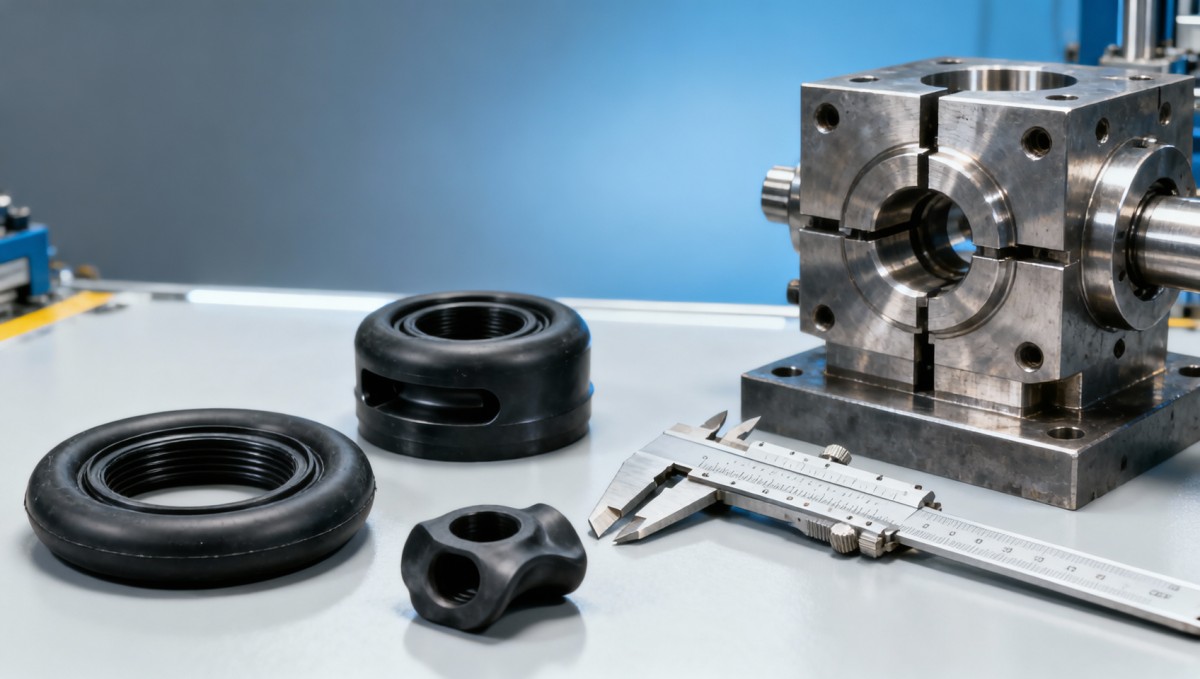
Many custom molded rubber defects begin before the mold is ever closed. If the base polymer is wrong for the application, no amount of post-production inspection will fully correct the problem. Choosing between EPDM, NBR, silicone, FKM, CR, or natural rubber is not a catalog exercise; it depends on temperature range, chemical exposure, compression set targets, and mechanical stress over time.
For example, a part designed for outdoor sealing may need stable performance from -40°C to 120°C, which often points toward EPDM or silicone rather than nitrile. A fuel-contact application may require NBR or FKM instead of EPDM. If a supplier substitutes a lower-cost compound without confirming media compatibility, the result may be swelling above 10%, hardness shift after 72 hours, or early cracking under cyclic load.
Another common issue is inconsistent raw material batching. Even when the nominal compound family is correct, poor control of fillers, curatives, plasticizers, and recycled content can produce unstable viscosity, uneven flow, and variable cure behavior. These changes affect flash, dimensional stability, tensile strength, and surface finish. In multi-cavity tooling, the same batch variation can create different results from cavity to cavity.
Typical Material-Driven Quality Failures
Procurement and QA teams should watch for a pattern: material mismatch usually shows up as repeat performance failures rather than isolated visual defects. The part may look acceptable at incoming inspection but fail after 500 to 2,000 operating cycles, after heat aging, or during fluid exposure. This is especially risky for healthcare technology devices, smart electronics enclosures, and advanced manufacturing equipment where reliability windows are narrow.
- Hardness outside tolerance, such as 60 Shore A specified but 66 Shore A delivered
- Compression set too high after 22 to 70 hours of testing
- Swelling, shrinkage, or tackiness after oil, ozone, UV, or cleaning chemical exposure
- Brittleness at low temperature or softening at elevated temperature
The table below summarizes common material selection mistakes and the quality risks they create during molded rubber production and field use.
The key takeaway is straightforward: when custom molded rubber quality problems appear across multiple lots, the root cause is often upstream in compound design or material handling. Buyers should request the full material specification, acceptable hardness range, operating media, and test expectations before approving tooling or mass production.
Tooling Design and Mold Condition Directly Affect Part Accuracy
Even with the right rubber compound, poor mold design can create visible and hidden defects. In custom molded rubber, tooling controls cavity fill, venting, flash line position, dimensional repeatability, and demolding behavior. If gate size, vent layout, cavity balance, or parting line design is weak, defects can appear from the first sampling run and become worse as volumes increase.
One common problem is trapped air. When vents are insufficient or poorly positioned, air pockets remain during compression, transfer, or injection molding. This can cause voids, short shots, blisters, burn marks, or weak sealing surfaces. For thin-wall parts, diaphragms, or geometries with deep ribs, even minor venting issues can reduce yield by 3% to 8% per lot.
Wear is another major factor. Over time, mold cavities, ejector features, and shut-off surfaces degrade. As tooling reaches thousands or tens of thousands of cycles, dimensional drift, burrs, flash increase, and mismatch between cavity halves may appear. If the supplier lacks a preventive tooling maintenance plan, defect rates can rise gradually and escape attention until the customer reports fit problems at assembly.
Tooling Risks That Buyers Should Review Early
Technical evaluators should not wait until first article inspection to ask tooling questions. A better approach is to review design-for-manufacturing details during quotation or pilot stage. This shortens approval cycles and reduces expensive mold rework after T1 or T2 trials.
- Confirm expected tolerance by feature, because not every dimension can realistically hold ±0.05 mm in elastomer parts.
- Review gate and vent strategy for thick sections, undercuts, and thin sealing lips.
- Check whether the tool uses multiple cavities and how cavity-to-cavity variation is monitored.
- Ask about maintenance intervals, such as cleaning every 3,000 to 5,000 cycles and wear inspection every scheduled batch.
Why tooling discipline matters in cross-industry supply chains
Across advanced manufacturing, healthcare technology, and smart electronics, molded rubber parts are often integrated into assemblies with metal, plastic, or bonded components. If mold variation changes part geometry, downstream processes such as ultrasonic welding fixture alignment, automated insertion, or leak testing may fail. A low-value rubber part can then disrupt a high-value assembly line.
For distributors and sourcing managers comparing suppliers, a practical signal of maturity is whether the supplier can discuss mold flow considerations, vent cleaning routines, cavity correction history, and first-off verification records in concrete terms rather than generic quality claims.
Curing and Process Control Problems Create Hidden Defects
Cure control is where many custom molded rubber quality failures become expensive. Rubber that is under-cured may feel acceptable during visual inspection but lack final mechanical strength, chemical resistance, or compression performance. Over-cured material can become brittle, distorted, or harder than specified. Process control therefore depends on balancing time, temperature, pressure, and material behavior, not simply following one fixed machine setting.
A typical molding window may involve platen temperatures around 160°C to 200°C, cure times from 2 to 12 minutes depending on part mass and compound type, and controlled post-curing for selected materials such as silicone or FKM. If machine variation, rushed cycle reduction, or uneven mold heating occurs, the supplier may unknowingly ship parts with a cure gradient between surface and core.
Contamination also matters. Dust, release agent overuse, moisture, or residue from prior jobs can interfere with bonding surfaces and appearance. In regulated or cleanliness-sensitive sectors, such as healthcare assemblies or smart sensor housings, contamination creates both performance and audit risk. Operators should follow a defined setup checklist, especially during changeovers across compounds and colors.
Critical Process Variables That Need Monitoring
The following table outlines process variables that most often drive molded rubber inconsistency and how teams can control them before defects reach shipment.
In supplier qualification, one useful question is whether process parameters are documented by product family and lot, or whether setup depends mainly on operator memory. Stable suppliers can usually show a 3-step discipline: validated recipe, in-process checks every defined interval such as 1 or 2 hours, and reaction plans when readings drift outside limits.
Hidden defects are the most expensive defects
Visual screening alone will not reliably catch under-cure, internal voids, poor adhesion in bonded parts, or out-of-spec compression behavior. That is why financial approvers and project managers should support sample validation beyond appearance only. Spending more on process capability review and pilot testing is often cheaper than absorbing warranty claims, field failures, or urgent resupply by air freight.
Inspection Gaps and Weak Quality Systems Allow Defects to Escape
Not all custom molded rubber quality problems originate in molding itself. Some defects escape simply because the inspection plan is too light for the application. A supplier may perform only visual checks and a few dimensions, while the actual use case requires hardness verification, compression set review, bond strength testing, color stability checks, or cleanliness inspection. The gap between production checks and field requirements becomes a hidden commercial risk.
Incoming inspection at the buyer’s site can catch obvious issues, but it should not be the first robust control point. If parts are sourced globally with lead times of 3 to 8 weeks, discovering nonconformance after receipt can delay assembly schedules and increase safety stock. This is especially serious for project-driven procurement, spare parts programs, or scheduled launches in new equipment lines.
Traceability is equally important. When a defect appears, teams need to connect the lot to raw material batch, machine setup, cure window, inspection records, and shipping date. Without lot traceability, root cause analysis becomes slow and expensive. Distributors and multi-site buyers should make this a standard supplier requirement, not an optional extra for critical parts only.
Inspection Points That Should Match Application Risk
The right inspection plan depends on end use, but the following matrix is a practical baseline for many industrial and B2B purchasing scenarios.
A strong quality system does not need to be complicated, but it must be repeatable. At minimum, buyers should expect documented inspection criteria, calibrated measurement tools, first-article approval, retained records, and a clear nonconformance response process within 24 to 72 hours depending on urgency.
Common oversight during supplier comparison
Many teams compare quotations based on tooling cost, unit price, and lead time, then assume quality plans are similar. They often are not. Two suppliers offering the same nominal rubber part may differ sharply in sampling frequency, traceability depth, calibration discipline, and containment speed. That difference becomes visible only when defects occur.
How Buyers and Engineers Can Prevent Quality Problems Before Production Launch
The most effective strategy is prevention before PPAP-like approval, pilot release, or mass ordering. Custom molded rubber projects perform better when procurement, engineering, QA, and operations align early on technical assumptions. This reduces late-stage changes, emergency tool rework, and disagreement about whether a defect is a design issue or a manufacturing issue.
A practical supplier onboarding process usually has 4 stages: technical review, sample validation, controlled pilot production, and ongoing batch monitoring. Depending on complexity, this may take 2 to 6 weeks for simple parts or 6 to 12 weeks for multi-material, bonded, or tight-tolerance projects. Rushing directly from drawing release to volume PO is one of the most common avoidable mistakes.
Prevention Checklist for B2B Sourcing Teams
- Define real service conditions, including temperature, media exposure, compression load, UV or ozone risk, and expected service life.
- Lock critical-to-quality features on the drawing, such as sealing lip dimensions, hardness range, flash limits, and color requirements.
- Request sample testing under realistic conditions rather than desk approval based only on material name.
- Review tooling concept, cavity number, maintenance plan, and expected dimensional variation before tool fabrication.
- Set incoming and outgoing inspection expectations, including lot traceability, packaging rules, and deviation approval procedures.
For decision-makers and financial reviewers, this front-loaded control effort supports better total cost management. A part quoted 6% cheaper may become 20% to 40% more expensive after line stoppages, scrap, reshipment, and engineering time are added. Total cost of ownership is the right lens, especially when molded rubber parts support high-value assemblies.
Questions to ask a supplier before approval
Ask for evidence, not promises. Can the supplier explain the selected compound and its limits? Can they show lot-level traceability? What is the plan for mold maintenance after 5,000, 10,000, or 20,000 cycles? How are nonconforming parts contained within the same shift? Clear answers to these questions usually predict better molded rubber quality than a low quote alone.
FAQ for procurement, QA, and engineering teams
How long should custom molded rubber sample validation take?
For simple geometry and familiar compounds, sample validation may take 7 to 15 days after tooling trial. For complex parts, bonded assemblies, or strict testing requirements, 3 to 6 weeks is more realistic. The timeline should include dimensional review, basic material checks, and at least one functional test relevant to the application.
Which defects are most expensive because they are hard to see?
The costliest hidden defects are often under-cure, internal voids, weak bond strength, incorrect compound substitution, and compression set failure. These may pass visual inspection but fail in service after heat, pressure, or chemical exposure. That is why visual checks alone are rarely enough for functional rubber parts.
What should distributors and agents verify before representing a supplier?
At minimum, verify compound traceability, tooling ownership terms, sample approval process, standard lead time, defect response procedure, and packaging discipline. If the supplier cannot clearly define these controls, channel partners may absorb avoidable complaint-handling and replacement costs later.
Custom molded rubber quality problems usually come from four sources: wrong material choice, weak tooling design or maintenance, unstable curing conditions, and incomplete inspection systems. Each source can be controlled with better technical communication, documented process windows, realistic validation, and stronger supplier discipline.
For operators, engineers, QA leaders, sourcing managers, and enterprise decision-makers, the goal is not simply to buy rubber parts at a lower price. It is to secure reliable molded components that protect uptime, product performance, and project budgets across advanced manufacturing and broader B2B supply chains.
If you are evaluating custom molded rubber suppliers, planning a new project, or troubleshooting recurring defects, now is the right time to review your material assumptions, tooling controls, and inspection standards. Contact TradeNexus Pro to explore deeper supplier insights, compare manufacturing capabilities, and get more informed support for your next sourcing decision.
Get weekly intelligence in your inbox.
No noise. No sponsored content. Pure intelligence.
 Apr 18, 2026TradeNexus Pro Launches Global Compliance RadarTradeNexus Pro Launches Global Compliance Radar
 Apr 18, 2026JIS T 2304:2026 Takes Effect June 1, 2026 for IVD SoftwareJIS T 2304:2026 Takes Effect June 1, 2026 for IVD Software
 Pathway for Rehab Devices with AI Modules") Apr 18, 2026FDA Updates 510(k) Pathway for Rehab Devices with AI ModulesFDA Updates 510(k) Pathway for Rehab Devices with AI Modules
Apr 18, 2026FDA Updates 510(k) Pathway for Rehab Devices with AI ModulesFDA Updates 510(k) Pathway for Rehab Devices with AI Modules Apr 18, 2026India BIS Approves 3 Chinese IoT Labs for IS 16444:2026 CertificationIndia BIS Approves 3 Chinese IoT Labs for IS 16444:2026 Certification
 Apr 18, 2026THE Alliance Launches Green Slot Priority for China PortsTHE Alliance Launches Green Slot Priority for China Ports
 Apr 18, 2026TÜV Rheinland Releases Dual-Standard ESS Certification Guide for ChinaTÜV Rheinland Releases Dual-Standard ESS Certification Guide for China
 Apr 18, 2026Vietnam Imposes AD Duties on Chinese Electronic ComponentsVietnam Imposes AD Duties on Chinese Electronic Components
 Apr 18, 2026SASO Launches PV Carbon Footprint Labeling from July 2026SASO Launches PV Carbon Footprint Labeling from July 2026
 Apr 18, 2026U.S. Adds 17 Smart Warehouse Robot Components to Export Control ListU.S. Adds 17 Smart Warehouse Robot Components to Export Control List
 Apr 18, 2026EU Enforces EN IEC 62443-4-2:2026 for Industrial Control Devices from 18 Apr 2026EU Enforces EN IEC 62443-4-2:2026 for Industrial Control Devices from 18 Apr 2026
 Apr 17, 2026Temperature data loggers drift unpredictably inside lithium-ion battery storage enclosuresTemperature data loggers drift unpredictably inside lithium-ion battery storage enclosures
 Apr 17, 2026Are solar microinverters really worth the extra cost?Are solar microinverters really worth the extra cost?
 Apr 17, 2026Bifacial solar panels: How much more energy can they generate?Bifacial solar panels: How much more energy can they generate?
 Apr 17, 2026Gear manufacturing: How to optimize production for high precision?Gear manufacturing: How to optimize production for high precision?
 Apr 17, 2026Why power transmission components fail earlier than expectedWhy power transmission components fail earlier than expected
 Apr 17, 2026Linear motion systems: belt drive or ball screw for speed?Linear motion systems: belt drive or ball screw for speed?
 Apr 17, 2026Industrial bearing suppliers: what signals reliable quality?Industrial bearing suppliers: what signals reliable quality?
 Apr 17, 2026When pneumatic valves wholesale gets expensive laterWhen pneumatic valves wholesale gets expensive later
 Apr 17, 2026Hydraulic cylinder fabrication mistakes that cause oil leaksHydraulic cylinder fabrication mistakes that cause oil leaks
 Apr 17, 2026Heavy equipment manufacturing delays often start hereHeavy equipment manufacturing delays often start here
 Apr 17, 2026Custom heatsinks: when a larger size solves nothingCustom heatsinks: when a larger size solves nothing
 Apr 17, 2026Electronic enclosure fabrication: steel or aluminum?Electronic enclosure fabrication: steel or aluminum?
 Apr 17, 2026Automotive parts machining tolerances that drive up scrapAutomotive parts machining tolerances that drive up scrap
 Apr 17, 2026Medical device manufacturing changes under tighter traceabilityMedical device manufacturing changes under tighter traceability
 Apr 17, 2026How to Choose Solid State Batteries in 2026How to Choose Solid State Batteries in 2026
 Apr 17, 2026Are Solid State Batteries Worth the Cost Yet?Are Solid State Batteries Worth the Cost Yet?
 Apr 17, 2026Commercial Energy Storage Sizing: What Matters Most?Commercial Energy Storage Sizing: What Matters Most?