Custom molded rubber problems that start with material selection
Many failures in custom molded rubber components begin long before tooling—at material selection. For buyers, engineers, and quality teams, choosing the wrong compound can trigger sealing issues, chemical incompatibility, premature wear, and higher lifecycle costs. This article explores how early material decisions shape product reliability, manufacturability, and procurement outcomes in demanding industrial applications.
In industrial sourcing, molded rubber parts often appear simple on a drawing: an O-ring, grommet, diaphragm, bushing, gasket, isolator, or valve seat. Yet performance is rarely determined by geometry alone. A component expected to last 12 months can fail in 12 weeks if the base polymer, filler system, hardness, compression set profile, or temperature resistance does not match the real service environment.
For procurement teams, the challenge is not only technical but commercial. A lower piece price can hide higher total cost when field replacements, downtime, scrap, and warranty claims are added. For project managers and decision-makers, early material alignment reduces requalification cycles, protects launch schedules, and improves supply chain predictability across multiple regions and production batches.
Why material selection is the real starting point of molded rubber quality
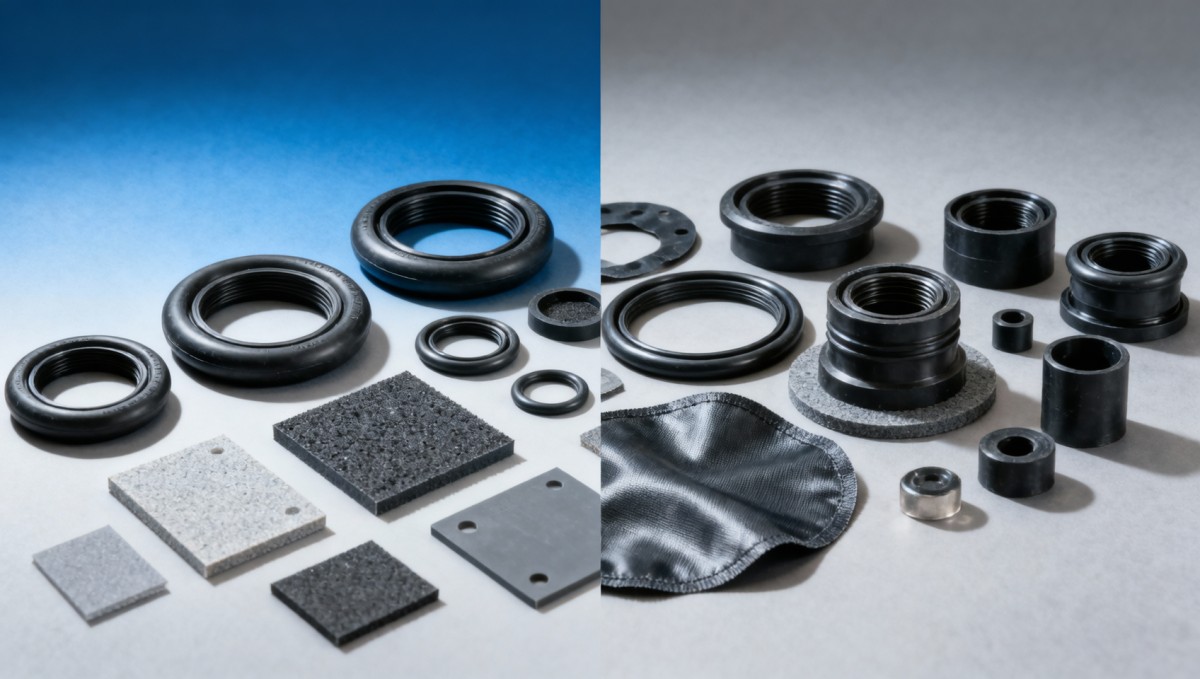
In custom molded rubber, tooling is often blamed first when parts leak, crack, swell, or lose elasticity. In reality, many defects begin before mold design is finalized. If the compound is mismatched to media, pressure, motion, or climate, even well-controlled molding cannot compensate for a flawed material decision. This is especially true in sectors such as advanced manufacturing, green energy systems, healthcare devices, smart electronics, and logistics equipment.
A rubber component may face temperatures from -40°C to 200°C, intermittent chemical splash, UV exposure, or dynamic compression at 1 to 5 Hz. These conditions require more than a generic “industrial rubber” choice. NBR, EPDM, silicone, FKM, CR, and natural rubber each respond differently to oil, ozone, steam, abrasion, and long-term deformation. One wrong assumption at the quoting stage can lock in repeated quality escapes later.
Common failure modes linked to the wrong compound
The most common field failures usually trace back to 4 material issues: chemical incompatibility, poor compression set, inadequate temperature resistance, and insufficient tear or abrasion strength. For example, a seal selected mainly on hardness may pass dimensional inspection but fail after 500 to 1,000 operating hours because the polymer backbone was never suited for the media. In critical applications, this can affect uptime, hygiene compliance, or operator safety.
- Swelling in oils or fuels, which can change dimensions by 5% to 25% depending on compound and exposure time.
- Hardening or embrittlement after thermal aging, especially above 120°C for compounds with weak heat resistance.
- Permanent deformation under compression, reducing sealing force after repeated load cycles.
- Surface cracking from ozone or UV when outdoor exposure was overlooked in the specification stage.
Why cross-functional teams should intervene early
Material selection should not be left to a single function. Engineers understand load, motion, and media. Quality teams evaluate tolerances, traceability, and inspection plans. Procurement compares lead time, MOQ, cost structure, and second-source options. Finance looks at lifecycle cost, not just unit price. When these groups review the compound decision during the first 2 to 3 project gates, redesign risk drops significantly.
In practice, many sourcing delays happen because the RFQ only includes a drawing and hardness callout such as “70 Shore A.” That is not enough. Two 70 Shore A compounds can behave very differently in compression set, fluid resistance, and low-temperature flexibility. A robust RFQ should define at least 6 points: operating temperature, media, dynamic or static use, regulatory needs, expected life, and key failure concerns.
How to match rubber materials to application conditions
The best material choice starts with the service environment rather than the lowest quote. Buyers and technical evaluators should map the part against temperature range, media exposure, compression ratio, movement type, cleaning method, and outdoor or indoor use. This avoids the common mistake of selecting based on one property while ignoring 3 or 4 others that are equally decisive in service.
The table below summarizes typical trade-offs among widely used rubber families in industrial molded parts. These are common selection ranges rather than absolute rules, but they provide a practical screening framework during early sourcing and design review.
A useful rule is to eliminate unsuitable materials first, then compare the short list on cost, manufacturability, and qualification burden. If a part is exposed to hot oil at 150°C, weather resistance alone will not save it. If it seals water outdoors for 3 to 5 years, fuel compatibility may be irrelevant while ozone resistance becomes critical.
A practical 5-step screening method
- Define the continuous and peak temperature range, for example -30°C to 120°C with short peaks to 140°C.
- List every media contact, including oils, cleaning agents, moisture, steam, solvents, or dust.
- Clarify whether the part is static, reciprocating, rotating, or shock-loaded.
- Set expected service life, such as 2 years, 10,000 cycles, or 1 million actuations.
- Confirm compliance and inspection needs before the compound is frozen.
Do not ignore secondary conditions
Secondary factors often decide whether a “workable” material becomes a reliable one. Cleaning frequency, storage climate, assembly lubricants, color requirements, and post-curing needs can all change outcomes. In electronics and healthcare assemblies, even outgassing, extractables, or particle generation may matter. Those details should be identified before sample approval, not after launch.
The procurement risks of choosing rubber by price alone
From a purchasing perspective, molded rubber often falls into a deceptively familiar category: low-cost components with many suppliers. But low complexity on paper does not mean low risk in execution. The wrong compound can multiply total cost through line stoppages, rework, emergency freight, and repeated supplier correction cycles. A 6% savings on unit price can disappear quickly if replacement frequency doubles.
Procurement teams should compare quotes on more than resin family and hardness. Compound consistency, batch traceability, cavity layout, flash control, tooling maintenance, and validation support all influence real cost. Lead time also matters. A supplier offering 2-week samples but 10-week production with limited material traceability may increase launch risk compared with one offering a 4-week validation package and stable repeatability.
What procurement should request in the RFQ package
A stronger RFQ reduces ambiguity and keeps suppliers from quoting against different assumptions. The table below shows practical procurement checkpoints that improve quote comparability and reduce downstream disputes on performance expectations.
The key takeaway is simple: a good molded rubber supplier quote should answer performance risk, not only piece price. When procurement teams standardize RFQ templates across plants or projects, they reduce requalification loops and improve supplier comparison quality.
Commercial signs that a low-cost quote may be risky
- The supplier recommends a compound without asking about media, pressure, or service temperature.
- No test method is proposed for compression set, aging, or fluid exposure.
- Tooling is quoted quickly, but there is no discussion of cavity balance, flash control, or dimensional capability.
- Lead time promises are unusually short, such as 7 days for a fully new validated molded program, without a clear sampling plan.
For distributors, agents, and project owners, these warning signs are especially relevant when serving multiple downstream industries. A compound that works in one customer’s dry indoor application may fail in another customer’s wet, hot, chemically exposed environment. Cross-application assumptions are one of the fastest ways to create return risk and reputation damage.
Quality control, testing, and validation before full-scale production
Even the best-looking compound selection should be validated under realistic conditions before mass production. A data sheet is only a starting point. Actual performance depends on formulation details, molding conditions, cure profile, part geometry, and assembly stress. Quality teams should treat first-article approval as a decision gate, not a paperwork step.
A practical validation plan often includes 3 layers: incoming material review, molded-part dimensional and visual inspection, and application-based performance testing. Depending on the criticality of the part, this can involve thermal aging for 70 to 168 hours, fluid immersion, hardness verification, tensile checks, elongation comparison, and compression set testing after defined dwell periods.
Tests that frequently reveal hidden material-selection problems
When a rubber part seems acceptable in appearance but fails in the field, the missed issue is often visible in controlled testing. Compression set may show loss of sealing force. Immersion testing can reveal swelling or hardness change. Accelerated aging can expose cracking, hardening, or loss of elasticity well before long-term operation does.
- Compression set after 22 to 70 hours at a defined temperature to estimate seal recovery behavior.
- Fluid immersion for 24 to 72 hours to track volume change, mass change, and hardness shift.
- Heat aging at application-relevant temperatures to compare before-and-after mechanical properties.
- Visual inspection for flash, voids, knit lines, contamination, and surface defects that affect assembly.
Validation should mirror the real use case
Testing only under room conditions can create false confidence. If the actual part runs in washdown conditions, cold storage, battery enclosures, process skids, or pump systems, validation should simulate those environments as closely as practical. A 2-stage test plan is often effective: laboratory screening first, then functional trials in the real assembly for 100, 500, or 1,000 cycles depending on application severity.
This disciplined approach helps operators, quality leaders, and engineering managers catch material-related issues before tooling adjustments, PPAP-style approvals, or multi-site rollout. It also gives finance approvers clearer evidence when a higher-grade compound carries a justified upfront premium.
A decision framework for buyers, engineers, and project leaders
Selecting custom molded rubber should be treated as a structured sourcing decision with technical, commercial, and operational checkpoints. The most effective teams use a shared decision matrix rather than isolated judgments. This is particularly useful for enterprise buyers and global sourcing groups managing multiple product families across different plants or contract manufacturers.
A simple evaluation model
A practical matrix can score each candidate material or supplier against 5 weighted categories: application fit, manufacturability, validation burden, supply stability, and lifecycle cost. For example, a project might weight application fit at 35%, lifecycle cost at 25%, supply stability at 20%, validation burden at 10%, and manufacturability at 10%. This keeps the final decision aligned with business risk rather than purchase price alone.
- Start with the use case and eliminate technically unfit materials.
- Compare remaining compounds on expected service life and failure consequences.
- Review supplier capability for repeatability, documentation, and change control.
- Assess commercial terms including MOQ, tooling ownership, and replenishment lead time.
- Approve only after sample results align with both performance and sourcing targets.
FAQ: what stakeholders usually ask
How do we know whether a cheaper rubber grade is acceptable?
It is acceptable only if it passes the same use-case conditions with a similar safety margin. Compare not just hardness and tensile values, but also compression set, aging behavior, fluid resistance, and expected replacement interval. If the lower-cost grade reduces service life from 24 months to 9 months, the savings may be illusory.
What is a realistic lead time for a new custom molded rubber project?
For standard industrial programs, sample timing often falls in the 2 to 6 week range after design freeze, while production readiness may take 4 to 10 weeks depending on tooling complexity, testing requirements, and material availability. Highly regulated or multi-test applications can take longer.
Which document details matter most for technical evaluation?
At minimum, provide operating conditions, drawing tolerances, expected life, media list, installation method, and quality acceptance criteria. If those 6 items are clear, material discussions become much more precise and supplier responses become more comparable.
For organizations tracking industrial sourcing trends, deeper visibility into component risk is increasingly valuable. Platforms such as TradeNexus Pro help procurement directors, engineering evaluators, and supply chain teams connect technical selection issues with broader sourcing strategy, supplier intelligence, and market movement across manufacturing-intensive sectors.
Material selection is where many custom molded rubber problems truly begin—or are prevented. When teams define service conditions early, compare compounds against real operating risks, and validate before scale-up, they reduce failure rates, avoid expensive redesigns, and improve total cost performance. If you are evaluating molded rubber components for industrial applications, now is the right time to review your specifications, refine your sourcing criteria, and get a tailored solution. Contact us to discuss application details, procurement priorities, or broader supply chain intelligence for your next project.
Get weekly intelligence in your inbox.
No noise. No sponsored content. Pure intelligence.
 Apr 18, 2026TradeNexus Pro Launches Global Compliance RadarTradeNexus Pro Launches Global Compliance Radar
 Apr 18, 2026JIS T 2304:2026 Takes Effect June 1, 2026 for IVD SoftwareJIS T 2304:2026 Takes Effect June 1, 2026 for IVD Software
 Pathway for Rehab Devices with AI Modules") Apr 18, 2026FDA Updates 510(k) Pathway for Rehab Devices with AI ModulesFDA Updates 510(k) Pathway for Rehab Devices with AI Modules
Apr 18, 2026FDA Updates 510(k) Pathway for Rehab Devices with AI ModulesFDA Updates 510(k) Pathway for Rehab Devices with AI Modules Apr 18, 2026India BIS Approves 3 Chinese IoT Labs for IS 16444:2026 CertificationIndia BIS Approves 3 Chinese IoT Labs for IS 16444:2026 Certification
 Apr 18, 2026THE Alliance Launches Green Slot Priority for China PortsTHE Alliance Launches Green Slot Priority for China Ports
 Apr 18, 2026TÜV Rheinland Releases Dual-Standard ESS Certification Guide for ChinaTÜV Rheinland Releases Dual-Standard ESS Certification Guide for China
 Apr 18, 2026Vietnam Imposes AD Duties on Chinese Electronic ComponentsVietnam Imposes AD Duties on Chinese Electronic Components
 Apr 18, 2026SASO Launches PV Carbon Footprint Labeling from July 2026SASO Launches PV Carbon Footprint Labeling from July 2026
 Apr 18, 2026U.S. Adds 17 Smart Warehouse Robot Components to Export Control ListU.S. Adds 17 Smart Warehouse Robot Components to Export Control List
 Apr 18, 2026EU Enforces EN IEC 62443-4-2:2026 for Industrial Control Devices from 18 Apr 2026EU Enforces EN IEC 62443-4-2:2026 for Industrial Control Devices from 18 Apr 2026
 Apr 17, 2026Temperature data loggers drift unpredictably inside lithium-ion battery storage enclosuresTemperature data loggers drift unpredictably inside lithium-ion battery storage enclosures
 Apr 17, 2026Are solar microinverters really worth the extra cost?Are solar microinverters really worth the extra cost?
 Apr 17, 2026Bifacial solar panels: How much more energy can they generate?Bifacial solar panels: How much more energy can they generate?
 Apr 17, 2026Gear manufacturing: How to optimize production for high precision?Gear manufacturing: How to optimize production for high precision?
 Apr 17, 2026Why power transmission components fail earlier than expectedWhy power transmission components fail earlier than expected
 Apr 17, 2026Linear motion systems: belt drive or ball screw for speed?Linear motion systems: belt drive or ball screw for speed?
 Apr 17, 2026Industrial bearing suppliers: what signals reliable quality?Industrial bearing suppliers: what signals reliable quality?
 Apr 17, 2026When pneumatic valves wholesale gets expensive laterWhen pneumatic valves wholesale gets expensive later
 Apr 17, 2026Hydraulic cylinder fabrication mistakes that cause oil leaksHydraulic cylinder fabrication mistakes that cause oil leaks
 Apr 17, 2026Heavy equipment manufacturing delays often start hereHeavy equipment manufacturing delays often start here
 Apr 17, 2026Custom heatsinks: when a larger size solves nothingCustom heatsinks: when a larger size solves nothing
 Apr 17, 2026Electronic enclosure fabrication: steel or aluminum?Electronic enclosure fabrication: steel or aluminum?
 Apr 17, 2026Automotive parts machining tolerances that drive up scrapAutomotive parts machining tolerances that drive up scrap
 Apr 17, 2026Medical device manufacturing changes under tighter traceabilityMedical device manufacturing changes under tighter traceability
 Apr 17, 2026How to Choose Solid State Batteries in 2026How to Choose Solid State Batteries in 2026
 Apr 17, 2026Are Solid State Batteries Worth the Cost Yet?Are Solid State Batteries Worth the Cost Yet?
 Apr 17, 2026Commercial Energy Storage Sizing: What Matters Most?Commercial Energy Storage Sizing: What Matters Most?