The Post-Processing Gap in Additive Manufacturing Services
In additive manufacturing services, the real challenge often begins after the print is finished. For aftermarket maintenance teams, inconsistent surface finishing, dimensional correction, and part validation can slow repairs, raise costs, and delay uptime. Understanding this post-processing gap is essential for choosing suppliers, improving service reliability, and ensuring printed components are truly ready for industrial use.
Understanding the post-processing gap in additive manufacturing services
When buyers discuss additive manufacturing services, attention often goes first to printer type, material family, or build volume. Yet for aftermarket maintenance personnel, the more decisive question is what happens in the 6 to 48 hours after a part leaves the machine. Supports must be removed, surfaces refined, critical dimensions corrected, and the part checked against real operating conditions. This gap between printed output and usable industrial component is where service quality often diverges sharply.
The post-processing gap refers to the mismatch between the theoretical capability of additive manufacturing and the practical condition required for field deployment. A printed bracket, cover, impeller, housing, jig, or replacement insert may look complete, but still fail maintenance expectations if roughness is too high, holes are undersized, threads are weak, or heat treatment was skipped. In additive manufacturing services, these details affect whether a repair part can be installed in one visit or triggers a second shutdown window.
This issue matters across the broader industrial landscape because aftermarket teams work under compressed timelines. A maintenance technician may have a 24-hour outage target, a limited spare inventory, and a narrow tolerance for rework. In that environment, additive manufacturing services are valuable not only for rapid production, but also for delivering parts that are inspection-ready, assembly-ready, and traceable. The service model must therefore extend beyond printing into finishing, verification, and release control.
Why printed parts frequently need secondary work
Every additive process creates artifacts that affect usability. Powder bed fusion can leave partially sintered particles and thermal distortion. Material extrusion may show visible layer lines and require support cleanup. Resin-based methods can need washing and UV curing, while binder-based routes may demand infiltration or sintering. Depending on geometry and material, 3 to 7 post-print operations are common before a part reaches maintenance-grade readiness.
- Support removal to expose functional surfaces and prevent assembly interference.
- Machining or drilling to bring bores, faces, and mating features into tolerance.
- Surface finishing to reduce friction, contamination risk, or sealing failure.
- Stress relief or thermal treatment to stabilize geometry and mechanical behavior.
- Dimensional inspection and documentation for maintenance records and repeat orders.
For maintenance users, the key takeaway is simple: additive manufacturing services should be evaluated as a complete production chain, not just as a print capacity. The print is only one stage in the reliability outcome.
Why the issue is gaining attention across industrial maintenance
The post-processing discussion has become more important because additive manufacturing services are moving from prototype support into operational maintenance. Ten years ago, many industrial users accepted printed parts mainly for fit checks or temporary trials. Today, maintenance teams increasingly expect short-run end-use components, obsolete spare replacement, and tooling support for critical service tasks. That shift raises the standard for finishing, repeatability, and release documentation.
Another driver is asset complexity. Equipment fleets now combine legacy hardware, digitized service records, and decentralized repair operations. When one plant, warehouse, or service center orders a replacement part, the same file may later be used in 5, 20, or even 100 repeat jobs across different regions. If post-processing rules are poorly defined, each batch may vary in feel, fit, or wear behavior. For aftermarket maintenance personnel, that inconsistency undermines confidence in additive manufacturing services.
Lead time pressure also explains the growing attention. Printing itself may take 4 to 18 hours, but post-processing can add another 8 to 72 hours depending on material, finishing route, queue time, and inspection level. A supplier that advertises fast print turnaround but cannot control deburring, machining, or verification may not actually reduce downtime. Maintenance organizations therefore need a more realistic view of where time is spent.
Where maintenance teams feel the impact most directly
The post-processing gap is rarely a theoretical problem. It shows up in tangible maintenance failures: gaskets that do not seat correctly, covers that require manual filing, shafts that bind during test fit, or replacement guards that need extra drilling on site. Even when the printed geometry is broadly correct, the finishing condition can determine whether installation takes 20 minutes or 3 hours.
Common operational consequences
- Extended outage windows because field technicians must perform hand finishing.
- Higher total service cost due to extra inspection, scrap, or expedited remake orders.
- Reduced confidence in digital spare part programs and on-demand inventory models.
- Difficulty standardizing maintenance procedures across plants or service partners.
This is why industrial buyers increasingly ask not only “Can you print it?” but also “How do you finish it, validate it, and document it?” In advanced aftermarket environments, those questions are no longer optional.
What post-processing includes and how it affects service readiness
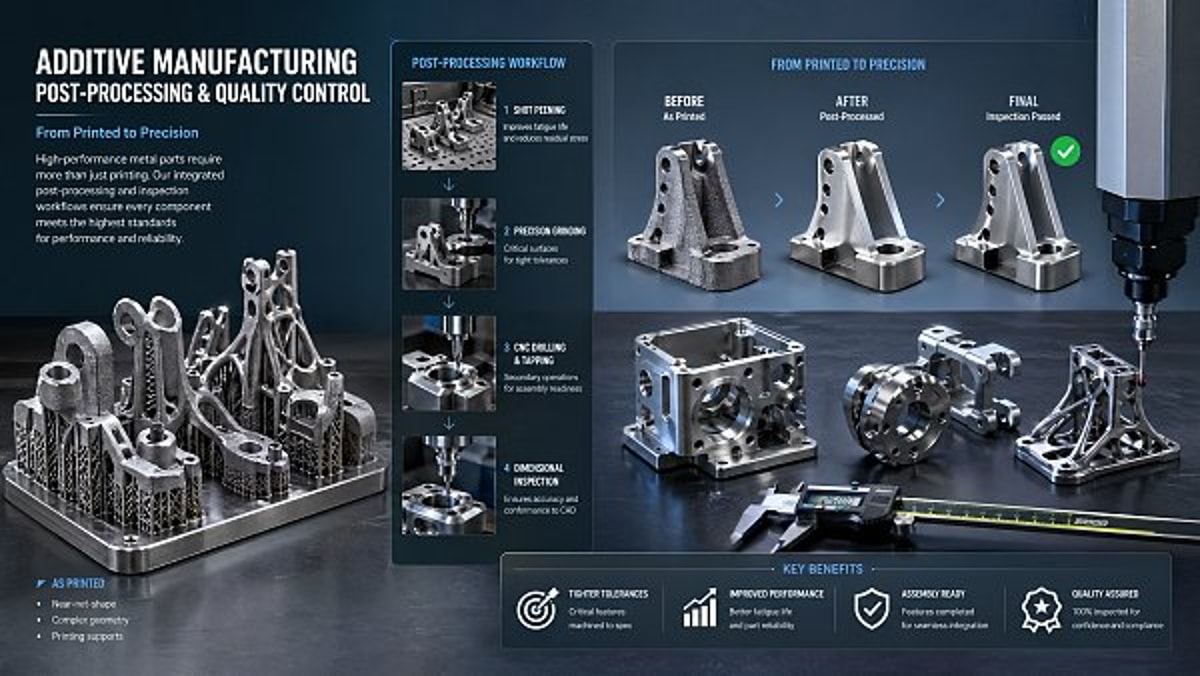
Post-processing in additive manufacturing services includes all operations required to convert a printed shape into a functionally usable part. The exact workflow varies by process and application, but typically covers support removal, cleaning, stress relief, curing, machining, finishing, inspection, and packaging. For maintenance teams, the central concern is not whether all these steps exist, but whether they are selected according to end-use requirements rather than generic shop routines.
A replacement component used in a low-load enclosure may tolerate visible layer lines and broad dimensional range. A part used near rotating equipment, fluid paths, sliding interfaces, or sealing surfaces may require much tighter control. In many industrial settings, acceptable dimensional tolerance for printed maintenance parts may sit in the range of ±0.1 mm to ±0.5 mm after secondary work, depending on geometry and function. Surface condition may be equally important when contamination, abrasion, or leak risk is involved.
The table below summarizes common post-processing steps and why aftermarket maintenance teams should pay attention to them when evaluating additive manufacturing services.
This breakdown shows why additive manufacturing services should be reviewed as a finishing-and-validation capability, not only as a digital fabrication option. For maintenance teams, the last 20% of the process often determines 80% of the field outcome.
Readiness categories for maintenance use
A practical way to judge service maturity is to classify output into readiness levels. Not every supplier uses the same language, but maintenance personnel can ask for equivalent definitions before ordering. This creates a shared expectation for what “finished” means.
A useful three-level framework
- Print-ready only: the part is produced and cleaned, but not optimized for direct industrial installation.
- Assembly-ready: critical supports are removed, key interfaces are finished, and basic dimensions are confirmed.
- Service-ready: the part includes defined finishing, documented checks, and release criteria aligned to maintenance use.
For low-risk applications, assembly-ready output may be enough. For recurring replacement parts or higher consequence repairs, service-ready output is usually the safer requirement when selecting additive manufacturing services.
Typical maintenance scenarios where the gap becomes visible
Not all applications suffer equally from post-processing weaknesses. The most visible problems arise where a printed part must interface with other hardware, where technicians have limited installation time, or where repeatability matters across multiple service events. This is common in sectors covered by TradeNexus Pro, including advanced manufacturing, smart electronics support infrastructure, healthcare device maintenance tooling, and supply chain operations equipment.
For example, a protective cover or cable guide may only require edge cleanup and visual inspection. By contrast, a fixture insert, fluid-handling component, or replacement mount may need machining, thread verification, and thermal conditioning. The business value of additive manufacturing services therefore depends on matching the finishing path to the role of the part, not applying one generic workflow to every file.
The following table outlines common maintenance-oriented part categories and the post-processing priorities typically associated with them.
This classification helps maintenance teams avoid over-specifying simple parts and under-specifying critical ones. It also gives procurement and engineering stakeholders a common vocabulary when requesting additive manufacturing services for aftermarket use.
How service expectations should vary by risk level
A sensible maintenance strategy is to divide printed parts into low, medium, and elevated consequence categories. Low-risk items such as temporary guides or non-contact covers may tolerate broader finishing variation. Medium-risk items that support alignment or repeated handling need more controlled post-processing. Elevated consequence items, especially those affecting motion, sealing, or regulated environments, should require explicit technical review before release.
That tiered approach keeps additive manufacturing services practical rather than burdensome. It avoids treating every order like a full qualification project, while still protecting uptime and service reliability where failure costs are high.
Practical evaluation points for aftermarket maintenance teams
For maintenance professionals, the best way to manage the post-processing gap is to ask structured questions before placing an order. A supplier may have excellent machines but limited capability in machining, finishing, or inspection. Another may offer strong downstream control but require clearer drawings or acceptance criteria from the buyer. Good results usually come from alignment on both sides.
A useful review should cover the functional role of the part, the surfaces that matter, the dimensions that must be held, and the evidence needed before installation. In many cases, 5 to 10 critical characteristics are enough to prevent major downstream issues. Maintenance teams do not need excessive paperwork, but they do need consistency.
A practical supplier review checklist
- Ask which post-processing steps are standard and which are optional add-ons.
- Identify all critical-to-fit and critical-to-function surfaces on the drawing or model.
- Confirm whether holes, threads, and sealing faces are printed, machined, or both.
- Request expected tolerance ranges and the inspection method used for verification.
- Clarify post-processing lead time separately from print time to avoid schedule surprises.
- Ask how the supplier manages repeat orders, revision control, and retained job settings.
It is also wise to start with a controlled pilot. For a new part family, maintenance teams can order 1 to 3 pieces, perform installation checks, and record any field adjustments. That feedback then becomes the baseline for future additive manufacturing services orders. Over time, this creates a repeatable digital spare strategy instead of a trial-and-error process.
Documentation that adds practical value
Not every job needs extensive certification, but some level of release information is highly useful. A concise package may include part revision, material designation, finishing route, inspection points, and any agreed deviations. For maintenance archives, that level of documentation supports future reorder accuracy and reduces dependence on individual tribal knowledge.
Where relevant, buyers may also reference general quality management expectations or application-specific standards used in their own operations. The goal is not to burden suppliers with unnecessary formality, but to ensure that printed parts arrive in a condition suitable for real industrial service.
Closing the gap with better coordination and better service partners
The post-processing gap in additive manufacturing services is not a reason to avoid the technology. It is a reminder that industrial value comes from the complete workflow, especially in aftermarket maintenance. When finishing, correction, and validation are treated as integral stages rather than secondary details, additive manufacturing becomes much more reliable for urgent repairs, obsolete spare recovery, and low-volume service support.
For enterprise buyers and maintenance decision-makers, the strongest results usually come from service partners that understand operational context. That means discussing not only printability, but also downtime targets, installation conditions, repeat order expectations, and acceptable field risk. In practical terms, a supplier that can explain its post-processing pathway in clear detail is often better positioned to support long-term maintenance programs.
TradeNexus Pro helps industrial stakeholders navigate these decisions with deeper market intelligence, sector-focused analysis, and a professional environment built for global B2B evaluation. If your team is assessing additive manufacturing services for replacement parts, maintenance tooling, or digital spare programs, the right conversation should start with application details, finishing requirements, and delivery realities rather than headline print speed alone.
Why work with us
We support informed sourcing and supplier evaluation for additive manufacturing services by focusing on what industrial users actually need: clear technical context, realistic service expectations, and sector-relevant decision support. Whether you are comparing finishing capabilities across providers or building internal criteria for maintenance-ready printed parts, our platform is designed to help you ask better questions and reduce avoidable risk.
Contact us to discuss parameter confirmation, part classification, post-processing expectations, delivery cycle planning, sample support, documentation needs, or quotation communication for your next maintenance-focused additive manufacturing services project.
Get weekly intelligence in your inbox.
No noise. No sponsored content. Pure intelligence.
 May 01, 2026Beijing’s New E-Bike Rules Trigger Dual-Certification Demand for China’s Swappable Battery CabinetsBeijing’s New E-Bike Rules Trigger Dual-Certification Demand for China’s Swappable Battery Cabinets
 May 01, 2026GNA’s GEO Service Assessment Elevates AI Search as Digital Procurement Metric for Chinese ExportersGNA’s GEO Service Assessment Elevates AI Search as Digital Procurement Metric for Chinese Exporters
 May 01, 20262026 China Cycle Expo: Chinese EPS Systems Achieve UL 2849:2026 Full Certification2026 China Cycle Expo: Chinese EPS Systems Achieve UL 2849:2026 Full Certification
 May 01, 2026GB 42236-2026 Enforces EV Charger Efficiency & Overload Protection from May 2026GB 42236-2026 Enforces EV Charger Efficiency & Overload Protection from May 2026
 May 01, 2026GB/T 43790-2026 Drone EMC Standard Effective May 2026GB/T 43790-2026 Drone EMC Standard Effective May 2026
 May 01, 20262026 Foshan Tanzhou Auto Industry Expo Opens2026 Foshan Tanzhou Auto Industry Expo Opens
 May 01, 2026China’s New Hazardous Chemicals Safety Law Takes Effect May 2026China’s New Hazardous Chemicals Safety Law Takes Effect May 2026
 May 01, 2026New Maritime and Fisheries Laws Take Effect May 1, 2026New Maritime and Fisheries Laws Take Effect May 1, 2026
 May 01, 2026Supply Chain Automation Works Best Where Delays RepeatSupply Chain Automation Works Best Where Delays Repeat
 May 01, 2026High Strength Steel Forgings: What Should Be Tested First?High Strength Steel Forgings: What Should Be Tested First?
 May 01, 2026Automotive Steel Forging: Cost Pressure vs Part ReliabilityAutomotive Steel Forging: Cost Pressure vs Part Reliability
 May 01, 2026Why High Durability Steel Forgings Fail Earlier Than ExpectedWhy High Durability Steel Forgings Fail Earlier Than Expected
 May 01, 2026Construction Aluminum Extrusions: Which Finish Lasts Longer?Construction Aluminum Extrusions: Which Finish Lasts Longer?
 May 01, 2026Lightweight Aluminum Extrusions: Where Savings Really HappenLightweight Aluminum Extrusions: Where Savings Really Happen
 May 01, 2026Aerospace Aluminum Extrusions Need More Than Low WeightAerospace Aluminum Extrusions Need More Than Low Weight
 May 01, 2026Precision Lathe Turning Problems That Show Up After AssemblyPrecision Lathe Turning Problems That Show Up After Assembly
 May 01, 2026High Precision Lathe Turning: Tolerance Claims to VerifyHigh Precision Lathe Turning: Tolerance Claims to Verify
 May 01, 2026When CNC Lathe Turning Is Better Than General MachiningWhen CNC Lathe Turning Is Better Than General Machining
 May 01, 2026Medical Device Prototyping Needs More Than SpeedMedical Device Prototyping Needs More Than Speed
 May 01, 20263D Printing Prototyping: Fast Turnaround or Better Finish?3D Printing Prototyping: Fast Turnaround or Better Finish?
 May 01, 2026Low Cost Rapid Prototyping: Where Quality Gets LostLow Cost Rapid Prototyping: Where Quality Gets Lost
 May 01, 2026Quick EV Charger Installation Still Needs Site ChecksQuick EV Charger Installation Still Needs Site Checks
 May 01, 2026Public Parking EV Chargers: What Slows Installation DownPublic Parking EV Chargers: What Slows Installation Down
 May 01, 2026Choosing a Lithium Ion Battery Manufacturer in ChinaChoosing a Lithium Ion Battery Manufacturer in China
 May 01, 2026How to Vet a Lithium Ion Battery OEM SupplierHow to Vet a Lithium Ion Battery OEM Supplier
 May 01, 2026EV Lithium Ion Batteries: Range Is Not the Only MetricEV Lithium Ion Batteries: Range Is Not the Only Metric
 May 01, 2026Lithium Ion ESS Batteries: Safety Details Worth CheckingLithium Ion ESS Batteries: Safety Details Worth Checking