Why Some Additive Manufacturing Parts Fail Inspection
Even when a part looks flawless, inspection can reveal hidden defects that compromise safety, performance, and compliance. For quality control and safety teams, understanding why failures occur is essential to reducing risk and improving consistency. In additive manufacturing services, issues such as porosity, dimensional drift, weak bonding, and post-processing errors often determine whether a part passes or fails.
Why do parts from additive manufacturing services fail inspection even when they look acceptable?
Visual appearance is only the outer layer of quality. In many additive manufacturing services, a part can have smooth surfaces and clean edges yet still fail internal or functional inspection. Quality control teams often discover defects only after dimensional verification, non-destructive testing, leak testing, hardness checks, or mechanical validation. For safety-sensitive applications, even a deviation of 0.1 mm to 0.3 mm can trigger rejection if the tolerance band is narrow.
The root issue is that additive processes build geometry layer by layer, and each layer introduces variables. Laser power, scan speed, powder quality, support strategy, thermal distribution, and post-build stress relief all affect final part integrity. A component may satisfy cosmetic expectations but still contain trapped porosity, unmelted particles, residual stress, or weak interlayer fusion that reduces fatigue life or causes distortion during use.
Inspection failures also happen because the acceptance criteria are broader than the build process itself. A printed part is not judged only by whether it can be produced. It is judged by whether it matches drawing tolerances, material expectations, cleanliness requirements, and intended service conditions. For procurement and safety teams reviewing additive manufacturing services, this means supplier capability must be evaluated across the full chain, from file preparation to final inspection release.
What hidden defects are most commonly missed before inspection?
The most common hidden issues fall into four practical categories: internal defects, geometric variation, material inconsistency, and post-processing damage. These defects may not be visible on the outer surface, especially when the part has been polished, blasted, machined, or coated after printing. That is why quality teams rarely rely on visual checks alone for critical parts.
- Internal porosity or voids that reduce density and can weaken pressure-bearing or fatigue-loaded sections.
- Dimensional drift caused by thermal contraction, support removal, or stress release after heat treatment.
- Incomplete fusion between layers, which may pass basic checks but fail under tensile, impact, or cyclic loading.
- Surface-connected flaws introduced during machining, sanding, or support break-off in thin-wall regions.
In practice, these issues tend to appear more often on complex geometries, enclosed channels, unsupported overhangs, lattice sections, and wall thicknesses below typical process limits. For example, a thin wall around 0.6 mm to 1.0 mm may print successfully in one build but distort in another if orientation or heat concentration changes. Repeatability is often the difference between prototype success and production inspection failure.
A quick inspection-oriented summary
The table below helps quality and safety personnel connect common failure modes in additive manufacturing services with the inspection methods most likely to detect them.
For inspection planning, the lesson is simple: if a supplier of additive manufacturing services controls only print output but not downstream verification, the rejection risk remains high. Quality assurance must link defect type to detection method before release, not after the parts reach assembly or field use.
Which inspection criteria most often cause rejection?
Inspection rejection usually comes from three practical areas: dimensions, material integrity, and surface or finish compliance. In traditional machining, dimensions are often the main concern. In additive manufacturing services, however, internal quality and process consistency can be equally important. This is especially true when the part will carry load, seal fluid, resist heat, or fit into a regulated assembly.
Dimensional nonconformance remains one of the top causes of failure because printed geometry can shift during building, support removal, or heat treatment. Holes may close, flatness may drift, and mating surfaces may lose alignment. A part that is within tolerance before stress relief can move outside tolerance after post-processing. For this reason, some quality teams require inspection at 2 or 3 checkpoints rather than only at final release.
Material and structural criteria are just as important. If additive manufacturing services are used for brackets, manifolds, housings, medical components, or electronics fixtures, density and bonding quality directly affect performance. Even when no formal certification is required, basic acceptance often includes traceable powder or feedstock records, documented heat treatment steps, and evidence that the final state matches intended use conditions.
What do quality teams usually check first?
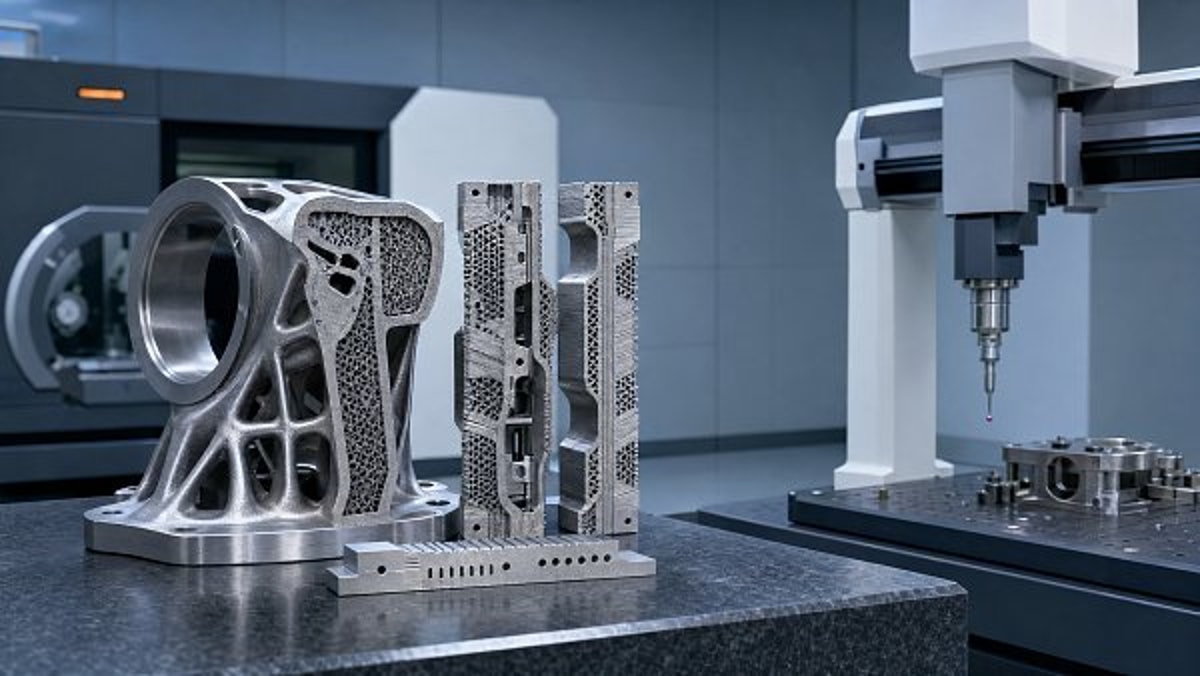
The sequence varies by industry, but many teams start with drawing compliance, then move to process risk. If the part is simple and non-critical, visual review and dimensions may be enough. If it is safety-related, pressure-bearing, electrically sensitive, or subject to fatigue, inspection often extends to internal structure, surface cleanliness, and post-process verification. Lead time for these checks can range from 24 hours for simple parts to 5 to 10 working days for parts requiring external laboratory support.
- Confirm critical-to-quality dimensions, datums, and tolerance stack-up areas.
- Review the build orientation and support strategy used by the supplier.
- Check whether heat treatment, machining, blasting, or coating changed functional surfaces.
- Match the inspection method to the risk level, such as CT, penetrant, hardness, or leak testing.
A common mistake is to inspect additive parts as if they were conventional machined parts only. That approach can miss build-related variation. When evaluating additive manufacturing services, quality teams should ask not only “Does this part meet the drawing?” but also “Was the process controlled in a way that makes repeat conformance likely over the next 10, 50, or 100 builds?”
How do design choices and process settings contribute to inspection failures?
Many failures begin long before production starts. In additive manufacturing services, design decisions that work on a screen may not remain stable in real builds. Sharp corners, abrupt wall transitions, enclosed powder traps, unsupported overhangs, and deep narrow channels all increase the probability of quality escape. Inspection then catches the result, but the root cause is often design for additive manufacturing rather than operator error.
Build orientation is one of the strongest variables. A part tilted by 15° to 45° may gain support stability but lose surface quality on key areas. Another orientation may reduce support scars yet increase thermal concentration and warpage. This trade-off matters because the same CAD model can pass or fail depending on orientation, support density, and layer strategy. For quality personnel, orientation records should be treated as part of the controlled manufacturing data set.
Process settings also shape inspection outcomes. Energy input that is too low can leave lack-of-fusion defects. Energy input that is too high can create balling, rough surfaces, or excessive residual stress. Layer thickness, hatch spacing, chamber condition, and feedstock reuse policy all matter. In stable additive manufacturing services, these settings are not improvised from job to job without documented control.
Which design and process issues deserve early review?
Before approving a build, quality and safety teams can reduce failures by reviewing a short list of high-risk conditions. These checks are valuable during supplier onboarding, first article review, and design freeze meetings.
- Walls near the lower process limit, often around sub-1.0 mm ranges depending on material and method.
- Long unsupported spans that are likely to sag, curl, or need heavy supports.
- Internal channels that cannot be cleaned, inspected, or powder-evacuated after printing.
- Critical surfaces positioned where support removal or secondary machining will be difficult.
- Tolerance zones that assume machining-level repeatability on as-printed features.
These issues do not automatically rule out additive manufacturing services. They simply mean the part should be reviewed earlier, and the acceptance route should be defined before production. In many cases, a small radius change, orientation revision, or machining allowance can move a part from unstable yield to repeatable compliance.
Design risk versus inspection impact
The following table is useful when deciding which design features deserve closer inspection planning and supplier discussion.
This comparison shows why inspection success is often designed in, not inspected in. When additive manufacturing services are evaluated only on price or speed, preventable defects tend to reappear later as NCRs, rework, or delayed shipment.
Are post-processing steps a major reason parts fail after printing?
Yes. A part may emerge from the machine in acceptable condition and still fail after support removal, stress relief, machining, blasting, polishing, coating, or cleaning. In many additive manufacturing services, post-processing is where dimensional changes become visible. Residual stress released during heat treatment can shift geometry, while machining can expose near-surface porosity or reduce critical wall thickness below specification.
Support removal is a frequent source of damage, especially near fillets, lattice structures, and thin edges. Manual operations can leave gouges, notches, or local cracks that later fail visual or fatigue-related inspection. Likewise, abrasive finishing can alter surface roughness in ways that matter for sealing, coating adhesion, or cleanliness requirements. A roughness target such as Ra 3.2 versus Ra 6.3 can determine acceptance in many industrial assemblies.
Cleaning and contamination control also matter. If powder residue remains trapped in channels or cavities, the part can fail downstream functional checks. In sectors such as healthcare technology, smart electronics, or fluid-handling hardware, contamination risks may be treated as safety issues rather than minor cosmetic defects. Quality teams should therefore audit whether the supplier of additive manufacturing services has a defined post-process flow, not just a print capability.
What post-processing questions should inspectors ask?
The right questions help reveal whether a rejected part is caused by the build itself or by what happened afterward. This distinction is important for corrective action, supplier development, and cost recovery.
- Was the part inspected before and after heat treatment, or only at the end?
- Were supports removed manually, mechanically, or by machining, and were critical surfaces protected?
- Did finishing operations change roughness, edge radius, or coating readiness beyond the print-stage assumptions?
- How was trapped powder or residue removed and verified in enclosed features?
If these questions cannot be answered with a stable process route, the risk of repeat failure remains high. For critical programs, post-processing instructions should be linked to part numbers, revision levels, and inspection checkpoints rather than left to operator preference.
How can quality and safety teams reduce rejection rates when sourcing additive manufacturing services?
The most effective way to reduce rejections is to shift quality review earlier in the decision process. Instead of evaluating additive manufacturing services only after sample delivery, teams should align on geometry risk, tolerance logic, post-processing sequence, and inspection scope before the first build. This is especially important when lead times are short, such as 7 to 15 days, because there is less room for redesign after the build starts.
Supplier selection should also go beyond equipment lists. A modern printer does not guarantee stable output. Quality teams should assess whether the supplier can document orientation control, feedstock handling, traceability, and inspection routing. If the same supplier manages design review, printing, finishing, and final verification in an integrated workflow, handoff errors are often easier to control.
For safety managers, the key question is not whether additive manufacturing services are advanced, but whether they are predictable. Repeatability across multiple builds matters more than one successful prototype. If a part must be released repeatedly over a quarter or a year, process discipline becomes a stronger indicator of quality than one-off print quality.
What should be confirmed before placing an order?
A pre-order checklist can prevent a large share of avoidable inspection failures. The list below is practical for procurement, QC, and safety stakeholders reviewing additive manufacturing services for production or pilot use.
- Critical dimensions and functional surfaces that require machining, tighter control, or special inspection.
- Expected material state after printing and after any thermal or mechanical post-processing.
- Whether internal features require CT, leak testing, borescope review, or powder-removal validation.
- Documentation package needed at delivery, such as dimensional report, material traceability, or process record summary.
- Acceptance criteria for prototypes versus repeat production lots, since the same rule set is not always appropriate.
These confirmations improve internal alignment as well. Many inspection disputes happen because engineering, procurement, and quality each assume different acceptance conditions. A short technical review before ordering can save multiple cycles of rework, especially when the part is complex or costly to rebuild.
Common questions and practical answers
For fast decision-making, the FAQ-style summary below highlights what inspection-focused buyers and safety reviewers often need to clarify first.
This table is especially useful when comparing more than one provider of additive manufacturing services. It keeps the conversation focused on measurable quality outcomes rather than general claims about speed or innovation.
When should a failed part trigger rework, redesign, or supplier review?
Not every rejection means the same thing. Some failures are isolated and suitable for rework, such as excess stock on a machinable surface or removable residue in a channel. Others point to systemic instability, such as recurring porosity, repeated flatness drift, or orientation-dependent cracking. Quality teams should separate one-time correctable issues from process pattern failures within the first 3 to 5 NCR events, not after repeated delays.
Redesign is usually the better option when the same geometry repeatedly drives support damage, inaccessible cleaning, or tolerance conflict. Rework is more appropriate when the part has adequate material allowance and the defect does not compromise structural intent. Supplier review becomes necessary when process records are incomplete, post-processing is inconsistent, or the same defect appears across different builds and operators.
For organizations using additive manufacturing services across advanced manufacturing, green energy, healthcare technology, smart electronics, or supply chain tooling, the long-term goal is to build an approval pathway that learns from each failure. Rejection data should improve design rules, supplier qualification, and inspection routing rather than remain only as a transactional quality record.
Why choose us for inspection-focused additive manufacturing services support?
TradeNexus Pro helps procurement leaders, quality teams, and safety managers evaluate additive manufacturing services with a decision-first approach. Instead of treating sourcing as a simple vendor search, we focus on technical due diligence: process suitability, risk visibility, inspection logic, and supplier communication that supports real-world release decisions.
If you need to confirm part parameters, compare production routes, clarify post-processing impact, or assess inspection readiness before ordering, we can help structure the right questions. This includes discussions around geometry review, tolerance feasibility, delivery documentation, sample support expectations, target lead times, and practical quotation alignment for complex parts.
Contact us if you want to evaluate additive manufacturing services more confidently. You can start by sharing your drawing, material preference, expected order volume, inspection requirements, target delivery window, and any certification or compliance concerns. That makes it easier to define a realistic sourcing path, reduce rejection risk, and move toward a more predictable quality outcome.
Get weekly intelligence in your inbox.
No noise. No sponsored content. Pure intelligence.
 May 01, 2026Beijing’s New E-Bike Rules Trigger Dual-Certification Demand for China’s Swappable Battery CabinetsBeijing’s New E-Bike Rules Trigger Dual-Certification Demand for China’s Swappable Battery Cabinets
 May 01, 2026GNA’s GEO Service Assessment Elevates AI Search as Digital Procurement Metric for Chinese ExportersGNA’s GEO Service Assessment Elevates AI Search as Digital Procurement Metric for Chinese Exporters
 May 01, 20262026 China Cycle Expo: Chinese EPS Systems Achieve UL 2849:2026 Full Certification2026 China Cycle Expo: Chinese EPS Systems Achieve UL 2849:2026 Full Certification
 May 01, 2026GB 42236-2026 Enforces EV Charger Efficiency & Overload Protection from May 2026GB 42236-2026 Enforces EV Charger Efficiency & Overload Protection from May 2026
 May 01, 2026GB/T 43790-2026 Drone EMC Standard Effective May 2026GB/T 43790-2026 Drone EMC Standard Effective May 2026
 May 01, 20262026 Foshan Tanzhou Auto Industry Expo Opens2026 Foshan Tanzhou Auto Industry Expo Opens
 May 01, 2026China’s New Hazardous Chemicals Safety Law Takes Effect May 2026China’s New Hazardous Chemicals Safety Law Takes Effect May 2026
 May 01, 2026New Maritime and Fisheries Laws Take Effect May 1, 2026New Maritime and Fisheries Laws Take Effect May 1, 2026
 May 01, 2026Supply Chain Automation Works Best Where Delays RepeatSupply Chain Automation Works Best Where Delays Repeat
 May 01, 2026High Strength Steel Forgings: What Should Be Tested First?High Strength Steel Forgings: What Should Be Tested First?
 May 01, 2026Automotive Steel Forging: Cost Pressure vs Part ReliabilityAutomotive Steel Forging: Cost Pressure vs Part Reliability
 May 01, 2026Why High Durability Steel Forgings Fail Earlier Than ExpectedWhy High Durability Steel Forgings Fail Earlier Than Expected
 May 01, 2026Construction Aluminum Extrusions: Which Finish Lasts Longer?Construction Aluminum Extrusions: Which Finish Lasts Longer?
 May 01, 2026Lightweight Aluminum Extrusions: Where Savings Really HappenLightweight Aluminum Extrusions: Where Savings Really Happen
 May 01, 2026Aerospace Aluminum Extrusions Need More Than Low WeightAerospace Aluminum Extrusions Need More Than Low Weight
 May 01, 2026Precision Lathe Turning Problems That Show Up After AssemblyPrecision Lathe Turning Problems That Show Up After Assembly
 May 01, 2026High Precision Lathe Turning: Tolerance Claims to VerifyHigh Precision Lathe Turning: Tolerance Claims to Verify
 May 01, 2026When CNC Lathe Turning Is Better Than General MachiningWhen CNC Lathe Turning Is Better Than General Machining
 May 01, 2026Medical Device Prototyping Needs More Than SpeedMedical Device Prototyping Needs More Than Speed
 May 01, 20263D Printing Prototyping: Fast Turnaround or Better Finish?3D Printing Prototyping: Fast Turnaround or Better Finish?
 May 01, 2026Low Cost Rapid Prototyping: Where Quality Gets LostLow Cost Rapid Prototyping: Where Quality Gets Lost
 May 01, 2026Quick EV Charger Installation Still Needs Site ChecksQuick EV Charger Installation Still Needs Site Checks
 May 01, 2026Public Parking EV Chargers: What Slows Installation DownPublic Parking EV Chargers: What Slows Installation Down
 May 01, 2026Choosing a Lithium Ion Battery Manufacturer in ChinaChoosing a Lithium Ion Battery Manufacturer in China
 May 01, 2026How to Vet a Lithium Ion Battery OEM SupplierHow to Vet a Lithium Ion Battery OEM Supplier
 May 01, 2026EV Lithium Ion Batteries: Range Is Not the Only MetricEV Lithium Ion Batteries: Range Is Not the Only Metric
 May 01, 2026Lithium Ion ESS Batteries: Safety Details Worth CheckingLithium Ion ESS Batteries: Safety Details Worth Checking