Choosing a Solar Panels Wholesale Distributor Without Price Traps
Choosing a solar panels wholesale distributor can make or break your margins, inventory stability, and customer trust. For dealers, distributors, and agents, the real challenge is not finding low quotes, but identifying reliable partners without hidden pricing traps, inconsistent quality, or weak after-sales support. This guide outlines how to evaluate wholesale suppliers strategically and protect your business from costly sourcing mistakes.
Why price traps happen when choosing a solar panels wholesale distributor

In solar distribution, the first quote rarely tells the full story. A supplier may advertise attractive module pricing, then recover margin through pallet minimums, insurance markups, packaging charges, delayed warranty handling, or substitution of cells, glass, junction boxes, or frame thickness. For dealers and regional agents, these hidden variables affect not just landed cost, but return rates, installer satisfaction, and brand credibility in the field.
A dependable solar panels wholesale distributor should be evaluated as a supply chain partner, not only as a source of inventory. That means reviewing pricing structure, documentation quality, fulfillment capability, compliance support, and communication discipline. In practice, many losses come from avoidable sourcing mistakes: unclear Incoterms, vague power tolerance statements, mixed batches, weak traceability, or warranty responses that stall once goods leave port.
- Quoted EXW prices that look low but shift freight, local transport, and loading risks to the buyer.
- Module specifications that omit degradation terms, test conditions, or bill-of-material consistency.
- Promises of immediate stock that actually depend on production slots not yet confirmed.
- Warranty language that sounds standard but lacks practical claims workflow and spare unit policy.
For companies serving commercial installers, EPC subcontractors, or local resellers, these issues become more serious when project deadlines are fixed and replacement shipments are costly. The distributor you choose must support your downstream obligations, not just close a transaction.
What dealers should compare beyond the unit price
When screening a solar panels wholesale distributor, use a structured total-cost lens. A lower module quote can still produce a higher operational cost if breakage rates are elevated, certifications are incomplete for your target market, or communication gaps delay customs clearance and installation planning.
The table below highlights practical comparison points that matter more than headline price when selecting a solar panels wholesale distributor for channel sales.
This comparison framework helps agents avoid the common error of treating modules like generic commodities. In reality, distribution performance depends on how well the supplier supports documentation, claim prevention, and predictable replenishment.
The hidden cost categories that often erode margin
A seasoned buyer asks for full cost visibility before discussing annual volume. Solar channel margins are often compressed by avoidable line items that were never modeled during supplier selection.
- Freight and delivery variation. Port congestion, inland transfer, and partial-container shipping can erase a discount quickly.
- Packaging loss and breakage. Inadequate pallet protection increases claims, rework, and project delays.
- Quality deviation costs. Lower output consistency or cosmetic defects can trigger installer complaints and discount pressure.
- Slow after-sales service. Delayed technical replies can hold up commissioning and damage dealer relationships.
How to verify whether a solar panels wholesale distributor is truly reliable
Reliability is not a slogan. It can be tested through documentation depth, operational transparency, and consistency under pressure. Before committing to a new solar panels wholesale distributor, request evidence that shows how they perform before shipment, during transit, and after delivery.
Ask for a distributor due-diligence pack
- Recent product data sheets with electrical characteristics, temperature coefficients, and mechanical loading notes.
- Current test and compliance documents relevant to your destination markets.
- Packing specifications, pallet loading details, and container quantity assumptions.
- Warranty claim workflow showing required photos, serial numbers, timelines, and settlement methods.
- References to logistics handling capability, inventory planning process, and communication response windows.
Run a pilot order before scaling
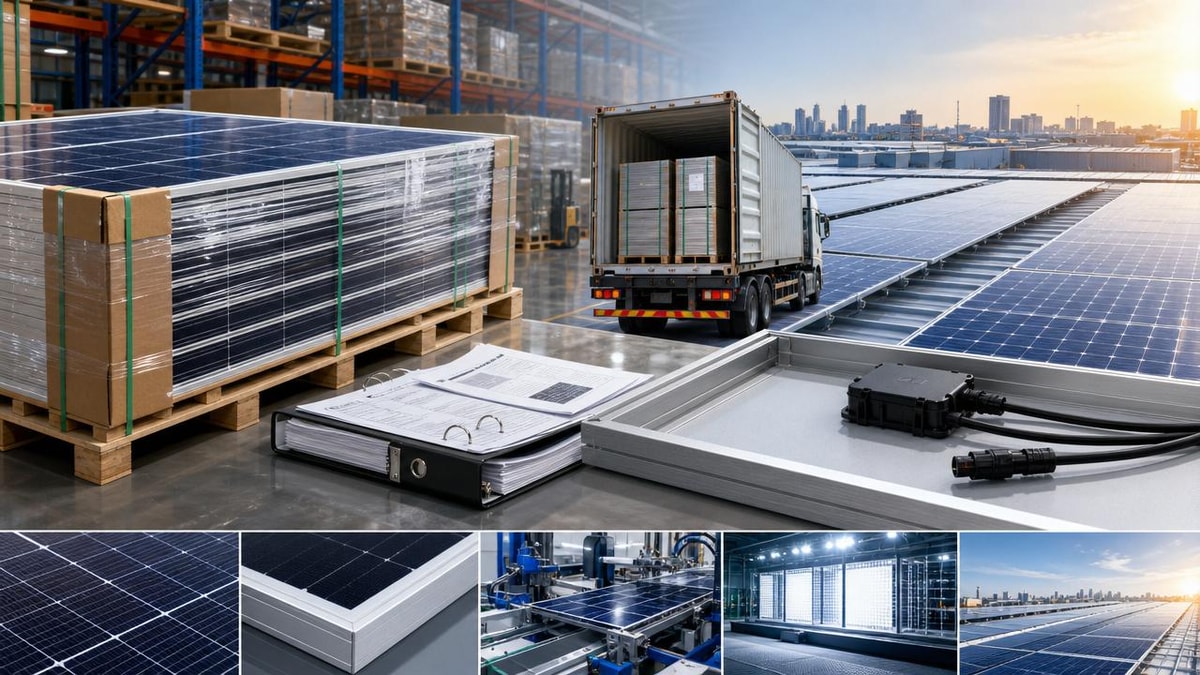
For dealers and distribution agents, a pilot order is a practical risk filter. It allows you to validate carton labeling, pallet stability, lead-time accuracy, and document completeness. You can also test how the supplier responds when minor issues appear, which is often more revealing than the initial sales presentation.
TradeNexus Pro supports this decision-making approach by helping buyers move beyond surface-level listings. Instead of relying on broad directory signals alone, procurement teams should use market intelligence, sector-specific sourcing benchmarks, and technical review discipline to identify partners with stronger operational fit.
Which technical and compliance checks matter most in distributor selection
Even if you are not buying cells or wafers directly, technical details still matter. A solar panels wholesale distributor serving commercial channel buyers should be able to explain the module category, performance tolerance, loading capacity, and target use cases clearly. This reduces mismatches between what is sold and what installers expect on site.
The following table can be used as a practical selection checklist for technical and compliance review.
These checks do not require a laboratory background. They require disciplined procurement. A qualified distributor should answer directly, provide supporting files, and keep answers consistent across sales, logistics, and after-sales teams.
Standards and certification awareness
Requirements vary by market, project type, and customer profile. Dealers should verify whether the solar panels wholesale distributor can support common documentation linked to module safety, performance testing, transport paperwork, and origin records. It is also wise to check labeling, serial traceability, and invoice consistency before cargo departure rather than after customs review begins.
What sourcing model fits your business: trader, master distributor, or strategic supply partner?
Not every supplier type fits every channel strategy. Some dealers need flexible mixed loads and fast turnover. Others need stable annual allocation, technical support, and protected regional development. Understanding the supplier model helps you avoid choosing a solar panels wholesale distributor that looks competitive but cannot support your growth pattern.
Comparison by channel need
The table below compares common sourcing models used in the solar trade and shows where price traps often appear.
For many distributors and agents, the best choice is not the cheapest source but the model with the lowest disruption cost. If your customers demand dependable fulfillment and repeatable quality, structured partnership usually outperforms opportunistic buying.
A practical procurement workflow to avoid costly sourcing mistakes
A disciplined buying process helps remove emotion from supplier selection. It also creates internal alignment across sales, procurement, operations, and finance. Dealers that standardize evaluation criteria are less likely to fall into price traps when market volatility increases.
- Define your sales mix. Separate residential resale, C&I demand, and project-based orders because their service needs differ.
- Build a landed-cost template. Include freight, duties, breakage reserve, financing impact, and expected claim handling cost.
- Shortlist suppliers by documentation quality first. A weak file package is usually an early warning sign.
- Run a sample or pilot shipment. Check packaging, label accuracy, response speed, and invoice-document consistency.
- Negotiate service terms, not just price. Clarify lead time tolerance, claim response timing, and replacement methods.
- Review performance quarterly. Track delivery accuracy, damage rate, support responsiveness, and customer complaint frequency.
This workflow is especially useful in cross-border sourcing, where solar distribution intersects with logistics, customs, energy compliance, and downstream installer performance. A solar panels wholesale distributor that scores well across these dimensions will usually deliver stronger long-term economics than a quote-driven alternative.
FAQ: common questions dealers ask before choosing a solar panels wholesale distributor
How do I know whether a low quote is actually a price trap?
Request a full quote breakdown with Incoterms, packaging, loading assumptions, lead time, and warranty handling terms. Then compare total landed cost and operational risk, not just module price per watt. If the seller avoids specifics, changes specifications between messages, or cannot confirm document readiness, the quote may not be reliable.
What is the most overlooked factor when evaluating a solar panels wholesale distributor?
After-sales execution is often underestimated. A distributor may appear competitive during negotiation but become slow or unclear when there is shipping damage, a serial-number issue, or a technical complaint from the installer. Ask for a written claims process before ordering.
Should small dealers prioritize local inventory or direct import pricing?
It depends on turnover, cash flow, and customer urgency. Local inventory may have a higher unit cost but lower delay risk and easier replacement handling. Direct import can improve margin when volumes are stable and your team can manage freight, customs, and documentation without disruption.
How long does supplier qualification usually take?
For a new solar panels wholesale distributor, a realistic process may take several weeks depending on documentation review, commercial negotiation, and pilot shipment timing. Rushing this stage often leads to higher hidden costs later, especially in project-led markets.
Why work with TradeNexus Pro when evaluating solar distribution partners
TradeNexus Pro supports procurement leaders, channel builders, and cross-border distributors that need more than a supplier list. In green energy and adjacent industrial sectors, partner selection requires technical reading ability, market context, and structured risk filtering. TNP is designed for that decision environment.
Our platform focuses on deep sector intelligence across advanced manufacturing, green energy, smart electronics, healthcare technology, and supply chain SaaS. For companies sourcing through a solar panels wholesale distributor, this means access to clearer procurement logic, sharper market interpretation, and stronger decision frameworks than broad, surface-level sourcing portals typically provide.
- Support for supplier comparison based on channel fit, compliance readiness, and total-cost impact.
- Insight into supply chain shifts that affect availability, lead times, and commercial negotiation strategy.
- A professional environment where exporters, distributors, and enterprise buyers can evaluate partnerships with greater confidence.
If you are reviewing a new solar panels wholesale distributor, refining your sourcing policy, or comparing direct import against local inventory strategy, contact TradeNexus Pro for practical guidance. You can discuss specification checks, supplier screening criteria, delivery cycle planning, sample support, compliance document review, channel-oriented product selection, and quotation comparison logic based on your target market and business model.
Get weekly intelligence in your inbox.
No noise. No sponsored content. Pure intelligence.
 May 02, 2026Commercial EV Charging Installation Costs Beyond the HardwareCommercial EV Charging Installation Costs Beyond the Hardware
 May 02, 2026Portable EV Charging Solutions: Where They Actually FitPortable EV Charging Solutions: Where They Actually Fit
 May 02, 2026Why Automotive Aluminum Extrusions Fail at Joining PointsWhy Automotive Aluminum Extrusions Fail at Joining Points
 May 02, 2026Sheet Metal Bending Services in the USA: What Drives Lead TimeSheet Metal Bending Services in the USA: What Drives Lead Time
 May 02, 2026Cost-Effective Factory Automation Often Starts Smaller Than ExpectedCost-Effective Factory Automation Often Starts Smaller Than Expected
 May 02, 2026Choosing a Solar Panels Wholesale Distributor Without Price TrapsChoosing a Solar Panels Wholesale Distributor Without Price Traps
 May 02, 2026High Efficiency PV Modules: When the Premium Makes SenseHigh Efficiency PV Modules: When the Premium Makes Sense
 May 02, 2026Why Data Centers Are Rethinking ESS Backup StrategyWhy Data Centers Are Rethinking ESS Backup Strategy
 May 02, 2026Do Agricultural PV Modules Need Different Frame Designs?Do Agricultural PV Modules Need Different Frame Designs?
 May 02, 2026How to Vet an OEM Machined Parts Supplier in GermanyHow to Vet an OEM Machined Parts Supplier in Germany
 May 02, 2026Custom Metal Fabrication for Aerospace: Cost vs CertificationCustom Metal Fabrication for Aerospace: Cost vs Certification
 May 02, 2026What Slows Rapid Prototyping for Automotive Parts MostWhat Slows Rapid Prototyping for Automotive Parts Most
 May 02, 2026Rapid Prototyping Choices That Cut Delays in Consumer ElectronicsRapid Prototyping Choices That Cut Delays in Consumer Electronics
 May 02, 2026Why Aerospace Parts Need More Than Tight Lathe TurningWhy Aerospace Parts Need More Than Tight Lathe Turning
 May 02, 2026What Fireproof Technology Really Changes in Lithium BatteriesWhat Fireproof Technology Really Changes in Lithium Batteries
 May 02, 2026Are Grid-Tied Hybrid Inverters Enough for Unstable Supply?Are Grid-Tied Hybrid Inverters Enough for Unstable Supply?
 May 02, 2026What a Solar Panels Wholesale Price List Does Not ShowWhat a Solar Panels Wholesale Price List Does Not Show
 May 02, 2026How Long Life Cycle Batteries Lower Replacement CostsHow Long Life Cycle Batteries Lower Replacement Costs
 May 02, 2026Lathe Turning Tolerances That Matter in Industrial MachineryLathe Turning Tolerances That Matter in Industrial Machinery
 May 02, 2026ESS for Commercial Buildings: Sizing Mistakes to AvoidESS for Commercial Buildings: Sizing Mistakes to Avoid
 May 02, 2026Warehouse Robotics Bottlenecks That Slow Automation ROIWarehouse Robotics Bottlenecks That Slow Automation ROI
 May 02, 2026Where Smart Manufacturing Pays Off First in Auto PlantsWhere Smart Manufacturing Pays Off First in Auto Plants
 May 02, 2026Marine Aluminum Extrusions: What Corrosion Ratings MissMarine Aluminum Extrusions: What Corrosion Ratings Miss
 May 02, 2026Plastic Injection Molding Machine Specs That Affect OutputPlastic Injection Molding Machine Specs That Affect Output
 May 02, 2026What Limits 5 Axis Milling Accuracy for Medical Devices?What Limits 5 Axis Milling Accuracy for Medical Devices?
 May 02, 2026How to Compare a Die Casting Parts Manufacturer in ChinaHow to Compare a Die Casting Parts Manufacturer in China
 May 02, 2026Why Oil and Gas Projects Still Rely on Steel ForgingWhy Oil and Gas Projects Still Rely on Steel Forging