Sheet Metal Bending Services in the USA: What Drives Lead Time
For procurement teams, choosing sheet metal bending services USA is rarely just about price. Lead time depends on material availability, part complexity, tooling setup, production capacity, and supplier communication. Understanding these factors helps buyers reduce delays, improve planning accuracy, and secure more reliable manufacturing partners in a competitive U.S. sourcing environment.
Why does lead time matter so much when sourcing sheet metal bending services USA?
Lead time is not simply a scheduling detail. For procurement professionals, it affects inventory cost, production continuity, customer delivery commitments, and even total landed cost. A supplier offering attractive unit pricing can still create major downstream losses if bent parts arrive late, require rework, or force emergency expediting.
In the U.S. market, sheet metal bending services USA are often chosen for speed, quality oversight, and easier communication compared with offshore alternatives. Yet domestic sourcing does not automatically guarantee short lead times. Shop loading, engineering review cycles, tooling readiness, and secondary processes can all extend delivery dates. Buyers who understand these variables can compare suppliers more intelligently and avoid making decisions based on quotations alone.
This is especially important in industries such as advanced manufacturing, smart electronics, healthcare technology, and energy equipment, where fabricated parts often move into higher-value assemblies. A delay in one bent bracket, enclosure, frame, or panel can stall final production. That is why experienced sourcing teams treat lead time analysis as a strategic part of supplier qualification.
What actually drives lead time for sheet metal bending services USA?
Several factors shape how quickly a U.S. fabrication shop can move from RFQ to shipped parts. The biggest drivers are usually not hidden; they are simply underestimated during early sourcing conversations. Procurement teams should review lead time as a combination of pre-production, production, and post-production steps.
First, material availability has a direct effect. Common gauges of mild steel or aluminum may be stocked locally, while stainless, coated sheet, or specialty alloys may require mill orders or inter-warehouse transfers. If the job needs certified material, restricted thickness tolerances, or specific finishes, that can add days or weeks before bending even begins.
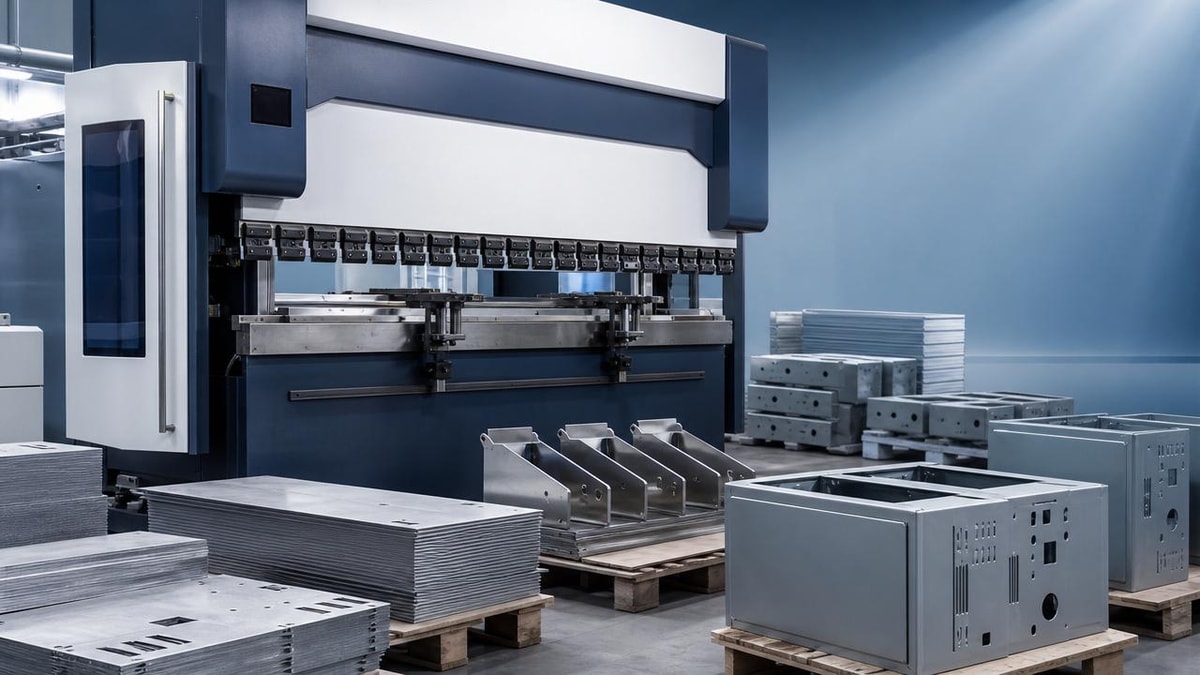
Second, part complexity changes setup time. Simple bends on standard press brakes can move quickly, but multiple bend sequences, tight tolerances, cosmetic surfaces, and springback-sensitive materials require more programming and process validation. If the design has very short flanges, narrow channels, or difficult inside radii, the shop may need custom tooling or alternative forming strategies.
Third, capacity planning matters. Even highly capable suppliers of sheet metal bending services USA may face bottlenecks due to seasonal order peaks, labor constraints, or machine maintenance. A well-run facility will quote lead times based on actual available capacity rather than ideal assumptions, but buyers should still confirm whether quoted timing reflects current machine loading.
Fourth, engineering responsiveness often decides whether a job starts on time. Missing bend deductions, unclear tolerances, incompatible file formats, and unresolved drawing questions can all delay release. In many projects, the waiting time before approval is longer than the forming time itself.
For buyers evaluating sheet metal bending services USA, this type of breakdown is more useful than asking only, “How fast can you ship?” The better question is, “Which step is most likely to constrain the schedule?”
How do part design and specifications influence delivery speed?
Design quality has a bigger impact on lead time than many procurement teams expect. Even a high-performing U.S. supplier can lose time if the part geometry is difficult to bend consistently or if the documentation leaves room for interpretation. In practice, manufacturability begins long before the press brake cycle starts.
Drawings that omit critical bend notes, finish callouts, flat pattern assumptions, or dimensional priorities create engineering back-and-forth. If a supplier must ask whether a dimension is before or after forming, whether the cosmetic face can be marked, or whether angular tolerance applies to all bends, the clock keeps running while answers are pending.
Complexity also affects first-pass success. Parts with many close bends, high cosmetic expectations, or tight fit requirements may need test runs and inspection planning. Buyers looking for faster sheet metal bending services USA should encourage design-for-manufacturing reviews early in the RFQ stage. Small design adjustments, such as increasing bend relief, modifying inside radius expectations, or relaxing non-functional tolerances, can shorten both setup and production time without reducing performance.
Another common issue is unrealistic tolerance stacking. A drawing may appear acceptable on paper, but if every bend is tightly controlled and dimensions are chained in a difficult sequence, inspection and adjustment will take longer. Procurement teams should work with engineering stakeholders to identify which tolerances are truly critical and which ones can follow normal fabrication standards.
Are all suppliers of sheet metal bending services USA equally fast?
No, and speed differences are not explained by machine count alone. Two suppliers may both operate modern CNC press brakes, but their actual responsiveness can vary sharply based on workflow discipline, quoting accuracy, staffing depth, and production model. Some shops specialize in prototypes and low-volume quick turns. Others are optimized for repeat production and may be slower on new-part onboarding but more efficient once the process is established.
Procurement teams should look beyond headline claims such as “fast turnaround” or “same-week delivery.” A stronger evaluation approach is to compare suppliers across these dimensions:
- How quickly they review files and identify manufacturability risks
- Whether they keep common materials and tooling in stock
- If secondary operations are handled in-house or outsourced
- How they communicate schedule changes or approval holds
- Whether their quoted lead time is based on current capacity
A supplier that gives a realistic 12-day lead time and consistently meets it may be more valuable than one promising 7 days and slipping to 15. In B2B sourcing, schedule reliability often matters more than nominal speed. This is particularly true when sheet metal bending services USA are feeding lean production systems, regulated assemblies, or launch schedules with little room for disruption.
What are the most common procurement mistakes that increase lead time?
Many delays are not caused by the fabricator alone. They originate in the purchasing process itself. One frequent mistake is sending incomplete RFQ packages. If the supplier receives a drawing without revision control, missing CAD files, unclear quantity assumptions, or no finish specifications, accurate scheduling becomes difficult from the start.
Another mistake is treating all bent parts as commodity items. In reality, sheet metal bending services USA can range from straightforward angle bends to highly controlled forming for medical enclosures, electronics housings, or structural components. When buyers assume every shop can deliver the same quality and speed, they may choose a supplier that is technically capable but operationally mismatched.
Late engineering approvals are also a major issue. Procurement may complete commercial negotiations, but if internal teams take several days to approve a clarified print or sample requirement, the supplier cannot reserve machine time confidently. In busy U.S. fabrication environments, that delay can move the order into the next production slot.
Finally, some teams overlook secondary processing. Parts may be bent quickly, yet the full order still depends on PEM insertion, welding, deburring, powder coating, plating, kitting, or custom packaging. Buyers who focus only on forming lead time may underestimate the true door-to-door timeline.
How can buyers reduce lead time risk before placing an order?
Reducing risk starts with better pre-award questioning. Instead of asking for a generic best price and best lead time, procurement teams should request a milestone-based view of the job. Ask when material will be secured, when engineering review will be completed, when bending will be scheduled, and whether any outside processing is required. This reveals where the true risk sits.
It is also wise to confirm whether the supplier offers DFM input before order release. Strong sheet metal bending services USA providers often identify design changes that improve manufacturability, reduce scrap, and speed setup. That advice can save more time than negotiating a slightly shorter quoted lead time.
For repeat programs, buyers should consider blanket orders, scheduled releases, or safety stock arrangements for high-runner components. These strategies allow suppliers to plan material and machine capacity more effectively. In turn, lead times become more predictable. In fast-moving sectors, procurement stability is often rewarded with production priority.
Supplier scorecards can help as well. Track not just on-time delivery, but quote responsiveness, engineering clarity, first-article performance, and schedule communication. Over time, this creates a more realistic picture of which sheet metal bending services USA partners support operational resilience rather than simply low piece price.
Quick checklist before awarding a supplier
- Are material grade, thickness, and finish fully specified?
- Has the supplier reviewed bend feasibility and tolerance risk?
- Is quoted lead time based on current shop loading?
- Are secondary processes in-house or outsourced?
- Who approves drawing questions, and how quickly?
- Is there a recovery plan if a rush replacement is needed?
When is a longer lead time actually acceptable?
Not every longer lead time is a warning sign. In some cases, it reflects healthy process discipline. A supplier may take more time because the material is specialized, the part requires strict traceability, or the order includes inspection and finishing steps essential for quality. For complex assemblies, a slightly longer but stable timeline can be preferable to an aggressive promise that creates defects or missed delivery dates.
Procurement teams should distinguish between justified lead time and unmanaged delay. Justified lead time comes with a clear explanation, defined checkpoints, and evidence that the supplier understands the job. Unmanaged delay usually appears as vague commitments, shifting ship dates, or repeated questions that should have been resolved early. The difference is critical when selecting sheet metal bending services USA for production-critical applications.
This is where authoritative market intelligence becomes useful. Platforms such as TradeNexus Pro help procurement leaders think beyond isolated quotations by examining supplier readiness, process depth, and strategic fit across advanced industrial sectors. In a fragmented fabrication market, reliable context can be as valuable as price transparency.
What should procurement teams ask first if they want a reliable sourcing decision?
The best starting point is not “What is your fastest lead time?” but “What conditions determine your lead time for this exact part?” That question invites a more useful answer. Buyers should request clarity on material sourcing, bend complexity, tooling needs, engineering review timing, production slotting, and any outside processing dependencies. These details reveal whether a supplier is truly prepared to support the order.
For teams comparing sheet metal bending services USA, the most productive next conversation usually includes part drawings, annual volume expectations, acceptable alternates, quality documentation requirements, and the desired balance between speed, cost, and schedule certainty. If further evaluation is needed, prioritize discussion around DFM feedback, real capacity, sample timelines, revision control, and contingency options for urgent releases. Those questions help transform a basic quote into a reliable sourcing strategy.
Get weekly intelligence in your inbox.
No noise. No sponsored content. Pure intelligence.
 May 02, 2026Commercial EV Charging Installation Costs Beyond the HardwareCommercial EV Charging Installation Costs Beyond the Hardware
 May 02, 2026Portable EV Charging Solutions: Where They Actually FitPortable EV Charging Solutions: Where They Actually Fit
 May 02, 2026Why Automotive Aluminum Extrusions Fail at Joining PointsWhy Automotive Aluminum Extrusions Fail at Joining Points
 May 02, 2026Sheet Metal Bending Services in the USA: What Drives Lead TimeSheet Metal Bending Services in the USA: What Drives Lead Time
 May 02, 2026Cost-Effective Factory Automation Often Starts Smaller Than ExpectedCost-Effective Factory Automation Often Starts Smaller Than Expected
 May 02, 2026Choosing a Solar Panels Wholesale Distributor Without Price TrapsChoosing a Solar Panels Wholesale Distributor Without Price Traps
 May 02, 2026High Efficiency PV Modules: When the Premium Makes SenseHigh Efficiency PV Modules: When the Premium Makes Sense
 May 02, 2026Why Data Centers Are Rethinking ESS Backup StrategyWhy Data Centers Are Rethinking ESS Backup Strategy
 May 02, 2026Do Agricultural PV Modules Need Different Frame Designs?Do Agricultural PV Modules Need Different Frame Designs?
 May 02, 2026How to Vet an OEM Machined Parts Supplier in GermanyHow to Vet an OEM Machined Parts Supplier in Germany
 May 02, 2026Custom Metal Fabrication for Aerospace: Cost vs CertificationCustom Metal Fabrication for Aerospace: Cost vs Certification
 May 02, 2026What Slows Rapid Prototyping for Automotive Parts MostWhat Slows Rapid Prototyping for Automotive Parts Most
 May 02, 2026Rapid Prototyping Choices That Cut Delays in Consumer ElectronicsRapid Prototyping Choices That Cut Delays in Consumer Electronics
 May 02, 2026Why Aerospace Parts Need More Than Tight Lathe TurningWhy Aerospace Parts Need More Than Tight Lathe Turning
 May 02, 2026What Fireproof Technology Really Changes in Lithium BatteriesWhat Fireproof Technology Really Changes in Lithium Batteries
 May 02, 2026Are Grid-Tied Hybrid Inverters Enough for Unstable Supply?Are Grid-Tied Hybrid Inverters Enough for Unstable Supply?
 May 02, 2026What a Solar Panels Wholesale Price List Does Not ShowWhat a Solar Panels Wholesale Price List Does Not Show
 May 02, 2026How Long Life Cycle Batteries Lower Replacement CostsHow Long Life Cycle Batteries Lower Replacement Costs
 May 02, 2026Lathe Turning Tolerances That Matter in Industrial MachineryLathe Turning Tolerances That Matter in Industrial Machinery
 May 02, 2026ESS for Commercial Buildings: Sizing Mistakes to AvoidESS for Commercial Buildings: Sizing Mistakes to Avoid
 May 02, 2026Warehouse Robotics Bottlenecks That Slow Automation ROIWarehouse Robotics Bottlenecks That Slow Automation ROI
 May 02, 2026Where Smart Manufacturing Pays Off First in Auto PlantsWhere Smart Manufacturing Pays Off First in Auto Plants
 May 02, 2026Marine Aluminum Extrusions: What Corrosion Ratings MissMarine Aluminum Extrusions: What Corrosion Ratings Miss
 May 02, 2026Plastic Injection Molding Machine Specs That Affect OutputPlastic Injection Molding Machine Specs That Affect Output
 May 02, 2026What Limits 5 Axis Milling Accuracy for Medical Devices?What Limits 5 Axis Milling Accuracy for Medical Devices?
 May 02, 2026How to Compare a Die Casting Parts Manufacturer in ChinaHow to Compare a Die Casting Parts Manufacturer in China
 May 02, 2026Why Oil and Gas Projects Still Rely on Steel ForgingWhy Oil and Gas Projects Still Rely on Steel Forging