What a Solar Panels Wholesale Price List Does Not Show
A solar panels wholesale price list may look like a shortcut to smarter sourcing, but it rarely reveals the full cost picture that matters to business evaluators. Beyond unit pricing, factors such as certification, degradation rates, logistics, warranty terms, and supplier reliability can reshape total value. Understanding what a solar panels wholesale price list does not show is essential for making lower-risk, higher-return procurement decisions.
Why scenario differences matter more than the headline price
For business evaluators, the biggest mistake is treating a solar panels wholesale price list as a universal benchmark. In practice, the same module price can lead to very different commercial outcomes depending on where and how the panels will be deployed. A buyer sourcing for a utility-scale project is not measuring value the same way as an EPC contractor serving commercial rooftops, a distributor building inventory, or an importer targeting a regulated market with strict certification rules.
This is why scenario-based evaluation matters. A low listed price may be attractive in spreadsheet comparisons, yet become expensive after freight damage risk, customs delays, lower energy yield, or warranty claim friction are included. Conversely, a higher quote may create better lifecycle economics if the supplier offers strong bankability, faster delivery, better packaging, and lower degradation. The role of the evaluator is not to find the cheapest number, but to determine whether the quoted module aligns with the operational, financial, and compliance realities of the target business scenario.
Common business scenarios where a solar panels wholesale price list is used
The phrase solar panels wholesale price list often appears in sourcing workflows, but the decision context varies widely. Understanding these differences helps evaluators ask better questions before shortlisting suppliers.
A solar panels wholesale price list may therefore be useful as an entry point, but never as the final decision tool. The right interpretation depends on the application scenario, not just the listed module tier or wattage band.

Scenario 1: Utility-scale procurement needs yield certainty, not just lower module cost
In utility-scale projects, procurement teams often begin with a solar panels wholesale price list to model cost per watt across large volumes. However, large projects are highly sensitive to hidden variables. A module with a lower listed price but weaker degradation profile can reduce lifetime generation enough to undermine internal rate of return. Likewise, if the supplier lacks a strong delivery track record, even a small schedule slip can trigger liquidated damages or financing complications.
In this scenario, evaluators should go beyond module pricing and request energy yield simulations, historical batch consistency data, independent test results, and references from similar-scale projects. They should also assess whether the supplier’s warranty is realistically enforceable across jurisdictions. For utility-scale buyers, the hidden value behind a solar panels wholesale price list lies in confidence that the promised performance can be banked, financed, and executed on schedule.
Scenario 2: Commercial rooftop installers care about labor efficiency and site constraints
For EPC firms serving factories, warehouses, malls, or office buildings, module selection is shaped by roof geometry, load limits, shading conditions, and installation speed. A solar panels wholesale price list may show attractive pricing on larger modules, but those modules may increase labor difficulty, handling risk, or roof layout inefficiency. A lower unit cost can disappear quickly if installers need more time, extra mounting adjustments, or higher breakage reserves.
Commercial rooftop scenarios require buyers to evaluate dimensions, weight, connector compatibility, pallet configuration, and replacement availability. If a module is discontinued too quickly, after-sales service becomes more costly. For this use case, the most important hidden cost is not always electrical performance; it is often field execution complexity. That is something a solar panels wholesale price list almost never communicates clearly.
Scenario 3: Distributors need products that move, not just products that are cheap
Distributors and wholesalers typically review multiple versions of a solar panels wholesale price list to compare margin opportunities. Yet resale success depends on more than purchase cost. If end customers do not recognize the brand, or if local installers have concerns about quality consistency, lower-priced stock may remain in the warehouse too long. Inventory aging, damaged packaging, and claim disputes can erase theoretical margin gains.
In this scenario, buyers should evaluate channel support, local demand trends, product positioning, and sales documentation quality. A supplier offering stable production, faster reorder cycles, and strong technical files may create better turnover than one offering the lowest initial number. The true question for distributors is not “What is the cheapest module on the solar panels wholesale price list?” but “Which module can be sold repeatedly with lower friction and lower reputational risk?”
Scenario 4: Cross-border importers face compliance and logistics variables that price sheets hide
Importers sourcing into the EU, North America, the Middle East, or emerging markets often begin with a solar panels wholesale price list and then discover that the listed number excludes many decisive costs. Certification differences, customs documentation, local content rules, sanctions screening, and changing tariff structures can alter the landed cost dramatically. Even the Incoterms used in the quote can shift exposure from supplier to buyer in meaningful ways.
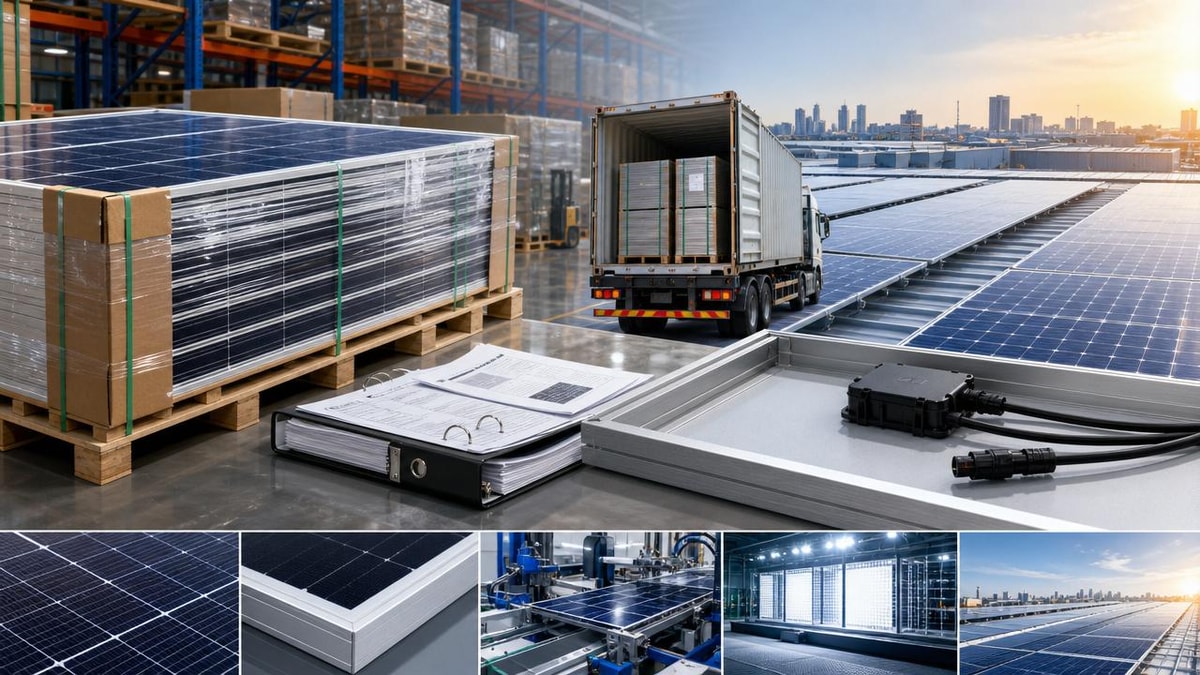
For import-heavy scenarios, evaluators should verify IEC and market-specific certifications, serial traceability, packing lists, HS code alignment, and cargo insurance terms. They should also stress-test logistics assumptions, especially for fragile high-wattage modules. Freight savings can vanish if breakage rates rise or port storage fees increase due to documentation errors. In short, the solar panels wholesale price list may show product cost, but not trade execution risk.
What the price list rarely reveals across all scenarios
Although each use case differs, certain hidden factors repeatedly shape purchasing outcomes. These items should be treated as core evaluation points regardless of industry segment or company size.
- Certification scope and validity for the destination market
- Annual degradation rate and long-term power retention
- Supplier bankability, financial health, and manufacturing stability
- Packaging quality, pallet structure, and transport damage resistance
- Warranty claims process, response times, and local support coverage
- Lead time reliability and exposure to production bottlenecks
- Batch consistency, flash test credibility, and inspection openness
- Currency risk, payment terms, and hidden financing costs
These items explain why a solar panels wholesale price list should be treated as a negotiation reference, not a standalone decision document. In professional sourcing, total value is always broader than the printed unit rate.
How different business evaluators should read the same quote differently
Common misjudgments when comparing a solar panels wholesale price list
One common error is comparing prices across different module technologies without normalizing for efficiency, degradation, and installation context. Another is assuming that all Tier-related branding implies equal quality control. Buyers also sometimes underestimate soft costs such as inspection, financing, demurrage, and replacement logistics. These omissions are especially risky in multi-country sourcing programs where supplier responsiveness can vary by region.
A further misjudgment is treating warranty years as equivalent regardless of claims procedure. A 25-year performance warranty on paper may offer limited real-world protection if the supplier has weak overseas service capabilities. Similarly, a competitive solar panels wholesale price list can lose relevance quickly if the supplier cannot provide stable lead times during peak demand cycles. For business evaluators, hidden operational friction is often the true cost multiplier.
A practical checklist for scenario-based sourcing decisions
Before approving a supplier based on a solar panels wholesale price list, evaluators should validate the following points against their specific business scenario:
- Define the end-use scenario clearly: utility, rooftop, distribution, or self-consumption.
- Convert unit price into landed cost and, where relevant, lifecycle cost.
- Confirm certifications and technical compatibility for the destination market.
- Review degradation assumptions and expected yield in local conditions.
- Assess supplier responsiveness, documentation quality, and dispute handling.
- Check packaging, breakage history, and logistics resilience.
- Model the cost of delay, underperformance, or replacement.
This process creates a stronger basis for decision-making than relying on a solar panels wholesale price list alone. It also improves internal alignment between procurement, finance, engineering, and compliance teams.
Final takeaway for business evaluators
A solar panels wholesale price list is useful, but only as the first layer of evaluation. Its numbers can support market scanning, shortlist creation, and negotiation preparation, yet they do not capture the full economics of risk, performance, compliance, and execution. The right module is not the one with the lowest visible price; it is the one that best fits the intended business scenario with the lowest total uncertainty.
For organizations making strategic sourcing decisions, the most effective next step is to map supplier quotes against actual deployment conditions, internal return targets, and downstream operational requirements. When evaluators move beyond the solar panels wholesale price list and examine scenario fit, they make procurement decisions that are more durable, more defensible, and more likely to deliver measurable business value.
Get weekly intelligence in your inbox.
No noise. No sponsored content. Pure intelligence.
 May 02, 2026Commercial EV Charging Installation Costs Beyond the HardwareCommercial EV Charging Installation Costs Beyond the Hardware
 May 02, 2026Portable EV Charging Solutions: Where They Actually FitPortable EV Charging Solutions: Where They Actually Fit
 May 02, 2026Why Automotive Aluminum Extrusions Fail at Joining PointsWhy Automotive Aluminum Extrusions Fail at Joining Points
 May 02, 2026Sheet Metal Bending Services in the USA: What Drives Lead TimeSheet Metal Bending Services in the USA: What Drives Lead Time
 May 02, 2026Cost-Effective Factory Automation Often Starts Smaller Than ExpectedCost-Effective Factory Automation Often Starts Smaller Than Expected
 May 02, 2026Choosing a Solar Panels Wholesale Distributor Without Price TrapsChoosing a Solar Panels Wholesale Distributor Without Price Traps
 May 02, 2026High Efficiency PV Modules: When the Premium Makes SenseHigh Efficiency PV Modules: When the Premium Makes Sense
 May 02, 2026Why Data Centers Are Rethinking ESS Backup StrategyWhy Data Centers Are Rethinking ESS Backup Strategy
 May 02, 2026Do Agricultural PV Modules Need Different Frame Designs?Do Agricultural PV Modules Need Different Frame Designs?
 May 02, 2026How to Vet an OEM Machined Parts Supplier in GermanyHow to Vet an OEM Machined Parts Supplier in Germany
 May 02, 2026Custom Metal Fabrication for Aerospace: Cost vs CertificationCustom Metal Fabrication for Aerospace: Cost vs Certification
 May 02, 2026What Slows Rapid Prototyping for Automotive Parts MostWhat Slows Rapid Prototyping for Automotive Parts Most
 May 02, 2026Rapid Prototyping Choices That Cut Delays in Consumer ElectronicsRapid Prototyping Choices That Cut Delays in Consumer Electronics
 May 02, 2026Why Aerospace Parts Need More Than Tight Lathe TurningWhy Aerospace Parts Need More Than Tight Lathe Turning
 May 02, 2026What Fireproof Technology Really Changes in Lithium BatteriesWhat Fireproof Technology Really Changes in Lithium Batteries
 May 02, 2026Are Grid-Tied Hybrid Inverters Enough for Unstable Supply?Are Grid-Tied Hybrid Inverters Enough for Unstable Supply?
 May 02, 2026What a Solar Panels Wholesale Price List Does Not ShowWhat a Solar Panels Wholesale Price List Does Not Show
 May 02, 2026How Long Life Cycle Batteries Lower Replacement CostsHow Long Life Cycle Batteries Lower Replacement Costs
 May 02, 2026Lathe Turning Tolerances That Matter in Industrial MachineryLathe Turning Tolerances That Matter in Industrial Machinery
 May 02, 2026ESS for Commercial Buildings: Sizing Mistakes to AvoidESS for Commercial Buildings: Sizing Mistakes to Avoid
 May 02, 2026Warehouse Robotics Bottlenecks That Slow Automation ROIWarehouse Robotics Bottlenecks That Slow Automation ROI
 May 02, 2026Where Smart Manufacturing Pays Off First in Auto PlantsWhere Smart Manufacturing Pays Off First in Auto Plants
 May 02, 2026Marine Aluminum Extrusions: What Corrosion Ratings MissMarine Aluminum Extrusions: What Corrosion Ratings Miss
 May 02, 2026Plastic Injection Molding Machine Specs That Affect OutputPlastic Injection Molding Machine Specs That Affect Output
 May 02, 2026What Limits 5 Axis Milling Accuracy for Medical Devices?What Limits 5 Axis Milling Accuracy for Medical Devices?
 May 02, 2026How to Compare a Die Casting Parts Manufacturer in ChinaHow to Compare a Die Casting Parts Manufacturer in China
 May 02, 2026Why Oil and Gas Projects Still Rely on Steel ForgingWhy Oil and Gas Projects Still Rely on Steel Forging